- Quick Buy/SellBuy & sell with cards and mobile payments
- P2PTrade with local payments at best prices
- Fiat DepositDeposit in BRL, COP, EUR, and more
- Global Bank TransferBuy and sell via local banks
- MEXC CardSpend your crypto worldwide
- USDT-MPerpetual Futures settled in USDT
- USDC-MPerpetual Futures settled in USDC
- USD1-MPerpetual Futures settled in USD1
- Coin-MPerpetual Futures settled in other cryptos
- Futures EarnEarn on balance and unlock higher APR as you trade
- Grid TradingCapture volatility with automated trading
- AI Copy TradeNew & improved AI-Masters with precise style matching
- Demo TradingSimulate Futures trading risk-free
- Futures OverviewExplore Futures tools, products, and features
- OIL Futures24/7 access to top liquidity & leveraged trading
- BTC FuturesMarket's lowest fees and high leverage
- ETH FuturesMarket's lowest fees and high leverage
- MEXC EarnEarn high APR on your crypto
- Hold and EarnHold assets and earn interest daily
- Futures EarnEarn on balance and unlock higher APR as you trade
- On-Chain EarnEasy staking. Real on-chain yield
- MEXC LoansBorrow instantly at competitive rates
- Rewards HubGet started with $10,000 in bonuses
- Event CenterHigher rewards, 0 fees
- Invite and EarnInvite friends and earn 140 USDT each
- $500K BTC CarnivalWin up to 1 BTC & more!
- LaunchpadAccess top tokens early or at a discount
- Airdrop+Deposit and trade to claim new airdrops
- KickstarterHold MX to earn new tokens
- 0 FeesTrade hot futures, enjoy limited 0 fees
- Futures M-DayTrade Futures and claim daily rewards
- Futures Loss Coverage PlanGet triple protection and win $5,000 in XAUT
- Referral ProgrammeInvite friends and unlock commissions from 40%
- Affiliate ProgrammeTop-tier affiliate commissions up to 70%
- MEXC VVIPM-Score into Wealth, 10+ Elite Benefits Upgrading
- MEXC × TradingViewConnect MEXC to trade directly on TradingView
- Crypto NewsFollow the latest crypto headlines
- AnnouncementsStay on top of every happening on MEXC
- LearnStrong crypto fundamentals for every beginner
- MEXC InstitutionalTailored solutions for institutional clients
Polygon Coinme Acquisition: A New Payments Strategy?
Polygon Labs completed its acquisition of Coinme on October 14, 2026, bringing regulated U.S. money movement infrastructure into its Open Money Stack (OMS) platform. According to Polygon's official announcement, the combined business now has payment regulatory coverage across 48 U.S. states, consisting of 37 state money transmitter licenses and 11 applicable exemptions, alongside registration with the Financial Crimes Enforcement Network (FinCEN) as a money services business. Tazapay, Mesh, Toku, and Kira are among the first customers adopting the integrated platform.
The Polygon Coinme Acquisition marks a strategic expansion beyond blockchain settlement into the operational infrastructure connecting traditional financial systems with stablecoins. Polygon already offered blockchain payment capabilities, but moving money between bank accounts, digital wallets, and local payment networks involves licensing, liquidity, identity verification, and payout arrangements that blockchain technology alone cannot provide.
The acquisition therefore raises a question about the changing economics of stablecoin payments. As blockchain settlement becomes increasingly accessible, competitive advantage may shift toward companies capable of controlling the complete payment process, from fiat deposits to final settlement. The significance of Polygon's transaction depends not simply on whether its infrastructure can process payments efficiently, but on whether the company can convert integrated regulatory and technical capabilities into sustained enterprise adoption.
Key Takeaways
- Polygon completed its Coinme acquisition on October 14, 2026, integrating regulated U.S. payment capabilities into Open Money Stack.
- The combined business reports coverage across 48 states through 37 licenses and 11 applicable exemptions, not 48 separate licenses.
- Coinme strengthens fiat access, while Polygon's existing infrastructure supports wallets, routing, and blockchain settlement.
- Tazapay, Mesh, Toku, and Kira demonstrate early commercial adoption, although customer announcements do not establish realized revenue.
- The acquisition's long-term value depends on payment volume, customer retention, economics, and integration with regulated financial systems.
What the Polygon Coinme Acquisition Actually Adds
The Polygon Coinme Acquisition addresses a limitation that has constrained the practical adoption of blockchain-based payments: transferring value onchain is only one part of a complete financial transaction. Businesses must also collect funds from customers, convert between fiat currencies and stablecoins, verify counterparties, maintain compliance, and deliver usable funds to recipients. These processes depend on financial institutions, local payment systems, and regulatory permissions that cannot be replaced simply by faster blockchain transactions. Coinme contributes infrastructure for regulated U.S. money movement, allowing Polygon to connect existing blockchain capabilities more directly with conventional financial services. The acquisition also follows Polygon's January 2026 announcement of plans to acquire Coinme and wallet infrastructure provider Sequence as part of a broader payments strategy. The previously reported transaction consideration exceeding $250 million covered the two proposed acquisitions collectively and should not be interpreted as Coinme's standalone purchase price.
Polygon's October announcement confirms that its U.S. payments business operates with regulatory coverage across 48 states, comprising 37 state money transmitter licenses and 11 applicable exemptions, together with FinCEN money services business registration. This strengthens the platform's regulatory foundation, but the coverage should not be confused with unrestricted authorization to offer every financial service in every jurisdiction. Different activities may carry additional licensing, compliance, banking, or customer eligibility requirements. The acquisition is commercially significant because regulated fiat entry and exit points are essential for stablecoins to function beyond cryptocurrency markets. A business accepting dollar payments, holding stablecoin balances, and paying suppliers internationally needs a combination of regulated financial access and blockchain infrastructure. Polygon is attempting to provide those components through a coordinated platform rather than leaving customers to establish each relationship independently.
How Does Polygon Open Money Stack Work?
Polygon Open Money Stack connects several functions required for enterprise payment processing, including fiat pay-ins, digital wallets, blockchain routing, settlement, and payouts. A business can use the infrastructure to receive funds through supported conventional payment methods, convert those funds into stablecoins, transfer value through blockchain networks, and deliver proceeds through available payout arrangements. Depending on the customer's needs and jurisdiction, the same infrastructure can support account funding, payroll, cross-border payments, and other financial workflows. This approach is intended to reduce integration complexity by connecting services that would otherwise require separate banking, custody, wallet, and blockchain providers. OMS is not synonymous with Polygon Chain: it is a broader platform that can incorporate multiple networks and service providers, meaning the presence of Polygon technology in a payment workflow does not necessarily establish that every transaction settles on Polygon Chain.
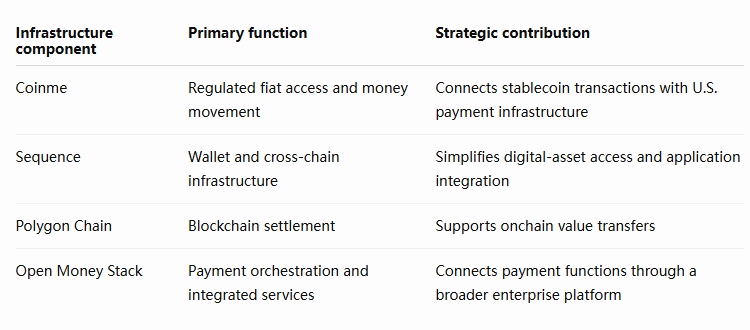
The distinction between these layers helps explain why Polygon pursued acquisitions rather than relying exclusively on blockchain development. Payment infrastructure becomes more useful when applications can connect money movement, account access, and settlement within a coherent operational framework. Coinme's contribution is primarily regulatory and financial, while Polygon's existing technology addresses transaction execution and blockchain connectivity. The commercial opportunity lies in integrating these functions effectively, although the integration itself does not guarantee lower costs, wider availability, or stronger revenues for every enterprise customer.
Why Fiat Access Matters More Than Settlement Speed
Blockchain performance remains relevant to stablecoin payments, particularly when companies need predictable transaction costs, continuous settlement availability, and reliable network execution. However, technological improvements have created competition among multiple blockchains capable of transferring stablecoins efficiently. For businesses, the harder operational problems often arise before or after the onchain transaction. Funds must enter through approved channels, customer identities and transaction risks must be assessed, currencies may need to be converted, and recipients must receive funds through payment methods available in their markets. Even a low-cost blockchain transfer offers limited practical benefit if the recipient cannot redeem the resulting stablecoins conveniently or if a payment provider cannot meet the relevant regulatory requirements. Polygon's acquisition suggests that management sees control over these surrounding processes as increasingly important to the competitiveness of its payments business.
The strategy also changes Polygon's relationship with enterprise customers. Infrastructure providers that sell only settlement capacity compete primarily on performance, reliability, and cost. Companies that manage a broader payment workflow can become more deeply integrated into customers' financial operations, including account funding, treasury management, and recurring payouts. Such integration may increase switching costs and create opportunities to serve additional use cases, although those outcomes depend on product quality and commercial execution. Polygon identifies Tazapay, Mesh, Toku, and Kira as early OMS adopters, covering cross-border business payments, digital-asset funding, global payroll, and dollar access. These relationships indicate a range of potential applications, but the announcement does not provide sufficient customer-level transaction or revenue data to measure the platform's commercial contribution.
There is also a distinction between possessing licenses and operating a profitable payments network. Regulatory infrastructure requires ongoing expenditure on compliance, supervision, operational controls, and institutional relationships. Bringing more payment functions together could reduce some customer integration costs while increasing Polygon's responsibility for maintaining service availability and coordinating regulated activities. Its competitive advantage will therefore depend on whether broader integration generates sufficient demand and economic efficiency to justify the additional operational commitments. The acquisition strengthens Polygon's capacity to provide an end-to-end service, but future financial performance will determine whether owning more of the payment lifecycle translates into greater value.
Can Polygon Compete With Stripe in Stablecoin Payments?
Polygon's strategy places it within a competitive landscape increasingly shaped by payment processors, financial technology companies, stablecoin issuers, and blockchain infrastructure providers. Established payments businesses have experience managing merchant relationships, compliance requirements, payment operations, and enterprise distribution. Blockchain-native companies, meanwhile, have developed expertise in digital wallets, smart contracts, interoperability, and onchain settlement. As stablecoin payments become more commercially relevant, these capabilities are converging. Competition is consequently shifting away from a simple comparison of blockchain transaction costs toward the broader question of which providers can deliver reliable, compliant, and economically attractive payment services.
Polygon's potential advantage lies in combining blockchain-native infrastructure with regulated access rather than building every capability through existing banking intermediaries alone. Its Open Money Stack approach may appeal to businesses that want to integrate stablecoins into payment products without independently coordinating numerous technical and financial providers. However, competing with established payment platforms requires more than a comprehensive technology stack. Enterprise customers evaluate service availability, geographic coverage, banking connectivity, settlement guarantees, customer support, fraud management, and contractual accountability. A platform that offers faster onchain settlement but provides weaker performance across these operational requirements may struggle to displace existing solutions. Conversely, a specialized infrastructure provider can succeed without becoming a direct replacement for a major payment processor if its services improve the economics or functionality of particular payment corridors.
The competitive comparison should therefore focus on product positioning rather than assuming all stablecoin payment providers offer identical services. Polygon may operate as an infrastructure supplier to fintech companies and payment businesses, while other providers maintain direct relationships with merchants or consumers. These models can compete in some markets and complement one another in others. As stablecoin payment infrastructure matures, the most defensible business relationships may belong to providers that combine customer distribution, regulatory permissions, banking liquidity, and settlement orchestration. Polygon's acquisition expands its participation in that value chain, but there is not yet enough disclosed evidence to conclude that it has materially displaced established payments competitors.
What Changes for POL and the Polygon Network?
The acquisition also raises questions about its implications for Polygon's blockchain ecosystem and the POL token. Greater adoption of stablecoin payment infrastructure could create opportunities for more transactions, higher network utilization, and deeper integration with financial applications. Nevertheless, corporate expansion and token value capture are not equivalent. Polygon Open Money Stack includes capabilities for moving funds across different blockchains, meaning enterprise adoption does not automatically translate into increased transaction activity on Polygon Chain. Even where payments settle on Polygon, the resulting economic impact depends on actual transaction volumes, fee levels, network usage, and the mechanisms through which activity affects POL's utility or supply dynamics.
Investors should therefore distinguish between three potential outcomes: growth in Polygon Labs' commercial payment activities, growth in settlement activity on Polygon Chain, and economic effects associated with POL. These developments can be related without moving proportionately. A successful enterprise payment platform could generate service revenue from infrastructure and operations while directing some settlement activity through other networks. Alternatively, increased usage of Polygon Chain might expand transaction counts without producing substantial fee revenue if individual payments remain inexpensive. The more informative indicators are the share of OMS settlement executed on Polygon, sustained transaction demand, fees generated, and any disclosed connection between enterprise activity and token economics. Until these figures become clearer, the acquisition should be evaluated primarily as a corporate infrastructure development rather than evidence of a predetermined POL price outcome.
MEXC View: The Payment Stack Is Becoming the Product
Polygon's acquisition of Coinme illustrates a structural change in stablecoin infrastructure competition: the commercial product is increasingly the complete payment workflow rather than the blockchain transaction alone. As multiple networks become capable of providing relatively efficient settlement, companies that control fiat access, compliance processes, liquidity arrangements, and distribution channels may capture a greater share of enterprise demand. This does not diminish the importance of blockchain technology. Instead, it changes where technological performance sits within the broader financial service. Settlement becomes one necessary component of an integrated system whose overall usefulness depends on completing transactions reliably across both traditional and digital financial infrastructure.
The next stage of competition will likely be determined by measurable operational outcomes rather than acquisition announcements. Polygon's integrated platform will need to demonstrate that it can attract recurring customer flows, reduce integration friction, operate across relevant jurisdictions, and support commercially sustainable payment services. Its first announced OMS adopters establish an initial foundation, while the company's broader stablecoin strategy provides context for the completion of the Coinme acquisition. The more consequential evidence will emerge from enterprise usage and the proportion of payments that can be completed through integrated services without unnecessary reliance on fragmented providers.
Risks and Limitations
Polygon's expanded payments infrastructure remains subject to regulatory, commercial, and operational risks. State-level licensing and exemptions do not eliminate the need for compliance with applicable financial rules, while international payment activity may require additional authorizations and local partnerships. Banking relationships, settlement liquidity, custody arrangements, cybersecurity, and blockchain interoperability introduce dependencies that could affect reliability or operating costs. Integrating acquired businesses into a common platform also requires organizational coordination and continued investment, and there is no assurance that customers will adopt every component of the expanded service.
The principal analytical limitation is the absence of sufficiently detailed public evidence connecting the Coinme acquisition to incremental transaction revenue or profitability. Announced customer relationships do not establish payment volumes, and reported blockchain activity should not be treated as equivalent to regulated fiat payment throughput. Any direct impact on POL also requires separate evaluation because commercial service adoption, chain usage, and token value capture are distinct measures. The acquisition establishes additional capabilities, not guaranteed financial results.
Polygon Is Buying Payment Access, Not Guaranteed Volume
Polygon's completed acquisition of Coinme represents a meaningful strategic shift from emphasizing blockchain settlement toward providing a more complete stablecoin payment infrastructure. By incorporating regulated U.S. money movement capabilities into Open Money Stack, Polygon can address financial processes that extend beyond the transfer of tokens between wallets. The combination of fiat access, wallet infrastructure, transaction routing, and settlement services may simplify enterprise integration and improve the company's position in a market where businesses increasingly expect stablecoin payments to operate alongside conventional banking and payment systems.
The Polygon Coinme Acquisition does not, however, establish that integrated infrastructure will automatically attract greater transaction volumes or generate profitable growth. Regulatory coverage creates an important operating foundation, but it also introduces ongoing compliance costs and responsibilities. Early enterprise adoption demonstrates commercial interest without revealing the complete economics of customer relationships. Similarly, the expansion of Polygon's payments business should not be confused with guaranteed growth in Polygon Chain activity or POL token demand, particularly when OMS can support multiple blockchain networks.
The most important future indicators will be recurring enterprise payment volume, active customer adoption, revenue attributable to integrated services, geographic service expansion, and the portion of settlement activity occurring on Polygon Chain. These measures will help determine whether the acquisition creates a defensible payments business or primarily broadens the range of services Polygon can offer.
In the longer term, the acquisition points toward an increasingly important competitive reality: blockchain networks may provide the settlement technology, but financial infrastructure companies must still solve the practical problems of accessing, managing, and delivering money. Polygon has strengthened its control over that payment process. Whether the strategy succeeds will depend on converting regulatory access and technical integration into sustained economic activity.
Sources
MEXC internal link used:
https://www.mexc.com/learn/article/mexc-on-chain-daily-report-polygon-labs-acquires-coinme-to-expand-into-stablecoin-payments
Polygon Labs — Coinme Acquisition Completion, October 14, 2026:
https://polygon.technology/blog/polygon-open-money-stack-us-regulated-payments-platform
Polygon Labs — Open Money Stack:
https://polygon.technology/blog-category/open-money-stack
Risk Disclaimer: This article is for reference only and does not constitute investment advice. The cryptocurrency market is highly volatile. Please make decisions cautiously based on your individual circumstances.
You May Also Like

USDC Revenue: Where Does Every Dollar Actually Go?
Can Bitcoin Return to $100,000 by the End of 2026?