The post A $13 Billion Dollar Aircraft Carrier Won’t Stop Organized Crime In Venezuela appeared on BitcoinEthereumNews.com. NEWPORT NEWS, VA – APRIL 8: In this handout photo provided by the U.S. Navy, sailors aboard the aircraft carrier Pre-Commissioning Unit (PCU) Gerald R. Ford (CVN 78) man the rails as the ship departs Huntington Ingalls Industries Newport News Shipbuilding for builder’s sea trials off the U.S. East Coast on April 8, 2017 in Newport News, Virginia. The first-of-class ship, the first new U.S. aircraft carrier design in 40 years, will spend several days conducting builder’s sea trials, a comprehensive test of many of the ship’s key systems and technologies. (Photo by Chief Mass Communication Specialist Christopher Delano/U.S. Navy via Getty Images) Getty Images On Friday it was announced that US Secretary of Defence Pete Hegseth had ordered the deployment of the aircraft carrier, the USS Gerald Ford (alongside other warships and attack planes) to the waters off the coast of Latin America. Since late August about 10,000 US military troops have been deployed to the Caribbean, with half on warships and the other half stationed in Puerto Rico. Another ten F-35 fighter jets were also sent to Puerto Rico in early September. The Centre for Strategic and International Studies called this deployment of the Ford aircraft carrier “one step closer to war” with Venezuela. Trump has repeatedly raised the possibility of a conflict with Venezuela, stating that the US may take “land action” now that the sea is “under control.” The Trump administration has justified the buildup by accusing Venezuelan President Nicolás Maduro of running a large-scale drug operation with the country’s most notorious criminal group, Tren de Araguas, allegations Maduro denies. Though a leaked intelligence memo has cast doubt that there is any cooperation between Maduro and Tren de Araguas, the Trump administration has claimed that Maduro emptied Venezuela’s prisons and remains involved in the drug trade.… The post A $13 Billion Dollar Aircraft Carrier Won’t Stop Organized Crime In Venezuela appeared on BitcoinEthereumNews.com. NEWPORT NEWS, VA – APRIL 8: In this handout photo provided by the U.S. Navy, sailors aboard the aircraft carrier Pre-Commissioning Unit (PCU) Gerald R. Ford (CVN 78) man the rails as the ship departs Huntington Ingalls Industries Newport News Shipbuilding for builder’s sea trials off the U.S. East Coast on April 8, 2017 in Newport News, Virginia. The first-of-class ship, the first new U.S. aircraft carrier design in 40 years, will spend several days conducting builder’s sea trials, a comprehensive test of many of the ship’s key systems and technologies. (Photo by Chief Mass Communication Specialist Christopher Delano/U.S. Navy via Getty Images) Getty Images On Friday it was announced that US Secretary of Defence Pete Hegseth had ordered the deployment of the aircraft carrier, the USS Gerald Ford (alongside other warships and attack planes) to the waters off the coast of Latin America. Since late August about 10,000 US military troops have been deployed to the Caribbean, with half on warships and the other half stationed in Puerto Rico. Another ten F-35 fighter jets were also sent to Puerto Rico in early September. The Centre for Strategic and International Studies called this deployment of the Ford aircraft carrier “one step closer to war” with Venezuela. Trump has repeatedly raised the possibility of a conflict with Venezuela, stating that the US may take “land action” now that the sea is “under control.” The Trump administration has justified the buildup by accusing Venezuelan President Nicolás Maduro of running a large-scale drug operation with the country’s most notorious criminal group, Tren de Araguas, allegations Maduro denies. Though a leaked intelligence memo has cast doubt that there is any cooperation between Maduro and Tren de Araguas, the Trump administration has claimed that Maduro emptied Venezuela’s prisons and remains involved in the drug trade.…

A $13 Billion Dollar Aircraft Carrier Won’t Stop Organized Crime In Venezuela

NEWPORT NEWS, VA – APRIL 8: In this handout photo provided by the U.S. Navy, sailors aboard the aircraft carrier Pre-Commissioning Unit (PCU) Gerald R. Ford (CVN 78) man the rails as the ship departs Huntington Ingalls Industries Newport News Shipbuilding for builder’s sea trials off the U.S. East Coast on April 8, 2017 in Newport News, Virginia. The first-of-class ship, the first new U.S. aircraft carrier design in 40 years, will spend several days conducting builder’s sea trials, a comprehensive test of many of the ship’s key systems and technologies. (Photo by Chief Mass Communication Specialist Christopher Delano/U.S. Navy via Getty Images)

Getty Images

On Friday it was announced that US Secretary of Defence Pete Hegseth had ordered the deployment of the aircraft carrier, the USS Gerald Ford (alongside other warships and attack planes) to the waters off the coast of Latin America. Since late August about 10,000 US military troops have been deployed to the Caribbean, with half on warships and the other half stationed in Puerto Rico. Another ten F-35 fighter jets were also sent to Puerto Rico in early September.

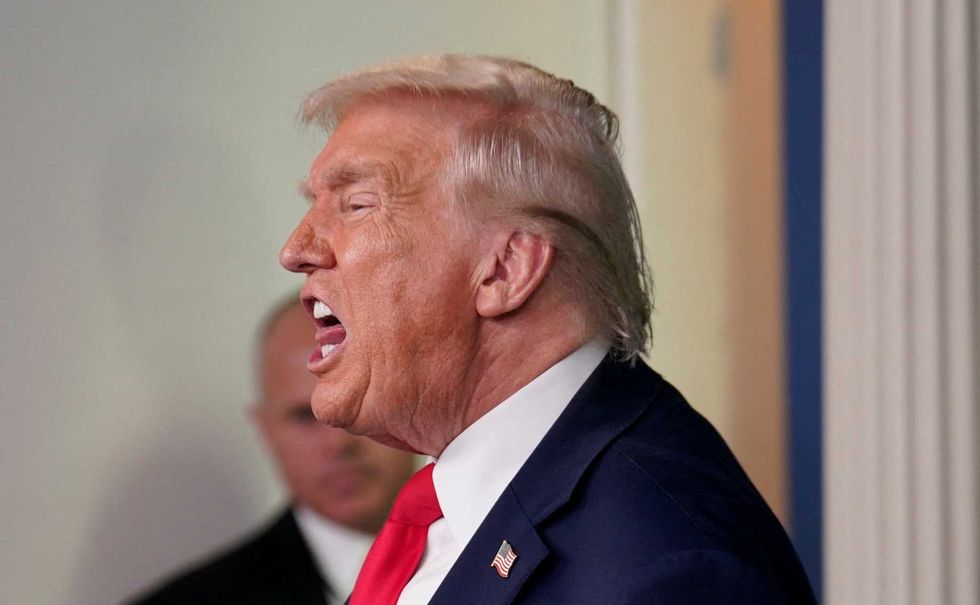
The Centre for Strategic and International Studies called this deployment of the Ford aircraft carrier “one step closer to war” with Venezuela. Trump has repeatedly raised the possibility of a conflict with Venezuela, stating that the US may take “land action” now that the sea is “under control.”

The Trump administration has justified the buildup by accusing Venezuelan President Nicolás Maduro of running a large-scale drug operation with the country’s most notorious criminal group, Tren de Araguas, allegations Maduro denies. Though a leaked intelligence memo has cast doubt that there is any cooperation between Maduro and Tren de Araguas, the Trump administration has claimed that Maduro emptied Venezuela’s prisons and remains involved in the drug trade.

The Trump administration has already carried out ten strikes of supposed drug boats in the Caribbean, killing 43 people in the process despite little evidence that the targeted vessels were trafficking narcotics.

It’s also unclear how effective it will be to send over an aircraft carrier to the Caribbean to engage in drug interdiction. The US Navy reportedly has 11 aircraft carriers , with the Ford class debuting more recently (the other ten aircraft carriers are Nimitz class). The Ford constitutes the most expensive warship ever built, costing $13 billion.

While formidable in combat, aircraft carriers are not well suited for surveillance activity. Their high-speed fighter jets, such as F/A-18E/Fs and F-35Cs, are not designed for the slow, persistent monitoring that countering narcotics operations requires.

Though the Ford is the largest nuclear-powered super carrier ever built, it can be vulnerable to low-tech threats from both undersea unmanned vehicles and aerial unmanned vehicles – or drones. The 2000 attack on the USS Cole in 2000 is a reminder that it does not take much to do considerable damage. Equipped with complex technology, it is also expensive to maintain and could be vulnerable to cyber attacks.

The administration claims that the deployment of the Ford will help target criminal organizations such as Tren de Aragua, which was designated an international terrorist organization last year and has about 5,000 members. Nevertheless, if the goal is to pursue drug cartels, it’s not clear if Tren de Aragua is the right target.

For decades Venezuelan groups have been involved in smaller scale organized crime, but Tren De Aragua is the only Venezuelan group to have projected its power internationally. Originating in a Venezuelan prison in Tocorón in the early 2010s, by 2018 the criminal group expanded to the Colombian border and eventually across parts of South America. But while the Mexican and Colombian criminal groups dominate the drug trade, Tren de Aragua has mostly focused on human trafficking and the exploitation of Venezuela migrants.

In spite of the Trump administration’s assertions, Venezuela does not play a huge role in the region’s drug trade; nearly all coca crop cultivation is still concentrated in Colombia, Peru and Bolivia. There is also no evidence that Tren de Aragua is involved in the movement of fentanyl. Additionally, the DEA estimates that only 8% of cocaine trafficked to the US passes through Venezuela.

Moreover, while Tren de Araguas has expanded its footprint in human trafficking, it does not have any capacity to invade another country, and its strength appears to be waning (the US recently declared that it is at war with the drug cartels). In 2023, the Venezuelan government finally took control of the Tocorón prison, which effectively deprived the criminal group of its stronghold. Though Maduro had initially offered government protection, his relationship with the gang ruptured.

Tren De Aragua has also clashed with the Colombian guerrilla group, the National Liberation Army and has been in conflict with other gangs such as MS-13, and with its own former members, who call themselves Anti-Tren.

The recent arrest of several of Tren de Aragua’s high-ranking leaders in Colombia caused disarray in the organization, disrupting some of its transnational operations. Tren de Araguas faced another blow on October 14th, when one of its alleged leaders died after falling from a building during a police raid in Colombia. Contrary to reports that the group is gaining more power, it is actually becoming more fragmented. It is also unlikely to regain strength because of so much attention from law enforcement.

While copycat groups of Tren de Aragua have emerged throughout South America, which has made it difficult to track when the criminal group is responsible, it’s nowhere near as powerful as the major Colombian and Mexican drug cartels.

Beyond the military option

Possibly more effective than bringing over an aircraft carrier would be to put more effort into prosecuting the businesses sponsoring criminal groups, and their political patrons at all levels of government. Organized criminal groups are involved in a wide range of activities besides drugs, and targeting all their operations beyond drugs, will help to weaken them. As the Brookings Institution reports, this includes prosecuting those involved in the middle operational layer of these groups such as financiers, money launderers and those involved in logistical operations.

It’s also crucial to tackle the factors that are driving human insecurity in Venezuela. Because migrants in Venezuela are so vulnerable, this provided Tren de Aragua with an opportunity to expand its criminal enterprises. As such, the United Nations Development Program Report has emphasized investing in long-term development in healthcare, education and job creation to provide economic opportunities to those that may be easily exploited by criminal groups engaged in human trafficking– and drug trafficking as well.

In 2022 the US provided about $2.8 billion in development aid for the entire region, but this aid is now being cut. This is far less than the program to construct multiple Ford aircraft carriers, which will cost upwards of $120 billion.

Source: https://www.forbes.com/sites/natashalindstaedt/2025/10/26/a-13-billion-dollar-aircraft-carrier-wont-stop-organized-crime-in-venezuela/


Market Opportunity
Threshold Logo
Threshold Price(T)
$0.009637
$0.009637$0.009637
+0.34%
USD
Threshold (T) Live Price Chart
Disclaimer: The articles reposted on this site are sourced from public platforms and are provided for informational purposes only. They do not necessarily reflect the views of MEXC. All rights remain with the original authors. If you believe any content infringes on third-party rights, please contact service@support.mexc.com for removal. MEXC makes no guarantees regarding the accuracy, completeness, or timeliness of the content and is not responsible for any actions taken based on the information provided. The content does not constitute financial, legal, or other professional advice, nor should it be considered a recommendation or endorsement by MEXC.

You May Also Like

Shocking OpenVPP Partnership Claim Draws Urgent Scrutiny

Shocking OpenVPP Partnership Claim Draws Urgent Scrutiny

The post Shocking OpenVPP Partnership Claim Draws Urgent Scrutiny appeared on BitcoinEthereumNews.com. The cryptocurrency world is buzzing with a recent controversy surrounding a bold OpenVPP partnership claim. This week, OpenVPP (OVPP) announced what it presented as a significant collaboration with the U.S. government in the innovative field of energy tokenization. However, this claim quickly drew the sharp eye of on-chain analyst ZachXBT, who highlighted a swift and official rebuttal that has sent ripples through the digital asset community. What Sparked the OpenVPP Partnership Claim Controversy? The core of the issue revolves around OpenVPP’s assertion of a U.S. government partnership. This kind of collaboration would typically be a monumental endorsement for any private cryptocurrency project, especially given the current regulatory climate. Such a partnership could signify a new era of mainstream adoption and legitimacy for energy tokenization initiatives. OpenVPP initially claimed cooperation with the U.S. government. This alleged partnership was said to be in the domain of energy tokenization. The announcement generated considerable interest and discussion online. ZachXBT, known for his diligent on-chain investigations, was quick to flag the development. He brought attention to the fact that U.S. Securities and Exchange Commission (SEC) Commissioner Hester Peirce had directly addressed the OpenVPP partnership claim. Her response, delivered within hours, was unequivocal and starkly contradicted OpenVPP’s narrative. How Did Regulatory Authorities Respond to the OpenVPP Partnership Claim? Commissioner Hester Peirce’s statement was a crucial turning point in this unfolding story. She clearly stated that the SEC, as an agency, does not engage in partnerships with private cryptocurrency projects. This response effectively dismantled the credibility of OpenVPP’s initial announcement regarding their supposed government collaboration. Peirce’s swift clarification underscores a fundamental principle of regulatory bodies: maintaining impartiality and avoiding endorsements of private entities. Her statement serves as a vital reminder to the crypto community about the official stance of government agencies concerning private ventures. Moreover, ZachXBT’s analysis…
Share
BitcoinEthereumNews2025/09/18 02:13
Ethereum Price Closer to $4,000 Breakout as ETH Whales go on Buying Spree

Ethereum Price Closer to $4,000 Breakout as ETH Whales go on Buying Spree

The post Ethereum Price Closer to $4,000 Breakout as ETH Whales go on Buying Spree appeared on BitcoinEthereumNews.com. Key Insights: Large ETH wallets are buying
Share
BitcoinEthereumNews2026/01/20 10:16
New Zealand Dollar weakens below 0.5800 despite Trump’s tariff threats

New Zealand Dollar weakens below 0.5800 despite Trump’s tariff threats

The post New Zealand Dollar weakens below 0.5800 despite Trump’s tariff threats appeared on BitcoinEthereumNews.com. The NZD/USD pair loses ground to around 0.5790
Share
BitcoinEthereumNews2026/01/20 10:10