Macro investor Michael Green, who is known as the Cassandra of Passive Investing, has sharpened his critique of Bitcoin, arguing that its design makes it economically brittle and socially corrosive, setting up a winner-takes-all outcome “like a Monopoly game.” In an interview with journalist Phil Rosen, Green said “the most important thing to understand is […]Macro investor Michael Green, who is known as the Cassandra of Passive Investing, has sharpened his critique of Bitcoin, arguing that its design makes it economically brittle and socially corrosive, setting up a winner-takes-all outcome “like a Monopoly game.” In an interview with journalist Phil Rosen, Green said “the most important thing to understand is […]

Bitcoin Could End ‘Like A Monopoly Game,’ Claims Wall Street Cassandra Michael Green

2025/11/26 11:00

Macro investor Michael Green, who is known as the Cassandra of Passive Investing, has sharpened his critique of Bitcoin, arguing that its design makes it economically brittle and socially corrosive, setting up a winner-takes-all outcome “like a Monopoly game.”

In an interview with journalist Phil Rosen, Green said “the most important thing to understand is that Bitcoin has marketed itself as multiple different things to try to appeal to investors at various points in time,” but has failed on its original brief. Under the Satoshi white paper, he noted, BTC was meant to be “a peer-to-peer payment system” that removed the dependence of payment rails on banks. “By moving to a distributed ledger and a peer-to-peer system, we’d be able to get banks out of the system.”

“That’s been a total failure,” he argued. “There are almost no real transactions that are occurring in Bitcoin. We have tons of transaction activity in speculative markets trading Bitcoin, but the actual quantity of retail transactions or peer-to-peer payments that occur over the Bitcoin network are remarkably small.”

Green distinguished between emergency government “money printing” and day-to-day bank credit. “There’s money printing that comes from the government, in which they largely are trying to smooth over mistakes that have been made,” he said, describing stimulus as a way to “basically create a do-over by printing money.”

More frequent, he added, is the expansion of money when banks lend: when a bank grants a $1,000 loan, “they simply created a new account for you called your checking account that has $1,000 in it… That expansion is totally normal and it has a credit function associated with it.”

“Bitcoin destroys the ability to do that because it was intentionally designed to skip the banking system,” Green contended. Rather than a full credit system, “it is effectively just a monetary system where what you’re really seeing is Bitcoin is effectively the tokens that are paid to the accounting firms that keep the blockchain in order… every Bitcoin that’s out there is basically a payment to Deloitte & Touche.”

Why Bitcoin Is Supposedly A ‘Monopoly Game’

Because its supply is capped and banks cannot create new BTC via lending, “no new money can be created. There is no capacity for mistake forgiveness in that type of framework,” he said. That makes the system “very limiting. Interest rates and credit spreads are just too high for a real economy framework.” Despite dramatic price gains, he concluded, Bitcoin “hasn’t emerged as a payment system” or “in any meaningful economic context.”

Green’s harshest criticism was distributional. “Because we have a finite quantity of it, ultimately, that means everybody who is born after the Bitcoin has been released finds themselves in deficit,” he said. He compared this to “a serf living off land in the 14th century that didn’t belong to you,” where “there was no other land that would ever become available to you.” That, he argued, “creates a deeply unequal society.”

Although he said he “was an early adopter of Bitcoin” and initially thought it was “a really interesting idea” of private money, he now believes “if you run through the simulation, Bitcoin, because there is a finite quantity of tokens, means that it basically plays like a Monopoly game.”

In that game, “you can’t add additional players as the game is being played… because they’re just going to lose very quickly. They don’t have any other properties. They don’t have any other money.” “How does every game of Monopoly end?” he asked. “Someone wins. With a single winner.”

“That’s exactly what we’ve seen within Bitcoin,” Green maintained, citing “increased concentration” and a Gini coefficient “beyond anything we’ve ever seen in the real world.” Instead of democratizing access, he argued, Bitcoin builds “a system that ultimately collapses upon itself and locks people out. Far from democratizing access, it does the exact opposite.”

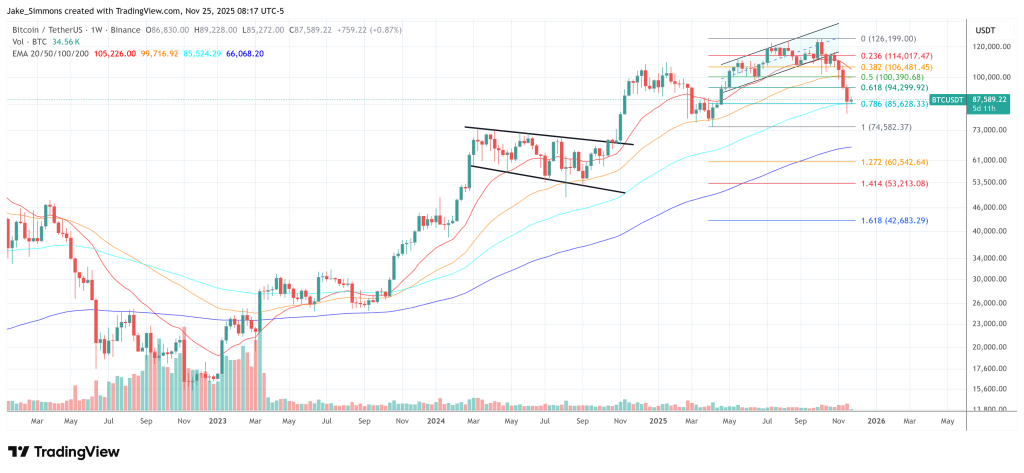
At press time, BTC traded at $87,589.
Bitcoin price
Disclaimer: The articles reposted on this site are sourced from public platforms and are provided for informational purposes only. They do not necessarily reflect the views of MEXC. All rights remain with the original authors. If you believe any content infringes on third-party rights, please contact service@support.mexc.com for removal. MEXC makes no guarantees regarding the accuracy, completeness, or timeliness of the content and is not responsible for any actions taken based on the information provided. The content does not constitute financial, legal, or other professional advice, nor should it be considered a recommendation or endorsement by MEXC.

You May Also Like

A ‘Detonation’ May Be Next, Analyst Says

A ‘Detonation’ May Be Next, Analyst Says

The post A ‘Detonation’ May Be Next, Analyst Says appeared on BitcoinEthereumNews.com. They say journalists never truly clock out. But for Christian, that’s not just a metaphor, it’s a lifestyle. By day, he navigates the ever-shifting tides of the cryptocurrency market, wielding words like a seasoned editor and crafting articles that decipher the jargon for the masses. When the PC goes on hibernate mode, however, his pursuits take a more mechanical (and sometimes philosophical) turn. Christian’s journey with the written word began long before the age of Bitcoin. In the hallowed halls of academia, he honed his craft as a feature writer for his college paper. This early love for storytelling paved the way for a successful stint as an editor at a data engineering firm, where his first-month essay win funded a months-long supply of doggie and kitty treats – a testament to his dedication to his furry companions (more on that later). Christian then roamed the world of journalism, working at newspapers in Canada and even South Korea. He finally settled down at a local news giant in his hometown in the Philippines for a decade, becoming a total news junkie. But then, something new caught his eye: cryptocurrency. It was like a treasure hunt mixed with storytelling – right up his alley! So, he landed a killer gig at NewsBTC, where he’s one of the go-to guys for all things crypto. He breaks down this confusing stuff into bite-sized pieces, making it easy for anyone to understand (he salutes his management team for teaching him this skill). Think Christian’s all work and no play? Not a chance! When he’s not at his computer, you’ll find him indulging his passion for motorbikes. A true gearhead, Christian loves tinkering with his bike and savoring the joy of the open road on his 320-cc Yamaha R3. Once a speed demon who hit…
Share
BitcoinEthereumNews2025/09/20 05:20
Maryland Man Sentenced for Allegedly Aiding North Korea’s US Company Infiltration and Sensitive Data Access

Maryland Man Sentenced for Allegedly Aiding North Korea’s US Company Infiltration and Sensitive Data Access

The post Maryland Man Sentenced for Allegedly Aiding North Korea’s US Company Infiltration and Sensitive Data Access appeared on BitcoinEthereumNews.com. North Korea’s IT workers infiltrated US companies through a Maryland man’s scheme, earning over $970,000 while enabling access to sensitive government systems. This operation supported the regime’s cyber activities, including crypto hacks that stole $2 billion in 2025, funding nuclear programs. Minh Phuong Ngoc Vong sentenced to 15 months in prison for aiding North Korean infiltration. He used fake credentials to secure jobs at 13 US firms, passing work to overseas conspirators. North Korea stole $2 billion in crypto in 2025 via hacks, totaling over $6 billion recently, per blockchain analytics firm Elliptic. Discover how North Korea’s IT infiltration and crypto hacking schemes threaten US security. Learn the details of the Maryland case and regime’s $6B theft. Stay informed on cybersecurity risks today. What is North Korea’s IT Infiltration Scheme in US Companies? North Korea’s IT infiltration scheme involves covertly placing regime-affiliated workers into US companies using fake identities to generate revenue and access sensitive systems. In a recent Maryland case, Minh Phuong Ngoc Vong was sentenced to 15 months in prison and three years of supervised release for facilitating this for three years across 13 companies. The operation netted over $970,000, much of which funded North Korea’s weapons programs through software work performed by overseas actors, including those in China near the border. How Does North Korea Use Crypto Hacking to Fund Its Programs? North Korea employs sophisticated cyber groups to target cryptocurrency exchanges and wallets, stealing digital assets that convert to fiat for regime funding. According to blockchain analytics firm Elliptic, these groups pilfered approximately $2 billion in cryptocurrencies in 2025 alone, contributing to a total exceeding $6 billion in recent years from hacks on platforms like Bybit and Upbit. This influx directly supports nuclear and missile development, as confirmed by US intelligence assessments. Experts note the regime’s…
Share
BitcoinEthereumNews2025/12/06 09:12