Beyond automation: Building AI-ready businesses and workforces
By Krystal Anjela H. Gamboa
The conversation about artificial intelligence (AI) is no longer for technologists; it’s a boardroom, a small-business, and a government conversation.
For the Philippines, a country with a strong services sector, a fast-growing digital economy, and millions of micro, small, and medium-sized enterprises (MSMEs), integrating AI into business operations offers an opportunity to boost productivity, improve customer experience, and create new revenue streams.
Such opportunities were explored in the second panel discussion of BusinessWorld Forecast 2026, which gathered a policy maker, a global management consultancy executive, and a professional services head to tackle the topic “AI Unleashed: Moving from Adoption to Integration.”
Congressman Brian Poe Llamanzares, who is also the chairman of Global AI Council Philippines, highlighted the need to bridge MSMEs closer to tapping the potentials of AI.
“AI is making it much easier for people to manage their businesses,” Mr. Llamanzares said. “But if you look at our MSMEs, which is 90% of our economy, how many of them have already been able to adapt AI and have we been helping them take advantage of what AI is available?”
For Philippine businesses, AI tools are found to translate into tangible benefits. Automating repetitive administrative tasks eases employee to focus on higher-value work. In labor-intensive industries, even modest productivity improvements can have large economic effects.
Also, AI-driven personalization and 24/7 conversational interfaces can raise customer satisfaction for e-commerce, finance, travel, and business process outsourcing services — sectors where Filipino companies often compete on speed and service quality.
 Chairman of the Global AI Council Philippines Cong. Brian Poe Llamanzares
Furthermore, data-driven forecasting for inventory, demand, and finance helps reduce waste and increase margins — vital for retail, logistics, and agriculture. AI also enables services such as risk-based lending, personalized health advice, predictive maintenance, and targeted marketing.
These combined benefits position AI as a transformative force capable of reshaping industries across the country.
“If we can improve the adoption rate of MSMEs to AI technologies and upskill small business owners, then we’re taking a step in the right direction,” Mr. Llamanzares stated.
However, seizing AI’s potential requires bridging capability gaps in data, talent, connectivity, and governance.
“Corporations are already putting in place for the regulation internally, but the government should be able to support,” Mr. Llamanzares noted.
AI integration roadmap
Philippine companies can adopt AI through structured and incremental planning, the panel agreed. A business should begin by clarifying objectives, identifying specific problems that AI can solve.
After the goals are set, the organization must assess data readiness, ensuring that information relevant to the chosen problem is available, accessible, and of reliable quality. Next would be a launch of a small AI pilot project rather than deploying a full-scale system immediately. Pilots reduce risk and help determine whether the solution genuinely produces measurable returns.
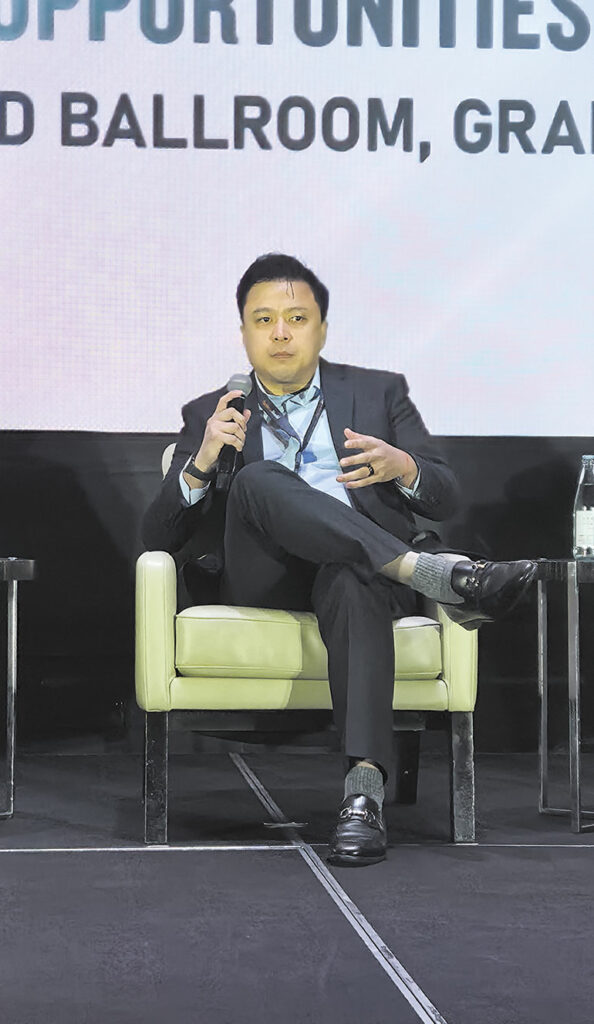 Kearney Senior Partner and Philippines Country Head Marco
de la Rosa
Kearney Senior Partner and Philippines Country Head Marco de la Rosa addresses the hurdle: “The challenge is that the short-term piece works from an adoption standpoint; but from a creation standpoint, that’s a longer term-play. We can’t be seen as being left behind.”
Adoption must follow a cycle of measurement and improvement. Such act is not a one-time installation but an ongoing organizational capability.
Reskilling for inclusion
The panel also noted that AI adoption will not replace workers but instead will create new roles, such as data engineers and AI product managers, while transforming existing ones. For the Philippines, where many workers are in services and MSMEs, the policy and corporate response should highlight the need for education.
“It’s a matter of educating the MSMEs of not just the availability, but the business viability of these,” Mr. de la Rosa said. “I think part of the adoption trick is having the conversation to say, ‘How do you run your business today?’”
Such education is suggested to be focused on AI-in-business literacy, AI tools usage, and domain-specific model applications. Furthermore, on-the-job training programs with industry partners and universities will enable employees through real-life application. Additionally, inclusive reskilling for frontline workers in human-centered skills, such as communication and complex problem solving, that complement AI shall ease the burden.
Equally important is ensuring that AI adoption does not result in workforce alienation or fear of replacement. Companies should proactively communicate the benefits of AI, emphasizing augmentation rather than automation-driven redundancy.
When paired with reskilling opportunities, AI can create pathways for employees to transition into analytical or supervisory roles rather than be displaced.
Companies that plan for reskilling will preserve institutional knowledge and reduce social friction from automation.
“We can scale training fast. In some ways, it’s cheap, it’s free,” Country Managing Director for Accenture Philippines Ambe C. Tierro noted.
 Accenture Philippines Country Managing Director Ambe C. Tierro
Data, ethics, and regulation
With new ideas entail worries; in the context of AI, security risks arise.
“[Companies should have] a responsible AI framework outside policies, even if the country doesn’t have a policy yet,” Ms. Tierro highlighted.
As Philippine businesses adopt AI, they also must uphold ethical standards and legal responsibilities. Compliance with Data Privacy Act is non-negotiable, as businesses must obtain clear consent from users, protect personally identifiable information, and adopt security measures appropriate to the data they handle.
Explainability is another pillar of responsible AI use. In sectors such as finance, healthcare, hiring, and education, decisions must be understandable and renewable rather than treated as checklists. Additionally, business must recognize cybersecurity threats unique to AI, such as data-poisoning attacks and model theft.
AI security should therefore be incorporated into a company’s overall cybersecurity framework rather than as a separate concern.
Common risks not only include data breaches, it also involves unrealistic expectations, model failures, vendor lock-in, and social pushback.
“You can’t really stop people from using AI,” Mr. de la Rosa reminded. “So, make the capabilities available first, and then put the guardrails around it.”
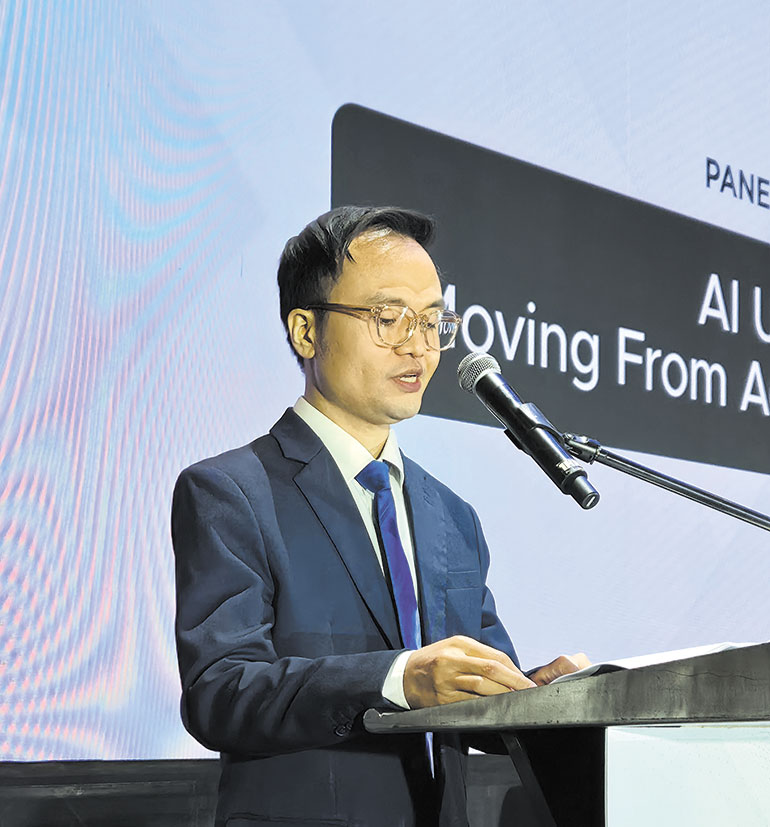 BusinessWorld Corporate Editor Arjay L. Balinbin moderated the panel discussion.
Cultural and organizational change
In Filipino workplaces, where hierarchy and personal relationships matter, adoption succeeds when leaders visibly champion AI and when teams feel supported.
“Tech, talent, and trust. These are the fundamentals and the foundations of a scalable AI. Always lead with value,” Ms. Tierro advised.
Employees should be trained early on how AI tools will alter workflows, and management should create a supportive environment where questions, mistakes, and experimentation are welcomed.
Moreover, organizations should promote cross-functional collaboration by forming teams that include both technical specialists and frontline workers to ensure AI serves real needs and is not imposed from top down.
If implemented at scale, AI-driven productivity could boost economic growth, expand digital employment opportunities, and strengthen the Philippines’ global relevance — but only if done with realistic goals, proper investments in data and talent, ethical guardrails, and inclusive policies.
The challenge for leaders is to translate technical possibility into practical business value while ensuring growth is responsible and shared.
For Mr. Llamanzares, the stakes are high: “In the coming years, if we see a high adoption rate and an environment that’s conducive to the growth of AI, I’d say we’re in the right track.”
With pragmatic pilots, steady investment in people and governance, and a policy environment that supports innovation and protection, Filipino businesses can harness AI not just as a tool, but as a catalyst for sustainable, inclusive growth.


You May Also Like

Bitcoin Price Crash to $10K? Peter Schiff Mocks MicroStrategy’s BTC Play

Lara Trump's 'weird' Met Gala snub response triggers instant mockery