Cybersecurity firm Blockaid warns that Pepe’s official site was hacked with Inferno Drainer malicious code, redirecting users. The official Pepe website suffered a disruptive breach on December 4, as attackers injected Inferno Drainer code into its front end. As a result, users were subjected to unknown redirects to malicious pages with the intention of draining […] The post Hackers Breach Pepe Site With Inferno Drainer Code appeared first on Live Bitcoin News.Cybersecurity firm Blockaid warns that Pepe’s official site was hacked with Inferno Drainer malicious code, redirecting users. The official Pepe website suffered a disruptive breach on December 4, as attackers injected Inferno Drainer code into its front end. As a result, users were subjected to unknown redirects to malicious pages with the intention of draining […] The post Hackers Breach Pepe Site With Inferno Drainer Code appeared first on Live Bitcoin News.

Hackers Breach Pepe Site With Inferno Drainer Code

2025/12/05 03:00
4 min read
For feedback or concerns regarding this content, please contact us at crypto.news@mexc.com

Cybersecurity firm Blockaid warns that Pepe’s official site was hacked with Inferno Drainer malicious code, redirecting users.

The official Pepe website suffered a disruptive breach on December 4, as attackers injected Inferno Drainer code into its front end. As a result, users were subjected to unknown redirects to malicious pages with the intention of draining connected wallets. Blockaid issued an alert warning against the compromise and the immediate avoidance of the platform.

Cyberattack Disrupts Pepe’s Web Infrastructure

According to Blockaid, the exploit was carried out by a known drainer family that was responsible for repeated phishing attacks across crypto networks. Moreover, preliminary investigations linked the breach to a wider scam-as-a-service operation described in recent cybersecurity reports. References from previous industry blogs also mentioned recurrent Inferno Drainer variants coming back since late 2023.
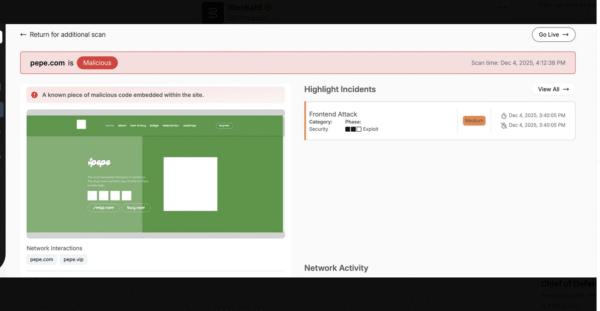
Cybersecurity firm Blockaid warns that Pepe’s official site was hacked with Inferno Drainer malicious code, redirecting users.                                                           Source: X

The attackers had placed malicious scripts in the site’s legitimate interface. Therefore, unsuspecting visitors were silently redirected to fraudulent links that impersonated services. Because these pages were requesting wallet connections, there came tremendous exposure to users. Additionally, the injection of the code worked quickly as soon as any transaction approval happened, allowing for the covert transfer of digital assets.

Related Reading: Yearn Finance Hack: Yearn Finance Recovers $2.4M From yETH Hack | Live Bitcoin News

Blockaid explained that this tactic is still effective as users trust familiar interfaces. Hence, the changed environment makes it more possible for quick authorization. Furthermore, the malicious pages often offer airdrops or bonuses, which adds to the engagement. Reports showed, such incentives are still prevalent with phishing campaigns against meme token communities.

Security Analysts Warn of Increased Drainer Activity

Industry specialists saw growing activity involving drainer toolkits all the way through 2025. Several of them pointed out that Inferno Drainer keeps circulating despite previous claims of retirement in 2023. As a result, monitoring groups anticipate more resurgent strains of the related strains. Experts added that attackers get a more perfect method of deployment by using the compromised front ends instead of independent imitations.

Cybersecurity commentators emphasized that compromises at the front-end often go undetected for a long time. As a result, users can repeatedly interact with insecure interfaces. Analysts also stressed that code obfuscation techniques make it difficult to mitigate quickly. Therefore, consistent scanning and third-party verification have become critical within the high-traffic crypto websites.

Financial researchers said that market reaction to the Pepe hack was muted. PEPE’s price did not show any major fluctuations during early trading hours. However, observers warned that the reputational effects might surface at a later time. Additionally, exchanges tend to re-evaluate associated risk metrics after such incidents, affecting liquidity and potential liquidation thresholds in the event of wider volatility increases.

Furthermore, user-side risk controls were the focus of several experts. They reiterated that transaction prompts need to be carefully reviewed, especially where permissions give extensive access. Wallet providers recently pointed out examples of using blanket approvals to allow full extraction of the tokens. Therefore, the strict scrutiny of each authorization is of vital importance when dealing with decentralized applications.

Wallet Risks Highlighted as Pepe Hack Sparks Safety Warnings

Security firms suggested the use of protective browser extensions. These tools identify known malicious endpoints and limit malicious scripts. Consequently, users can minimise exposure when visiting unknown domains. However, they recommended not to visit the Pepe website at all until the project team or trusted security publishers have given a formal clearance.

Additionally, analysts warned caution about promotional links that are circulating on social platforms. They noted phishing groups like to exploit trending tokens to create more engagement. Therefore, the users should have to verify all sorts of communication ways and perform cross-checks of the official statements. Given that the risks of liquidation increase during wallet-draining attacks, the protection of funds is key to maintaining overall market stability.

The post Hackers Breach Pepe Site With Inferno Drainer Code appeared first on Live Bitcoin News.

Market Opportunity
Pepe Logo
Pepe Price(PEPE)
$0.000004141
$0.000004141$0.000004141
+1.29%
USD
Pepe (PEPE) Live Price Chart
Disclaimer: The articles reposted on this site are sourced from public platforms and are provided for informational purposes only. They do not necessarily reflect the views of MEXC. All rights remain with the original authors. If you believe any content infringes on third-party rights, please contact crypto.news@mexc.com for removal. MEXC makes no guarantees regarding the accuracy, completeness, or timeliness of the content and is not responsible for any actions taken based on the information provided. The content does not constitute financial, legal, or other professional advice, nor should it be considered a recommendation or endorsement by MEXC.

You May Also Like

Dovish patience with geopolitical risks – TD Securities

Dovish patience with geopolitical risks – TD Securities

The post Dovish patience with geopolitical risks – TD Securities appeared on BitcoinEthereumNews.com. TD Securities analysts characterize the Bank of Canada’s (
Share
BitcoinEthereumNews2026/04/02 21:22
Cashing In On University Patents Means Giving Up On Our Innovation Future

Cashing In On University Patents Means Giving Up On Our Innovation Future

The post Cashing In On University Patents Means Giving Up On Our Innovation Future appeared on BitcoinEthereumNews.com. “It’s a raid on American innovation that would deliver pennies to the Treasury while kneecapping the very engine of our economic and medical progress,” writes Pipes. Getty Images Washington is addicted to taxing success. Now, Commerce Secretary Howard Lutnick is floating a plan to skim half the patent earnings from inventions developed at universities with federal funding. It’s being sold as a way to shore up programs like Social Security. In reality, it’s a raid on American innovation that would deliver pennies to the Treasury while kneecapping the very engine of our economic and medical progress. Yes, taxpayer dollars support early-stage research. But the real payoff comes later—in the jobs created, cures discovered, and industries launched when universities and private industry turn those discoveries into real products. By comparison, the sums at stake in patent licensing are trivial. Universities collectively earn only about $3.6 billion annually in patent income—less than the federal government spends on Social Security in a single day. Even confiscating half would barely register against a $6 trillion federal budget. And yet the damage from such a policy would be anything but trivial. The true return on taxpayer investment isn’t in licensing checks sent to Washington, but in the downstream economic activity that federally supported research unleashes. Thanks to the bipartisan Bayh-Dole Act of 1980, universities and private industry have powerful incentives to translate early-stage discoveries into real-world products. Before Bayh-Dole, the government hoarded patents from federally funded research, and fewer than 5% were ever licensed. Once universities could own and license their own inventions, innovation exploded. The result has been one of the best returns on investment in government history. Since 1996, university research has added nearly $2 trillion to U.S. industrial output, supported 6.5 million jobs, and launched more than 19,000 startups. Those companies pay…

Share
BitcoinEthereumNews2025/09/18 03:26
Unpacking The ‘Extreme Fear’ Gripping Digital Asset Markets

Unpacking The ‘Extreme Fear’ Gripping Digital Asset Markets

The post Unpacking The ‘Extreme Fear’ Gripping Digital Asset Markets appeared on BitcoinEthereumNews.com. Crypto Fear & Greed Index Plummets To 9: Unpacking The
Share
BitcoinEthereumNews2026/04/03 09:13

Starter Gold Rush: Win $2,500!

Starter Gold Rush: Win $2,500!Starter Gold Rush: Win $2,500!

Start your first trade & capture every Alpha move


