ACX, the native token of Across Protocol, has dropped sharply following serious allegations of insider self-dealing involving $23 million in decentralized autonomous organization funds. The token is trading at $0.1342, down 10% in the past 24 hours and over 40%…ACX, the native token of Across Protocol, has dropped sharply following serious allegations of insider self-dealing involving $23 million in decentralized autonomous organization funds. The token is trading at $0.1342, down 10% in the past 24 hours and over 40%…

Across Protocol token plunges amid allegations of $23M misappropriation by team

2025/06/27 14:28

ACX, the native token of Across Protocol, has dropped sharply following serious allegations of insider self-dealing involving $23 million in decentralized autonomous organization funds.

The token is trading at $0.1342, down 10% in the past 24 hours and over 40% in the past month. It’s now 91% below its all-time high of $1.69 set in December 2024.

The allegations were made public on June 27 by Ogle, the pseudonymous founder of Layer 1 project Glue and advisor to World Liberty Financial. In a detailed post on X, Ogle accused the Across Protocol team, particularly project lead Kevin Chan and chief executive officer Hart Lambur, of orchestrating two secretive proposals that directly benefited their own company using undisclosed wallets.

These proposals, made to appear as having community support, transferred 150 million ACX tokens worth about $23 million at current prices to Risk Labs over two separate governance votes. The first vote in October 2023 granted 100 million ACX under the pretense of future development support, with claims that the tokens would not be sold for two years.

But soon after, Risk Labs allegedly began selling token option agreements to external investors  A second vote, for “retroactive funding” of 50 million ACX, passed primarily due to insider-controlled wallets. Without those votes, it would not have reached quorum.

The report argues that such actions run counter to DAO governance principles and create significant future sell pressure, especially harmful to ACX holders unaware of the conflicts of interest behind these decisions. Across Protocol has not publicly responded to the allegations at the time of writing.

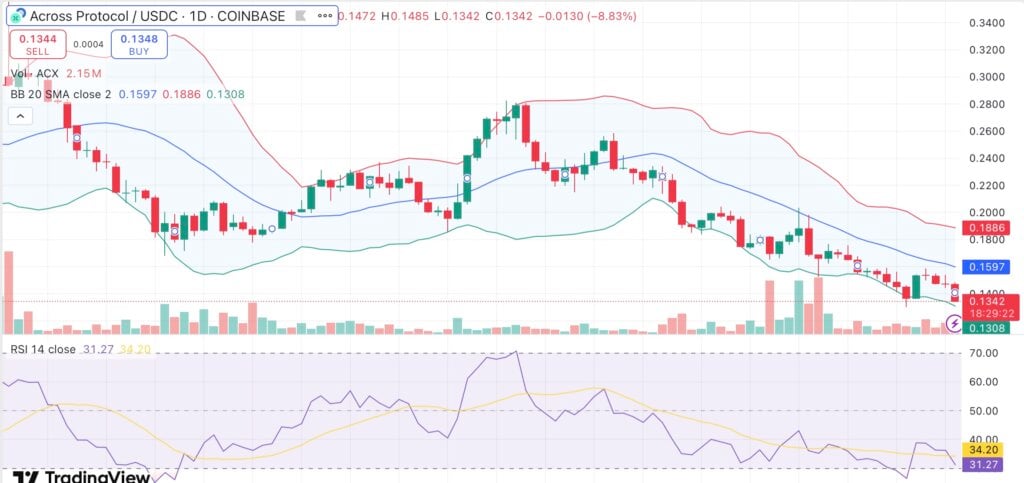
Looking at the technical picture, the chart shows clear downward pressure. The token is currently hugging the lower Bollinger Band at $0.1308 and trading below its 20-day simple moving average of $0.1597. At 31.27, the relative streghth index, which is trending downwards, is close to oversold territory.
Across Protocol token plunges amid allegations of $23M misappropriation by team - 1

More declines may occur if the price breaks through the $0.13 support zone. Some investors may watching for a bounce move back toward the mid-Bollinger band despite the sell-off. However, in the short term, upward momentum might be limited due to deteriorating sentiment and eroded trust in the team.


Disclaimer: The articles reposted on this site are sourced from public platforms and are provided for informational purposes only. They do not necessarily reflect the views of MEXC. All rights remain with the original authors. If you believe any content infringes on third-party rights, please contact service@support.mexc.com for removal. MEXC makes no guarantees regarding the accuracy, completeness, or timeliness of the content and is not responsible for any actions taken based on the information provided. The content does not constitute financial, legal, or other professional advice, nor should it be considered a recommendation or endorsement by MEXC.

You May Also Like

China Launches Cross-Border QR Code Payment Trial

China Launches Cross-Border QR Code Payment Trial

The post China Launches Cross-Border QR Code Payment Trial appeared on BitcoinEthereumNews.com. Key Points: Main event involves China initiating a cross-border QR code payment trial. Alipay and Ant International are key participants. Impact on financial security and regulatory focus on illicit finance. China’s central bank, led by Deputy Governor Lu Lei, initiated a trial of a unified cross-border QR code payment gateway with Alipay and Ant International as participants. This pilot addresses cross-border fund risks, aiming to enhance financial security amid rising money laundering through digital channels, despite muted crypto market reactions. China’s Cross-Border Payment Gateway Trial with Alipay The trial operation of a unified cross-border QR code payment gateway marks a milestone in China’s financial landscape. Prominent entities such as Alipay and Ant International are at the forefront, participating as the initial institutions in this venture. Lu Lei, Deputy Governor of the People’s Bank of China, highlighted the systemic risks posed by increased cross-border fund flows. Changes are expected in the dynamics of digital transactions, potentially enhancing transaction efficiency while tightening regulations around illicit finance. The initiative underscores China’s commitment to bolstering financial security amidst growing global fund movements. “The scale of cross-border fund flows is expanding, and the frequency is accelerating, providing opportunities for risks such as cross-border money laundering and terrorist financing. Some overseas illegal platforms transfer funds through channels such as virtual currencies and underground banks, creating a ‘resonance’ of risks at home and abroad, posing a challenge to China’s foreign exchange management and financial security.” — Lu Lei, Deputy Governor, People’s Bank of China Bitcoin and Impact of China’s Financial Initiatives Did you know? China’s latest initiative echoes the Payment Connect project of June 2025, furthering real-time cross-boundary remittances and expanding its influence on global financial systems. As of September 17, 2025, Bitcoin (BTC) stands at $115,748.72 with a market cap of $2.31 trillion, showing a 0.97%…
Share
BitcoinEthereumNews2025/09/18 05:28



