*What does the future of crypto look like in 2026?* In this landmark panel from Binance Blockchain Week, three of the industry’s most influential leaders — B...*What does the future of crypto look like in 2026?* In this landmark panel from Binance Blockchain Week, three of the industry’s most influential leaders — B...

Ripple CEO Predicts 2026 Will Be A Breakout Year For Crypto

2025/12/05 11:00

At Binance Blockchain Week on December 3, Ripple Labs CEO Brad Garlinghouse argued that a rare alignment of regulatory change, institutional demand and real-world utility is setting up crypto for what he called powerful “macro tailwinds” heading into 2026.

“I personally will echo some of the things Richard said: there are so many macro factors that are continuing to provide tailwinds for this industry that I think as we go into 2026 I don’t remember being this optimistic in the last handful of years,” the Ripple CEO told CNBC’s Dan Murphy, speaking alongside Binance CEO Richard Teng and Solana Foundation President Lily Liu.

Ripple CEO Is Optimistic For 2026: Here’s Why

He framed the latest drawdown not as the start of a structural bear market but as a risk-off interlude against a fundamentally improved backdrop. “Crypto has gone through cycles and when you have risk-on people are excited […] now you have kind of a risk-off moment, there’s uncertainty,” he said. The difference this time, he argued, is that the United States—the largest single economy and roughly “22% of global GDP”—is finally moving away from what he described as years of open hostility toward the sector.

“This is a market that has been really openly hostile to crypto for four or five years or maybe longer, and now you have that that has changed significantly, pretty quickly,” he said. Institutions, in his view, are only beginning to adjust. He pointed to the visible presence of traditional asset managers at the event: “You saw Franklin Templeton on stage here, you saw BlackRock on stage just this week. I think Vanguard has now opened up […] Vanguard historically has said ‘we won’t touch crypto’ and now they’ve had a massive sea change.”

On crypto ETFs, the Ripple CEO rejected the idea that the trade was over-hyped. “Definitely no,” he said when asked whether the ETF “floor” narrative had been exaggerated. He stressed how new these vehicles still are in the United States and highlighted early demand for XRP products. “In the last two or three weeks over $700 million have flowed into XRP ETFs, which is just pent-up demand from institutional investors, from investors who want access because they don’t want to custody themselves,” he said.

He argued that the key metric is crypto’s still-small slice of the overall ETF universe. “The total ETF market—only one or two percent of the total ETF market is crypto. I will bet anybody here that a year from now that will be more than one or two percent,” he said. Short-term outflows from Bitcoin products, he suggested, should be viewed in context: “Over 2026 do we really think crypto ETFs are only going to be one or two percent of the total ETF market? No chance.”

Garlinghouse said Ripple’s own prime brokerage business is already seeing that shift in behavior. Institutions that had remained “on the sidelines” due to regulatory uncertainty or risk aversion are now “getting involved and they’re starting small, and they’re going to walk, then they’re going to crawl—or crawl then walk then run.” Asked directly whether recent volatility had deterred institutional capital, he replied: “Definitely not.”

Stablecoins Will Be A Key Pillar

Stablecoins were another pillar of his 2026 thesis. He agreed that in the latest risk-off phase, capital largely rotated into stablecoins rather than exiting on-chain rails, which he said reflects both utility and trust. “People are recognizing stablecoins can be stable and easier to manage,” he said.

Garlinghouse highlighted that Ripple’s own stablecoin, launched “just over a year ago,” has “just passed about a billion market cap,” is “approved and whitelisted in Abu Dhabi,” and is being used as “good collateral on various platforms from a lending point of view.” For him, stablecoins are an entry ramp to broader adoption, alongside other applications that will be built across Solana, Binance and Ripple ecosystems.

On US policy, he said the trajectory has clearly improved, especially for payment tokens. He cited the GENIUS Act as “regulatory clarity for stablecoins” and linked it to growing corporate interest in on-chain payments. After Ripple’s acquisition of GTreasury, which has visibility into “over 10 trillion dollars of payments,” he said “the number of those customers that are already approaching us interested in leveraging stablecoins […] because of that clarity, people are leaning in.”

The Ripple CEO noted that XRP has already received a form of clarity from US federal courts but said broader legislation is still needed. He referenced the “Clarity Act” for crypto, saying there is “still forward momentum” and predicting that “sometime in the first half of next year we’ll see passage of legislation, which will continue to unlock and create more tailwinds for the whole industry.”

He closed with an explicit price target for the next cycle, acknowledging he was “going out on a limb”: “I’ll say Bitcoin $180,000 December 23rd—or December 31st—2026.”

At press time, XRP traded at $2.15.
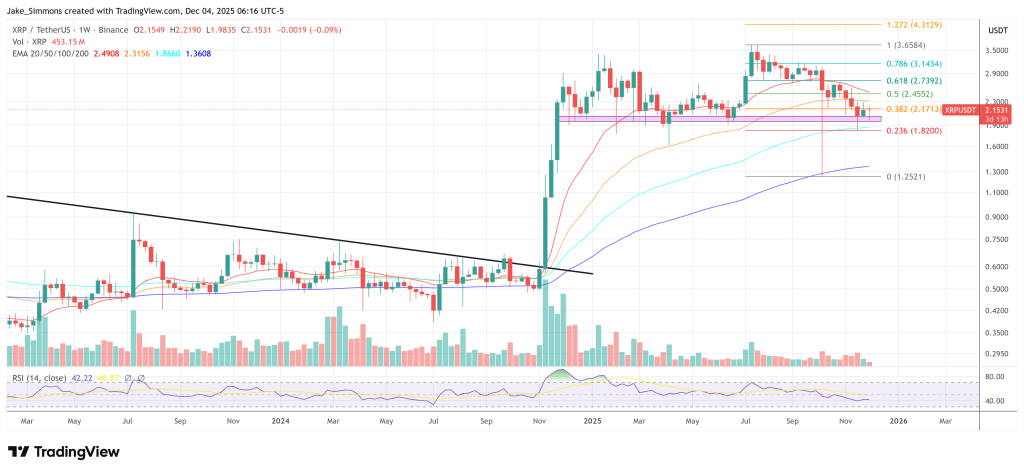
XRP price
Disclaimer: The articles reposted on this site are sourced from public platforms and are provided for informational purposes only. They do not necessarily reflect the views of MEXC. All rights remain with the original authors. If you believe any content infringes on third-party rights, please contact service@support.mexc.com for removal. MEXC makes no guarantees regarding the accuracy, completeness, or timeliness of the content and is not responsible for any actions taken based on the information provided. The content does not constitute financial, legal, or other professional advice, nor should it be considered a recommendation or endorsement by MEXC.

You May Also Like

China Blocks Nvidia’s RTX Pro 6000D as Local Chips Rise

China Blocks Nvidia’s RTX Pro 6000D as Local Chips Rise

The post China Blocks Nvidia’s RTX Pro 6000D as Local Chips Rise appeared on BitcoinEthereumNews.com. China Blocks Nvidia’s RTX Pro 6000D as Local Chips Rise China’s internet regulator has ordered the country’s biggest technology firms, including Alibaba and ByteDance, to stop purchasing Nvidia’s RTX Pro 6000D GPUs. According to the Financial Times, the move shuts down the last major channel for mass supplies of American chips to the Chinese market. Why Beijing Halted Nvidia Purchases Chinese companies had planned to buy tens of thousands of RTX Pro 6000D accelerators and had already begun testing them in servers. But regulators intervened, halting the purchases and signaling stricter controls than earlier measures placed on Nvidia’s H20 chip. Image: Nvidia An audit compared Huawei and Cambricon processors, along with chips developed by Alibaba and Baidu, against Nvidia’s export-approved products. Regulators concluded that Chinese chips had reached performance levels comparable to the restricted U.S. models. This assessment pushed authorities to advise firms to rely more heavily on domestic processors, further tightening Nvidia’s already limited position in China. China’s Drive Toward Tech Independence The decision highlights Beijing’s focus on import substitution — developing self-sufficient chip production to reduce reliance on U.S. supplies. “The signal is now clear: all attention is focused on building a domestic ecosystem,” said a representative of a leading Chinese tech company. Nvidia had unveiled the RTX Pro 6000D in July 2025 during CEO Jensen Huang’s visit to Beijing, in an attempt to keep a foothold in China after Washington restricted exports of its most advanced chips. But momentum is shifting. Industry sources told the Financial Times that Chinese manufacturers plan to triple AI chip production next year to meet growing demand. They believe “domestic supply will now be sufficient without Nvidia.” What It Means for the Future With Huawei, Cambricon, Alibaba, and Baidu stepping up, China is positioning itself for long-term technological independence. Nvidia, meanwhile, faces…
Share
BitcoinEthereumNews2025/09/18 01:37
Crucial Fed Rate Cut: October Probability Surges to 94%

Crucial Fed Rate Cut: October Probability Surges to 94%

BitcoinWorld Crucial Fed Rate Cut: October Probability Surges to 94% The financial world is buzzing with a significant development: the probability of a Fed rate cut in October has just seen a dramatic increase. This isn’t just a minor shift; it’s a monumental change that could ripple through global markets, including the dynamic cryptocurrency space. For anyone tracking economic indicators and their impact on investments, this update from the U.S. interest rate futures market is absolutely crucial. What Just Happened? Unpacking the FOMC Statement’s Impact Following the latest Federal Open Market Committee (FOMC) statement, market sentiment has decisively shifted. Before the announcement, the U.S. interest rate futures market had priced in a 71.6% chance of an October rate cut. However, after the statement, this figure surged to an astounding 94%. This jump indicates that traders and analysts are now overwhelmingly confident that the Federal Reserve will lower interest rates next month. Such a high probability suggests a strong consensus emerging from the Fed’s latest communications and economic outlook. A Fed rate cut typically means cheaper borrowing costs for businesses and consumers, which can stimulate economic activity. But what does this really signify for investors, especially those in the digital asset realm? Why is a Fed Rate Cut So Significant for Markets? When the Federal Reserve adjusts interest rates, it sends powerful signals across the entire financial ecosystem. A rate cut generally implies a more accommodative monetary policy, often enacted to boost economic growth or combat deflationary pressures. Impact on Traditional Markets: Stocks: Lower interest rates can make borrowing cheaper for companies, potentially boosting earnings and making stocks more attractive compared to bonds. Bonds: Existing bonds with higher yields might become more valuable, but new bonds will likely offer lower returns. Dollar Strength: A rate cut can weaken the U.S. dollar, making exports cheaper and potentially benefiting multinational corporations. Potential for Cryptocurrency Markets: The cryptocurrency market, while often seen as uncorrelated, can still react significantly to macro-economic shifts. A Fed rate cut could be interpreted as: Increased Risk Appetite: With traditional investments offering lower returns, investors might seek higher-yielding or more volatile assets like cryptocurrencies. Inflation Hedge Narrative: If rate cuts are perceived as a precursor to inflation, assets like Bitcoin, often dubbed “digital gold,” could gain traction as an inflation hedge. Liquidity Influx: A more accommodative monetary environment generally means more liquidity in the financial system, some of which could flow into digital assets. Looking Ahead: What Could This Mean for Your Portfolio? While the 94% probability for a Fed rate cut in October is compelling, it’s essential to consider the nuances. Market probabilities can shift, and the Fed’s ultimate decision will depend on incoming economic data. Actionable Insights: Stay Informed: Continue to monitor economic reports, inflation data, and future Fed statements. Diversify: A diversified portfolio can help mitigate risks associated with sudden market shifts. Assess Risk Tolerance: Understand how a potential rate cut might affect your specific investments and adjust your strategy accordingly. This increased likelihood of a Fed rate cut presents both opportunities and challenges. It underscores the interconnectedness of traditional finance and the emerging digital asset space. Investors should remain vigilant and prepared for potential volatility. The financial landscape is always evolving, and the significant surge in the probability of an October Fed rate cut is a clear signal of impending change. From stimulating economic growth to potentially fueling interest in digital assets, the implications are vast. Staying informed and strategically positioned will be key as we approach this crucial decision point. The market is now almost certain of a rate cut, and understanding its potential ripple effects is paramount for every investor. Frequently Asked Questions (FAQs) Q1: What is the Federal Open Market Committee (FOMC)? A1: The FOMC is the monetary policymaking body of the Federal Reserve System. It sets the federal funds rate, which influences other interest rates and economic conditions. Q2: How does a Fed rate cut impact the U.S. dollar? A2: A rate cut typically makes the U.S. dollar less attractive to foreign investors seeking higher returns, potentially leading to a weakening of the dollar against other currencies. Q3: Why might a Fed rate cut be good for cryptocurrency? A3: Lower interest rates can reduce the appeal of traditional investments, encouraging investors to seek higher returns in alternative assets like cryptocurrencies. It can also be seen as a sign of increased liquidity or potential inflation, benefiting assets like Bitcoin. Q4: Is a 94% probability a guarantee of a rate cut? A4: While a 94% probability is very high, it is not a guarantee. Market probabilities reflect current sentiment and data, but the Federal Reserve’s final decision will depend on all available economic information leading up to their meeting. Q5: What should investors do in response to this news? A5: Investors should stay informed about economic developments, review their portfolio diversification, and assess their risk tolerance. Consider how potential changes in interest rates might affect different asset classes and adjust strategies as needed. Did you find this analysis helpful? Share this article with your network to keep others informed about the potential impact of the upcoming Fed rate cut and its implications for the financial markets! To learn more about the latest crypto market trends, explore our article on key developments shaping Bitcoin price action. This post Crucial Fed Rate Cut: October Probability Surges to 94% first appeared on BitcoinWorld.
Share
Coinstats2025/09/18 02:25