The U.S. Securities and Exchange Commission has formally concluded its multi-year investigation into the Aave Protocol without recommending any enforcement actionThe U.S. Securities and Exchange Commission has formally concluded its multi-year investigation into the Aave Protocol without recommending any enforcement action

SEC Drops 4-Year Aave Investigation Following ‘Significant’ Defense Battle: Report

The U.S. Securities and Exchange Commission has formally concluded its multi-year investigation into the Aave Protocol without recommending any enforcement action.

The action ends nearly four years of regulatory uncertainty surrounding one of decentralized finance’s most widely used lending platforms.

Aave founder and chief executive Stani Kulechov disclosed the outcome in a public post on August 12.

Aave Survived the SEC’s DeFi Crackdown — Here’s What Happened Behind the Scenes

The probe into Aave began around late 2021 or early 2022, during a period of heightened regulatory scrutiny of decentralized finance platforms.

At the time, the SEC was expanding its enforcement focus beyond centralized exchanges to include protocols offering lending, borrowing, and liquidity services without traditional intermediaries.

While the SEC did not publicly outline the scope of its concerns, industry observers have long assumed that the inquiry centered on whether the AAVE token or aspects of the protocol’s operations fell under U.S. securities laws and whether any registration obligations applied.

Throughout the investigation, Aave cooperated with regulators, engaging with SEC staff over several years.

In June 2025, Aave representatives met with members of the SEC’s Crypto Task Force to discuss regulatory approaches, though the agency has not indicated whether those discussions were connected to the closure decision.

Kulechov said the process required significant effort and resources from both the company and him personally, describing the investigation as a prolonged period of regulatory pressure not only for Aave but for decentralized finance more broadly.

As is typical in cases that end without enforcement, the SEC did not publish findings or allegations tied to the probe.

The letter stated that, as of that date, staff did not intend to recommend an enforcement action to the Commission in connection with the investigation identified internally as “HO-14386.”

The notice followed standard SEC practice and included a disclaimer that the decision should not be interpreted as an exoneration and does not prevent the agency from reopening the matter in the future.

The SEC has consistently maintained flexibility to act quickly when investor protection concerns arise, avoiding rigid procedural rules that could delay enforcement.

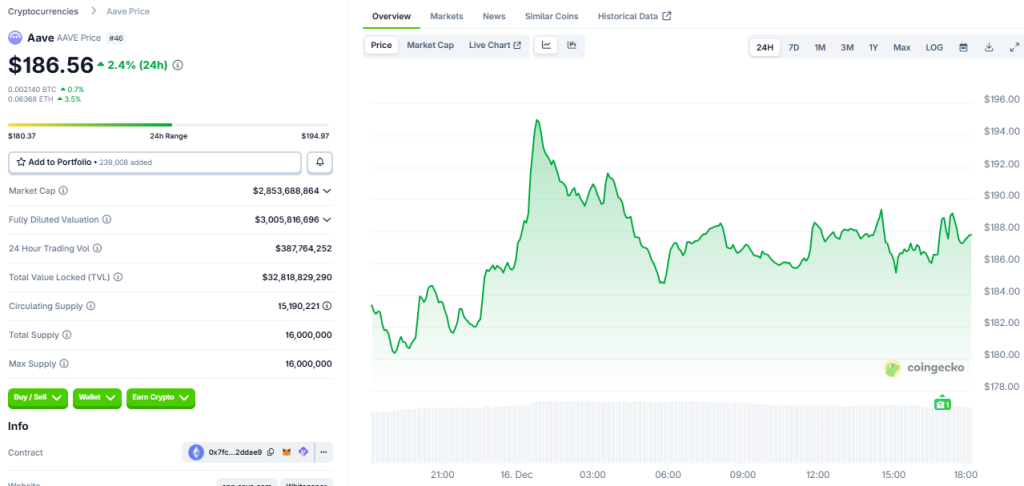
Notably, earlier today, the Aave (AAVE) token reached a high of $194 before dipping to a low of $184. The token has since stabilized at $187.67, marking a 2.4% gain over the past 24 hours.
Source: CoinGecko

For Aave users, it means the protocol can continue operating without the immediate risk of U.S. enforcement action tied to the long-running SEC investigation.

It also reduces regulatory uncertainty around Aave’s core products, offering users more confidence that the platform will remain accessible and stable in the near term.

Is the SEC Done Fighting Crypto? Major Cases Close Without Charges

Aave’s case is the latest in a growing list of high-profile crypto investigations closed without charges in 2025.

In December, Ondo Finance disclosed that the SEC had ended its own multi-year probe into the firm’s tokenized real-world asset products and its ONDO token.

The broader enforcement landscape has shifted notably since early 2025, as the SEC has dropped or dismissed cases and investigations involving Coinbase, Kraken, Robinhood, OpenSea, Uniswap Labs, Consensys, Crypto.com, and several other firms.

Many of those actions were withdrawn with prejudice, preventing the agency from bringing the same claims again.

The change followed a leadership transition at the SEC and a stated move away from regulation through litigation toward developing clearer policy guidance.

A review published by The New York Times earlier today found that the SEC initiated no new crypto-related federal court cases.

Of the crypto cases inherited from prior administrations, the agency pulled back from more than half, either dismissing them, staying proceedings, or conceding key issues.


Market Opportunity
4 Logo
4 Price(4)
$0.02137
$0.02137$0.02137
-6.02%
USD
4 (4) Live Price Chart
Disclaimer: The articles reposted on this site are sourced from public platforms and are provided for informational purposes only. They do not necessarily reflect the views of MEXC. All rights remain with the original authors. If you believe any content infringes on third-party rights, please contact service@support.mexc.com for removal. MEXC makes no guarantees regarding the accuracy, completeness, or timeliness of the content and is not responsible for any actions taken based on the information provided. The content does not constitute financial, legal, or other professional advice, nor should it be considered a recommendation or endorsement by MEXC.

You May Also Like

Kalshi Jumps to 62% Market Share While Polymarket Eyes $10B Valuation

Kalshi Jumps to 62% Market Share While Polymarket Eyes $10B Valuation

The post Kalshi Jumps to 62% Market Share While Polymarket Eyes $10B Valuation appeared on BitcoinEthereumNews.com. Fintech 19 September 2025 | 16:03 Event-based trading platforms are no longer niche experiments – they’re emerging as a major arena where finance, crypto, and information converge. After months of subdued activity, volumes are climbing again, and U.S.-regulated Kalshi has unexpectedly taken the lead. Betting on Everything From Rates to Sports Analysts at Bernstein describe prediction markets as a new “interface for information,” where users speculate not only on sports results but also on Federal Reserve decisions, quarterly earnings, and even crypto price moves. This year alone, more than $200 million changed hands on Polymarket contracts linked to the Fed’s recent 25 bps rate cut, while $85 million traded on Kalshi around the same decision. Mainstream brokers like Coinbase and Robinhood are watching closely, with ambitions to capture some of the momentum. With U.S. sports betting already worth tens of billions annually, the overlap is too big to ignore. Against that backdrop, Kalshi has delivered one of its strongest months since the 2024 elections. The platform reports $1.3 billion in trading volume so far in September, accounting for 62% of global prediction market activity. Just a year ago, Kalshi’s share stood at 3%. CEO Tarek Mansour called the growth “remarkable,” noting that the exchange still serves only U.S. clients. Polymarket’s Pushback Its main rival, Polymarket, has logged about $773 million in trades this month. While that trails Kalshi for now, Polymarket has unique advantages: as a crypto-native platform, it has carved out strong global demand and is working toward a formal U.S. relaunch via its acquisition of derivatives exchange QCEX. The two platforms now stand as the clear leaders of the sector, though they embody different philosophies — one regulated from the ground up, the other built around decentralization. Investors Take Notice The boom hasn’t escaped venture capital. Reports suggest…
Share
BitcoinEthereumNews2025/09/19 21:34
Visa Expands USDC Stablecoin Settlement For US Banks

Visa Expands USDC Stablecoin Settlement For US Banks

The post Visa Expands USDC Stablecoin Settlement For US Banks appeared on BitcoinEthereumNews.com. Visa Expands USDC Stablecoin Settlement For US Banks
Share
BitcoinEthereumNews2025/12/17 15:23
Bitcoin Lightning Network Capacity Surges to Historic Peak as Exchange Adoption Accelerates

Bitcoin Lightning Network Capacity Surges to Historic Peak as Exchange Adoption Accelerates

The Bitcoin Lightning Network has reached an all-time high in total network capacity, marking a significant milestone for the layer-2 scaling solution designed to enable fast and inexpensive Bitcoin transactions. The surge comes as major cryptocurrency exchanges increasingly integrate Lightning functionality, bringing the technology to millions of users who previously relied solely on slower, more expensive on-chain transactions. This capacity expansion reflects growing confidence in Lightning's reliability and utility after years of development and real-world testing. What began as an experimental protocol discussed primarily among technical enthusiasts has matured into infrastructure that some of the industry's largest platforms now consider essential to their operations.
Share
MEXC NEWS2025/12/17 17:14




