Ethereum co-founder Vitalik Buterin rang in 2026 by switching his X profile image back to a Milady-style avatar and pairing it with a manifesto-like post that reEthereum co-founder Vitalik Buterin rang in 2026 by switching his X profile image back to a Milady-style avatar and pairing it with a manifesto-like post that re

Ethereum: Buterin Revives ‘Milady’ For A World Computer Push

2026/01/02 15:15
3 min read
For feedback or concerns regarding this content, please contact us at crypto.news@mexc.com

Ethereum co-founder Vitalik Buterin rang in 2026 by switching his X profile image back to a Milady-style avatar and pairing it with a manifesto-like post that re-centers Ethereum’s identity around a single, old-school ambition: becoming “the world computer” for an open internet.

“Welcome to 2026! Milady is back,” Buterin wrote, before ticking through what he framed as Ethereum’s 2025 progress: higher gas limits, a larger blob count, better node software quality, and zkEVMs hitting major performance milestones. He also argued that “with zkEVMs and PeerDAS ethereum made its largest step toward being a fundamentally new and more powerful kind of blockchain.”

Ethereum Must Deliver The World Computer

But the post’s center of gravity wasn’t a victory lap. It was a warning that the network is still falling short of its own stated goals and that chasing whatever narrative is currently printing attention is not the point.

Buterin drew a bright line between Ethereum’s long-term mission and trend-driven incentives that often dominate crypto cycles. “Ethereum needs to do more to meet its own stated goals,” he wrote. “Not the quest of ‘winning the next meta’ regardless of whether it’s tokenized dollars or political memecoins, not arbitrarily convincing people to help us fill up blockspace to make ETH ultrasound again, but the mission: To build the world computer that serves as a central infrastructure piece of a more free and open internet.”

From there, he offered a description of what “world computer” should mean in practice: decentralized applications that can’t be quietly altered or shut off, and that remain usable even when the companies and infrastructure most users take for granted fail.

“We’re building decentralized applications. Applications that run without fraud, censorship or third-party interference,” he wrote. “Applications that pass the walkaway test: they keep running even if the original developers disappear. Applications where if you’re a user, you don’t even notice if Cloudflare goes down — or even if all of Cloudflare gets hacked by North Korea.”

Buterin extended that same set of expectations beyond finance, explicitly name-checking identity, governance, and “whatever other civilizational infrastructure people want to build,” and he emphasized privacy as a core property rather than a nice-to-have.

A notable thread in the post is that Buterin refuses to treat usability-at-scale and decentralization as a trade-off Ethereum can punt on. “To achieve this, it needs to be (i) usable, and usable at scale, and (ii) actually decentralized,” he wrote, arguing those requirements apply both to the base layer—“including the software we use to run and talk to the blockchain” and to the application layer.

That framing implicitly puts pressure on multiple constituencies at once: core protocol work, client diversity and quality, infrastructure that doesn’t centralize around a few providers, and dapp architectures that can survive developer abandonment while still meeting user expectations.

Buterin closed on a note of resolve rather than specifics, saying Ethereum has “powerful tools” but needs to apply them more aggressively. “All of these pieces must be improved — they are already being improved, but they must be improved more,” he wrote. “Fortunately, we have powerful tools on our side — but we need to apply them, and we will.”

At press time, ETH traded at $3,030.
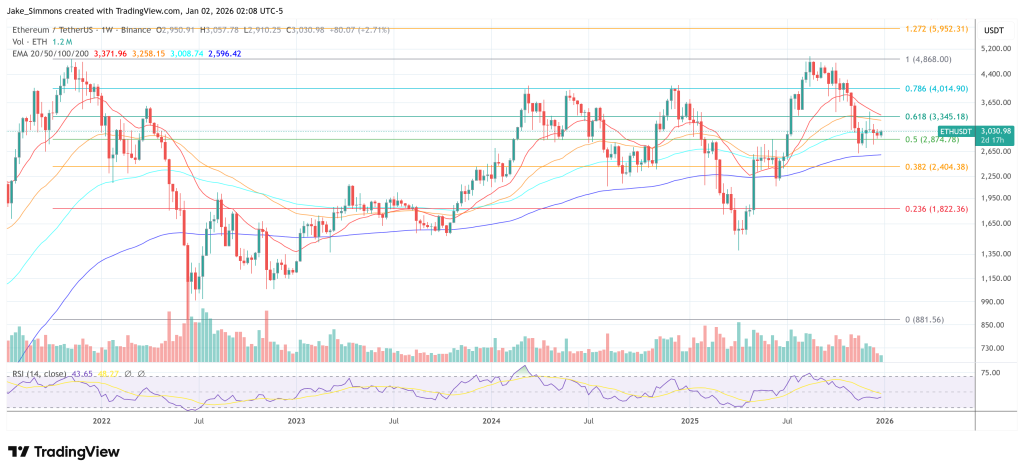
Ethereum price chart
Market Opportunity
EPNS Logo
EPNS Price(PUSH)
$0.012054
$0.012054$0.012054
-1.06%
USD
EPNS (PUSH) Live Price Chart
Disclaimer: The articles reposted on this site are sourced from public platforms and are provided for informational purposes only. They do not necessarily reflect the views of MEXC. All rights remain with the original authors. If you believe any content infringes on third-party rights, please contact crypto.news@mexc.com for removal. MEXC makes no guarantees regarding the accuracy, completeness, or timeliness of the content and is not responsible for any actions taken based on the information provided. The content does not constitute financial, legal, or other professional advice, nor should it be considered a recommendation or endorsement by MEXC.

You May Also Like

Red state lawmaker warns something ominous hiding behind Supreme Court's 'five alarm fire'

Red state lawmaker warns something ominous hiding behind Supreme Court's 'five alarm fire'

A former lawmaker from a red state warned that something ominous is hiding behind the latest "five-alarm fire" from the Supreme Court, according to a new report
Share
Rawstory2026/05/15 08:07
One Of Frank Sinatra’s Most Famous Albums Is Back In The Spotlight

One Of Frank Sinatra’s Most Famous Albums Is Back In The Spotlight

The post One Of Frank Sinatra’s Most Famous Albums Is Back In The Spotlight appeared on BitcoinEthereumNews.com. Frank Sinatra’s The World We Knew returns to the Jazz Albums and Traditional Jazz Albums charts, showing continued demand for his timeless music. Frank Sinatra performs on his TV special Frank Sinatra: A Man and his Music Bettmann Archive These days on the Billboard charts, Frank Sinatra’s music can always be found on the jazz-specific rankings. While the art he created when he was still working was pop at the time, and later classified as traditional pop, there is no such list for the latter format in America, and so his throwback projects and cuts appear on jazz lists instead. It’s on those charts where Sinatra rebounds this week, and one of his popular projects returns not to one, but two tallies at the same time, helping him increase the total amount of real estate he owns at the moment. Frank Sinatra’s The World We Knew Returns Sinatra’s The World We Knew is a top performer again, if only on the jazz lists. That set rebounds to No. 15 on the Traditional Jazz Albums chart and comes in at No. 20 on the all-encompassing Jazz Albums ranking after not appearing on either roster just last frame. The World We Knew’s All-Time Highs The World We Knew returns close to its all-time peak on both of those rosters. Sinatra’s classic has peaked at No. 11 on the Traditional Jazz Albums chart, just missing out on becoming another top 10 for the crooner. The set climbed all the way to No. 15 on the Jazz Albums tally and has now spent just under two months on the rosters. Frank Sinatra’s Album With Classic Hits Sinatra released The World We Knew in the summer of 1967. The title track, which on the album is actually known as “The World We Knew (Over and…

Share
BitcoinEthereumNews2025/09/18 00:02
Data focus shifts to payrolls – Societe Generale

Data focus shifts to payrolls – Societe Generale

The post Data focus shifts to payrolls – Societe Generale appeared on BitcoinEthereumNews.com. Societe Generale analysts note a quiet data calendar ahead of key
Share
BitcoinEthereumNews2026/04/02 17:52

KAIO Global Debut

KAIO Global DebutKAIO Global Debut

Enjoy 0-fee KAIO trading and tap into the RWA boom



