SymTax, a new AI for citation recommendation, uses a "symbiotic" model and taxonomy fusion to more accurately predict relevant scientific papers.SymTax, a new AI for citation recommendation, uses a "symbiotic" model and taxonomy fusion to more accurately predict relevant scientific papers.

A Three-Stage Architecture for Precision Citation Recommendation

2025/08/26 16:55
5 min read
For feedback or concerns regarding this content, please contact us at crypto.news@mexc.com

Abstract and 1. Introduction

  1. Related Work

  2. Proposed Dataset

  3. SymTax Model

    4.1 Prefetcher

    4.2 Enricher

    4.3 Reranker

  4. Experiments and Results

  5. Analysis

    6.1 Ablation Study

    6.2 Quantitative Analysis and 6.3 Qualitative Analysis

  6. Conclusion

  7. Limitations

  8. Ethics Statement and References

Appendix

4 SymTax Model

We discuss the detailed architecture of our proposed model – SymTax, as shown in Figure 2. It comprises a fast prefetching module, an enriching module and a slow and precise reranking module. We borrow an existing prefetching module from Gu et al. (2022) whereas an enriching module and a reranking module are our novel contributions in the overall recommendation technique. The subsequent subsections elaborate on the architectures of these three modules.

\

4.1 Prefetcher

The task of the prefetching module is to provide an initial set of high-ranking candidates by scoring all the papers in the database with respect to the query context. It uses cosine similarity between query embedding and document embedding to estimate the relevance between query context and the candidate document. Prefetcher comprises two submodules, namely, Paragraph Encoder and Document Encoder. Paragraph Encoder computes the embedding of a given paragraph, i.e. title, abstract or citation context, using a transformer layer followed by multi-head pooling. Document Encoder takes paragraph encodings as input along with paragraph types and passes them through a multi-head pooled transformer layer to obtain the final document embedding. We adopt the prefetching module from Gu et al. (2022) and use it as a plugin in our overall recommendation technique. For brevity, we refer readers to follow the source to understand the detailed working of the prefetcher.

\

4.2 Enricher
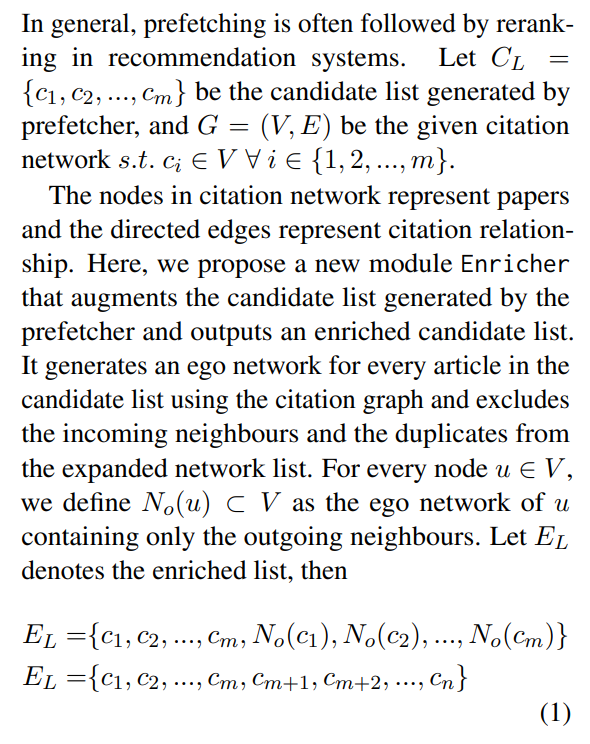
\ where {} represents a set operator. We then feed this enriched list as input to the reranker. The design notion of Enricher is inspired by Symbiosis, aka Symbiotic Relationship, a concept in Biology.

\ Symbiosis. The idea of including cited papers of identified candidates has been pursued in the literature (Cohan et al., 2020) but from the perspective of hard negatives. To the best of our knowledge, the concept of Enrichment has never been discussed earlier for citation recommendation to model the human citation behaviour. We identify two different types of citation behaviours that prevail in the citation ecosystem and draw a corresponding analogy with mutualism and parasitism that falls under the concept of Symbiosis. Symbiosis is a long-term relationship or interaction between two dissimilar organisms in a habitat. In our work, the habitat is
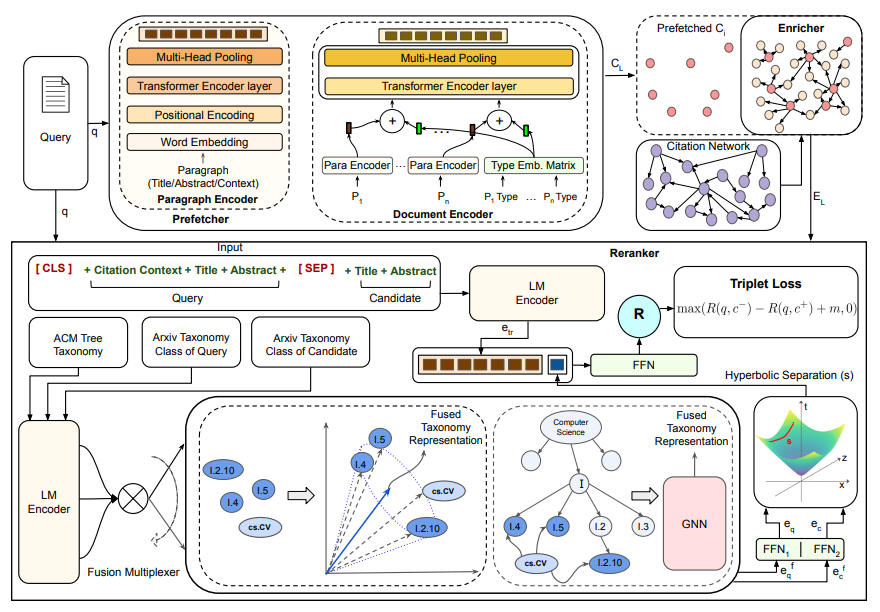
Figure 2: Architecture of SymTax. It consists of three essential modules – (a) Prefetcher, (b) Enricher, and (c) Reranker. The task of Enricher is to enrich the candidate list generated by Prefetcher and provide it as an input to Reranker. Reranker utilises taxonomy fusion and hyperbolic separation to yield final recommendation score (R). Mapping:- I.4: Image Processing and Computer Vision, I.5: Pattern Recognition, I.2.10: Vision and Scene Understanding, cs.CV: Computer Vision. Fusion Multiplexer enables switching between vector based and graphbased taxonomy fusion. We have released the mapping config file along with the data.

\ the citation ecosystem, and the two dissimilar organisms are the candidate article and its neighbourhood. We try to explain the citation phenomena through Symbiosis wherein the candidate and its neighbourhood either play the role of mutualism or parasitism. In mutualism, the query paper recommends either only the candidate paper under consideration or both the considered candidate paper and from its 1-hop outdegree neighbour network. On the other hand, in parasitism, the neighbour organism feeds upon the candidate to get itself cited, i.e., the query paper, rather than citing the candidate article, in turn, recommends from its outgoing edge neighbours. This whole idea, in practice, is analogous to human citation behaviour. When writing a research article, researchers often gather a few highly relevant prior art and cite highly from their references. We can interpret this tendency as a slight human bias or highly as utilising the research crowd’s wisdom. Owing to this, Enricher is only required at the inference stage. Nevertheless, it is a significantly important signal, as evident from the results in Table 2 and Table 3.

\

4.3 Reranker
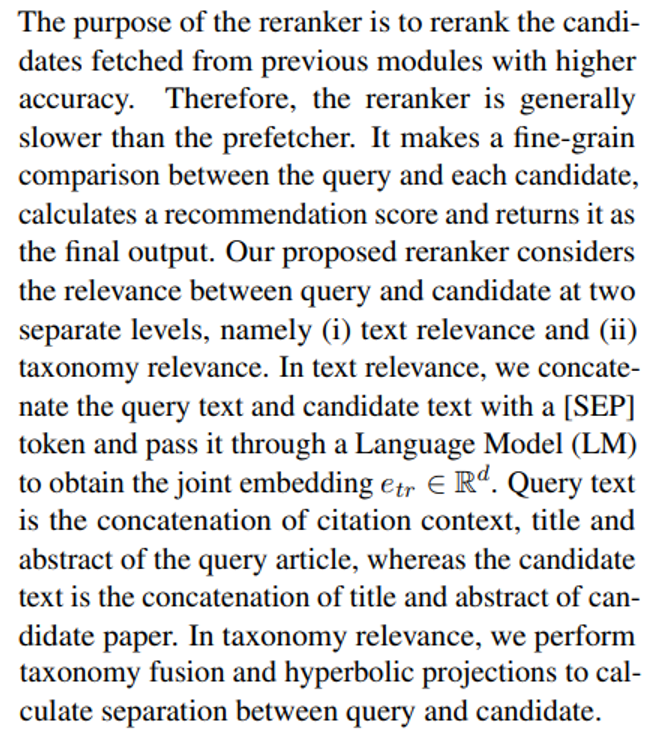
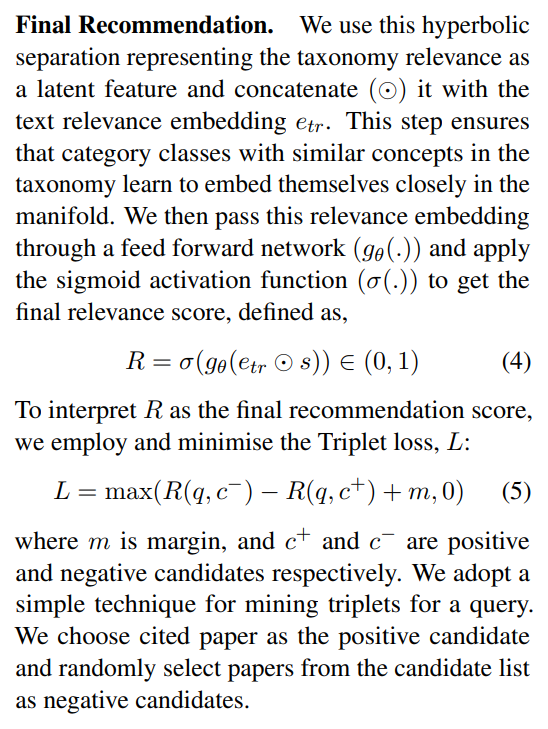
\ Taxonomy Fusion. The inclusion of taxonomy fusion is an important and careful design choice. Intuitively, a flat-level taxonomy (arXiv concepts) does not have a rich semantic structure in comparison to a hierarchically structured taxonomy like ACM. In a hierarchical taxonomy, we have a semantic relationship in terms of generalisation, specialisation and containment. Mapping the flat concepts into hierarchical taxonomy infuses a structure into the flat taxonomy. It also enriches the hierarchical taxonomy as we get equivalent concepts from the flat taxonomy. Each article in our proposed dataset ArSyTa consists of a feature category that represents the arXiv taxonomy[7] class it belongs to. Since ArSyTa contains papers from the CS domain, so we have a flat arXiv taxonomy. e.g. cs.LG and cs.CV represents Machine Learning and Computer Vision classes, respectively. We now propose the fusion of flat-level arXiv taxonomy with ACM tree taxonomy[8] to obtain rich feature representations for the category classes. We mainly utilise the subject class mapping information mentioned in the arXiv taxonomy and domain knowledge to create a class taxonomy mapping from arXiv to ACM. e.g. cs.CV is mapped to ACM classes I.2.10, I.4 and I.5 (as shown in Fig. 2). Also, we release the mapping config file in the data release phase. We employ two fusion strategies, namely vector-based and graph-based. In vector-based fusion, the classes are passed through LM and their conical vector is obtained by averaging out class vectors in feature space. In graph-based fusion, we first form a graph by injecting arXiv classes into the ACM tree and creating directed edges between them. We initialise node embeddings using LM and run Graph Neural Network (GNN) algorithm to learn fused representations. We consider GAT(Velickovic et al., 2018) and APPNP(Gasteiger et al., 2019) as GNN algorithms and observe their performance as the same. The final representations of cs.{} nodes represent the fused representations learnt. Empirically, we can clearly observe that the fusion of concepts helps to attain significant performance gains (as shown in Table 3).

\
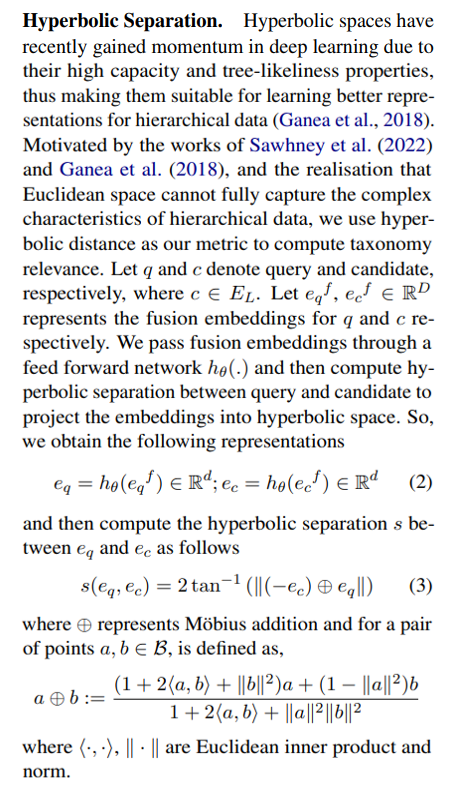
\
\

:::info Authors:

(1) Karan Goyal, IIIT Delhi, India (karang@iiitd.ac.in);

(2) Mayank Goel, NSUT Delhi, India (mayank.co19@nsut.ac.in);

(3) Vikram Goyal, IIIT Delhi, India (vikram@iiitd.ac.in);

(4) Mukesh Mohania, IIIT Delhi, India (mukesh@iiitd.ac.in).

:::


:::info This paper is available on arxiv under CC by-SA 4.0 Deed (Attribution-Sharealike 4.0 International) license.

:::

[7] https://arxiv.org/category_taxonomy

\ [8] https://tinyurl.com/22t2b43v

Market Opportunity
Moonveil Logo
Moonveil Price(MORE)
$0.00004066
$0.00004066$0.00004066
+7.68%
USD
Moonveil (MORE) Live Price Chart
Disclaimer: The articles reposted on this site are sourced from public platforms and are provided for informational purposes only. They do not necessarily reflect the views of MEXC. All rights remain with the original authors. If you believe any content infringes on third-party rights, please contact crypto.news@mexc.com for removal. MEXC makes no guarantees regarding the accuracy, completeness, or timeliness of the content and is not responsible for any actions taken based on the information provided. The content does not constitute financial, legal, or other professional advice, nor should it be considered a recommendation or endorsement by MEXC.

You May Also Like

Lovable AI’s Astonishing Rise: Anton Osika Reveals Startup Secrets at Bitcoin World Disrupt 2025

Lovable AI’s Astonishing Rise: Anton Osika Reveals Startup Secrets at Bitcoin World Disrupt 2025

BitcoinWorld Lovable AI’s Astonishing Rise: Anton Osika Reveals Startup Secrets at Bitcoin World Disrupt 2025 Are you ready to witness a phenomenon? The world of technology is abuzz with the incredible rise of Lovable AI, a startup that’s not just breaking records but rewriting the rulebook for rapid growth. Imagine creating powerful apps and websites just by speaking to an AI – that’s the magic Lovable brings to the masses. This groundbreaking approach has propelled the company into the spotlight, making it one of the fastest-growing software firms in history. And now, the visionary behind this sensation, co-founder and CEO Anton Osika, is set to share his invaluable insights on the Disrupt Stage at the highly anticipated Bitcoin World Disrupt 2025. If you’re a founder, investor, or tech enthusiast eager to understand the future of innovation, this is an event you cannot afford to miss. Lovable AI’s Meteoric Ascent: Redefining Software Creation In an era where digital transformation is paramount, Lovable AI has emerged as a true game-changer. Its core premise is deceptively simple yet profoundly impactful: democratize software creation. By enabling anyone to build applications and websites through intuitive AI conversations, Lovable is empowering the vast majority of individuals who lack coding skills to transform their ideas into tangible digital products. This mission has resonated globally, leading to unprecedented momentum. The numbers speak for themselves: Achieved an astonishing $100 million Annual Recurring Revenue (ARR) in less than a year. Successfully raised a $200 million Series A funding round, valuing the company at $1.8 billion, led by industry giant Accel. Is currently fielding unsolicited investor offers, pushing its valuation towards an incredible $4 billion. As industry reports suggest, investors are unequivocally “loving Lovable,” and it’s clear why. This isn’t just about impressive financial metrics; it’s about a company that has tapped into a fundamental need, offering a solution that is both innovative and accessible. The rapid scaling of Lovable AI provides a compelling case study for any entrepreneur aiming for similar exponential growth. The Visionary Behind the Hype: Anton Osika’s Journey to Innovation Every groundbreaking company has a driving force, and for Lovable, that force is co-founder and CEO Anton Osika. His journey is as fascinating as his company’s success. A physicist by training, Osika previously contributed to the cutting-edge research at CERN, the European Organization for Nuclear Research. This deep technical background, combined with his entrepreneurial spirit, has been instrumental in Lovable’s rapid ascent. Before Lovable, he honed his skills as a co-founder of Depict.ai and a Founding Engineer at Sana. Based in Stockholm, Osika has masterfully steered Lovable from a nascent idea to a global phenomenon in record time. His leadership embodies a unique blend of profound technical understanding and a keen, consumer-first vision. At Bitcoin World Disrupt 2025, attendees will have the rare opportunity to hear directly from Osika about what it truly takes to build a brand that not only scales at an incredible pace in a fiercely competitive market but also adeptly manages the intense cultural conversations that inevitably accompany such swift and significant success. His insights will be crucial for anyone looking to understand the dynamics of high-growth tech leadership. Unpacking Consumer Tech Innovation at Bitcoin World Disrupt 2025 The 20th anniversary of Bitcoin World is set to be marked by a truly special event: Bitcoin World Disrupt 2025. From October 27–29, Moscone West in San Francisco will transform into the epicenter of innovation, gathering over 10,000 founders, investors, and tech leaders. It’s the ideal platform to explore the future of consumer tech innovation, and Anton Osika’s presence on the Disrupt Stage is a highlight. His session will delve into how Lovable is not just participating in but actively shaping the next wave of consumer-facing technologies. Why is this session particularly relevant for those interested in the future of consumer experiences? Osika’s discussion will go beyond the superficial, offering a deep dive into the strategies that have allowed Lovable to carve out a unique category in a market long thought to be saturated. Attendees will gain a front-row seat to understanding how to identify unmet consumer needs, leverage advanced AI to meet those needs, and build a product that captivates users globally. The event itself promises a rich tapestry of ideas and networking opportunities: For Founders: Sharpen your pitch and connect with potential investors. For Investors: Discover the next breakout startup poised for massive growth. For Innovators: Claim your spot at the forefront of technological advancements. The insights shared regarding consumer tech innovation at this event will be invaluable for anyone looking to navigate the complexities and capitalize on the opportunities within this dynamic sector. Mastering Startup Growth Strategies: A Blueprint for the Future Lovable’s journey isn’t just another startup success story; it’s a meticulously crafted blueprint for effective startup growth strategies in the modern era. Anton Osika’s experience offers a rare glimpse into the practicalities of scaling a business at breakneck speed while maintaining product integrity and managing external pressures. For entrepreneurs and aspiring tech leaders, his talk will serve as a masterclass in several critical areas: Strategy Focus Key Takeaways from Lovable’s Journey Rapid Scaling How to build infrastructure and teams that support exponential user and revenue growth without compromising quality. Product-Market Fit Identifying a significant, underserved market (the 99% who can’t code) and developing a truly innovative solution (AI-powered app creation). Investor Relations Balancing intense investor interest and pressure with a steadfast focus on product development and long-term vision. Category Creation Carving out an entirely new niche by democratizing complex technologies, rather than competing in existing crowded markets. Understanding these startup growth strategies is essential for anyone aiming to build a resilient and impactful consumer experience. Osika’s session will provide actionable insights into how to replicate elements of Lovable’s success, offering guidance on navigating challenges from product development to market penetration and investor management. Conclusion: Seize the Future of Tech The story of Lovable, under the astute leadership of Anton Osika, is a testament to the power of innovative ideas meeting flawless execution. Their remarkable journey from concept to a multi-billion-dollar valuation in record time is a compelling narrative for anyone interested in the future of technology. By democratizing software creation through Lovable AI, they are not just building a company; they are fostering a new generation of creators. His appearance at Bitcoin World Disrupt 2025 is an unmissable opportunity to gain direct insights from a leader who is truly shaping the landscape of consumer tech innovation. Don’t miss this chance to learn about cutting-edge startup growth strategies and secure your front-row seat to the future. Register now and save up to $668 before Regular Bird rates end on September 26. To learn more about the latest AI market trends, explore our article on key developments shaping AI features. This post Lovable AI’s Astonishing Rise: Anton Osika Reveals Startup Secrets at Bitcoin World Disrupt 2025 first appeared on BitcoinWorld.
Share
Coinstats2025/09/17 23:40
Polygon’s Giugliano Hardfork Signals a Stability Push After a Rough 2025

Polygon’s Giugliano Hardfork Signals a Stability Push After a Rough 2025

The post Polygon’s Giugliano Hardfork Signals a Stability Push After a Rough 2025 appeared on BitcoinEthereumNews.com. The Polygon Foundation confirmed the Giugliano

Share
BitcoinEthereumNews2026/04/07 13:31
Pi Network Completes First KYC Rewards Distribution

Pi Network Completes First KYC Rewards Distribution

The Pi Network has completed its first KYC validator rewards distribution. This marks an important step in its long-running mainnet rollout. The rewards cover a
Share
Coinfomania2026/04/07 13:22

$30,000 in PRL + 15,000 USDT

$30,000 in PRL + 15,000 USDT$30,000 in PRL + 15,000 USDT

Deposit & trade PRL to boost your rewards!