This review of DRL hedging literature highlights the need for hyperparameter analysis, especially for real-world American option applications.This review of DRL hedging literature highlights the need for hyperparameter analysis, especially for real-world American option applications.

Avoiding the Pitfalls: A Guide to the Current State of DRL Option Hedging Research

2025/08/26 17:39
7 min read
For feedback or concerns regarding this content, please contact us at crypto.news@mexc.com

Abstract and 1. Introduction

  1. Deep Reinforcement Learning

  2. Similar Work

    3.1 Option Hedging with Deep Reinforcement Learning

    3.2 Hyperparameter Analysis

  3. Methodology

    4.1 General DRL Agent Setup

    4.2 Hyperparameter Experiments

    4.3 Optimization of Market Calibrated DRL Agents

  4. Results

    5.1 Hyperparameter Analysis

    5.2 Market Calibrated DRL with Weekly Re-Training

  5. Conclusions

Appendix

References

3 Similar Work

3.1 Option Hedging with Deep Reinforcement Learning

The first to apply DRL in the option hedging space are Du et al. (2020) and Giurca and Borovkova (2021), who each use a DQN method. The literature is extended by Cao et al. (2021), who use the DDPG algorithm to allow for continuous action spaces. Assa et al. (2021), Xu and Dai (2022), Fathi and Hientzsch (2023), and Pickard et al. (2024). Cao et al. (2023) use distributed DDPG, which uses quantile regression to approximate the distribution of rewards. Across the literature, there a consistent inclusion of the current asset price, the time-to-maturity, and the current holding in the DRL agent state-space. However, there is a disagreement concerning the inclusion of the BS Delta in the state-space. Vittori et al. (2020), Giurca and Borovkova (2021), Xu and Dai (2022), Fathi and Hientzch (2023), and Zheng et al. (2023) include the BS Delta, while several articles argue that the BS Delta can be deduced from the option and stock prices and its inclusion only serves to unnecessarily augment the state (Cao et al. (2021), Kolm and Ritter (2019), Du et al. (2020)). Moreover, in Pickard et al. (2024), the DRL agent is attempting to hedge an American option, and therefore the inclusion of the BS Delta, which is derived for a European option, is counterproductive.

\
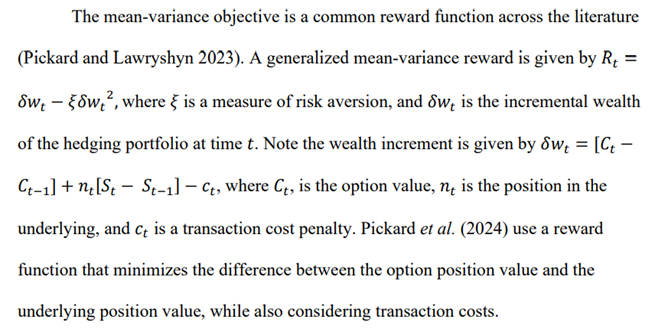
\ The acquisition of underlying asset price data is an integral part of training a DRL option hedger, as the current price is required in both the state-space and the reward. Moreover, the option price is required for the reward function. In the DRL hedging literature, almost all studies employ at least one experiment wherein the data is generated through Monte Carlo (MC) simulations of a GBM process. As this is aligned with the BS model, studies that use GBM use the BS option price in the reward function (Pickard and Lawryshyn 2023). However, recall that Pickard et al. (2024) hedge American put options, and therefore compute the option price at each step by interpolating an American put option binomial tree. The majority of studies in the DRL option hedging literature also simulate training paths using a stochastic volatility model such as the SABR (Stochastic Alpha, Beta, Rho) (Hagan et al. 2002) or Heston (1993) models. Note that when the option is European, the option price may still be computed at each time with the BS model, simply by substituting the updated volatility into the closed form expression. However, in Pickard et al. (2024) the option is American and therefore the option price is computed by using a Chebyshev interpolation method. This Chebyshev method, which is given a through overview by Glau et al. (2018), is described in the next section. A final note on training data is that Pickard et al. (2024) are the only study to calibrate the stochastic volatility model to empirical option data. This calibration process is described in the next section, and the final experiment of this paper will examine the difference between one-time and weekly re-calibration to new market data.

\ Pickard and Lawryshyn (2023) describe that studies generally test the trained DRL agent using MC paths from the same underlying process from training, i.e., GBM or a stochastic volatility model. Consistent results are present in such experiments, as DRL agents who are trained with a transaction cost penalty outperform the BS Delta strategy when transaction costs are present (Pickard and Lawryshyn 2023). There are also cases wherein the DRL agents are tested on data that does not match the training data. For example, each of Giurca and Borovkova (2021), Xiao et al. (2021), Zheng et al. (2023), and Mikkilä and Kanniainen (2023) perform a sim-to-real test in which they test the simulation trained DRL agent on empirical data, and all but Giurca and Borovkova (2021) achieve desirable results.

\ Those using only empirical data for both training and testing are Pham et al. (2021) and Xu and Dai (2022). Pham et al. (2021) show that their DRL agent has a profit higher than the market return when testing with empirical prices. Of further note, Xu and Dai (2022) train and test their DRL agent with empirical American option data, which is not seen elsewhere in the DRL hedging literature. However, Xu and Dai (2022) do not change their DRL approach in any manner when considering American versus European options. As such, Pickard et al. (2024) are the first to train DRL agents to consider early exercise. Consistent with the literature, Pickard et al. (2024) first test agents with data generation processes that match the training, i.e., agents trained with MC paths of a GBM process are tested on MC paths of a GBM process, and agents trained with MC paths of the modified SABR model are tested on MC paths of the modified SABR model. Additionally, given that the modified SABR model is calibrated to market prices, a final test examines DRL agent performance on realized market paths. The results indicate that the DRL agents outperform the BS Delta method across 80 options. As this paper aims to optimize the results of Pickard et al. (2024), this process will be given a much more thorough description in the methodology section.

\ It is noted that while the literature featuring to the use of DRL for American option hedging is limited, there are still applications of DRL in American option applications. Fathan and Delage (2021) use double DQN to solve an optimal stopping problem for Bermudan put options, which they write are a proxy for American options. Ery and Michel (2021) apply DQN to solving an optimal stopping problem for an American option. While the DRL solutions are limited to the two studies described, further articles have used other RL techniques for American option applications such as pricing and exercising, and such articles are summarized in a review given by (Bloch 2023).

\

3.2 Hyperparameter Analysis

\
\ \ \
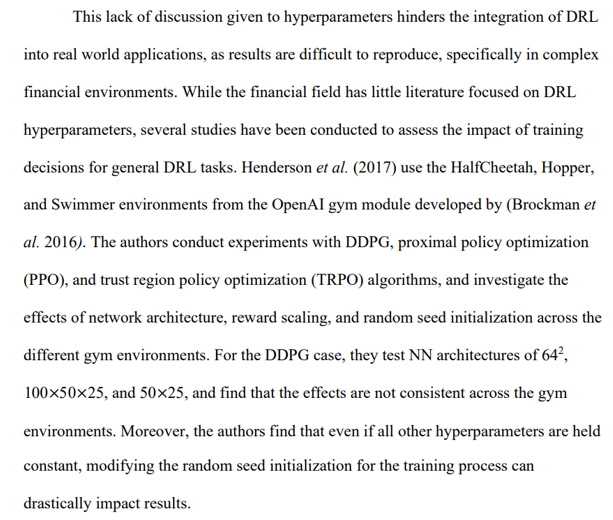
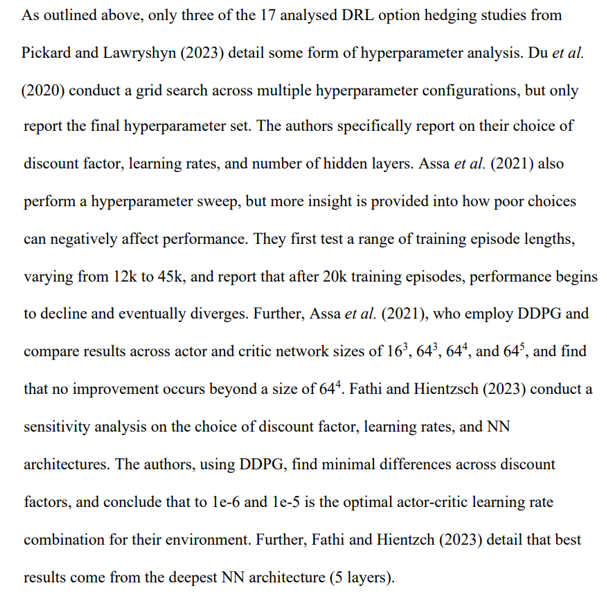
\ \ Islam et al. (2017) follow up on the work of Henderson et. al (2017) by examining the performance of DDPG and TRPO methods in the HalfCheetah and Hopper gym environments. They first note that it is difficult to reproduce the results of Henderson et al. (2017), even with similar hyperparameter configurations. Next, Islam et al. (2017) add to the literature an analysis of DDPG actor and critic learning rates. They conclude first that the optimal learning rates vary between the Hopper and HalfCheetah environments, before noting it is difficult to gain a true understanding of optimal learning rate choices while all other parameters are held fixed. Andrychowicz et al. (2020) perform a thorough hyperparameter sensitivity analysis for multiple on-policy DRL methods, but do not consider off-policy methods such as DDPG. Overall, Andrychowicz et al. (2020) conclude that performance is highly dependent on hyperparameter tuning, and this limits the pace of research advances. Several other studies find similar results when testing various DRL methods in different environments, whether through a manual search of hyperparameters or some predefined hyperparameter optimization algorithm (Ashraf et al. (2021), Kiran and Ozyildirim (2022), Eimer et al. (2022)).

\ As such, it is evident that hyperparameter configurations can drastically impact DRL agent results. However, much of the literature on DRL hyperparameter choices often utilize a generic, pre-constructed environment for analysis, rather than addressing real-life applicable problems. Therefore, this study aims to contribute to the DRL hedging literature, and the DRL space as a whole, by conducting a thorough investigation of how hyperparameter choices impact the realistic problem of option hedging in a highly uncertain financial landscape.

\

:::info Authors:

(1) Reilly Pickard, Department of Mechanical and Industrial Engineering, University of Toronto, Toronto, Canada (reilly.pickard@mail.utoronto.ca);

(2) F. Wredenhagen, Ernst & Young LLP, Toronto, ON, M5H 0B3, Canada;

(3) Y. Lawryshyn, Department of Chemical Engineering, University of Toronto, Toronto, Canada.

:::


:::info This paper is available on arxiv under CC BY-NC-ND 4.0 Deed (Attribution-Noncommercial-Noderivs 4.0 International) license.

:::

\

Market Opportunity
RealLink Logo
RealLink Price(REAL)
$0.06164
$0.06164$0.06164
-2.15%
USD
RealLink (REAL) Live Price Chart
Disclaimer: The articles reposted on this site are sourced from public platforms and are provided for informational purposes only. They do not necessarily reflect the views of MEXC. All rights remain with the original authors. If you believe any content infringes on third-party rights, please contact crypto.news@mexc.com for removal. MEXC makes no guarantees regarding the accuracy, completeness, or timeliness of the content and is not responsible for any actions taken based on the information provided. The content does not constitute financial, legal, or other professional advice, nor should it be considered a recommendation or endorsement by MEXC.

You May Also Like

Lovable AI’s Astonishing Rise: Anton Osika Reveals Startup Secrets at Bitcoin World Disrupt 2025

Lovable AI’s Astonishing Rise: Anton Osika Reveals Startup Secrets at Bitcoin World Disrupt 2025

BitcoinWorld Lovable AI’s Astonishing Rise: Anton Osika Reveals Startup Secrets at Bitcoin World Disrupt 2025 Are you ready to witness a phenomenon? The world of technology is abuzz with the incredible rise of Lovable AI, a startup that’s not just breaking records but rewriting the rulebook for rapid growth. Imagine creating powerful apps and websites just by speaking to an AI – that’s the magic Lovable brings to the masses. This groundbreaking approach has propelled the company into the spotlight, making it one of the fastest-growing software firms in history. And now, the visionary behind this sensation, co-founder and CEO Anton Osika, is set to share his invaluable insights on the Disrupt Stage at the highly anticipated Bitcoin World Disrupt 2025. If you’re a founder, investor, or tech enthusiast eager to understand the future of innovation, this is an event you cannot afford to miss. Lovable AI’s Meteoric Ascent: Redefining Software Creation In an era where digital transformation is paramount, Lovable AI has emerged as a true game-changer. Its core premise is deceptively simple yet profoundly impactful: democratize software creation. By enabling anyone to build applications and websites through intuitive AI conversations, Lovable is empowering the vast majority of individuals who lack coding skills to transform their ideas into tangible digital products. This mission has resonated globally, leading to unprecedented momentum. The numbers speak for themselves: Achieved an astonishing $100 million Annual Recurring Revenue (ARR) in less than a year. Successfully raised a $200 million Series A funding round, valuing the company at $1.8 billion, led by industry giant Accel. Is currently fielding unsolicited investor offers, pushing its valuation towards an incredible $4 billion. As industry reports suggest, investors are unequivocally “loving Lovable,” and it’s clear why. This isn’t just about impressive financial metrics; it’s about a company that has tapped into a fundamental need, offering a solution that is both innovative and accessible. The rapid scaling of Lovable AI provides a compelling case study for any entrepreneur aiming for similar exponential growth. The Visionary Behind the Hype: Anton Osika’s Journey to Innovation Every groundbreaking company has a driving force, and for Lovable, that force is co-founder and CEO Anton Osika. His journey is as fascinating as his company’s success. A physicist by training, Osika previously contributed to the cutting-edge research at CERN, the European Organization for Nuclear Research. This deep technical background, combined with his entrepreneurial spirit, has been instrumental in Lovable’s rapid ascent. Before Lovable, he honed his skills as a co-founder of Depict.ai and a Founding Engineer at Sana. Based in Stockholm, Osika has masterfully steered Lovable from a nascent idea to a global phenomenon in record time. His leadership embodies a unique blend of profound technical understanding and a keen, consumer-first vision. At Bitcoin World Disrupt 2025, attendees will have the rare opportunity to hear directly from Osika about what it truly takes to build a brand that not only scales at an incredible pace in a fiercely competitive market but also adeptly manages the intense cultural conversations that inevitably accompany such swift and significant success. His insights will be crucial for anyone looking to understand the dynamics of high-growth tech leadership. Unpacking Consumer Tech Innovation at Bitcoin World Disrupt 2025 The 20th anniversary of Bitcoin World is set to be marked by a truly special event: Bitcoin World Disrupt 2025. From October 27–29, Moscone West in San Francisco will transform into the epicenter of innovation, gathering over 10,000 founders, investors, and tech leaders. It’s the ideal platform to explore the future of consumer tech innovation, and Anton Osika’s presence on the Disrupt Stage is a highlight. His session will delve into how Lovable is not just participating in but actively shaping the next wave of consumer-facing technologies. Why is this session particularly relevant for those interested in the future of consumer experiences? Osika’s discussion will go beyond the superficial, offering a deep dive into the strategies that have allowed Lovable to carve out a unique category in a market long thought to be saturated. Attendees will gain a front-row seat to understanding how to identify unmet consumer needs, leverage advanced AI to meet those needs, and build a product that captivates users globally. The event itself promises a rich tapestry of ideas and networking opportunities: For Founders: Sharpen your pitch and connect with potential investors. For Investors: Discover the next breakout startup poised for massive growth. For Innovators: Claim your spot at the forefront of technological advancements. The insights shared regarding consumer tech innovation at this event will be invaluable for anyone looking to navigate the complexities and capitalize on the opportunities within this dynamic sector. Mastering Startup Growth Strategies: A Blueprint for the Future Lovable’s journey isn’t just another startup success story; it’s a meticulously crafted blueprint for effective startup growth strategies in the modern era. Anton Osika’s experience offers a rare glimpse into the practicalities of scaling a business at breakneck speed while maintaining product integrity and managing external pressures. For entrepreneurs and aspiring tech leaders, his talk will serve as a masterclass in several critical areas: Strategy Focus Key Takeaways from Lovable’s Journey Rapid Scaling How to build infrastructure and teams that support exponential user and revenue growth without compromising quality. Product-Market Fit Identifying a significant, underserved market (the 99% who can’t code) and developing a truly innovative solution (AI-powered app creation). Investor Relations Balancing intense investor interest and pressure with a steadfast focus on product development and long-term vision. Category Creation Carving out an entirely new niche by democratizing complex technologies, rather than competing in existing crowded markets. Understanding these startup growth strategies is essential for anyone aiming to build a resilient and impactful consumer experience. Osika’s session will provide actionable insights into how to replicate elements of Lovable’s success, offering guidance on navigating challenges from product development to market penetration and investor management. Conclusion: Seize the Future of Tech The story of Lovable, under the astute leadership of Anton Osika, is a testament to the power of innovative ideas meeting flawless execution. Their remarkable journey from concept to a multi-billion-dollar valuation in record time is a compelling narrative for anyone interested in the future of technology. By democratizing software creation through Lovable AI, they are not just building a company; they are fostering a new generation of creators. His appearance at Bitcoin World Disrupt 2025 is an unmissable opportunity to gain direct insights from a leader who is truly shaping the landscape of consumer tech innovation. Don’t miss this chance to learn about cutting-edge startup growth strategies and secure your front-row seat to the future. Register now and save up to $668 before Regular Bird rates end on September 26. To learn more about the latest AI market trends, explore our article on key developments shaping AI features. This post Lovable AI’s Astonishing Rise: Anton Osika Reveals Startup Secrets at Bitcoin World Disrupt 2025 first appeared on BitcoinWorld.
Share
Coinstats2025/09/17 23:40
Polygon’s Giugliano Hardfork Signals a Stability Push After a Rough 2025

Polygon’s Giugliano Hardfork Signals a Stability Push After a Rough 2025

The post Polygon’s Giugliano Hardfork Signals a Stability Push After a Rough 2025 appeared on BitcoinEthereumNews.com. The Polygon Foundation confirmed the Giugliano

Share
BitcoinEthereumNews2026/04/07 13:31
Pi Network Completes First KYC Rewards Distribution

Pi Network Completes First KYC Rewards Distribution

The Pi Network has completed its first KYC validator rewards distribution. This marks an important step in its long-running mainnet rollout. The rewards cover a
Share
Coinfomania2026/04/07 13:22

$30,000 in PRL + 15,000 USDT

$30,000 in PRL + 15,000 USDT$30,000 in PRL + 15,000 USDT

Deposit & trade PRL to boost your rewards!