Open‑YOLO 3D replaces costly SAM/CLIP steps with 2D detection, LG label‑maps, and parallelized visibility, enabling fast and accurate 3D OV segmentation.Open‑YOLO 3D replaces costly SAM/CLIP steps with 2D detection, LG label‑maps, and parallelized visibility, enabling fast and accurate 3D OV segmentation.

Drop the Heavyweights: YOLO‑Based 3D Segmentation Outpaces SAM/CLIP

2025/08/26 16:20

Abstract and 1 Introduction

  1. Related works
  2. Preliminaries
  3. Method: Open-YOLO 3D
  4. Experiments
  5. Conclusion and References

A. Appendix

3 Preliminaries

Problem formulation: 3D instance segmentation aims at segmenting individual objects within a 3D scene and assigning one class label to each segmented object. In the open-vocabulary (OV) setting, the class label can belong to previously known classes in the training set as well as new class labels. To this end, let P denote a 3D reconstructed point cloud scene, where a sequence of RGB-D images was used for the reconstruction. We denote the RGB image frames as I along with their corresponding depth frames D. Similar to recent methods [35, 42, 34], we assume that the poses and camera parameters are available for the input 3D scene.

\

3.1 Baseline Open-Vocabulary 3D Instance Segmentation

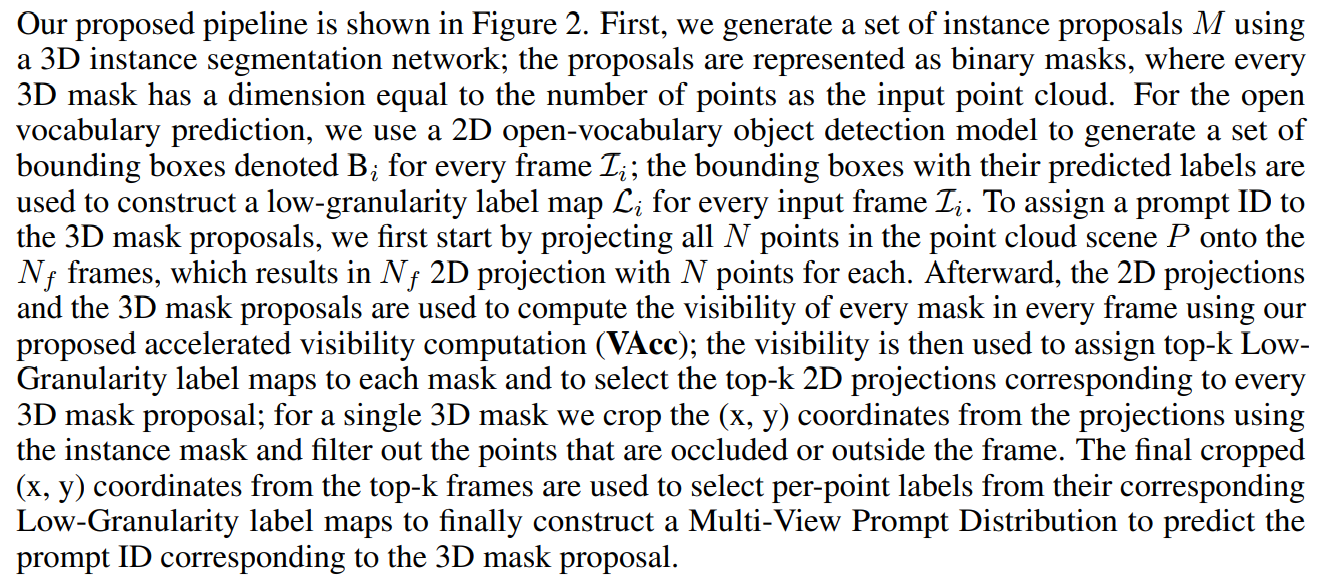
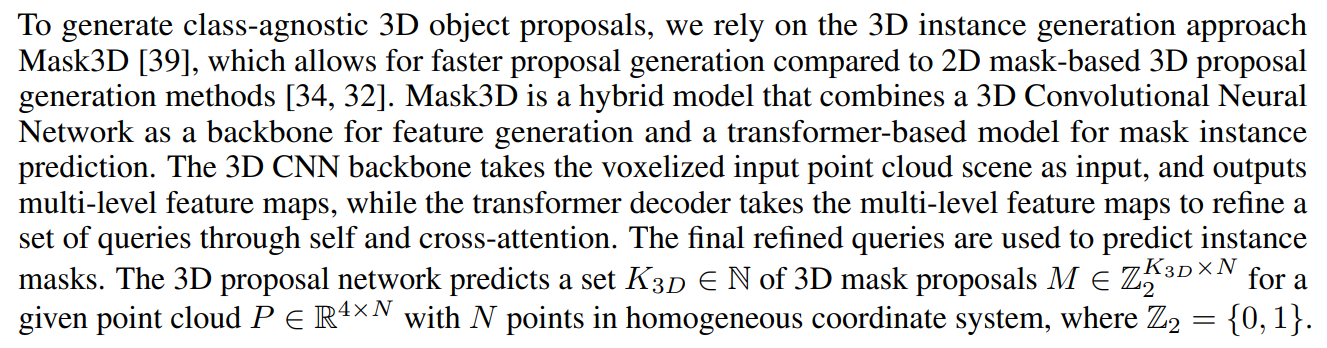
We base our approach on OpenMask3D [42], which is the first method that performs open-vocabulary 3D instance segmentation in a zero-shot manner. OpenMask3D has two main modules: a class-agnostic mask proposal head, and a mask-feature computation module. The class-agnostic mask proposal head uses a transformer-based pre-trained 3D instance segmentation model [39] to predict a binary mask for each object in the point cloud. The mask-feature computation module first generates 2D segmentation masks by projecting 3D masks into views in which the 3D instances are highly visible, and refines them using the SAM [23] model. A pre-trained CLIP vision-language model [55] is then used to generate image embeddings for the 2D segmentation masks. The embeddings are then aggregated across all the 2D frames to generate a 3D mask-feature representation.

\ Limitations: OpenMask3D makes use of the advancements in 2D segmentation (SAM) and vision-language models (CLIP) to generate and aggregate 2D feature representations, enabling the querying of instances according to open-vocabulary concepts. However, this approach suffers from a high computation burden leading to slow inference times, with a processing time of 5-10 minutes per scene. The computation burden mainly originates from two sub-tasks: the 2D segmentation of the large number of objects from the various 2D views, and the 3D feature aggregation based on the object visibility. We next introduce our proposed method which aims at reducing the computation burden and improving the task accuracy.

\

4 Method: Open-YOLO 3D

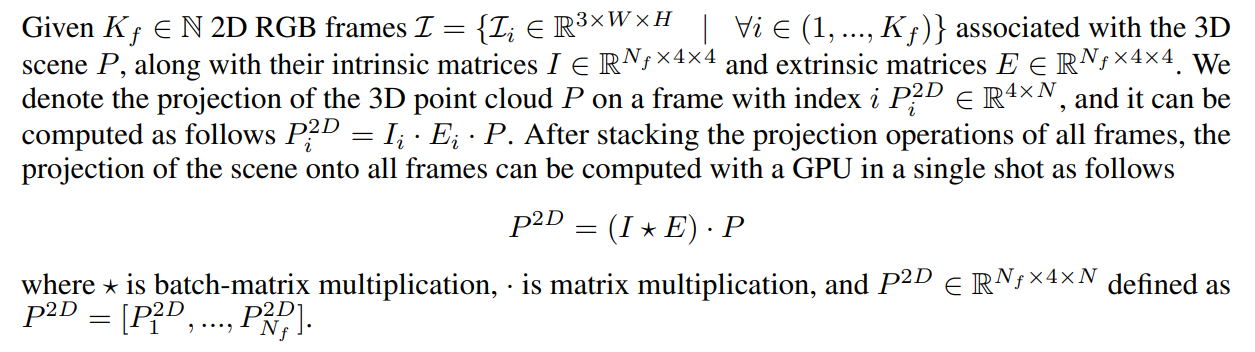
Motivation: We here present our proposed 3D open-vocabulary instance segmentation method, Open-YOLO 3D, which aims at generating 3D instance predictions in an efficient strategy. Our proposed method introduces efficient and improved modules at the task level as well as the data level. Task Level: Unlike OpenMask3D, which generates segmentations of the projected 3D masks, we pursue a more efficient approach by relying on 2D object detection. Since the end target is to generate labels for the 3D masks, the increased computation from the 2D segmentation task is not necessary. Data Level: OpenMask3D computes the 3D mask visibility in 2D frames by iteratively counting visible points for each mask across all frames. This approach is time-consuming, and we propose an alternative approach to compute the 3D mask visibility within all frames at once.

\

4.1 Overall Architecture
\

4.2 3D Object Proposal
\

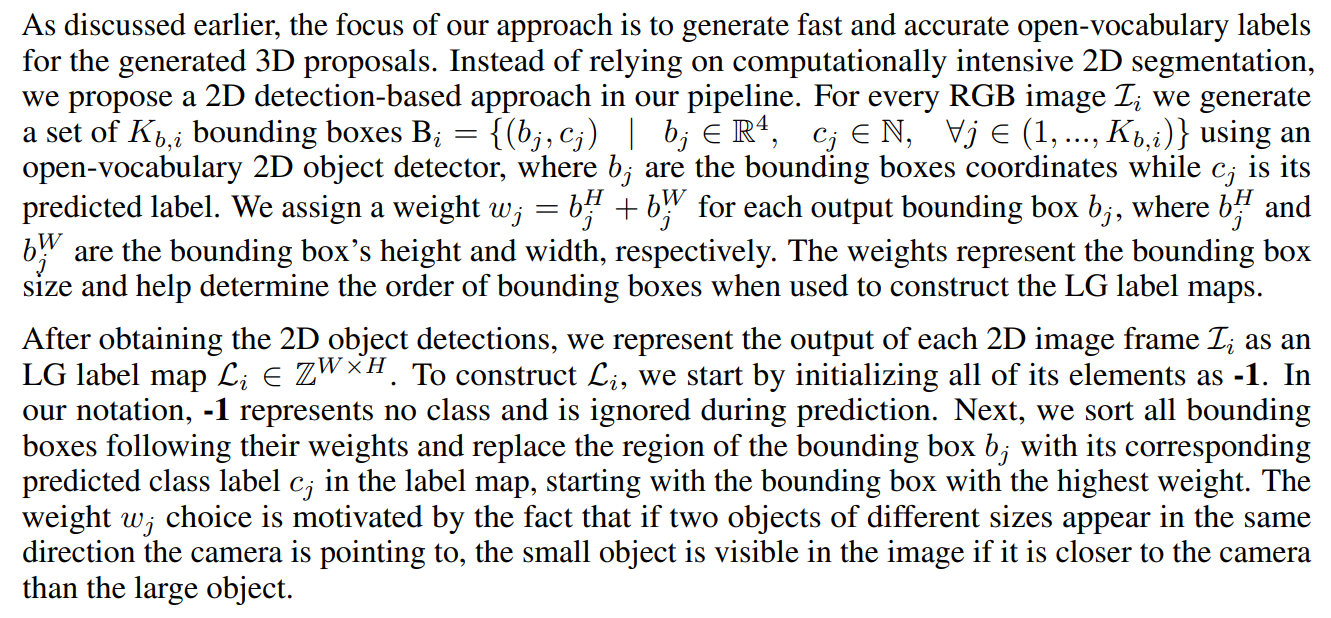
4.3 Low Granularity (LG) Label-Maps
\

4.4 Accelerated Visibility Computation (VAcc)

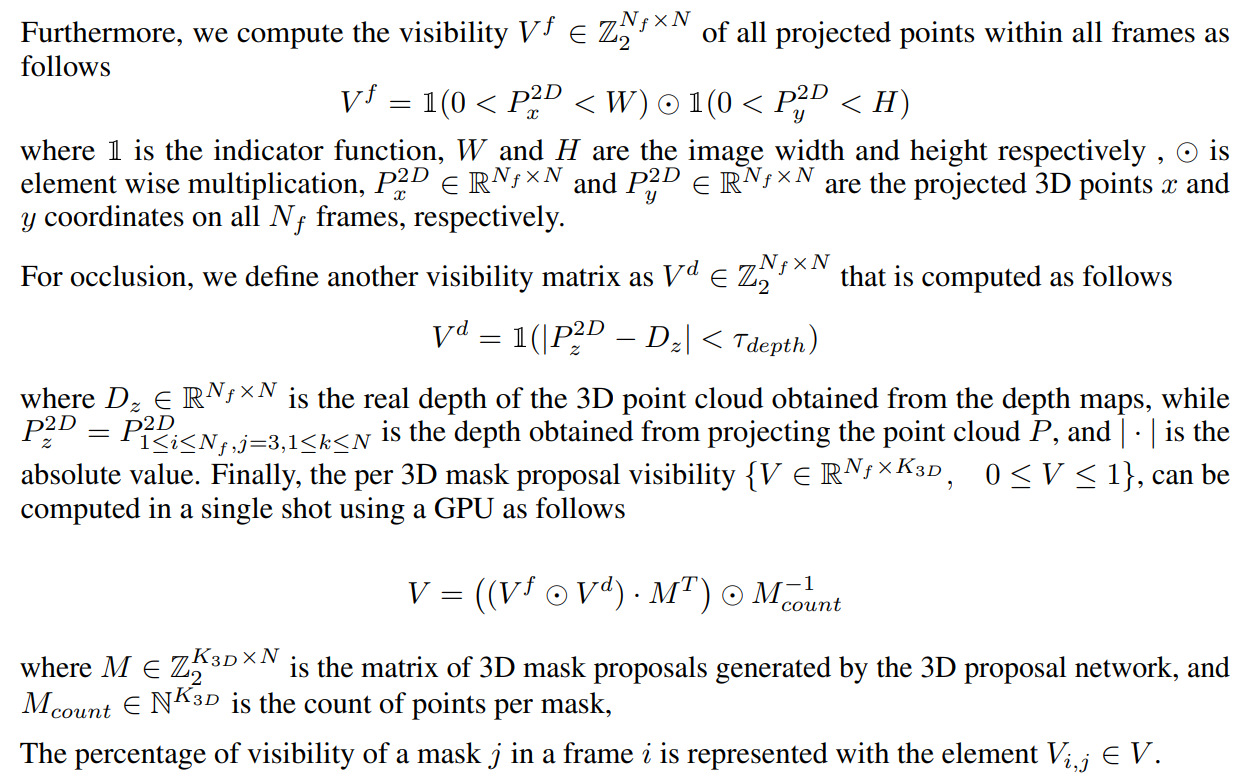
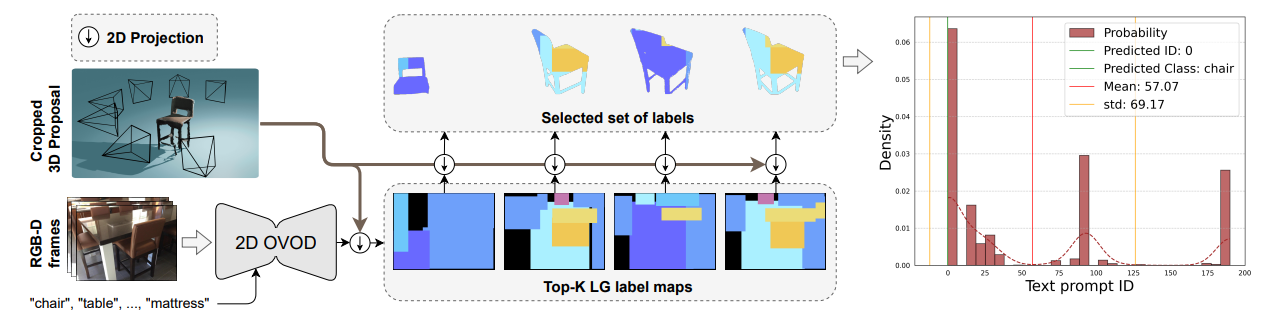
In order to associate 2D label maps with 3D proposals, we compute the visibility of each 3D mask. To this end, we propose a fast approach that is able to compute 3D mask visibility within frames via tensor operations which are highly parallelizable.

\ Figure 3: Multi-View Prompt Distribution (MVPDist). After creating the LG label maps for all frames, we select the top-k label maps based on the 2D projection of the 3D proposal. Using the (x, y) coordinates of the 2D projection, we choose the labels from the LG label maps to generate the MVPDist. This distribution predicts the ID of the text prompt with the highest probability.
\

\

\

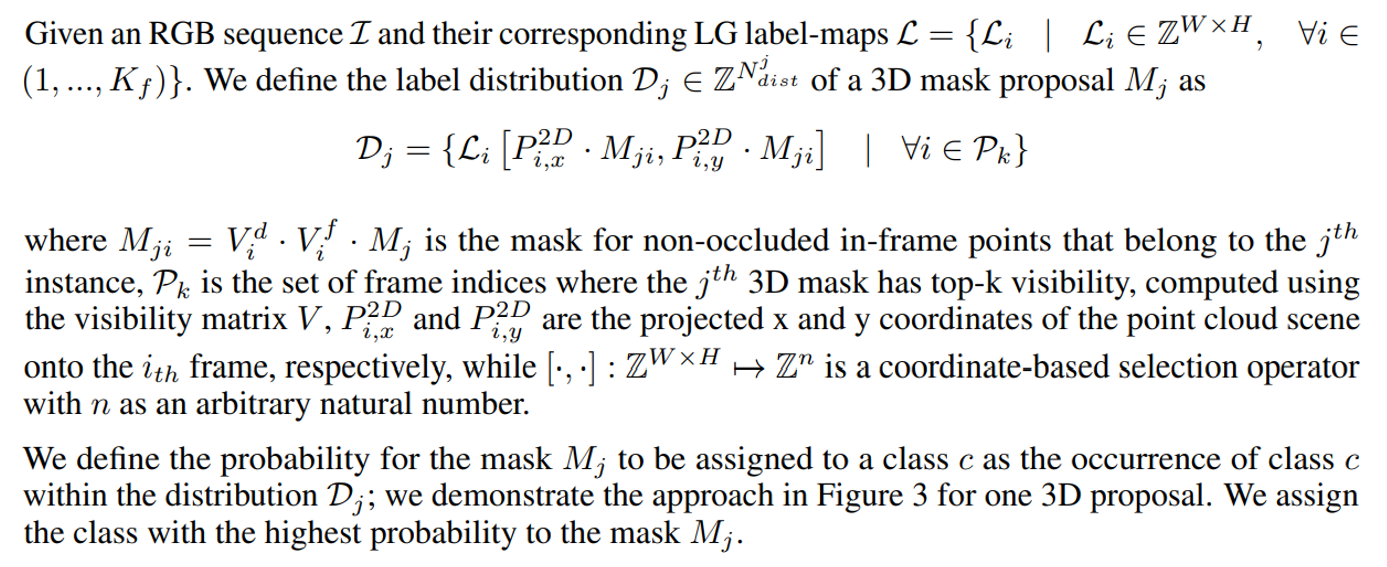
4.5 Multi-View Prompt Distribution (MVPDist)
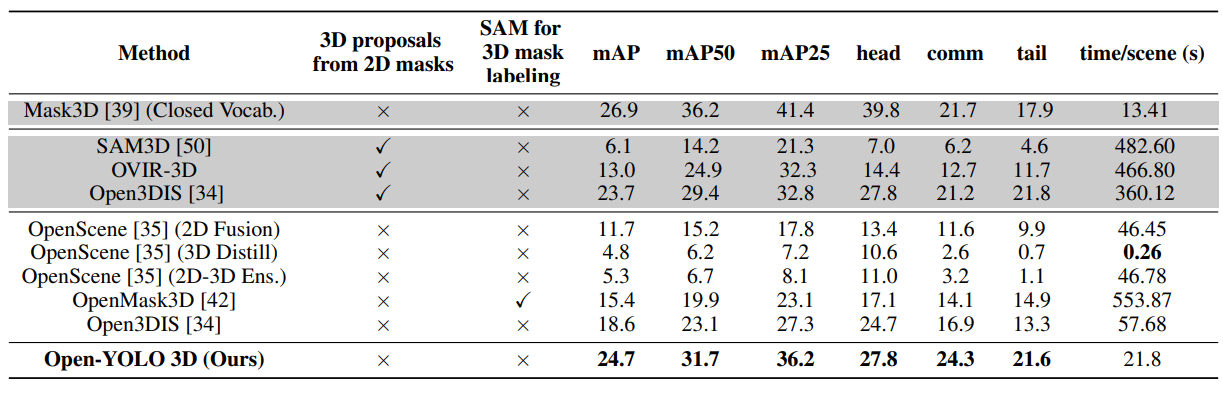
\ Table 1: State-of-the-art comparison on ScanNet200 validation set. We use Mask3D trained on the ScanNet200 training set to generate class-agnostic mask proposals. Our method demonstrates better performance compared to those that generate 3D proposals by fusing 2D masks and proposals from a 3D network (highlighted in gray in the table). It outperforms state-of-the-art methods by a wide margin under the same conditions using only proposals from a 3D network.
\

4.6 Instance Prediction Confidence Score
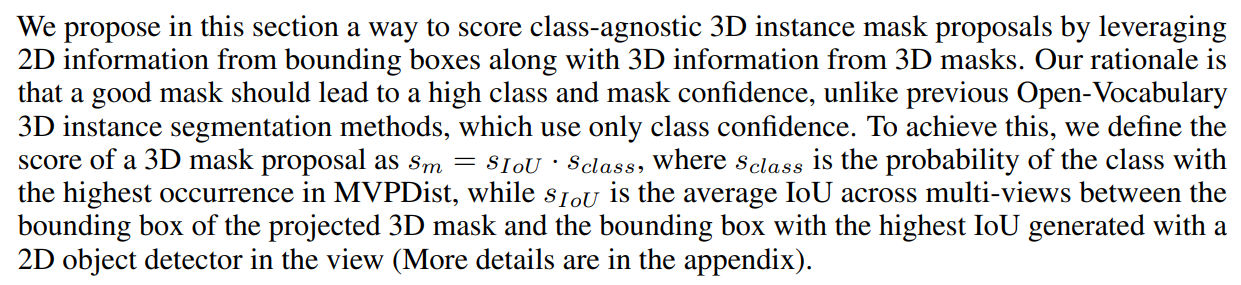
\

:::info Authors:

(1) Mohamed El Amine Boudjoghra, Mohamed Bin Zayed University of Artificial Intelligence (MBZUAI) (mohamed.boudjoghra@mbzuai.ac.ae);

(2) Angela Dai, Technical University of Munich (TUM) (angela.dai@tum.de);

(3) Jean Lahoud, Mohamed Bin Zayed University of Artificial Intelligence (MBZUAI) ( jean.lahoud@mbzuai.ac.ae);

(4) Hisham Cholakkal, Mohamed Bin Zayed University of Artificial Intelligence (MBZUAI) (hisham.cholakkal@mbzuai.ac.ae);

(5) Rao Muhammad Anwer, Mohamed Bin Zayed University of Artificial Intelligence (MBZUAI) and Aalto University (rao.anwer@mbzuai.ac.ae);

(6) Salman Khan, Mohamed Bin Zayed University of Artificial Intelligence (MBZUAI) and Australian National University (salman.khan@mbzuai.ac.ae);

(7) Fahad Shahbaz Khan, Mohamed Bin Zayed University of Artificial Intelligence (MBZUAI) and Australian National University (fahad.khan@mbzuai.ac.ae).

:::


:::info This paper is available on arxiv under CC BY-NC-SA 4.0 Deed (Attribution-Noncommercial-Sharelike 4.0 International) license.

:::

\

Disclaimer: The articles reposted on this site are sourced from public platforms and are provided for informational purposes only. They do not necessarily reflect the views of MEXC. All rights remain with the original authors. If you believe any content infringes on third-party rights, please contact service@support.mexc.com for removal. MEXC makes no guarantees regarding the accuracy, completeness, or timeliness of the content and is not responsible for any actions taken based on the information provided. The content does not constitute financial, legal, or other professional advice, nor should it be considered a recommendation or endorsement by MEXC.

You May Also Like

Shocking OpenVPP Partnership Claim Draws Urgent Scrutiny

Shocking OpenVPP Partnership Claim Draws Urgent Scrutiny

The post Shocking OpenVPP Partnership Claim Draws Urgent Scrutiny appeared on BitcoinEthereumNews.com. The cryptocurrency world is buzzing with a recent controversy surrounding a bold OpenVPP partnership claim. This week, OpenVPP (OVPP) announced what it presented as a significant collaboration with the U.S. government in the innovative field of energy tokenization. However, this claim quickly drew the sharp eye of on-chain analyst ZachXBT, who highlighted a swift and official rebuttal that has sent ripples through the digital asset community. What Sparked the OpenVPP Partnership Claim Controversy? The core of the issue revolves around OpenVPP’s assertion of a U.S. government partnership. This kind of collaboration would typically be a monumental endorsement for any private cryptocurrency project, especially given the current regulatory climate. Such a partnership could signify a new era of mainstream adoption and legitimacy for energy tokenization initiatives. OpenVPP initially claimed cooperation with the U.S. government. This alleged partnership was said to be in the domain of energy tokenization. The announcement generated considerable interest and discussion online. ZachXBT, known for his diligent on-chain investigations, was quick to flag the development. He brought attention to the fact that U.S. Securities and Exchange Commission (SEC) Commissioner Hester Peirce had directly addressed the OpenVPP partnership claim. Her response, delivered within hours, was unequivocal and starkly contradicted OpenVPP’s narrative. How Did Regulatory Authorities Respond to the OpenVPP Partnership Claim? Commissioner Hester Peirce’s statement was a crucial turning point in this unfolding story. She clearly stated that the SEC, as an agency, does not engage in partnerships with private cryptocurrency projects. This response effectively dismantled the credibility of OpenVPP’s initial announcement regarding their supposed government collaboration. Peirce’s swift clarification underscores a fundamental principle of regulatory bodies: maintaining impartiality and avoiding endorsements of private entities. Her statement serves as a vital reminder to the crypto community about the official stance of government agencies concerning private ventures. Moreover, ZachXBT’s analysis…
Share
BitcoinEthereumNews2025/09/18 02:13
Metaplanet 50M Bitcoin Loan and BTC Relief Rally

Metaplanet 50M Bitcoin Loan and BTC Relief Rally

The post Metaplanet 50M Bitcoin Loan and BTC Relief Rally appeared on BitcoinEthereumNews.com. Metaplanet has secured a 50 million dollar loan using its Bitcoin holdings as collateral to fund new BTC purchases and income products. At the same time, chartist Titan of Crypto says Bitcoin’s price action continues to track a earlier relief rally fractal on the two day chart. Metaplanet secured a 50 million dollar loan backed by its existing Bitcoin holdings, according to a new disclosure shared today. The company said the funds will support additional Bitcoin purchases and expand its Bitcoin-based income operations as part of its ongoing treasury strategy. The filing shows that Metaplanet pledged part of its current holdings to obtain the loan instead of issuing new equity or bonds. This structure allows the firm to raise capital while keeping its Bitcoin position intact. It also signals that the company continues to lean heavily on Bitcoin as both a reserve asset and a financing tool. The move follows a series of Bitcoin-focused initiatives from Metaplanet, including earlier bond issuances and ongoing accumulation programs. Today’s loan marks the latest step in that strategy as the company increases leverage to expand its holdings. Analyst Sees Bitcoin Still Following Earlier Cycle Fractal Meanwhile, Crypto chartist Titan of Crypto says Bitcoin’s latest pullback still fits the “relief rally” fractal he has been tracking on the two-day chart. In a new update, he compares the current structure to the 2021–2022 cycle, highlighting a similar sequence of a local peak, a sharp drop into a demand zone, and then a rebound. Bitcoin Relief Rally Fractal Roadmap. Source: Titan of Crypto and TradingView In the chart, Bitcoin’s price action forms a pattern that mirrors the earlier cycle, with a shaded support area marking the zone where the last major relief rally started. An accompanying momentum oscillator also shows a repeat of lower highs on price…
Share
BitcoinEthereumNews2025/12/06 01:14