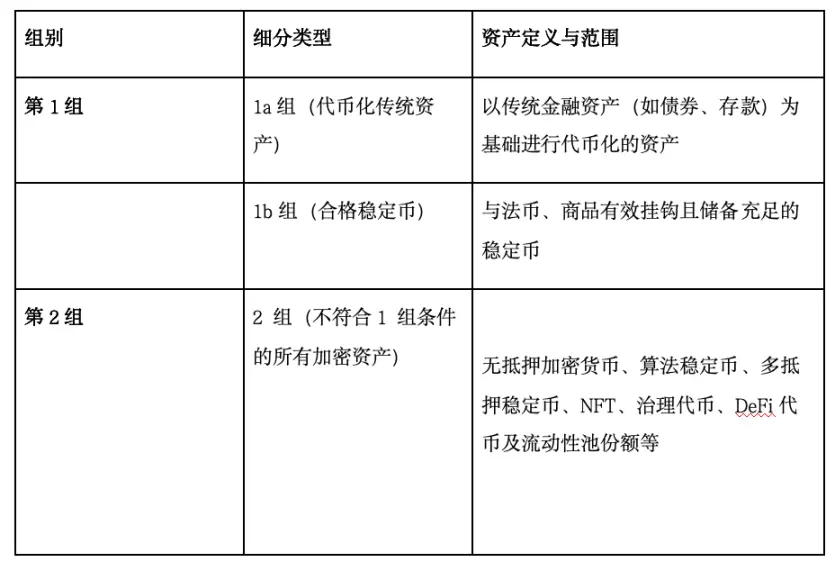
Let’s take a closer look at the new requirements of CRP-1, compare them with the regulatory policies of other countries and regions, and then discuss the impact these changes will have on us cryptocurrency players. Written by Xiao Sa Legal Team Driven by a wave of technological innovation, the global cryptoasset market has expanded rapidly. This has, however, also exposed a range of risks, including price volatility and money laundering, making the need for effective regulation even more urgent. In September 2025, the Hong Kong Monetary Authority (HKMA) issued a draft of the new module CRP-1, "Cryptoasset Classification," of the Banking Supervisory Policy Manual (SPM), to the local banking industry for public comment. This draft aims to align with international regulatory standards and establish a regulatory framework that balances innovation and risk prevention, providing clear guidance for banks involved in cryptoasset-related businesses. Next, the Sajie team will take a closer look at the new requirements of CRP-1, compare them with the regulatory policies of other countries and regions, and discuss the impact these changes will have on our cryptocurrency players. 01 Interpretation of the core content of the new Hong Kong CRP-1 regulations (I) Basic Definition: Scope of Supervision and Applicable Objects The new CRP-1 regulation clearly defines the scope of cryptoasset regulation, laying a solid foundation for subsequent implementation. Specifically, the new regulation defines cryptoassets as those primarily relying on cryptography and distributed ledger technology (DLT), or similar technologies, that can be used for payment or investment purposes, or to acquire goods or services. However, it explicitly excludes central bank-issued digital currencies from this scope. This approach provides a precise definition of cryptoassets while distinguishing them from legal tender digital currencies, preventing overly broad regulation. The new regulations will apply to all licensed financial institutions in Hong Kong, including regular banks, restricted license banks, and deposit-taking companies. These institutions are an important part of Hong Kong's financial system, and the crypto businesses they conduct directly impact financial stability. Bringing them under regulation will help control risks at the source. In terms of risk management, the new regulations adopt a comprehensive approach. Risks arising from banks' own holdings of crypto assets, the safekeeping and trading of crypto assets for clients, and indirect exposure to crypto assets through financial derivatives must all be managed. This prevents financial institutions from exploiting loopholes to evade regulation, ensuring that all crypto-related risks are rigorously managed. (2) Core categories Risk grading is the core logic of the new CRP-1 regulations. The new regulations divide crypto assets into Group 1 (low risk) and Group 2 (high risk) based on their risk mitigation capabilities. The table below provides a clear overview of these core categories. 02. Connection and Differences between CRP-1 and International Rules (BCBS Standards) (1) BCBS Standard Core Logic The Basel Committee on Banking Supervision (BCBS), as the core institution of global banking supervision, issued the "Prudent Treatment of Crypto-Asset Risk Exposures" in December 2022 and launched the "Revision of Crypto-Asset Standards" in July 2024, building a global unified crypto-asset regulatory framework. Its core logic can be summarized as "risk classification and prudent control." The BCBS standards focus on "preventing and controlling cryptoasset risks and ensuring adequate bank capitalization" to prevent the transmission of cryptoasset risks to the traditional banking system and maintain global financial stability. Within the core framework, the BCBS classifies cryptoassets into "Group 1" and "Group 2" based on risk, setting strict capital requirements for high-risk assets while also promoting global regulatory coordination to prevent regulatory arbitrage. The launch of the BCBS standard stems from the rapid development and risk accumulation of the global crypto asset market. It aims to provide a unified regulatory benchmark for internationally active banks, balance "financial stability" and "responsible innovation", and provide a reference framework for regulators in various countries. (2) Integration of CRP-1 and BCBS The new CRP-1 regulations and BCBS standards are consistent in many key areas, demonstrating Hong Kong's commitment as an international financial center to keeping pace with global regulation. In terms of asset classification, CRP-1 divides crypto assets into "Group 1" and "Group 2," while BCBS divides them into "Group 1" and "Group 2." The core criterion for both classifications is the ability of an asset to manage risk. For example, relatively low-risk and reliable assets like compliant stablecoins fall into "Group 1" under BCBS and "Group 1" under CRP-1. Both require clear legal regulations for such assets and effective risk management. For higher-risk assets, both sides implement strict regulations on the amount of capital that financial institutions must maintain to manage risk, fully embodying the principle of "the greater the risk, the stricter the management." In terms of fund supervision requirements, CRP-1 largely continues the BCBS's approach to prudent management. The BCBS stipulates that for certain high-risk crypto assets, financial institutions must maintain a reserve of funds equivalent to 1250% of the asset's value to mitigate risk. CRP-1 also applies this standard to Group 2b assets. For highly liquid crypto assets, the BCBS requires trading on regulated exchanges and achieving a certain market size. CRP-1 also imposes similar requirements on Group 2a assets, requiring trading on regulated exchanges and setting market capitalization and trading volume thresholds to ensure that the funds invested align with the asset's risk. In addition, both CRP-1 and BCBS place particular emphasis on comprehensive supervision. Whether it is the crypto assets held by the bank itself, the assets involved in providing services to customers, or even indirectly related risks, all must be included in the regulatory scope to avoid the emergence of "gray areas" where no one is in charge and to achieve the goal of global unified supervision. 03 CRP-1 Specific Impact of the New Regulations on Crypto Asset Users After the implementation of the new CRP-1 regulations, banks’ crypto business has undergone major adjustments, which directly affects our friends’ trading, custody, and use of crypto assets. Let's start with trading options. The new regulations have tightened trading restrictions on both assets and channels. High-risk Category 2b assets, like some NFTs and governance tokens, are no longer permitted by banks, forcing users to switch to other platforms, which can be less reliable. While Category 1 compliant assets are safe, the selection is narrower. Category 2a assets must be traded on licensed exchanges, which require stricter account opening procedures and higher thresholds. Regarding asset security, the new regulations do make asset custody safer, providing priority for recovering funds even if a platform fails. However, the stringent anti-money laundering requirements reduce personal privacy, and the price fluctuations of different assets vary. For those holding Category 2b NFTs and governance tokens, the Sajie team recommends prioritizing platforms regulated by the Hong Kong Monetary Authority or with international compliance qualifications, and avoiding storing all assets in one place. Those who prefer Category 1 compliant assets can seek the security of a bank, but must accept that they can purchase fewer items. For those trading Category 2a assets, remember to prepare a complete set of documents, including your ID and bank card, in advance to prepare for the exchange's rigorous review. Regardless of the type of asset you hold, you'll need to restructure your portfolio and monitor changes in bank fees. You need to balance the security provided by the new regulations with privacy protection and operational convenience. Final Thoughts In summary, the new Hong Kong CRP-1 regulation demonstrates significant foresight in the field of crypto asset regulation, providing new ideas and directions for industry development and risk prevention and control. Sister Sa recognizes that Hong Kong's cryptoasset regulation will enter a phase of dynamic optimization and deepening practice. Going forward, regulators must closely follow international trends and strengthen cross-border regulatory coordination. Industry participants should establish regular compliance communication mechanisms. I hope Hong Kong will use CRP-1 as an opportunity to improve regulatory technology, balance investor protection and innovation, and set a global regulatory precedent.Let’s take a closer look at the new requirements of CRP-1, compare them with the regulatory policies of other countries and regions, and then discuss the impact these changes will have on us cryptocurrency players. Written by Xiao Sa Legal Team Driven by a wave of technological innovation, the global cryptoasset market has expanded rapidly. This has, however, also exposed a range of risks, including price volatility and money laundering, making the need for effective regulation even more urgent. In September 2025, the Hong Kong Monetary Authority (HKMA) issued a draft of the new module CRP-1, "Cryptoasset Classification," of the Banking Supervisory Policy Manual (SPM), to the local banking industry for public comment. This draft aims to align with international regulatory standards and establish a regulatory framework that balances innovation and risk prevention, providing clear guidance for banks involved in cryptoasset-related businesses. Next, the Sajie team will take a closer look at the new requirements of CRP-1, compare them with the regulatory policies of other countries and regions, and discuss the impact these changes will have on our cryptocurrency players. 01 Interpretation of the core content of the new Hong Kong CRP-1 regulations (I) Basic Definition: Scope of Supervision and Applicable Objects The new CRP-1 regulation clearly defines the scope of cryptoasset regulation, laying a solid foundation for subsequent implementation. Specifically, the new regulation defines cryptoassets as those primarily relying on cryptography and distributed ledger technology (DLT), or similar technologies, that can be used for payment or investment purposes, or to acquire goods or services. However, it explicitly excludes central bank-issued digital currencies from this scope. This approach provides a precise definition of cryptoassets while distinguishing them from legal tender digital currencies, preventing overly broad regulation. The new regulations will apply to all licensed financial institutions in Hong Kong, including regular banks, restricted license banks, and deposit-taking companies. These institutions are an important part of Hong Kong's financial system, and the crypto businesses they conduct directly impact financial stability. Bringing them under regulation will help control risks at the source. In terms of risk management, the new regulations adopt a comprehensive approach. Risks arising from banks' own holdings of crypto assets, the safekeeping and trading of crypto assets for clients, and indirect exposure to crypto assets through financial derivatives must all be managed. This prevents financial institutions from exploiting loopholes to evade regulation, ensuring that all crypto-related risks are rigorously managed. (2) Core categories Risk grading is the core logic of the new CRP-1 regulations. The new regulations divide crypto assets into Group 1 (low risk) and Group 2 (high risk) based on their risk mitigation capabilities. The table below provides a clear overview of these core categories. 02. Connection and Differences between CRP-1 and International Rules (BCBS Standards) (1) BCBS Standard Core Logic The Basel Committee on Banking Supervision (BCBS), as the core institution of global banking supervision, issued the "Prudent Treatment of Crypto-Asset Risk Exposures" in December 2022 and launched the "Revision of Crypto-Asset Standards" in July 2024, building a global unified crypto-asset regulatory framework. Its core logic can be summarized as "risk classification and prudent control." The BCBS standards focus on "preventing and controlling cryptoasset risks and ensuring adequate bank capitalization" to prevent the transmission of cryptoasset risks to the traditional banking system and maintain global financial stability. Within the core framework, the BCBS classifies cryptoassets into "Group 1" and "Group 2" based on risk, setting strict capital requirements for high-risk assets while also promoting global regulatory coordination to prevent regulatory arbitrage. The launch of the BCBS standard stems from the rapid development and risk accumulation of the global crypto asset market. It aims to provide a unified regulatory benchmark for internationally active banks, balance "financial stability" and "responsible innovation", and provide a reference framework for regulators in various countries. (2) Integration of CRP-1 and BCBS The new CRP-1 regulations and BCBS standards are consistent in many key areas, demonstrating Hong Kong's commitment as an international financial center to keeping pace with global regulation. In terms of asset classification, CRP-1 divides crypto assets into "Group 1" and "Group 2," while BCBS divides them into "Group 1" and "Group 2." The core criterion for both classifications is the ability of an asset to manage risk. For example, relatively low-risk and reliable assets like compliant stablecoins fall into "Group 1" under BCBS and "Group 1" under CRP-1. Both require clear legal regulations for such assets and effective risk management. For higher-risk assets, both sides implement strict regulations on the amount of capital that financial institutions must maintain to manage risk, fully embodying the principle of "the greater the risk, the stricter the management." In terms of fund supervision requirements, CRP-1 largely continues the BCBS's approach to prudent management. The BCBS stipulates that for certain high-risk crypto assets, financial institutions must maintain a reserve of funds equivalent to 1250% of the asset's value to mitigate risk. CRP-1 also applies this standard to Group 2b assets. For highly liquid crypto assets, the BCBS requires trading on regulated exchanges and achieving a certain market size. CRP-1 also imposes similar requirements on Group 2a assets, requiring trading on regulated exchanges and setting market capitalization and trading volume thresholds to ensure that the funds invested align with the asset's risk. In addition, both CRP-1 and BCBS place particular emphasis on comprehensive supervision. Whether it is the crypto assets held by the bank itself, the assets involved in providing services to customers, or even indirectly related risks, all must be included in the regulatory scope to avoid the emergence of "gray areas" where no one is in charge and to achieve the goal of global unified supervision. 03 CRP-1 Specific Impact of the New Regulations on Crypto Asset Users After the implementation of the new CRP-1 regulations, banks’ crypto business has undergone major adjustments, which directly affects our friends’ trading, custody, and use of crypto assets. Let's start with trading options. The new regulations have tightened trading restrictions on both assets and channels. High-risk Category 2b assets, like some NFTs and governance tokens, are no longer permitted by banks, forcing users to switch to other platforms, which can be less reliable. While Category 1 compliant assets are safe, the selection is narrower. Category 2a assets must be traded on licensed exchanges, which require stricter account opening procedures and higher thresholds. Regarding asset security, the new regulations do make asset custody safer, providing priority for recovering funds even if a platform fails. However, the stringent anti-money laundering requirements reduce personal privacy, and the price fluctuations of different assets vary. For those holding Category 2b NFTs and governance tokens, the Sajie team recommends prioritizing platforms regulated by the Hong Kong Monetary Authority or with international compliance qualifications, and avoiding storing all assets in one place. Those who prefer Category 1 compliant assets can seek the security of a bank, but must accept that they can purchase fewer items. For those trading Category 2a assets, remember to prepare a complete set of documents, including your ID and bank card, in advance to prepare for the exchange's rigorous review. Regardless of the type of asset you hold, you'll need to restructure your portfolio and monitor changes in bank fees. You need to balance the security provided by the new regulations with privacy protection and operational convenience. Final Thoughts In summary, the new Hong Kong CRP-1 regulation demonstrates significant foresight in the field of crypto asset regulation, providing new ideas and directions for industry development and risk prevention and control. Sister Sa recognizes that Hong Kong's cryptoasset regulation will enter a phase of dynamic optimization and deepening practice. Going forward, regulators must closely follow international trends and strengthen cross-border regulatory coordination. Industry participants should establish regular compliance communication mechanisms. I hope Hong Kong will use CRP-1 as an opportunity to improve regulatory technology, balance investor protection and innovation, and set a global regulatory precedent.

Hong Kong's new crypto regulations are here: CRP-1 and its impact on the market

2025/09/17 21:00
7 min read
For feedback or concerns regarding this content, please contact us at crypto.news@mexc.com

Let’s take a closer look at the new requirements of CRP-1, compare them with the regulatory policies of other countries and regions, and then discuss the impact these changes will have on us cryptocurrency players.

Written by Xiao Sa Legal Team

Driven by a wave of technological innovation, the global cryptoasset market has expanded rapidly. This has, however, also exposed a range of risks, including price volatility and money laundering, making the need for effective regulation even more urgent. In September 2025, the Hong Kong Monetary Authority (HKMA) issued a draft of the new module CRP-1, "Cryptoasset Classification," of the Banking Supervisory Policy Manual (SPM), to the local banking industry for public comment. This draft aims to align with international regulatory standards and establish a regulatory framework that balances innovation and risk prevention, providing clear guidance for banks involved in cryptoasset-related businesses.

Next, the Sajie team will take a closer look at the new requirements of CRP-1, compare them with the regulatory policies of other countries and regions, and discuss the impact these changes will have on our cryptocurrency players.

01 Interpretation of the core content of the new Hong Kong CRP-1 regulations

(I) Basic Definition: Scope of Supervision and Applicable Objects

The new CRP-1 regulation clearly defines the scope of cryptoasset regulation, laying a solid foundation for subsequent implementation. Specifically, the new regulation defines cryptoassets as those primarily relying on cryptography and distributed ledger technology (DLT), or similar technologies, that can be used for payment or investment purposes, or to acquire goods or services. However, it explicitly excludes central bank-issued digital currencies from this scope. This approach provides a precise definition of cryptoassets while distinguishing them from legal tender digital currencies, preventing overly broad regulation.

The new regulations will apply to all licensed financial institutions in Hong Kong, including regular banks, restricted license banks, and deposit-taking companies. These institutions are an important part of Hong Kong's financial system, and the crypto businesses they conduct directly impact financial stability. Bringing them under regulation will help control risks at the source.

In terms of risk management, the new regulations adopt a comprehensive approach. Risks arising from banks' own holdings of crypto assets, the safekeeping and trading of crypto assets for clients, and indirect exposure to crypto assets through financial derivatives must all be managed. This prevents financial institutions from exploiting loopholes to evade regulation, ensuring that all crypto-related risks are rigorously managed.

(2) Core categories

Risk grading is the core logic of the new CRP-1 regulations. The new regulations divide crypto assets into Group 1 (low risk) and Group 2 (high risk) based on their risk mitigation capabilities. The table below provides a clear overview of these core categories.
02. Connection and Differences between CRP-1 and International Rules (BCBS Standards)

(1) BCBS Standard Core Logic

The Basel Committee on Banking Supervision (BCBS), as the core institution of global banking supervision, issued the "Prudent Treatment of Crypto-Asset Risk Exposures" in December 2022 and launched the "Revision of Crypto-Asset Standards" in July 2024, building a global unified crypto-asset regulatory framework. Its core logic can be summarized as "risk classification and prudent control."

The BCBS standards focus on "preventing and controlling cryptoasset risks and ensuring adequate bank capitalization" to prevent the transmission of cryptoasset risks to the traditional banking system and maintain global financial stability. Within the core framework, the BCBS classifies cryptoassets into "Group 1" and "Group 2" based on risk, setting strict capital requirements for high-risk assets while also promoting global regulatory coordination to prevent regulatory arbitrage.

The launch of the BCBS standard stems from the rapid development and risk accumulation of the global crypto asset market. It aims to provide a unified regulatory benchmark for internationally active banks, balance "financial stability" and "responsible innovation", and provide a reference framework for regulators in various countries.

(2) Integration of CRP-1 and BCBS

The new CRP-1 regulations and BCBS standards are consistent in many key areas, demonstrating Hong Kong's commitment as an international financial center to keeping pace with global regulation.

In terms of asset classification, CRP-1 divides crypto assets into "Group 1" and "Group 2," while BCBS divides them into "Group 1" and "Group 2." The core criterion for both classifications is the ability of an asset to manage risk. For example, relatively low-risk and reliable assets like compliant stablecoins fall into "Group 1" under BCBS and "Group 1" under CRP-1. Both require clear legal regulations for such assets and effective risk management. For higher-risk assets, both sides implement strict regulations on the amount of capital that financial institutions must maintain to manage risk, fully embodying the principle of "the greater the risk, the stricter the management."

In terms of fund supervision requirements, CRP-1 largely continues the BCBS's approach to prudent management. The BCBS stipulates that for certain high-risk crypto assets, financial institutions must maintain a reserve of funds equivalent to 1250% of the asset's value to mitigate risk. CRP-1 also applies this standard to Group 2b assets. For highly liquid crypto assets, the BCBS requires trading on regulated exchanges and achieving a certain market size. CRP-1 also imposes similar requirements on Group 2a assets, requiring trading on regulated exchanges and setting market capitalization and trading volume thresholds to ensure that the funds invested align with the asset's risk.

In addition, both CRP-1 and BCBS place particular emphasis on comprehensive supervision. Whether it is the crypto assets held by the bank itself, the assets involved in providing services to customers, or even indirectly related risks, all must be included in the regulatory scope to avoid the emergence of "gray areas" where no one is in charge and to achieve the goal of global unified supervision.

03 CRP-1 Specific Impact of the New Regulations on Crypto Asset Users

After the implementation of the new CRP-1 regulations, banks’ crypto business has undergone major adjustments, which directly affects our friends’ trading, custody, and use of crypto assets.

Let's start with trading options. The new regulations have tightened trading restrictions on both assets and channels. High-risk Category 2b assets, like some NFTs and governance tokens, are no longer permitted by banks, forcing users to switch to other platforms, which can be less reliable. While Category 1 compliant assets are safe, the selection is narrower. Category 2a assets must be traded on licensed exchanges, which require stricter account opening procedures and higher thresholds. Regarding asset security, the new regulations do make asset custody safer, providing priority for recovering funds even if a platform fails. However, the stringent anti-money laundering requirements reduce personal privacy, and the price fluctuations of different assets vary.

For those holding Category 2b NFTs and governance tokens, the Sajie team recommends prioritizing platforms regulated by the Hong Kong Monetary Authority or with international compliance qualifications, and avoiding storing all assets in one place. Those who prefer Category 1 compliant assets can seek the security of a bank, but must accept that they can purchase fewer items. For those trading Category 2a assets, remember to prepare a complete set of documents, including your ID and bank card, in advance to prepare for the exchange's rigorous review. Regardless of the type of asset you hold, you'll need to restructure your portfolio and monitor changes in bank fees. You need to balance the security provided by the new regulations with privacy protection and operational convenience.

Final Thoughts

In summary, the new Hong Kong CRP-1 regulation demonstrates significant foresight in the field of crypto asset regulation, providing new ideas and directions for industry development and risk prevention and control.

Sister Sa recognizes that Hong Kong's cryptoasset regulation will enter a phase of dynamic optimization and deepening practice. Going forward, regulators must closely follow international trends and strengthen cross-border regulatory coordination. Industry participants should establish regular compliance communication mechanisms. I hope Hong Kong will use CRP-1 as an opportunity to improve regulatory technology, balance investor protection and innovation, and set a global regulatory precedent.


Market Opportunity
Moonveil Logo
Moonveil Price(MORE)
$0.00003907
$0.00003907$0.00003907
0.00%
USD
Moonveil (MORE) Live Price Chart
Disclaimer: The articles reposted on this site are sourced from public platforms and are provided for informational purposes only. They do not necessarily reflect the views of MEXC. All rights remain with the original authors. If you believe any content infringes on third-party rights, please contact crypto.news@mexc.com for removal. MEXC makes no guarantees regarding the accuracy, completeness, or timeliness of the content and is not responsible for any actions taken based on the information provided. The content does not constitute financial, legal, or other professional advice, nor should it be considered a recommendation or endorsement by MEXC.

You May Also Like

Canadian Dollar falls further as USD haven demand counters WTI surge

Canadian Dollar falls further as USD haven demand counters WTI surge

The post Canadian Dollar falls further as USD haven demand counters WTI surge appeared on BitcoinEthereumNews.com. The Canadian Dollar (CAD) is extending its pullback
Share
BitcoinEthereumNews2026/04/13 08:22
Q2 Market Insights: Bitcoin regains dominance in risk-averse environment, ETFs remain critical to market structure


Q2 Market Insights: Bitcoin regains dominance in risk-averse environment, ETFs remain critical to market structure

The market will show a downward trend in the short term, and then rebound and set new highs in the second half of the year.
Share
PANews2025/04/28 19:40
Lovable AI’s Astonishing Rise: Anton Osika Reveals Startup Secrets at Bitcoin World Disrupt 2025

Lovable AI’s Astonishing Rise: Anton Osika Reveals Startup Secrets at Bitcoin World Disrupt 2025

BitcoinWorld Lovable AI’s Astonishing Rise: Anton Osika Reveals Startup Secrets at Bitcoin World Disrupt 2025 Are you ready to witness a phenomenon? The world of technology is abuzz with the incredible rise of Lovable AI, a startup that’s not just breaking records but rewriting the rulebook for rapid growth. Imagine creating powerful apps and websites just by speaking to an AI – that’s the magic Lovable brings to the masses. This groundbreaking approach has propelled the company into the spotlight, making it one of the fastest-growing software firms in history. And now, the visionary behind this sensation, co-founder and CEO Anton Osika, is set to share his invaluable insights on the Disrupt Stage at the highly anticipated Bitcoin World Disrupt 2025. If you’re a founder, investor, or tech enthusiast eager to understand the future of innovation, this is an event you cannot afford to miss. Lovable AI’s Meteoric Ascent: Redefining Software Creation In an era where digital transformation is paramount, Lovable AI has emerged as a true game-changer. Its core premise is deceptively simple yet profoundly impactful: democratize software creation. By enabling anyone to build applications and websites through intuitive AI conversations, Lovable is empowering the vast majority of individuals who lack coding skills to transform their ideas into tangible digital products. This mission has resonated globally, leading to unprecedented momentum. The numbers speak for themselves: Achieved an astonishing $100 million Annual Recurring Revenue (ARR) in less than a year. Successfully raised a $200 million Series A funding round, valuing the company at $1.8 billion, led by industry giant Accel. Is currently fielding unsolicited investor offers, pushing its valuation towards an incredible $4 billion. As industry reports suggest, investors are unequivocally “loving Lovable,” and it’s clear why. This isn’t just about impressive financial metrics; it’s about a company that has tapped into a fundamental need, offering a solution that is both innovative and accessible. The rapid scaling of Lovable AI provides a compelling case study for any entrepreneur aiming for similar exponential growth. The Visionary Behind the Hype: Anton Osika’s Journey to Innovation Every groundbreaking company has a driving force, and for Lovable, that force is co-founder and CEO Anton Osika. His journey is as fascinating as his company’s success. A physicist by training, Osika previously contributed to the cutting-edge research at CERN, the European Organization for Nuclear Research. This deep technical background, combined with his entrepreneurial spirit, has been instrumental in Lovable’s rapid ascent. Before Lovable, he honed his skills as a co-founder of Depict.ai and a Founding Engineer at Sana. Based in Stockholm, Osika has masterfully steered Lovable from a nascent idea to a global phenomenon in record time. His leadership embodies a unique blend of profound technical understanding and a keen, consumer-first vision. At Bitcoin World Disrupt 2025, attendees will have the rare opportunity to hear directly from Osika about what it truly takes to build a brand that not only scales at an incredible pace in a fiercely competitive market but also adeptly manages the intense cultural conversations that inevitably accompany such swift and significant success. His insights will be crucial for anyone looking to understand the dynamics of high-growth tech leadership. Unpacking Consumer Tech Innovation at Bitcoin World Disrupt 2025 The 20th anniversary of Bitcoin World is set to be marked by a truly special event: Bitcoin World Disrupt 2025. From October 27–29, Moscone West in San Francisco will transform into the epicenter of innovation, gathering over 10,000 founders, investors, and tech leaders. It’s the ideal platform to explore the future of consumer tech innovation, and Anton Osika’s presence on the Disrupt Stage is a highlight. His session will delve into how Lovable is not just participating in but actively shaping the next wave of consumer-facing technologies. Why is this session particularly relevant for those interested in the future of consumer experiences? Osika’s discussion will go beyond the superficial, offering a deep dive into the strategies that have allowed Lovable to carve out a unique category in a market long thought to be saturated. Attendees will gain a front-row seat to understanding how to identify unmet consumer needs, leverage advanced AI to meet those needs, and build a product that captivates users globally. The event itself promises a rich tapestry of ideas and networking opportunities: For Founders: Sharpen your pitch and connect with potential investors. For Investors: Discover the next breakout startup poised for massive growth. For Innovators: Claim your spot at the forefront of technological advancements. The insights shared regarding consumer tech innovation at this event will be invaluable for anyone looking to navigate the complexities and capitalize on the opportunities within this dynamic sector. Mastering Startup Growth Strategies: A Blueprint for the Future Lovable’s journey isn’t just another startup success story; it’s a meticulously crafted blueprint for effective startup growth strategies in the modern era. Anton Osika’s experience offers a rare glimpse into the practicalities of scaling a business at breakneck speed while maintaining product integrity and managing external pressures. For entrepreneurs and aspiring tech leaders, his talk will serve as a masterclass in several critical areas: Strategy Focus Key Takeaways from Lovable’s Journey Rapid Scaling How to build infrastructure and teams that support exponential user and revenue growth without compromising quality. Product-Market Fit Identifying a significant, underserved market (the 99% who can’t code) and developing a truly innovative solution (AI-powered app creation). Investor Relations Balancing intense investor interest and pressure with a steadfast focus on product development and long-term vision. Category Creation Carving out an entirely new niche by democratizing complex technologies, rather than competing in existing crowded markets. Understanding these startup growth strategies is essential for anyone aiming to build a resilient and impactful consumer experience. Osika’s session will provide actionable insights into how to replicate elements of Lovable’s success, offering guidance on navigating challenges from product development to market penetration and investor management. Conclusion: Seize the Future of Tech The story of Lovable, under the astute leadership of Anton Osika, is a testament to the power of innovative ideas meeting flawless execution. Their remarkable journey from concept to a multi-billion-dollar valuation in record time is a compelling narrative for anyone interested in the future of technology. By democratizing software creation through Lovable AI, they are not just building a company; they are fostering a new generation of creators. His appearance at Bitcoin World Disrupt 2025 is an unmissable opportunity to gain direct insights from a leader who is truly shaping the landscape of consumer tech innovation. Don’t miss this chance to learn about cutting-edge startup growth strategies and secure your front-row seat to the future. Register now and save up to $668 before Regular Bird rates end on September 26. To learn more about the latest AI market trends, explore our article on key developments shaping AI features. This post Lovable AI’s Astonishing Rise: Anton Osika Reveals Startup Secrets at Bitcoin World Disrupt 2025 first appeared on BitcoinWorld.
Share
Coinstats2025/09/17 23:40

USD1 Genesis: 0 Fees + 12% APR

USD1 Genesis: 0 Fees + 12% APRUSD1 Genesis: 0 Fees + 12% APR

New users: stake for up to 600% APR. Limited time!

