

Kenya’s best coffee was always for export. This founder kept it.
This article is based on a conversation from Voices & Visions, a podcast produced through a partnership between Tutto Passa Agency and TechCabal, which explores the people and ideas shaping Africa’s innovation economy.
For decades, Kenya exported its best coffee and drank its lower grades. The country’s highest-grade beans—globally sought after for their physical density, vibrant acidity, and distinctive aroma—were shipped in burlap sacks for roasters in Europe, the US, and Japan, where value was added and margins captured. At home, what remained were lower-grade or instant coffees.
Ritesh Doshi, the CEO and owner of Spring Valley Coffee, a Nairobi-based specialty coffee roaster, is trying to change that. The first time he realised something was wrong with Kenya’s coffee industry, he was drinking a cup in Brooklyn. The best lot of that harvesting season.
Ritesh is Kenyan. He had never tasted that coffee at home.
In a recorded conversation on Voices & Visions, a podcast backed by Tutto Passa Agency and TechCabal, Doshi said the simple question of why Kenyan coffee tastes better abroad than it does in Nairobi led him into the business.
The answer, he recalls, was direct. Producers kept little of their best output for the domestic market; most was exported for processing and consumption elsewhere.
“I’m Kenyan,” he says. “Why am I not drinking the best coffee here?”
Doshi did not set out to build a coffee company. His early career followed a more predictable path: investment banking, private equity, and a stint with HSBC in the Middle East. But the shift back to Nairobi in 2012 exposed something practical—and, in its own way, more revealing about the gaps in the local economy.
It began with a late pizza delivery.
Orders took upwards of 90 minutes to arrive, sometimes longer. In cities he had lived in before, that kind of delay would have been unthinkable. So he built what was missing: a delivery network. Without reliable digital maps, his team sketched their own—large, wall-sized layouts marking roads that had no official names, sometimes identified only by landmarks, including one known internally as “UN Tank Road.”
What emerged was less a food business than a logistics system. By 2016, it had been acquired by Pizza Hut, along with its fleet, routing infrastructure, and operational backbone.
“It ended up being a logistics business,” Doshi says. “We just happened to sell great pizza.”
Coffee came later, and almost incidentally.
When Doshi encountered Spring Valley Coffee, it was as a customer. Founded in 2009 as a small café and roastery in Nairobi, the company had built a quiet reputation for quality. What distinguished it, he realised, was not branding or scale, but something more fundamental: it kept some of Kenya’s best coffee in Kenya.
That, in itself, was unusual.
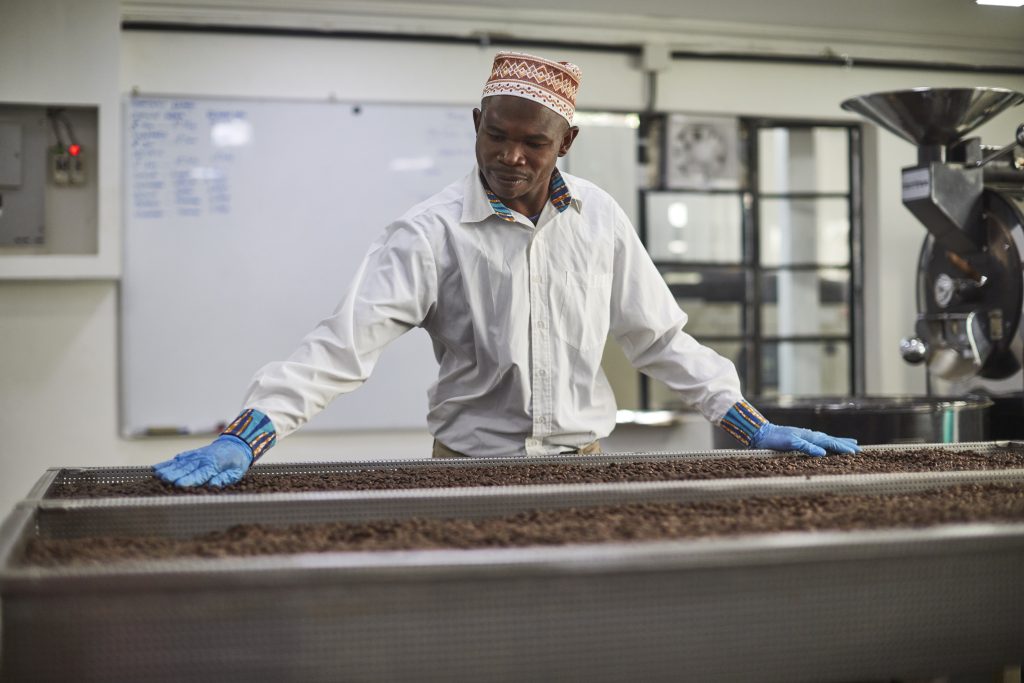 A worker sorting coffee beans at Spring Valley Coffee roastery in Nairobi. Image source: Tutto Passa
Buying the supply
Doshi’s entry into coffee was neither immediate nor inevitable. After selling his logistics business, he deliberately sought something rooted in Kenya’s real economy, not dependent on imports or abstract capital flows.
“I wanted to take the best of what Kenya had,” he says, “and take it to the world.”
At the time, Spring Valley Coffee was still small: a café, a modest roastery, and a team of fewer than 10. Doshi had become, by his own telling, a “fanatic customer,” drawn less by branding than by the product’s consistency.
When he first approached the founders about investing, they declined. Months later, as they prepared to relocate abroad, the conversation reopened. Doshi acquired the business.
“We joke now that I didn’t want to lose my daily supply,” he says.
The remark might be light, but the underlying shift was not. Doshi was moving from consumption to control, from buying coffee to shaping how it was sourced, processed, and ultimately experienced.
What premium means
Coffee, like wine, has its own internal hierarchy. On a 100-point scale, anything above 80 is classified as “specialty”—a threshold defined by clarity, balance, and the absence of defects. By most industry accounts, Kenya consistently produces beans in that upper tier.
Yet the domestic market has historically captured little of that value.
Export markets pay in hard currency, while domestic consumption has been shallow. For years, brewed coffee accounted for a fraction of beverage consumption in Kenya, with instant coffee dominating what little demand existed.
Doshi says Spring Valley’s proposition sits in that gap.
He resists calling it luxury. The word, he argues, implies distance—something aspirational but out of reach for most consumers. The goal instead is to make high-quality coffee part of everyday urban consumption, not an occasional indulgence.
That ambition, however, runs up against price. Specialty coffee is more expensive by design—farmers are paid more, traceability is tighter, and the roasting process itself requires precision. The challenge, therefore, is whether enough consumers are willing to consistently pay for quality.
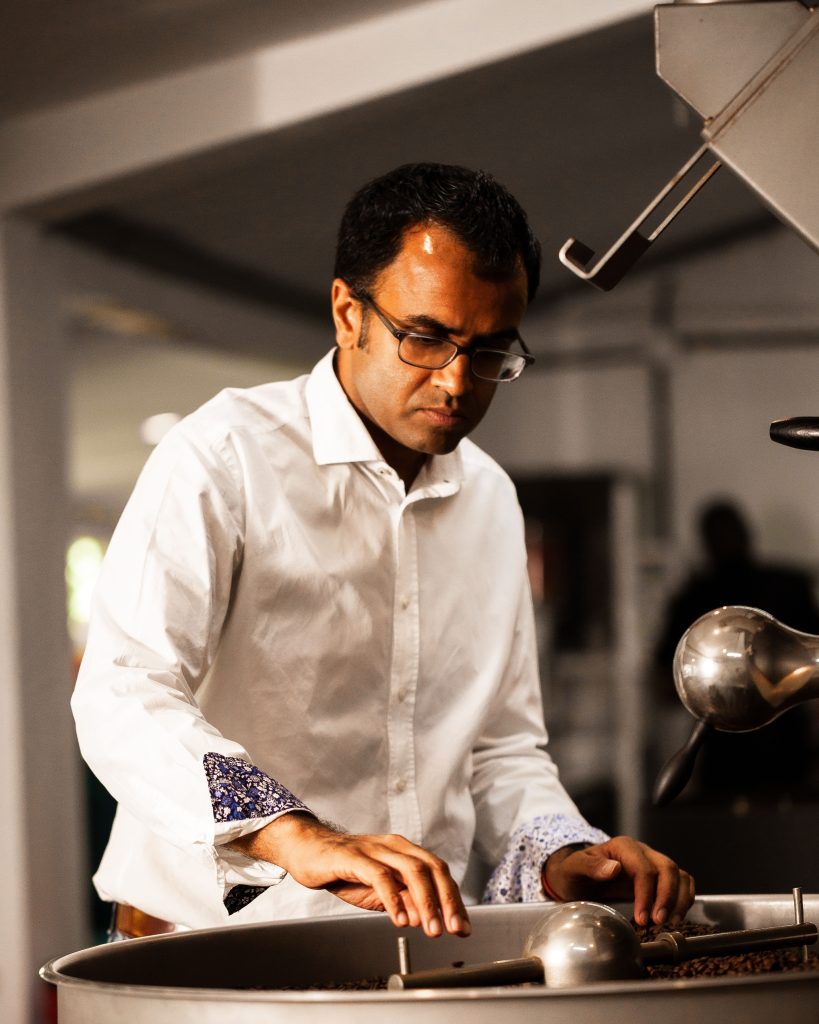 Ritesh Doshi roasting coffee at Spring Valley roastery. Image source: Tutto Passa
The long chain
To understand that challenge, it helps to look upstream.
Kenya’s coffee industry still operates, in large part, through a centralised auction system. Smallholder farmers—many cultivating less than an acre—deliver cherries to cooperative societies. The beans are processed, milled, and graded before being presented at weekly auctions in Nairobi, now regulated by the Capital Markets Authority (CMA).
From there, they move through a layered chain: agents, dealers, exporters. Payment can take months to reach farmers.
“It’s a long chain,” Doshi says. “And a lot gets lost along the way.”
Yet the system also offers traceability, something rare in global coffee markets. Each lot carries an out-turn number that links it to a specific factory, week, and production batch.
“It’s not blockchain,” he says, “but it works.”
Spring Valley buys both through this auction system and, where regulations allow, directly from producers. The aim is not to bypass the system entirely, but to navigate it more efficiently, retaining quality while improving margins at multiple points in the chain.
Roasting at origin
The more radical shift happens after purchase. For decades, Kenya exported most of its coffee in its raw, green form. The high-value stages—roasting, branding, retail—took place abroad. It is in those stages that margins expand.
Roasting at origin, then, is both a technical and economic intervention.
Green coffee, pale and almost odourless, only develops its defining characteristics through heat. Temperature curves, timing, and batch control determine whether a bean expresses acidity, fruit, or body, or loses those qualities entirely.
By building local roasting capacity, Spring Valley is aiming to capture more of that value within Kenya.
“We’re not just a producing country,” Doshi says. “We can add value to a global standard.”
Today, the company operates 10 cafés in Nairobi and supplies a network of hotels, restaurants, and retailers. In 2025, it opened its first international outlet in London, a market dense with specialty coffee competitors.
In Nairobi, the task has been to build a market and explain why a smaller, stronger cup might be preferable and why flavour profiles matter. In London, the argument shifts to whether coffee roasted in Kenya can match, or exceed, the quality of beans roasted in Europe.
“That it’s authentic,” he says. “That we know whose hands it’s gone through.”
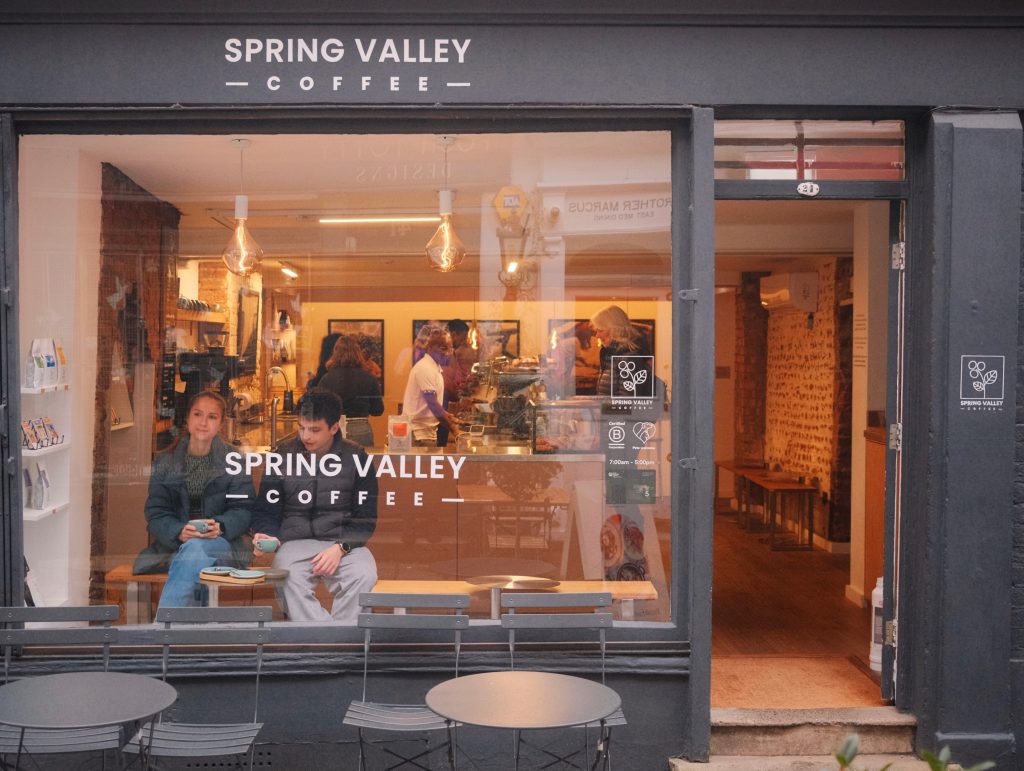 A Spring Valley Coffeehouse in London. Image source: Spring Valley Coffee
Changing taste
That argument may be finding traction, at least domestically. When Doshi entered the business, brewed coffee represented a marginal share of Kenya’s beverage market. Most consumption was instant, often disconnected from the country’s own production strengths.
Over the past decade, that has begun to change.
Urban cafés have multiplied, with major Nairobi streets having between 5 and 10 outlets. Doshi argues that consumer preferences have shifted toward espresso-based drinks and, increasingly, manual brews. Coffee has become, in a limited but growing sense, part of urban culture, both a social activity and a signal of taste.
Spring Valley is not alone in driving that shift, but it has positioned itself at its centre. “It’s a space where we can catalyse connections,” Doshi says.
Keeping value at home
The value of coffee produced in distant places like the US and Europe has, over the years, left its origins in Kenya, with the work of growing it. What players like Spring Valley Coffee are doing is to tilt it in another direction.
Most Kenyan coffee still leaves the country unfinished, but the small share being held back by local roasters and coffee houses, roasted a few kilometres from where it will be brewed, makes an economic difference and builds confidence in local manufacturing.
Coffee roasting is a modest manufacturing process, but it is where it begins to earn margins and become a brand. For example, when Spring Valley ships its coffee to London, it sends something finished, or close to it, something that carries with it the labour, the decisions, and the identity of the place it came from, Kenya.
Listen to the full podcast on Spotify.


You May Also Like

XAU USD Daily Analysis: Gold Breaks Last Week’s Low as Traders Watch 200-Day Moving Average

Kash Patel appears to have ripped off iconic Beastie Boys video using AI: report




