QFEX Review: First 24/7 Brokerless Exchange
Traditional financial markets have a problem that nobody with a vested interest wants to solve. Retail traders cannot access exchanges directly. Markets close on weekends, leverage above 20x on US stocks is practically impossible without navigating complex options structures, and Robinhood sells order flow to the same hedge funds competing against the retail traders using it. Interactive Brokers buries users in a bloated interface built for a different era. QFEX was founded by quantitative traders from Citadel and Tower Research who experienced all of this firsthand and decided to build the exchange they always wished existed. Unlike charting platforms like TrendSpider or scanning tools like TC2000 that sit on top of existing market infrastructure, QFEX is rebuilding the infrastructure itself. This review covers what QFEX actually offers, how its architecture works, where it stands today, and who it is built for.
What Is QFEX?

QFEX is the first 24/7 brokerless perpetual futures exchange for traditional financial assets. It lets traders access US equities, commodities, and FX pairs around the clock with up to 100x leverage, margined in USDC, without routing orders through a broker or clearing house.
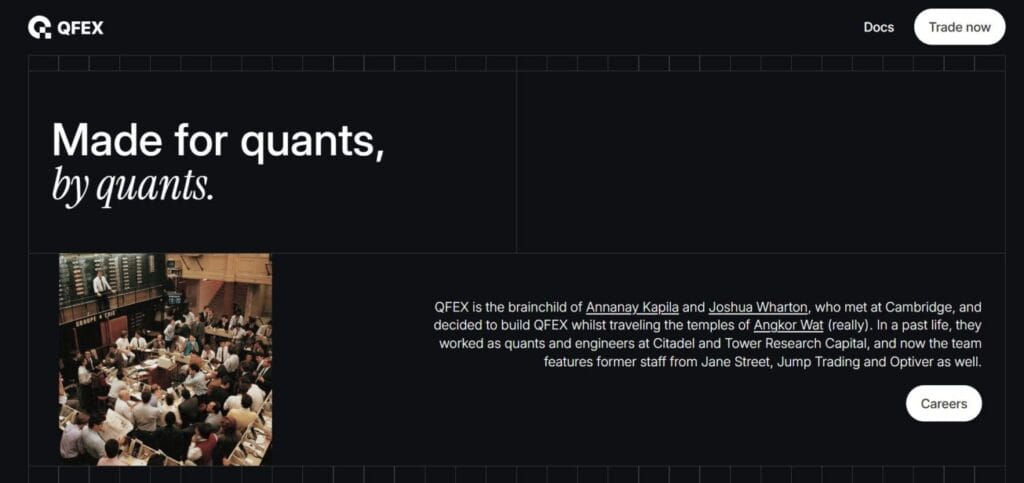
Founded in London in 2025 by Annanay Kapila and Joshua Wharton, both Cambridge graduates with backgrounds at Flow Traders, Citadel, and Tower Research Capital, QFEX launched through Y Combinator’s X25 batch. The long-term ambition is explicit: to replace the entire traditional exchange, clearing, and brokerage stack, an industry worth roughly $100 billion, and become the trading venue of choice for retail traders, global banks, hedge funds, and family offices who want 24/7 access to traditional assets without the friction that defines legacy infrastructure.
How QFEX Works
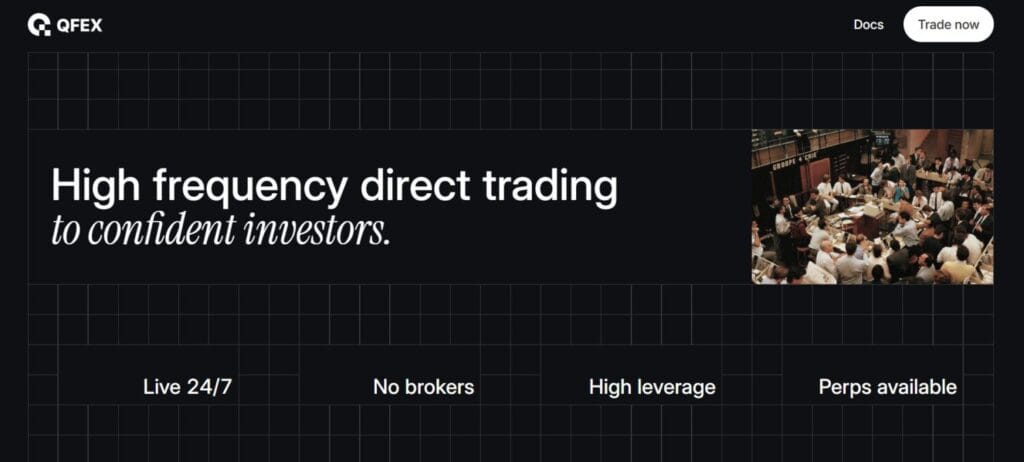
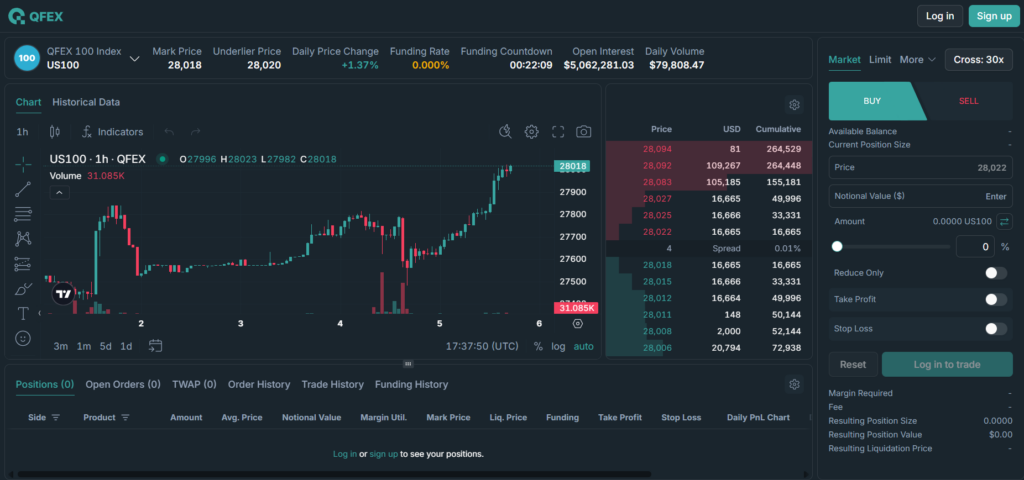
QFEX is built around a Centralised Limit Order Book (CLOB) with strict price-time priority. Every order, from every participant, sits in the same transparent book. There is no payment for order flow, no dark pool routing, and no intermediary sitting between the trader and the market. What you see in the order book is what is actually available.
The matching engine is written primarily in Rust and incorporates machine learning components. It runs on Amazon Web Services in Tokyo, delivering microsecond-level latency and equal access for all participants via both the GUI and the API over WebSockets. A 100 millisecond speed bump applies uniformly across all clients, preventing high-frequency traders from gaining a structural latency advantage over retail participants. This is a deliberate fairness mechanism borrowed from exchange design principles developed by venues like IEX.
Perpetual futures on QFEX have no expiry dates, meaning positions can be held indefinitely. Funding is computed and paid every hour rather than the 8-hour cycles used by most crypto perpetuals exchanges, which gives traders a more accurate and responsive cost of carry signal.
Key Features
24/7 Perpetual Futures on Traditional Assets
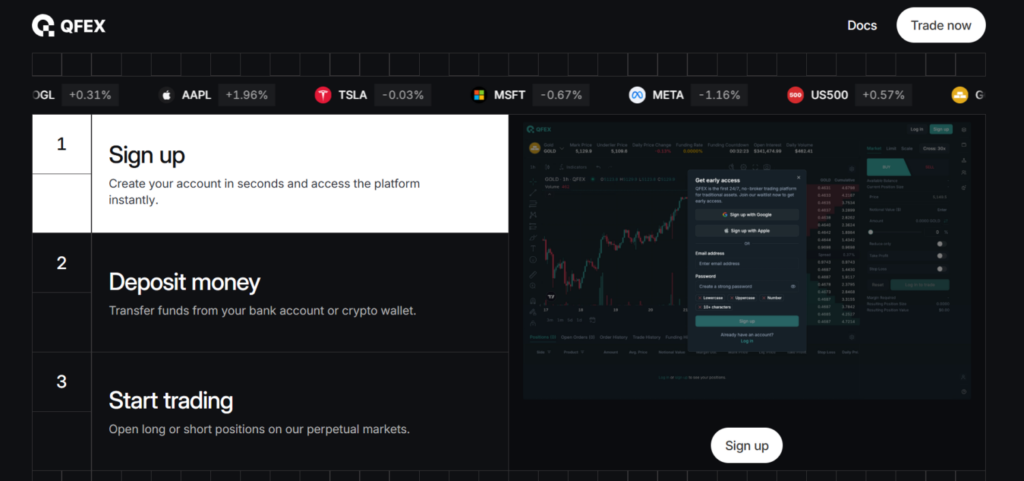
QFEX currently lists 15 or more US equity perpetuals covering megacap tech, semiconductors, and high-beta names, including Nvidia, Amazon, Tesla and many more. Commodity perpetuals cover Gold, Silver, and Uranium. FX perpetuals cover major pairs including GBP/USD, EUR/USD, and AUD/USD. All markets run continuously, supported by external market makers providing liquidity even when underlying cash markets are closed. Traders who use order flow tools like Bookmap or ATAS to read institutional activity during regular hours will find QFEX extends that opportunity to hours where no comparable venue previously existed.
Brokerless Direct Market Access
QFEX removes the broker layer entirely. Traders interact directly with the exchange, which means no payment for order flow, no front-running risk from intermediaries, and no spread games from retail FX brokers. For traders who have spent years frustrated by structural disadvantages that platforms like Robinhood and Interactive Brokers are built around, the brokerless model is the most meaningful architectural decision QFEX has made.
USDC Margined with Fiat and Crypto Rails
All positions on QFEX are margined in USDC. The platform integrates with both traditional payment rails and crypto on-ramps, meaning traders can deposit from a bank account or from a crypto wallet without friction. This hybrid approach removes one of the biggest onboarding barriers that pure crypto-native exchanges face when targeting traders who primarily operate in traditional finance. Traders already comfortable with USDC margin from AI portfolio tools like Milo on Solana will find the collateral model immediately familiar.
Volume-Based Fee Structure
QFEX charges fees based purely on trading volume with no hidden costs, no payment for order flow, and no account maintenance fees. Tier 1 makers trade for free. This fee model directly competes with the cost structures of legacy retail brokers and aligns the exchange’s incentives entirely with trading activity rather than data sales or order routing arrangements.
Equal-Access API with WebSocket Support
QFEX offers full API access via WebSockets on the same terms as the GUI, meaning algorithmic and high-frequency traders are not given preferential access to the order book or matching engine. This is a meaningful commitment to fairness that most traditional exchanges and many crypto venues do not make. The roadmap includes expanded API tooling for algorithmic traders as the platform scales.
Who Should Use QFEX
QFEX is built for three types of traders.
- First, active retail traders want leveraged exposure to US equities and commodities without a broker sitting between them and the market.
- Second, global traders outside the US have historically struggled to access US equity markets with meaningful leverage through regulated venues.
- Third, algorithmic traders who want equal-access API connectivity to a CLOB-based exchange with microsecond-level matching and transparent price-time priority.
Casual long-term investors who want to buy and hold shares for dividends and capital appreciation should look at traditional brokers instead. QFEX is a trading venue, not an investment platform.
Conclusion
QFEX is one of the most structurally ambitious exchange projects to emerge from the traditional finance space in years. The brokerless model, 24/7 perpetuals on equities, CLOB architecture with a fairness speed bump, and volume-only fee structure each address a real and longstanding problem in how retail traders interact with financial markets. Founded by people who traded professionally at the highest levels and backed by General Catalyst and Y Combinator, the team has both the credibility and the resources to execute. The platform is early, the liquidity is still building, and the regulatory path for a global brokerless perpetuals exchange is not straightforward. But the direction is correct, the infrastructure is serious, and for traders who have spent years frustrated by the friction built into legacy market structure, QFEX is worth watching closely.
Frequently Asked Questions (FAQs)
Is QFEX regulated?
QFEX requires mandatory KYC for all users and has made market integrity a stated architectural priority through features like the 100ms speed bump and strict price-time priority. Full regulatory details and jurisdiction-specific licensing information should be verified directly on the QFEX platform before trading.
What assets can I trade on QFEX?
QFEX currently offers perpetual futures on 15 or more US equities, including NVDA, TSLA, AAPL, and META, commodity perpetuals on Gold, Silver, and Uranium, and FX perpetuals on major pairs including GBP/USD, EUR/USD, and AUD/USD. All markets run 24/7 with no expiry dates.
What is the maximum leverage on QFEX?
QFEX offers leverage of up to 100x on its perpetual futures contracts. The appropriate leverage level depends on the asset class and the trader’s risk tolerance. Higher leverage significantly amplifies both gains and losses and is not suitable for all traders.
How is QFEX different from Robinhood or Interactive Brokers?
QFEX removes the broker layer entirely, charges no payment for order flow, operates 24/7 with perpetual futures rather than spot equity, and gives all participants equal access to the order book. Robinhood and Interactive Brokers route orders through intermediaries and operate only during standard market hours.
What currency is used for margin on QFEX?
All positions on QFEX are margined in USDC. The platform accepts deposits through both traditional fiat payment rails and crypto on-ramps, making it accessible to traders coming from either a traditional finance or a crypto-native background.


You May Also Like

Why Is MemeCore Up 20% Today?

Telegram steps in as Toncoin validator – Can $191M staking drive TON’s rally?