Dynamic inverse problems in imaging struggle with undersampled data and unrealistic motion. Neural fields provide a lightweight, smooth representation but often miss motion detail. This study shows that combining neural fields with explicit PDE-based motion regularizers (like optical flow) significantly improves 2D+time CT reconstruction. Results demonstrate that neural fields not only outperform grid-based solvers but also generalize effectively to higher resolutions, offering a powerful path forward for medical and scientific imaging.Dynamic inverse problems in imaging struggle with undersampled data and unrealistic motion. Neural fields provide a lightweight, smooth representation but often miss motion detail. This study shows that combining neural fields with explicit PDE-based motion regularizers (like optical flow) significantly improves 2D+time CT reconstruction. Results demonstrate that neural fields not only outperform grid-based solvers but also generalize effectively to higher resolutions, offering a powerful path forward for medical and scientific imaging.

How PDE Motion Models Boost Image Reconstruction in Dynamic CT

2025/10/01 03:30

:::info Authors:

(1) Pablo Arratia, University of Bath, Bath, UK (pial20@bath.ac.uk);

(2) Matthias Ehrhardt, University of Bath, Bath, UK (me549@bath.ac.uk);

(3) Lisa Kreusser, University of Bath, Bath, UK (lmk54@bath.ac.uk).

:::

Abstract and 1. Introduction

  1. Dynamic Inverse Problems in Imaging

    2.1 Motion Model

    2.2 Joint Image Reconstruction and Motion Estimation

  2. Methods

    3.1 Numerical evaluation with Neural Fields

    3.2 Numerical evaluation with grid-based representation

  3. Numerical Experiments

    4.1 Synthetic experiments

  4. Conclusion, Acknowledgments, and References

ABSTRACT

Image reconstruction for dynamic inverse problems with highly undersampled data poses a major challenge: not accounting for the dynamics of the process leads to a non-realistic motion with no time regularity. Variational approaches that penalize time derivatives or introduce PDE-based motion model regularizers have been proposed to relate subsequent frames and improve image quality using grid-based discretization. Neural fields are an alternative to parametrize the desired spatiotemporal quantity with a deep neural network, a lightweight, continuous, and biased towards smoothness representation. The inductive bias has been exploited to enforce time regularity for dynamic inverse problems resulting in neural fields optimized by minimizing a data-fidelity term only. In this paper we investigate and show the benefits of introducing explicit PDE-based motion regularizers, namely, the optical flow equation, in 2D+time computed tomography for the optimization of neural fields. We also compare neural fields against a grid-based solver and show that the former outperforms the latter.

1 Introduction
\
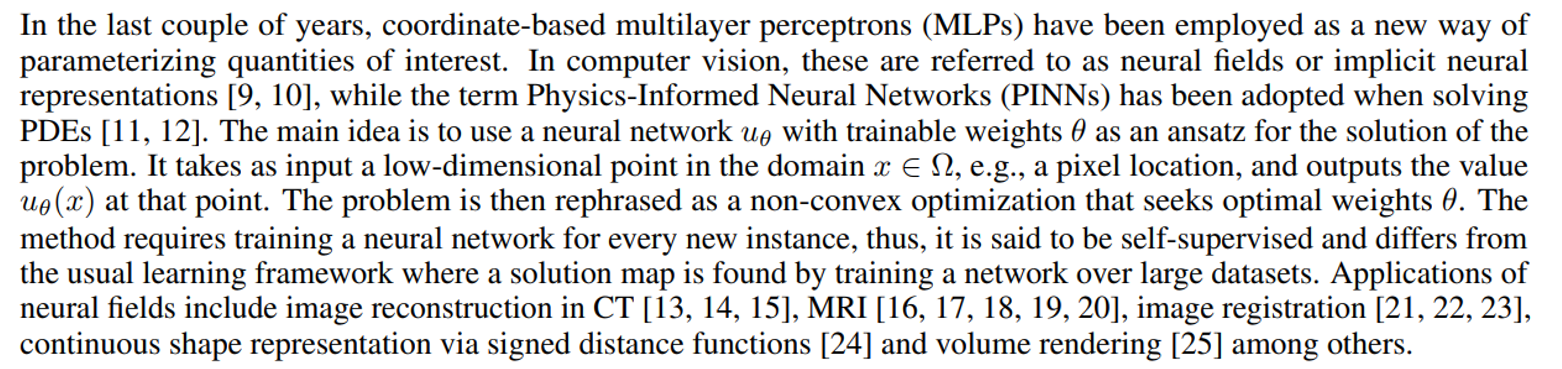
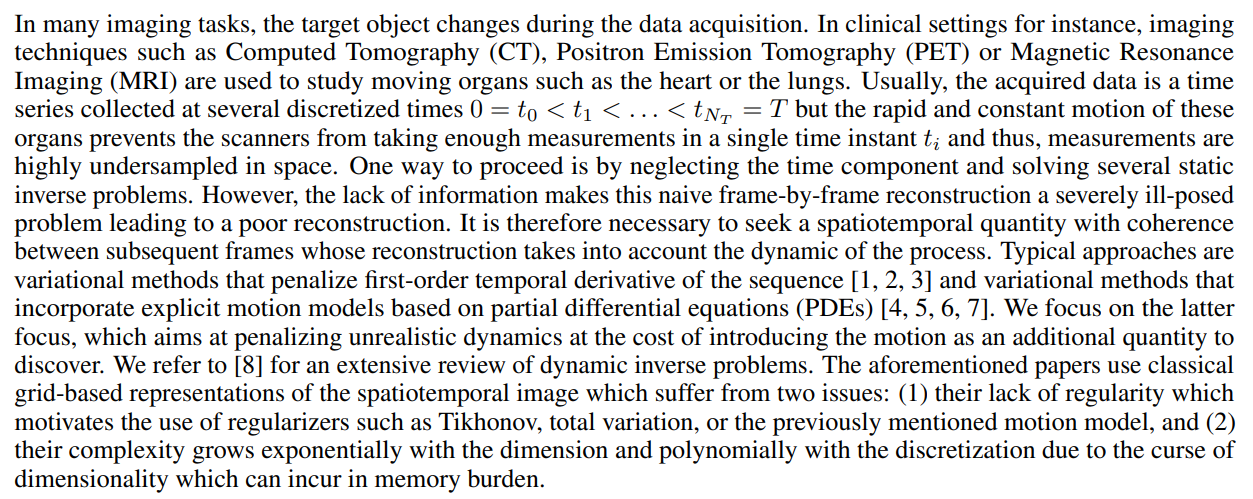
\ It is well-known that, under mild conditions, neural networks can approximate functions at any desired tolerance [26], but their widespread use has been justified by other properties such as (1) the implicit regularization they introduce, (2) overcoming the curse of dimensionality, and (3) their lightweight, continuous and differentiable representation. In [27, 28] it is shown that the amount of weights needed to approximate the solution of particular PDEs grows polynomially on the dimension of the domain. For the same reason, only a few weights can represent complex images, leading to a compact and memory-efficient representation. Finally, numerical experiments and theoretical results show that neural fields tend to learn smooth functions early during training [29, 30, 31]. This is both advantageous and disadvantageous: neural fields can capture smooth regions of natural images but will struggle at capturing edges. The latter can be overcome with Fourier feature encoding [32].

\ In the context of dynamic inverse problems and neural fields, most of the literature relies entirely on the smoothness introduced by the network on the spatial and temporal variables to get a regularized solution. This allows minimizing a data-fidelity term only without considering any explicit regularizers. Applications can be found on dynamic cardiac MRI in [17, 20, 19], where the network outputs the real and imaginary parts of the signal, while in [18] the neural field is used to directly fit the measurements and then inference is performed by inpainting the k-space with the neural field and taking the inverse Fourier transform. In [33, 34] neural fields are used to solve a photoacoustic tomography dynamic reconstruction emphasizing their memory efficiency. In [15], a 3D+time CT inverse problem is addressed with a neural field parametrizing the initial frame and a polynomial tensor warping it to get the subsequent frames. To the best of our knowledge, it is the only work making use of neural fields and a motion model via a deformable template.

\ In this paper, we investigate the performance of neural fields regularized by explicit PDE-based motion models in the context of dynamic inverse problems in CT in a highly undersampled measurement regime with two dimensions in space. Motivated by [4] and leveraging automatic differentiation to compute spatial and time derivatives, we study the optical flow equation as an explicit motion regularizer imposed as a soft constraint as in PINNs. Our findings are based on numerical experiments and are summarized as follows:

\ • An explicit motion model constraints the neural field into a physically feasible manifold improving the reconstruction when compared to a motionless model.

\ • Neural fields outperform grid-based representations in the context of dynamic inverse problems in terms of the quality of the reconstruction.

\ • We show that, once the neural field has been trained, it generalizes well into higher resolutions.

\ The paper is organized as follows: in section 2 we introduce dynamic inverse problems, motion models and the optical flow equation, and the joint image reconstruction and motion estimation variational problem as in [4]; in section 3 we state the main variational problem to be minimized and study how to minimize it with neural fields and with a grid-based representation; in section 4 we study our method on a synthetic phantom which, by construction, perfectly satisfies the optical flow constraint, and show the improvements given by explicit motion regularizers; we finish with the conclusions in section 5.

2 Dynamic Inverse Problems in Imaging
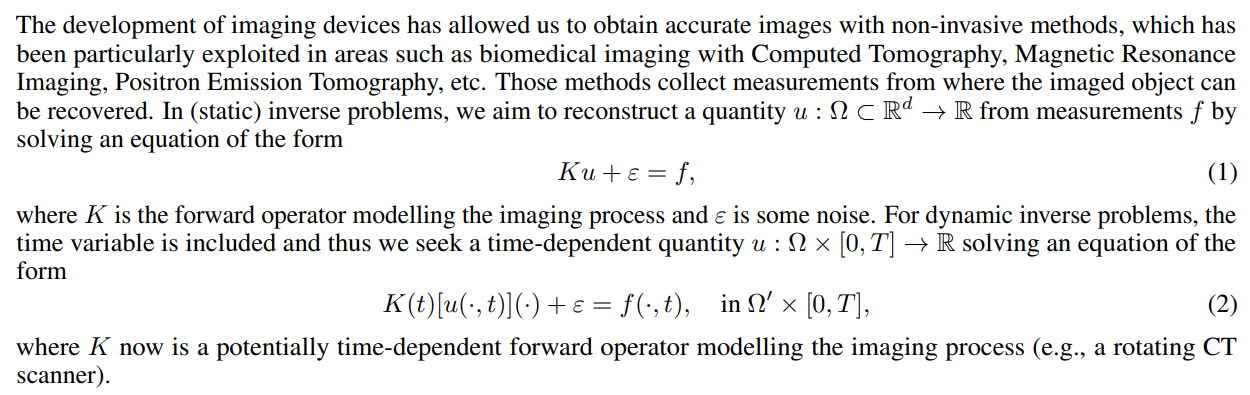
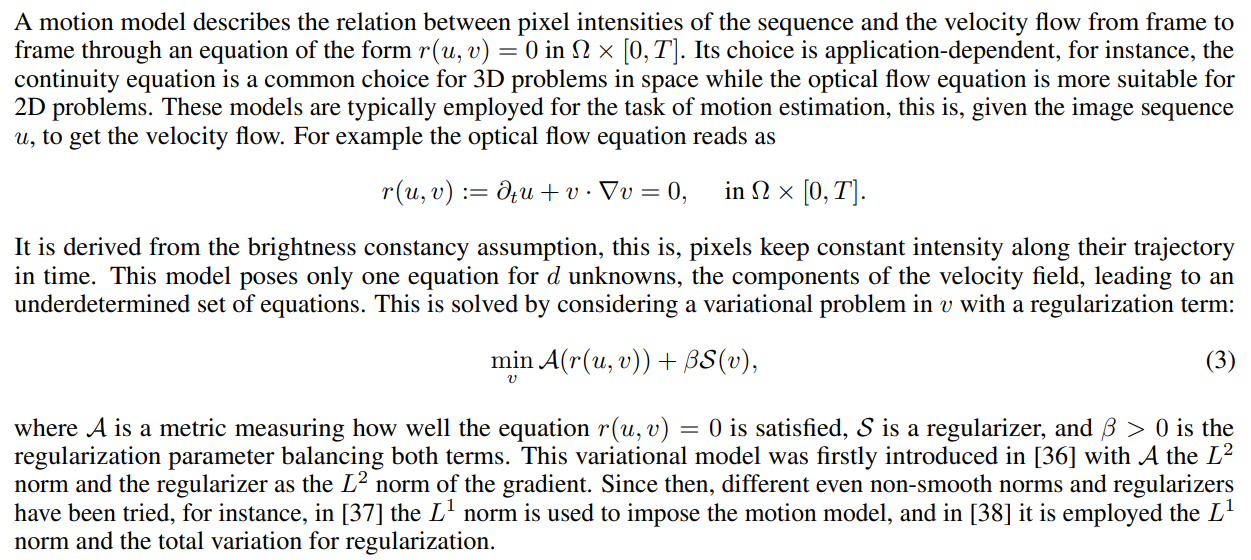
2.1 Motion Model
\

2.2 Joint Image Reconstruction and Motion Estimation

To solve highly-undersampled dynamic inverse problems, in [4] it is proposed a joint variational problem where not only the dynamic process u is sought, but also the underlying motion expressed in terms of a velocity field v. The main hypothesis is that a joint reconstruction can enhance the discovery of both quantities, image sequence and motion, improving the final reconstruction compared to motionless models. Hence, the sought solution (u ∗ , v∗ ) is a minimizer for the variational problem given below:

\

\ with α, β, γ > 0 being regularization parameters balancing the four terms. In [4], the domain is 2D+time, and among others, it is shown how the purely motion estimation task of a noisy sequence can be enhanced by solving the joint task of image denoising and motion estimation.

\ This model was further employed for 2D+time problems in [6] and [7]. In the former it is studied its application on dynamic CT with sparse limited-angles and it is studied both L 1 and L 2 norms for the data fidelity term, with better results for the former. In the latter, the same logic is used for dynamic cardiac MRI. In 3D+time domains, we mention [39] and [40] for dynamic CT and dynamic photoacoustic tomography respectively.

\

3 Methods

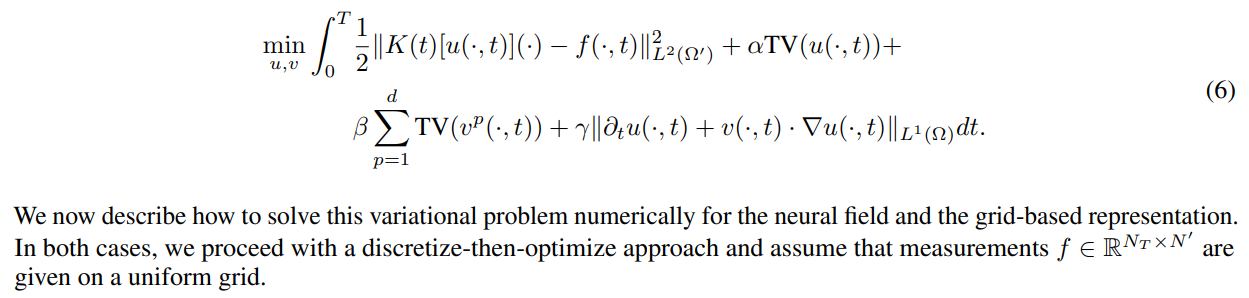
Depending on the nature of the noise, different data-fidelity terms can be considered. In this work, we consider Gaussian noise ε, so, to satisfy equation (2) we use an L2 distance between predicted measurements and data

\

\ Since u represents a natural image, a suitable choice for regularizer R is the total variation to promote noiseless images and capture edges:

\

\ For the motion model, we consider the optical flow equation (5), and to measure its distance to 0 we use the L1 norm. For the regularizer in v we consider the total variation on each of its components.

\

\ Thus, the whole variational problem reads as follows:

\
\

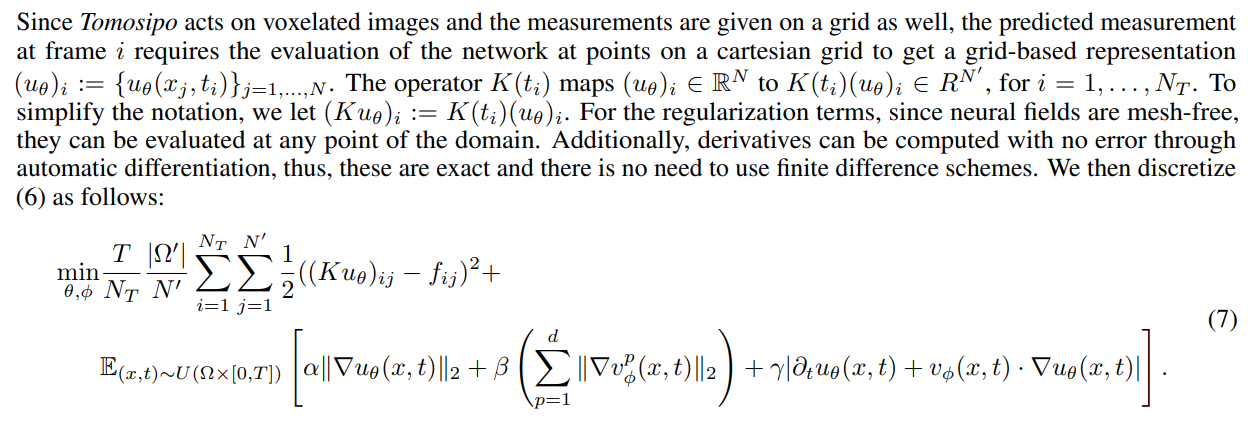
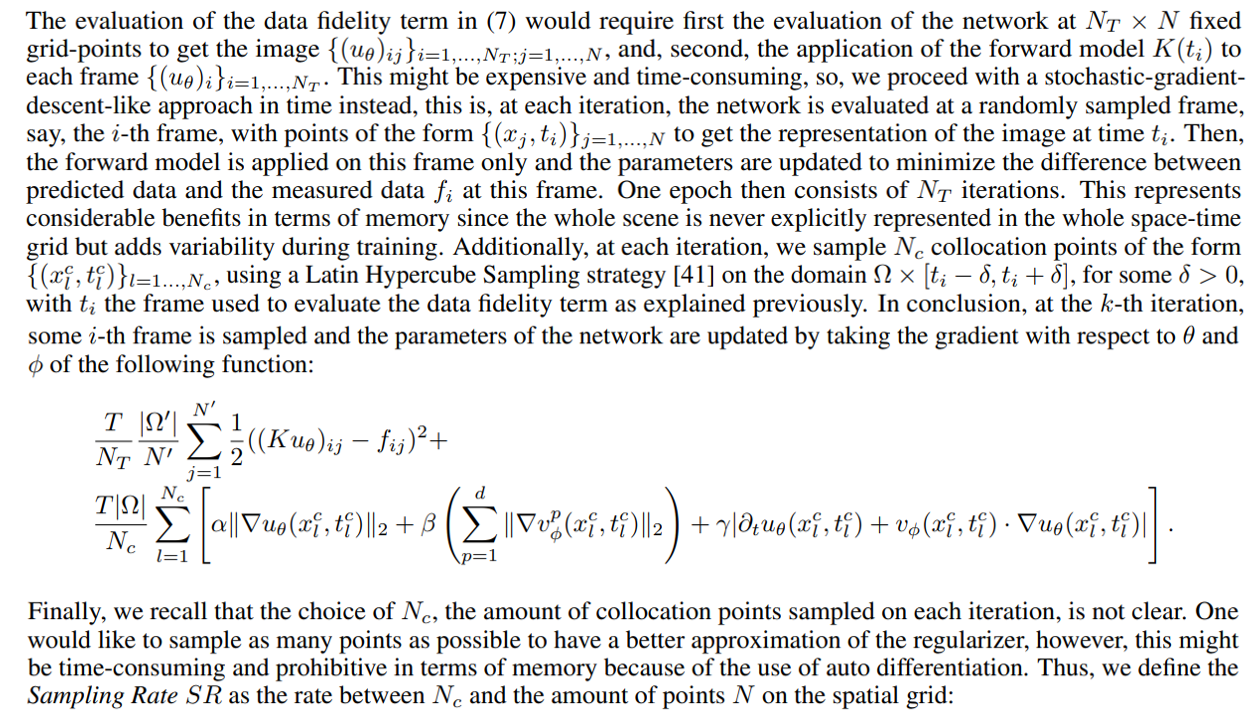
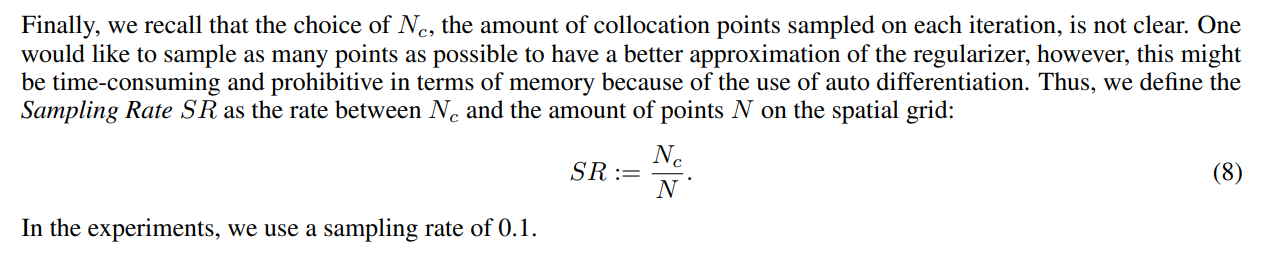
3.1 Numerical evaluation with Neural Fields
\
\
\

3.2 Numerical evaluation with grid-based representation
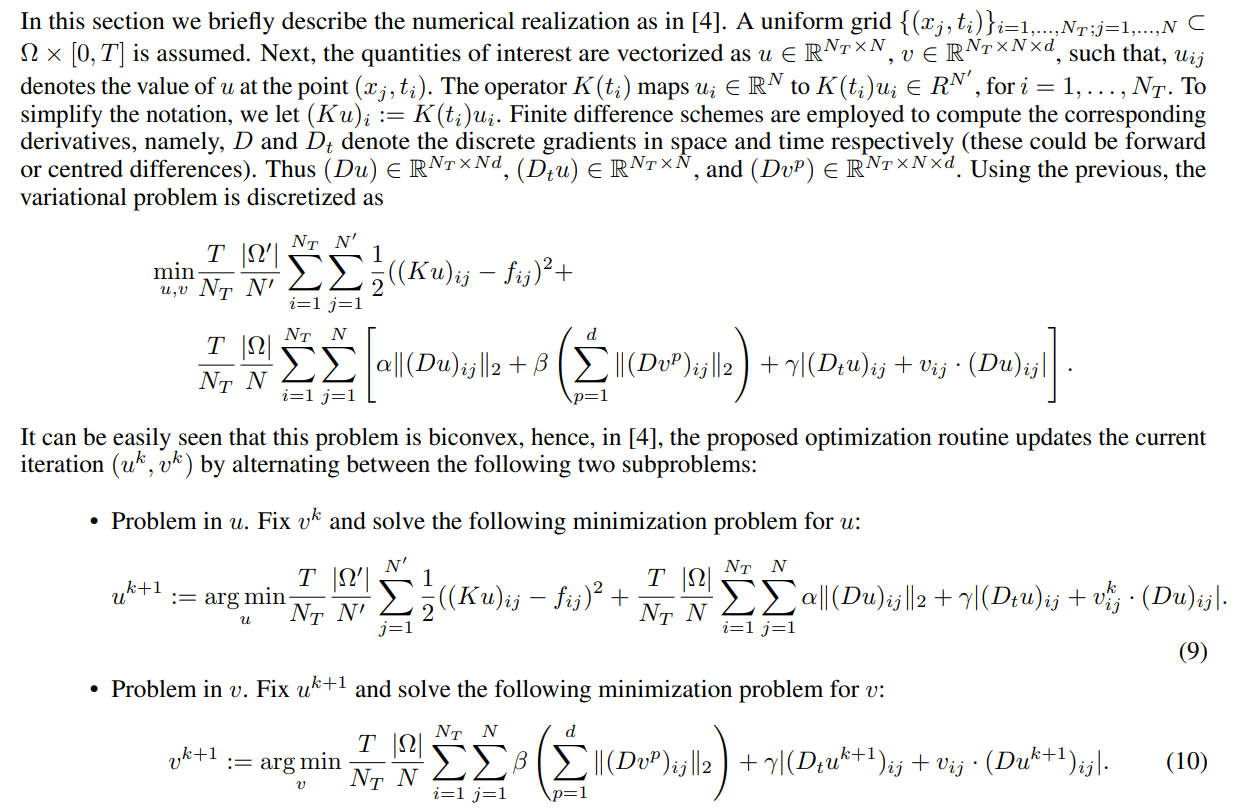
\ Each subproblem is convex with non-smooth terms involved that can be solved using the Primal-Dual Hybrid Gradient (PDHG) algorithm [42]. We refer to [4] for the details.

\

:::info This paper is available on arxiv under CC BY 4.0 DEED license.

:::

\

Disclaimer: The articles reposted on this site are sourced from public platforms and are provided for informational purposes only. They do not necessarily reflect the views of MEXC. All rights remain with the original authors. If you believe any content infringes on third-party rights, please contact service@support.mexc.com for removal. MEXC makes no guarantees regarding the accuracy, completeness, or timeliness of the content and is not responsible for any actions taken based on the information provided. The content does not constitute financial, legal, or other professional advice, nor should it be considered a recommendation or endorsement by MEXC.

You May Also Like

Superstate Launches SEC‑Approved Tokenized Share Issuance on Ethereum and Solana

Superstate Launches SEC‑Approved Tokenized Share Issuance on Ethereum and Solana

Superstate introduced a new pathway that brings public equity issuance onto blockchain networks through a regulated structure. The firm now enables SEC-registered companies to sell new tokenized shares directly to investors on Ethereum and Solana. The move signals a shift toward faster capital formation as firms search for more efficient fundraising channels. Moreover, the development arrives as U.S. regulators accelerate experiments that merge traditional finance with blockchain infrastructure. Consequently, the launch positions Superstate at the center of efforts to modernize how public companies raise money and maintain shareholder records.Direct Issuance Targets Faster Funding and Instant SettlementThe Direct Issuance Program lets issuers receive capital in stablecoins while investors receive tokenized shares in real time. This structure allows companies to manage shareholder updates instantly through Superstate’s regulated transfer agent system. Additionally, the program supports existing share classes or new digital-only classes, giving companies more flexibility in how they engage investors.Superstate expects the first offerings to launch in 2026. The firm argues that companies need issuance rails that match global capital flows and deliver immediate settlement. Hence, the appeal of stablecoin-based transactions grows as markets demand more certainty and speed. The approach may also help smaller issuers reach investors who prefer blockchain-based assets with transparent lifecycle tracking.Regulators Accelerate Blockchain ExperimentsRegulators under the Trump administration encourage more crypto-financial innovation, which strengthens interest in tokenized securities. Both the SEC and CFTC now advance guidelines that reduce uncertainty around digital issuance. Moreover, large issuers and fintech firms continue to test onchain models that integrate with compliance tools and custodial systems.Earlier efforts by Galaxy and Sharplink involved tokenizing existing shares for onchain holding. However, those initiatives did not raise new capital. Superstate now extends that foundation by enabling primary issuance that interacts directly with blockchain liquidity.Programmable Securities Unlock New Use CasesTokenized shares issued through the program can include programmable features that update governance or distribution rules automatically. Besides, the digital structure allows integrations with onchain settlement, portfolio management, and institutional custody providers. These features may attract investors seeking assets that combine regulatory protection with efficient blockchain execution.Superstate intends to open its offering to both retail and institutional buyers after KYC checks. Consequently, the initiative may reshape how issuers approach capital formation and how investors access regulated digital securities.
Share
Coinstats2025/12/11 03:16
XRP triggert patroon dat voorafging aan eerdere 7000% stijging

XRP triggert patroon dat voorafging aan eerdere 7000% stijging

i Kennisgeving: Dit artikel bevat inzichten van onafhankelijke auteurs en valt buiten de redactionele verantwoordelijkheid van BitcoinMagazine.nl. De informatie is bedoeld ter educatie en reflectie. Dit is geen financieel advies. Doe zelf onderzoek voordat je financiële beslissingen neemt. Crypto is zeer volatiel er zitten kansen en risicos aan deze investering. Je kunt je inleg verliezen. XRP laat opnieuw hetzelfde koerspatroon zien dat in 2017 leidde tot een stijging van meer dan 7000%. De nieuwe vergelijking die rondgaat op X laat zien dat de huidige structuur bijna een-op-een lijkt op die van toen. Wanneer gaat Ripple stijgen en hoe serieus is deze technische setup? Check onze Discord Connect met "like-minded" crypto enthousiastelingen Leer gratis de basis van Bitcoin & trading - stap voor stap, zonder voorkennis. Krijg duidelijke uitleg & charts van ervaren analisten. Sluit je aan bij een community die samen groeit. Nu naar Discord Ripple koers toont dezelfde golven als in 2017 De grafieken van 2017 en nu lijken opvallend veel op elkaar. Je ziet dezelfde golfbewegingen, dezelfde rustfase en dezelfde neerwaartse afronding van de vierde golf. In 2017 volgde daarna de grote doorbraak. 🚨𝐁𝐑𝐄𝐀𝐊𝐈𝐍𝐆: 𝐗𝐑𝐏 𝐉𝐮𝐬𝐭 𝐄𝐧𝐭𝐞𝐫𝐞𝐝 𝐭𝐡𝐞 𝐒𝐚𝐦𝐞 𝐏𝐚𝐭𝐭𝐞𝐫𝐧 𝐭𝐡𝐚𝐭 𝐋𝐞𝐝 𝐭𝐨 𝐭𝐡𝐞 𝟕,𝟒𝟓𝟐% 𝐑𝐚𝐥𝐥𝐲 𝐢𝐧 𝟐𝟎𝟏𝟕 👀🔥 A new side-by-side chart shows XRP’s 𝟐𝟎𝟐𝟓 𝐬𝐭𝐫𝐮𝐜𝐭𝐮𝐫𝐞 𝐢𝐬 𝐚𝐥𝐦𝐨𝐬𝐭 𝐢𝐝𝐞𝐧𝐭𝐢𝐜𝐚𝐥 𝐭𝐨 𝟐𝟎𝟏𝟕 — same… pic.twitter.com/14uIZQxRus — Diana (@InvestWithD) December 7, 2025 De Ripple koers laat nu precies dat punt zien. De steun rond de zone van ongeveer twee dollar blijft tot nu toe sterk. De weerstand rond $ 2,20 blijft hard, maar dat was in 2017 niet anders. Diana herkent het patroon meteen. Niet omdat het perfect moet zijn, maar omdat de structuur gelijk is. Lees ook ons artikel over Solana dat XRP provoceert met ‘589’ en illustratie — wat zit hierachter? Wanneer gaat Ripple stijgen? Alles draait op dit moment om de zone boven $ 2,20. Zolang XRP daar niet doorheen sluit met kracht, blijft de Ripple koers vlak. In de grafiek zie je dat elke poging om boven deze weerstand te komen snel wordt teruggeduwd. Dat maakt de beweging traag en voorzichtig. Steun en weerstand + EMA’s XRP koers – bron: TradingView De RSI staat neutraal. Dat betekent dat er ruimte is voor een stevige beweging zodra de koers richting de weerstand loopt. In 2017 brak die beweging pas los na weken van dezelfde zijwaartse fase. Het is dus geen zwakte, maar een periode waarin kopers en verkopers elkaar in evenwicht houden. Bekijk hier de Ripple koersverwachting voor de lange termijn. Praat mee op onze socials! Chat met onze experts via Telegram, geef je mening op Twitter of "sit back and relax" terwijl je naar onze YouTube-video's kijkt. Chat met ons Geef je mening Bekijk onze video's Ripple kopen blijft vooral een patroon spel Veel handelaren die nu Ripple kopen doen dat vanwege het patroon. Ze kijken minder naar het nieuws en meer naar de vergelijking met 2017. De grafiek laat namelijk zien dat XRP in beide jaren rond hetzelfde punt draaide voordat de grote stijging begon. Toch blijft de markt bewust rustig. De fundamentals zijn sterker dan in 2017, maar de Ripple koers laat dat nog niet zien. Dat maakt het patroon interessant, maar niet automatisch explosief. Het is vooral een technische reden om XRP strak in de gaten te houden. Voor de liefhebbers hebben we een lijst samengesteld met crypto’s die gaan stijgen naast XRP. Wat gaat de Ripple koers doen als de weerstand eindelijk breekt? De weerstand van $ 2,20 is het niveau dat alles kan openzetten. Komt er volume achter, dan kan XRP snel richting $ 3,00 – $ 3,50 bewegen. Pas boven die zone ontstaat ruimte voor een grotere stijging, vergelijkbaar met de verticale fase uit 2017. Zakt de Ripple koers onder de steun rond $ 2,00, dan duurt het langer voordat het patroon opnieuw kracht krijgt. De structuur blijft dan staan, maar de uitbraak schuift verder vooruit. Voor nu staat XRP precies op het punt waar de rally van 2017 ook begon. De grafiek klopt, het sentiment is voorzichtig positief en de markt wacht op de eerste candle die laat zien welke kant het opgaat. Nieuwe altcoin met snelgroeiende community Als het patroon van 2017 zich herhaalt, kan een XRP rally een algehele bull run ontketenen. In het verleden hebben we gezien dat memecoins zoals Dogecoin hier het meeste van profiteren. Dat maakt het een interessant moment om te kijken naar het laatste lid van de Doge familie met een snelgroeiende community. Maxi Doge ($MAXI) is het “bro gym” neefje van Dogecoin en zit vol met Red Bull, testosteron, pre-workout en 1000x leverage. Het is voor degenen die de eerste rally’s van DOGE, WIF en SHIB gemist hebben. Vroege investeerders kunnen nu al hun $MAXI tokens staken tegen het hoge jaarlijkse rendement van 72%. Hier is al massaal gebruik van gemaakt, want er staan al meer dan 10 miljard $MAXI tokens vast in het stakingsysteem. Je hebt nog even de tijd om je eerste $MAXI tokens te bemachtigen voor de huidige lage prijs. Bij elke nieuwe fase van de presale hoort namelijk een nieuwe prijsverhoging. Nu naar Maxi Doge i Kennisgeving: Dit artikel bevat inzichten van onafhankelijke auteurs en valt buiten de redactionele verantwoordelijkheid van BitcoinMagazine.nl. De informatie is bedoeld ter educatie en reflectie. Dit is geen financieel advies. Doe zelf onderzoek voordat je financiële beslissingen neemt. Crypto is zeer volatiel er zitten kansen en risicos aan deze investering. Je kunt je inleg verliezen. Het bericht XRP triggert patroon dat voorafging aan eerdere 7000% stijging is geschreven door Christiaan Kopershoek en verscheen als eerst op Bitcoinmagazine.nl.
Share
Coinstats2025/12/11 03:16