For decades, gold has anchored global portfolios as the quintessential safe-haven asset. But in the past ten years, bitcoin has rapidly emerged as its digital counterpart — and, in many cases, its outperformer. New research from Dovile Silenskyte, Director of Digital Assets Research at WisdomTree, suggests that investors may no longer need to choose between the two. Instead, the data increasingly supports a combined approach, where gold provides stability and bitcoin offers asymmetric upside. Gold vs. Bitcoin: A Changing Store-of-Value Hierarchy Gold’s safe-haven characteristics remain structurally intact. Its scarcity, established role in global markets and historical performance during periods of stress have kept it resilient. Since 2013, gold posted annualised returns of 10.4% with 14.5% volatility, delivering a Sharpe ratio of 0.6, according to Silenskyte’s analysis. Bitcoin, however, has shifted the paradigm. Over the same period, it generated annualised returns of 50.5% with 67.0% volatility, resulting in a Sharpe ratio of 0.7 — marginally outperforming gold on a risk-adjusted basis despite its extreme swings. On the Sortino ratio, which focuses on downside risk, the gap is even wider: 1.0 for bitcoin versus 0.3 for gold. In simple terms, bitcoin has historically compensated investors more efficiently for the risk taken. “Even with high volatility, bitcoin has offered superior risk-adjusted returns,” Silenskyte notes. Bitcoin Volatility: From Barrier to Manageable Risk Bitcoin’s volatility is frequently cited as the primary reason some investors remain hesitant. Yet Silenskyte’s research shows that this volatility has declined significantly over the past decade. Its 90-day annualised volatility has compressed from above 150% to under 40%, putting it within range of several commodities. At the same time, liquidity has deepened, with daily spot volumes comparable to major S&P 500 equities. Derivatives markets — particularly futures and options — provide sophisticated hedging tools that make volatility increasingly manageable for institutional allocators. “Volatility is a tax, but a declining one,” Silenskyte says. Macro Conditions Favour a Combined Allocation Rather than competing, bitcoin and gold appear to hedge different types of macro risk. Gold thrives during inflation, geopolitical turmoil and periods of negative real yields. Bitcoin, with its 21-million-supply cap and decentralised issuance, serves as a hedge against fiat debasement and technological disruption. Importantly, bitcoin and gold display a low long-term correlation of just 6%, according to WisdomTree. This gives them powerful diversification properties: gold anchors the defensive side of a portfolio, while bitcoin provides convex upside driven by digital adoption. Portfolio Implications: Not Either-Or, but Both WisdomTree’s modelling shows that adding even 1% bitcoin to a traditional 60/40 portfolio can increase the Sharpe ratio by 0.06, with only a marginal change in maximum drawdowns. The takeaway from Silenskyte’s research is clear: gold remains foundational, but bitcoin enhances the opportunity set. As digital assets mature, the case for treating the two as complementary hedges — not rivals — becomes stronger. Together, they broaden the safe-haven spectrum for the modern investorFor decades, gold has anchored global portfolios as the quintessential safe-haven asset. But in the past ten years, bitcoin has rapidly emerged as its digital counterpart — and, in many cases, its outperformer. New research from Dovile Silenskyte, Director of Digital Assets Research at WisdomTree, suggests that investors may no longer need to choose between the two. Instead, the data increasingly supports a combined approach, where gold provides stability and bitcoin offers asymmetric upside. Gold vs. Bitcoin: A Changing Store-of-Value Hierarchy Gold’s safe-haven characteristics remain structurally intact. Its scarcity, established role in global markets and historical performance during periods of stress have kept it resilient. Since 2013, gold posted annualised returns of 10.4% with 14.5% volatility, delivering a Sharpe ratio of 0.6, according to Silenskyte’s analysis. Bitcoin, however, has shifted the paradigm. Over the same period, it generated annualised returns of 50.5% with 67.0% volatility, resulting in a Sharpe ratio of 0.7 — marginally outperforming gold on a risk-adjusted basis despite its extreme swings. On the Sortino ratio, which focuses on downside risk, the gap is even wider: 1.0 for bitcoin versus 0.3 for gold. In simple terms, bitcoin has historically compensated investors more efficiently for the risk taken. “Even with high volatility, bitcoin has offered superior risk-adjusted returns,” Silenskyte notes. Bitcoin Volatility: From Barrier to Manageable Risk Bitcoin’s volatility is frequently cited as the primary reason some investors remain hesitant. Yet Silenskyte’s research shows that this volatility has declined significantly over the past decade. Its 90-day annualised volatility has compressed from above 150% to under 40%, putting it within range of several commodities. At the same time, liquidity has deepened, with daily spot volumes comparable to major S&P 500 equities. Derivatives markets — particularly futures and options — provide sophisticated hedging tools that make volatility increasingly manageable for institutional allocators. “Volatility is a tax, but a declining one,” Silenskyte says. Macro Conditions Favour a Combined Allocation Rather than competing, bitcoin and gold appear to hedge different types of macro risk. Gold thrives during inflation, geopolitical turmoil and periods of negative real yields. Bitcoin, with its 21-million-supply cap and decentralised issuance, serves as a hedge against fiat debasement and technological disruption. Importantly, bitcoin and gold display a low long-term correlation of just 6%, according to WisdomTree. This gives them powerful diversification properties: gold anchors the defensive side of a portfolio, while bitcoin provides convex upside driven by digital adoption. Portfolio Implications: Not Either-Or, but Both WisdomTree’s modelling shows that adding even 1% bitcoin to a traditional 60/40 portfolio can increase the Sharpe ratio by 0.06, with only a marginal change in maximum drawdowns. The takeaway from Silenskyte’s research is clear: gold remains foundational, but bitcoin enhances the opportunity set. As digital assets mature, the case for treating the two as complementary hedges — not rivals — becomes stronger. Together, they broaden the safe-haven spectrum for the modern investor

Bitcoin and Gold: A New Era of Complementary Safe-Haven Assets, Says WisdomTree Analyst

For decades, gold has anchored global portfolios as the quintessential safe-haven asset. But in the past ten years, bitcoin has rapidly emerged as its digital counterpart — and, in many cases, its outperformer.

New research from Dovile Silenskyte, Director of Digital Assets Research at WisdomTree, suggests that investors may no longer need to choose between the two. Instead, the data increasingly supports a combined approach, where gold provides stability and bitcoin offers asymmetric upside.

Gold vs. Bitcoin: A Changing Store-of-Value Hierarchy

Gold’s safe-haven characteristics remain structurally intact. Its scarcity, established role in global markets and historical performance during periods of stress have kept it resilient.

Since 2013, gold posted annualised returns of 10.4% with 14.5% volatility, delivering a Sharpe ratio of 0.6, according to Silenskyte’s analysis.
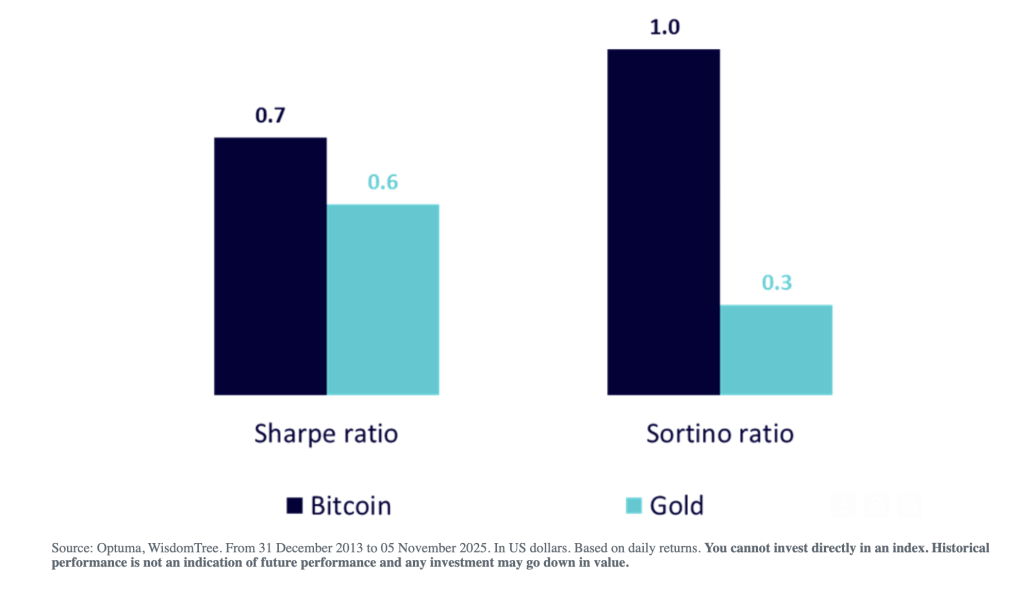
Bitcoin, however, has shifted the paradigm. Over the same period, it generated annualised returns of 50.5% with 67.0% volatility, resulting in a Sharpe ratio of 0.7 — marginally outperforming gold on a risk-adjusted basis despite its extreme swings.

On the Sortino ratio, which focuses on downside risk, the gap is even wider: 1.0 for bitcoin versus 0.3 for gold. In simple terms, bitcoin has historically compensated investors more efficiently for the risk taken.

“Even with high volatility, bitcoin has offered superior risk-adjusted returns,” Silenskyte notes.

Bitcoin Volatility: From Barrier to Manageable Risk

Bitcoin’s volatility is frequently cited as the primary reason some investors remain hesitant. Yet Silenskyte’s research shows that this volatility has declined significantly over the past decade. Its 90-day annualised volatility has compressed from above 150% to under 40%, putting it within range of several commodities.

At the same time, liquidity has deepened, with daily spot volumes comparable to major S&P 500 equities. Derivatives markets — particularly futures and options — provide sophisticated hedging tools that make volatility increasingly manageable for institutional allocators.

“Volatility is a tax, but a declining one,” Silenskyte says.

Macro Conditions Favour a Combined Allocation

Rather than competing, bitcoin and gold appear to hedge different types of macro risk. Gold thrives during inflation, geopolitical turmoil and periods of negative real yields. Bitcoin, with its 21-million-supply cap and decentralised issuance, serves as a hedge against fiat debasement and technological disruption.

Importantly, bitcoin and gold display a low long-term correlation of just 6%, according to WisdomTree. This gives them powerful diversification properties: gold anchors the defensive side of a portfolio, while bitcoin provides convex upside driven by digital adoption.

Portfolio Implications: Not Either-Or, but Both

WisdomTree’s modelling shows that adding even 1% bitcoin to a traditional 60/40 portfolio can increase the Sharpe ratio by 0.06, with only a marginal change in maximum drawdowns.

The takeaway from Silenskyte’s research is clear: gold remains foundational, but bitcoin enhances the opportunity set. As digital assets mature, the case for treating the two as complementary hedges — not rivals — becomes stronger.

Together, they broaden the safe-haven spectrum for the modern investor.

Market Opportunity
ERA Logo
ERA Price(ERA)
$0.1976
$0.1976$0.1976
-0.75%
USD
ERA (ERA) Live Price Chart
Disclaimer: The articles reposted on this site are sourced from public platforms and are provided for informational purposes only. They do not necessarily reflect the views of MEXC. All rights remain with the original authors. If you believe any content infringes on third-party rights, please contact service@support.mexc.com for removal. MEXC makes no guarantees regarding the accuracy, completeness, or timeliness of the content and is not responsible for any actions taken based on the information provided. The content does not constitute financial, legal, or other professional advice, nor should it be considered a recommendation or endorsement by MEXC.

You May Also Like

BlackRock boosts AI and US equity exposure in $185 billion models

BlackRock boosts AI and US equity exposure in $185 billion models

The post BlackRock boosts AI and US equity exposure in $185 billion models appeared on BitcoinEthereumNews.com. BlackRock is steering $185 billion worth of model portfolios deeper into US stocks and artificial intelligence. The decision came this week as the asset manager adjusted its entire model suite, increasing its equity allocation and dumping exposure to international developed markets. The firm now sits 2% overweight on stocks, after money moved between several of its biggest exchange-traded funds. This wasn’t a slow shuffle. Billions flowed across multiple ETFs on Tuesday as BlackRock executed the realignment. The iShares S&P 100 ETF (OEF) alone brought in $3.4 billion, the largest single-day haul in its history. The iShares Core S&P 500 ETF (IVV) collected $2.3 billion, while the iShares US Equity Factor Rotation Active ETF (DYNF) added nearly $2 billion. The rebalancing triggered swift inflows and outflows that realigned investor exposure on the back of performance data and macroeconomic outlooks. BlackRock raises equities on strong US earnings The model updates come as BlackRock backs the rally in American stocks, fueled by strong earnings and optimism around rate cuts. In an investment letter obtained by Bloomberg, the firm said US companies have delivered 11% earnings growth since the third quarter of 2024. Meanwhile, earnings across other developed markets barely touched 2%. That gap helped push the decision to drop international holdings in favor of American ones. Michael Gates, lead portfolio manager for BlackRock’s Target Allocation ETF model portfolio suite, said the US market is the only one showing consistency in sales growth, profit delivery, and revisions in analyst forecasts. “The US equity market continues to stand alone in terms of earnings delivery, sales growth and sustainable trends in analyst estimates and revisions,” Michael wrote. He added that non-US developed markets lagged far behind, especially when it came to sales. This week’s changes reflect that position. The move was made ahead of the Federal…
Share
BitcoinEthereumNews2025/09/18 01:44
SICAK GELİŞME: Binance, Üç Altcoini Vadeli İşlemlerde Listeliyor!

SICAK GELİŞME: Binance, Üç Altcoini Vadeli İşlemlerde Listeliyor!

Kripto para borsası Binance, ZKP, GUA ve IR tokenlerini vadeli işlemler platformunda listeleyeceğini açıkladı. *Yatırım tavsiyesi değildir. Kaynak: Bitcoinsistemi
Share
Coinstats2025/12/21 16:41
USDC Treasury mints 250 million new USDC on Solana

USDC Treasury mints 250 million new USDC on Solana

PANews reported on September 17 that according to Whale Alert , at 23:48 Beijing time, USDC Treasury minted 250 million new USDC (approximately US$250 million) on the Solana blockchain .
Share
PANews2025/09/17 23:51