

Must Read
Our economy, damaged enough as it is, won’t survive Duterte 2.0Our economy, damaged enough as it is, won’t survive Duterte 2.0
[In This Economy] Economic risks of a Sara Duterte presidency
For feedback or concerns regarding this content, please contact us at crypto.news@mexc.com
Sara Duterte’s announcement that she is running for president in 2028, unusually early even by Philippine electoral standards, is obviously a move designed to dominate the narrative, freeze out rivals, and project inevitability.
Admittedly, she’s faring well in the polls, and she’s leveraging on this fact to project power — even as impeachment complaints are piling up, even as her father awaits trial in The Hague, and even as many of her father’s closest allies, like Senators Bong Go and Bato Dela Rosa, have been explicitly named by the International Criminal Court (ICC) as “co-conspirators” in the drug war.
But here I want to explore what a Sara Duterte presidency might mean for the Philippine governance and the economy, given her own track record.
Mayor and vice president
Let’s start with her stint as mayor of Davao City. After the decades-long rule of Rodrigo Duterte, Sara inherited a well-oiled dynastic machine that rotated posts in her family to strategically circumvent term limits. Back in 2025, she said she’d support an anti-dynasty law, but in fact the Duterte dynasty expanded after the May 2025 polls.
As mayor, Sara also acted with an iron fist — literally involving a fist, in the case of physical assault on a court sheriff in 2011. That act, which was caught on tape and she publicly admitted to, is symptomatic of Sara’s comfort with coercion as a first-resort tool and a willingness to subordinate legal institutions to personal authority.
These instincts, if scaled to Malacañang, could have real consequences for the rule of law, contract enforcement, and institutional predictability. Her record suggests a governing style that prioritizes coercion over institutional restraint.
Sara Duterte’s time as vice president only deepens these governance concerns.
The confidential funds controversy at the Office of the Vice President and the Department of Education was not merely a political scandal but also a window into how she views checks and balances and fiscal oversight. Civilian agencies such as these are not supposed to have large, opaque intelligence-style budgets. By the looks of it, Sara has no real concern at all about fiscal responsibility, nor an understanding of the concept. This matters enormously given the budget scandals of late, and amid chronic deficits and debt.
In addition, she’s been essentially silent about allegations of P51-billion worth of flood control projects pushed by her brother, Paolo Duterte, who was a representative of the 1st District of Davao City in the 18th Congress. The radio silence on this issue is unsettling, and it suggests that efforts to pursue legitimate budget reforms and curb budget-related corruption will likely come to a halt under another Duterte presidency.
During her stint as education secretary, the picture is equally troubling. The Philippines entered the Marcos Jr. period with a severe learning crisis, with international test scores of our students among the worst globally, pandemic-era learning losses compounding decades of underinvestment, and a teaching workforce that needed serious structural reform.
Sara produced no coherent learning-recovery strategy. In an economy where human capital is the driver of long-run productivity, that omission is economically consequential.
Recall that she initially wanted to get the post of defense secretary, and early in her term in the Department of Education (DepEd), she held meetings with police and military personnel inside the DepEd compound. Then she pushed for a half-baked “Matatag Curriculum” whose rollout teachers called “chaotic.” Sara came and went, but she made no real changes in DepEd.
Economic prospects
What would a Sara Duterte presidency likely mean for the Philippine economy? I predict a return to the political-economy conditions that made the Rodrigo Duterte years so damaging, but with her own flavor of unpredictability layered on top.
Headline macroeconomic numbers held up in the early years of Rodrigo Duterte’s presidency, partly through inherited growth momentum. But institutional erosion accelerated underneath, and this inevitably spilled over to the economy. The drug war, for instance, frightened foreign observers and prospective investors, and consumed resources and policy attention that should have gone toward infrastructure quality, competition reform, and human capital formation. (READ: Oligarchs, taxes, POGOs: Big business and the economy under Duterte)
Rodrigo Duterte’s most serious economic failure was not a single bad policy but the steady degradation in governance: the weakening of checks on executive power, the politicization and militarization of independent agencies, and the normalization of opacity that makes sustained high growth structurally harder to achieve. Because of these governance failures, the pandemic response was botched and led to the country’s worst postwar recession and the worst downturn in Southeast Asia.
Sara’s record suggests she would continue that trajectory, not correct it. She has made no serious reckoning with the institutional and economic damage of 2016–2022. Her messaging emphasizes order, loyalty, and discipline. That’s the vocabulary of authority that his father espoused.
So far, she has also said nothing of real substance about the Philippines’ actual binding development constraints, like bottlenecks in infrastructure, logistics, and regulations; the cost of electricity, which remains among the highest in Asia and is a direct tax on manufacturing competitiveness; competition policy failures that sustain oligopolistic rents across utilities, shipping, and retail; and flagging human capital formation.
These are among the structural problems that explain why the Philippines consistently underperforms its regional peers on manufacturing employment and productivity growth. A president with no coherent economic strategy does not inspire confidence, and even poses a real threat to our growth and development prospects.
A Sara Duterte presidency would almost certainly generate the same investor wariness her father’s did: not necessarily capital flight, but a higher risk premium, a hesitation, a preference for waiting-and-seeing that shows up eventually in economic statistics. In practical terms, that might show up in slower capital formation, a decline in foreign direct investments, and poor job creation. We already saw some of this during her father’s time, and the last thing we want is a repeat of that.
There is also the external factor. Under Sara Duterte, Philippine foreign policy will likely tilt in favor of China again. This carries strong economic implications: heightened geopolitical risk in the West Philippine Sea (hurting our ability to explore the region and use up the natural resources there), investor confidence, and long-run strategic positioning in regional supply chains.
To sum, as early as now it’s easy to see that a Sara Duterte presidency will have massive economic and social impacts. I’m particularly worried about our economy. In the run-up to 2050, policies should be focusing on boosting learning competencies, reducing the costs of doing business, pursuing sustainable energy, etc. But if we make the same mistakes as before, we will descend headlong not just into a repeat of authoritarian populism and institutional erosion, but also more years of economic malaise. (Funnily, Sara Duterte’s announcement of her presidential bid came on the same day I was discussing the economic impact of “country risk” in my macroeconomics class.)
The Philippines came out of the pandemic with a real opportunity to reset its growth trajectory. That opportunity is narrowing with every election cycle that produces ill outcomes. The way I see it, our economy, damaged enough as it is, won’t survive Duterte 2.0. – Rappler.com
Dr. JC Punongbayan is an assistant professor at the UP School of Economics and the author of False Nostalgia: The Marcos “Golden Age” Myths and How to Debunk Them. In 2024, he received The Outstanding Young Men (TOYM) Award for economics. Follow him on Instagram (@jcpunongbayan).
Click here for more In This Economy by JC Punongbayan articles.


Disclaimer: The articles reposted on this site are sourced from public platforms and are provided for informational purposes only. They do not necessarily reflect the views of MEXC. All rights remain with the original authors. If you believe any content infringes on third-party rights, please contact crypto.news@mexc.com for removal. MEXC makes no guarantees regarding the accuracy, completeness, or timeliness of the content and is not responsible for any actions taken based on the information provided. The content does not constitute financial, legal, or other professional advice, nor should it be considered a recommendation or endorsement by MEXC.
You May Also Like

Palantir (PLTR) Stock Plunges 20% in 2026 — Analysts Signal Strong Buy Opportunity
The post Palantir (PLTR) Stock Plunges 20% in 2026 — Analysts Signal Strong Buy Opportunity appeared on BitcoinEthereumNews.com. Quick Overview Palantir shares
Share
BitcoinEthereumNews2026/04/26 01:25

The Chemistry of UV Resistance: How Titanium Dioxide Protects Against the California Sun
Homeowners considering synthetic boundary systems frequently voice a singular, pervasive concern: “Will the material turn yellow and brittle after a few years in
Share
Techbullion2026/04/02 18:06
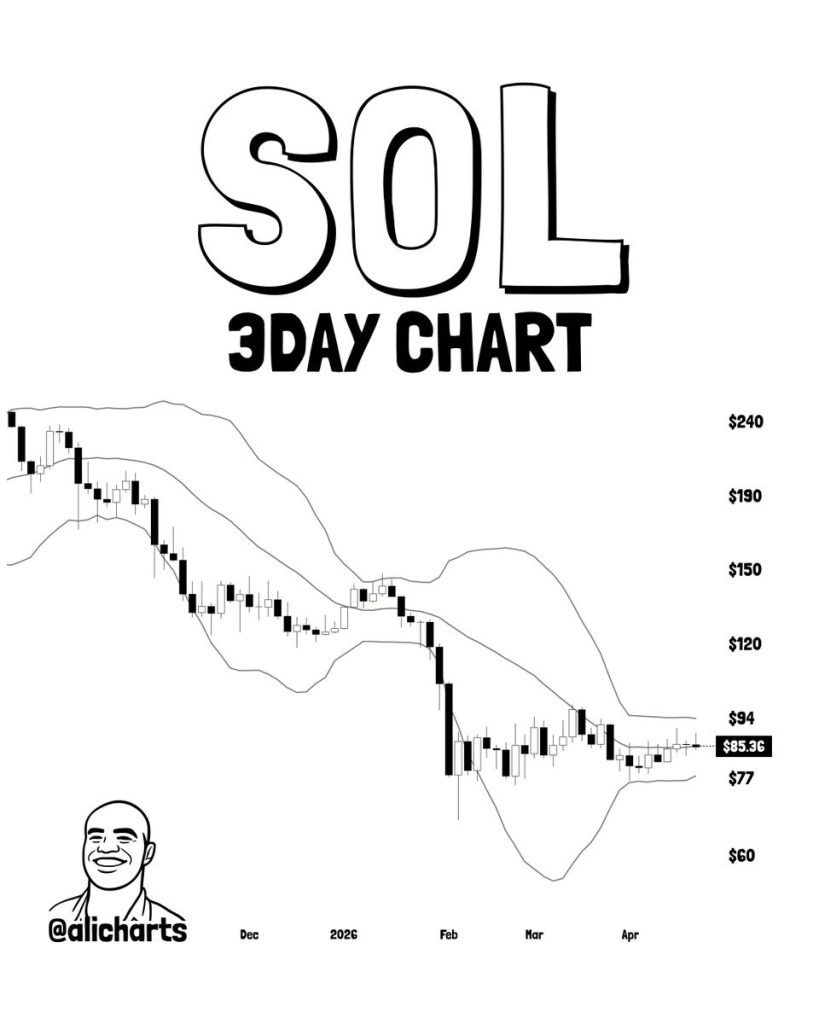
Solana (SOL) Price Looks Trapped, But This Bullish Signal Just Flashed – Here’s the Outlook
The SOL price is trading near $85, stuck in a tight range between $77 and $94. That is a 71% discount from its all time high. Ali Martinez notes that the Bollinger
Share
Captainaltcoin2026/04/26 01:00



