The 3DIML approach uses a three-step pipeline to convert erratic 2D instance masks into logical 3D instance segmentations. To ensure consistent object classification in spite of segmentation noise, InstanceMap uses a scalable mask association graph based on extended hLoc to associate masks across pictures in the first stage. After resolving ambiguities with a label NeRF, InstanceLift refines these pseudolabels. A quick post-processing step then effectively combines labels that are in disagreement.The 3DIML approach uses a three-step pipeline to convert erratic 2D instance masks into logical 3D instance segmentations. To ensure consistent object classification in spite of segmentation noise, InstanceMap uses a scalable mask association graph based on extended hLoc to associate masks across pictures in the first stage. After resolving ambiguities with a label NeRF, InstanceLift refines these pseudolabels. A quick post-processing step then effectively combines labels that are in disagreement.

Consistent 3D Mask Labeling Made Simple

Abstract and I. Introduction

II. Background

III. Method

IV. Experiments

V. Conclusion and References

\

III. METHOD

Given a sequence of N posed RGB images, (Ii , Ti) where I denotes the image and T pose, we first extract viewinconsistent instance masks Mi using a generic instance segmentation model such as Mask2Former or SAM.

\ A. Mask Association

\ We first generate pseudolabel masks with InstanceMap. Formally, define ϕ(M, r) to map a mask M and region r to a consistent label for the same 3D object across different masks and regions. We extend the popular hLoc [16] framework for scalable 3D reconstruction to mask association as follows:

\
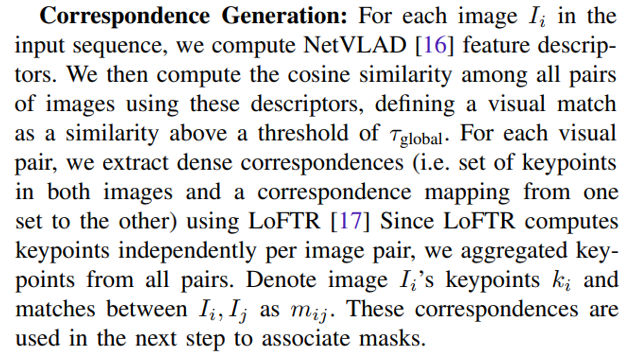
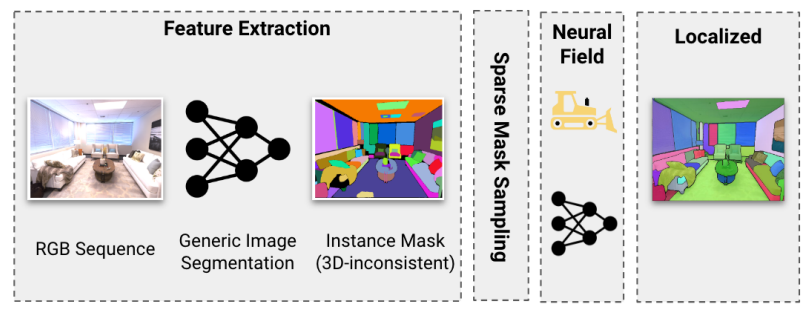
\ Fig. 2: Overview of 3DIML. A sequence of color images is segmented into object instances by an image segmentation backbone. The resulting masks produced are fed into InstanceMap, which produces instance masks consistent over all frames. These pseudo instance masks and their respective camera poses are used to supervise an instance label NeRF, which further improves consistency and resolves ambiguity present in the InstanceMap outputs. The feature extraction and global data association blocks together form InstanceMap.
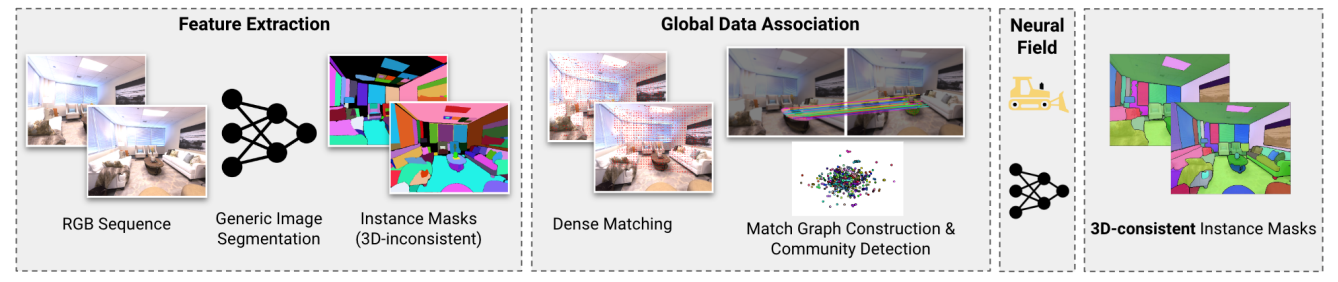
\ Since NetVLAD and LoFTR don’t have 3D information, 3DIML only performs well if each image in the scan sequence contains enough context for these models. We observe empirically a good rule of thumb is to have at least one other recognizable landmark for frames containing near-identical objects.

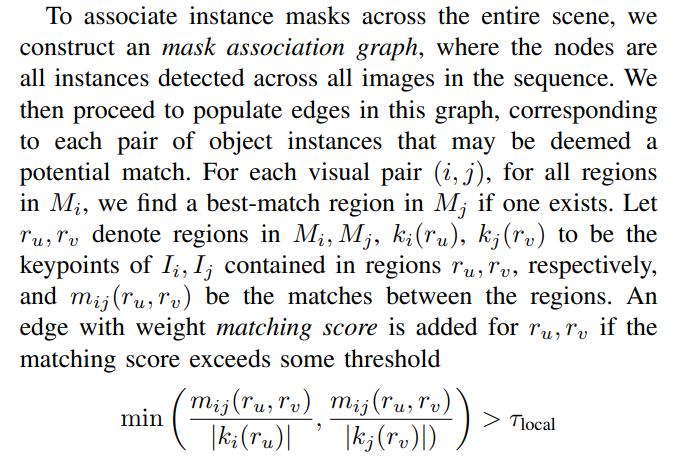
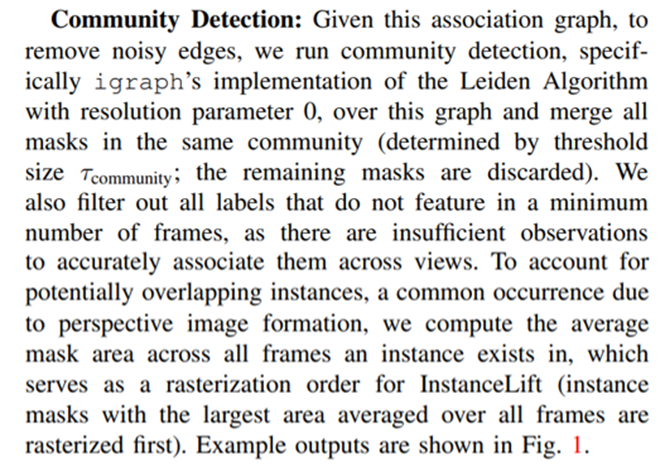
\ Mask Association Graph: Insofar, our approach produces instance masks and dense pixel correspondences among images that share a visual overlap. However, segmentation models such as SAM [2] suffer multiple issues: (a) segmentations of the same object need not be consistent across images, owing to viewpoint and appearance variations; and (b) owing to over-segmentation of objects, there isn’t usually a one-one correspondence among masks.

\
\
\ B. Mask Refinement

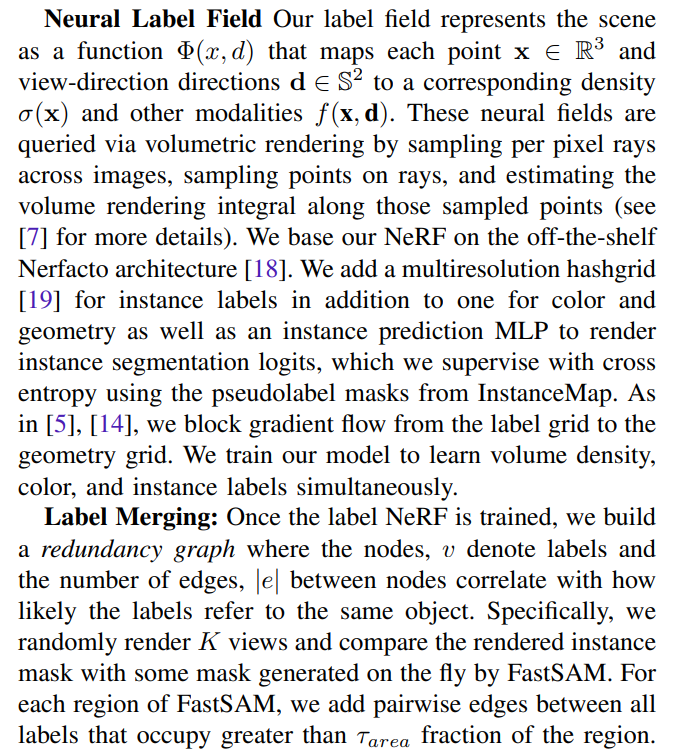
\ ϕ(M, r) is inherently noisy due to varying segmentation hierarchies for different instance masks due to differing viewpoints as well as design specifics. To address this, in InstanceLift we feed the pseudolabel masks to a label NeRF, which resolves some ambiguities. Still, NeRF cannot handle extreme cases of label ambiguity, to which we devise a fast post-processing method that determines and merges colliding labels based on random renders from the label NeRF. The few remaining, if any, ambiguities can be corrected via sparse human annotation.

\
\ Fig. 3: InstanceLoc enables 3D-consistent instance segmentation for novel views of the scene unobserved by the InstanceMap pipeline. We leverage off-the-shelf instance segmentation models to first produce 3D-inconsistent instance labels for a new input image. We then query the label field over a sparse set of points on the image and use this to localize each 2D instance mask i.e., assign a 3Dconsistent label to each mask.
\ Post graph construction, we merge labels a, b if

\

\ Since we only need coarse information i.e. instance mask noise, we render images downsampled by a factor of 2.

\ C. Fast Instance Localization and Rendering

\ Training a label field enables us to predict 3D-consistent instance labels for novel viewpoints without rerunning 3DIML. However, rendering every pixel is slow, and rendering from a novel viewpoint is often noisy. We propose a fast localization approach that instead precomputes instance masks for the input image using an instance segmentation model (here FastSAM [8]). Given this instance mask, for each instance region, we sample the corresponding pixelwise 3D object labels from the label NeRF and take the majority label. Another benefit is that the input instance masks can be constructed using prompts and edited before localization.

\

:::info Authors:

(1) George Tang, Massachusetts Institute of Technology;

(2) Krishna Murthy Jatavallabhula, Massachusetts Institute of Technology;

(3) Antonio Torralba, Massachusetts Institute of Technology.

:::


:::info This paper is available on arxiv under CC by 4.0 Deed (Attribution 4.0 International) license.

:::

\

Market Opportunity
Mask Network Logo
Mask Network Price(MASK)
$0.5801
$0.5801$0.5801
+1.16%
USD
Mask Network (MASK) Live Price Chart
Disclaimer: The articles reposted on this site are sourced from public platforms and are provided for informational purposes only. They do not necessarily reflect the views of MEXC. All rights remain with the original authors. If you believe any content infringes on third-party rights, please contact service@support.mexc.com for removal. MEXC makes no guarantees regarding the accuracy, completeness, or timeliness of the content and is not responsible for any actions taken based on the information provided. The content does not constitute financial, legal, or other professional advice, nor should it be considered a recommendation or endorsement by MEXC.

You May Also Like

Fundstrat’s Internal Report Contradicts CIO Tom Lee’s Bold Crypto Forecasts

Fundstrat’s Internal Report Contradicts CIO Tom Lee’s Bold Crypto Forecasts

The post Fundstrat’s Internal Report Contradicts CIO Tom Lee’s Bold Crypto Forecasts appeared on BitcoinEthereumNews.com. Key Points: Fundstrat internal report
Share
BitcoinEthereumNews2025/12/21 13:19
SEC Backs Nasdaq, CBOE, NYSE Push to Simplify Crypto ETF Rules

SEC Backs Nasdaq, CBOE, NYSE Push to Simplify Crypto ETF Rules

The US SEC on Wednesday approved new listing rules for major exchanges, paving the way for a surge of crypto spot exchange-traded funds. On Wednesday, the regulator voted to let Nasdaq, Cboe BZX and NYSE Arca adopt generic listing standards for commodity-based trust shares. The decision clears the final hurdle for asset managers seeking to launch spot ETFs tied to cryptocurrencies beyond Bitcoin and Ether. In July, the SEC outlined how exchanges could bring new products to market under the framework. Asset managers and exchanges must now meet specific criteria, but will no longer need to undergo drawn-out case-by-case reviews. Solana And XRP Funds Seen to Be First In Line Under the new system, the time from filing to launch can shrink to as little as 75 days, compared with up to 240 days or more under the old rules. “This is the crypto ETP framework we’ve been waiting for,” Bloomberg research analyst James Seyffart said on X, predicting a wave of new products in the coming months. The first filings likely to benefit are those tracking Solana and XRP, both of which have sat in limbo for more than a year. SEC Chair Paul Atkins said the approval reflects a commitment to reduce barriers and foster innovation while maintaining investor protections. The move comes under the administration of President Donald Trump, which has signaled strong support for digital assets after years of hesitation during the Biden era. New Standards Replace Lengthy Reviews And Repeated Denials Until now, the commission reviewed each application separately, requiring one filing from the exchange and another from the asset manager. This dual process often dragged on for months and led to repeated denials. Even Bitcoin spot ETFs, finally approved in Jan. 2024, arrived only after years of resistance and a legal battle with Grayscale. According to Bloomberg ETF analyst Eric Balchunas, the streamlined rules could apply to any cryptocurrency with at least six months of futures trading on the Coinbase Derivatives Exchange. That means more than a dozen tokens may now qualify for listing, potentially unleashing a new wave of altcoin ETFs. SEC Clears Grayscale Large Cap Fund Tracking CoinDesk 5 Index The SEC also approved the Grayscale Digital Large Cap Fund, which tracks the CoinDesk 5 Index, including Bitcoin, Ether, XRP, Solana and Cardano. Alongside this, it cleared the launch of options linked to the Cboe Bitcoin US ETF Index and its mini contract, broadening the set of crypto-linked derivatives on regulated US markets. Analysts say the shift shows how far US policy has moved. Where once regulators resisted digital assets, the latest changes show a growing willingness to bring them into the mainstream financial system under established safeguards
Share
CryptoNews2025/09/18 12:40
Bank of Canada cuts rate to 2.5% as tariffs and weak hiring hit economy

Bank of Canada cuts rate to 2.5% as tariffs and weak hiring hit economy

The Bank of Canada lowered its overnight rate to 2.5% on Wednesday, responding to mounting economic damage from US tariffs and a slowdown in hiring. The quarter-point cut was the first since March and met predictions from markets and economists. Governor Tiff Macklem, speaking in Ottawa, said the decision was unanimous. “With a weaker economy […]
Share
Cryptopolitan2025/09/17 23:09