Can markets trust the jobs report? Another revision risk hangs over Bitcoin’s macro test
At 8:30 on a Friday morning, the Bureau of Labor Statistics dropped one of the more surprising jobs reports of the past year. The US economy added 178,000 jobs in March, and the unemployment rate ticked down to 4.3%.
When put against a Wall Street consensus calling for roughly 57,000 nonfarm payrolls, the number was an especially emphatic beat. It was the strongest monthly gain since the end of 2024, higher than every estimate in Bloomberg's recent surveys.
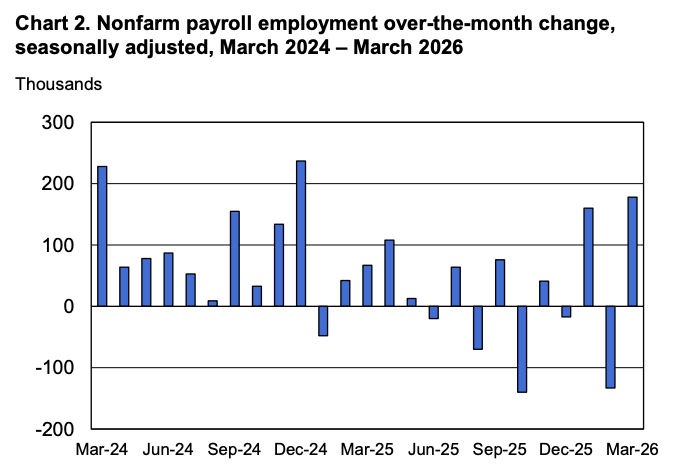 Chart showing the seasonally adjusted MoM change for non-farm payroll employment from March 2024 to March 2026 (Source: BLS)
But it came with a slight problem: nobody on Wall Street can actually do anything about it.
Why this matters: A stronger labor print usually pushes rate-cut expectations further out, which can pressure risk assets across stocks and crypto. With traditional markets shut, Bitcoin became the only major venue where that macro shock could start getting priced in ahead of Monday.
NYSE, Nasdaq, and bond markets were closed in observance of Good Friday, sealing off every traditional channel through which a data surprise like this would normally be absorbed and repriced.
For one of the most market-sensitive economic prints on the calendar, the timing couldn't have been more off.
That's why what follows is going to be a rare and instructive moment: a forced experiment in what price discovery looks like when all the normal machinery is offline.
February had been a disaster. The economy lost 92,000 jobs that month, nearly double the expectations, marking the fourth monthly job loss in nine months. The revisions compounded the damage: December was revised down by 65,000, from +48,000 to -17,000, and January was revised down by a further 4,000.
Heading into Friday, even the most optimistic forecasters weren't calling for anything like a rebound of this scale.
Much of March's gain came from healthcare. A strike of healthcare workers had pulled February's payrolls down, and the sector added 76,000 jobs in March to push overall job growth higher. Positions were also added in construction, transportation, and warehousing.
While the bounce itself was real, it's important to note that a big part of the growth was mechanical, a catch-up from previous disruptions rather than evidence of a suddenly recovered economy.
Still, 178,000 jobs against expectations of 57,000 isn't a rounding error. The implications for the Federal Reserve's policy were immediate and precise: if the numbers come in strong, crypto prices will fall because interest rate expectations rise.
Stronger labor data reduces the Fed's space to cut rates, and tighter financial conditions ripple through every risk asset. So the question here wasn't whether markets would react, but which markets, specifically, were still open to react at all.
When the NYSE goes dark, Bitcoin becomes the market
Bitcoin remained the only major financial market still trading as the March report landed at 8:30 AM ET, with the NYSE closed and sentiment sitting at extreme fear levels. The crypto Fear and Greed Index had printed at 9 out of 100 on Apr. 3, a reading so low that it doesn't even signal panic anymore, but something closer to exhausted resignation. Bitcoin touched $66,300 in the morning, with traders seemingly focused on the incoming data.
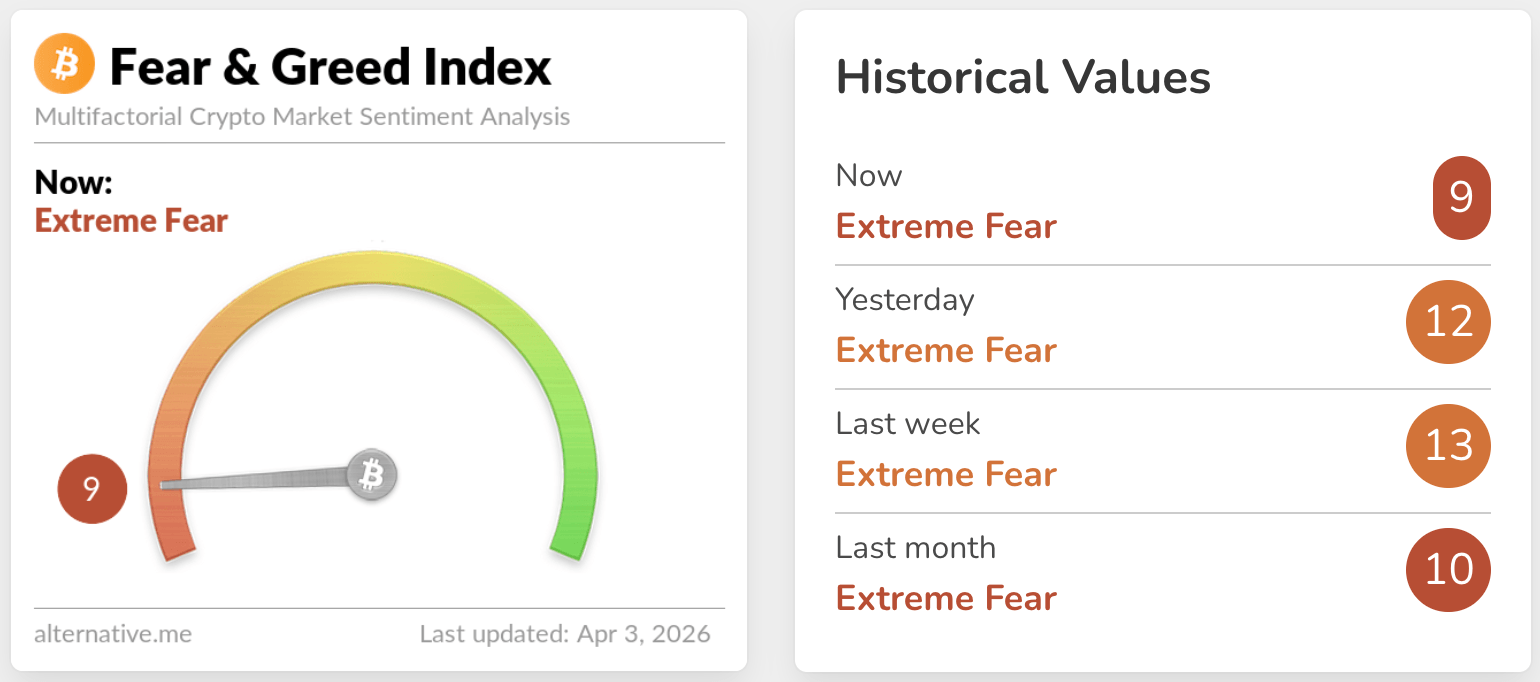 Crypto fear and greed index on Apr. 3, 2026 (Source: Alternative.me)
And when the number hit, Bitcoin went nowhere.
The hot jobs print wasn't bullish or bearish per se. It was complicated, and Bitcoin, in its flatness, reflected that complexity with more fidelity than a knee-jerk rally or selloff would have.
Consider what the report contained beneath its surface. Long-term unemployment stood at 1.8 million, up 322,000 over the year. Federal government employment, under relentless contraction, continued to fall. The ongoing war with Iran still threatens to strain a delicate labor market, and developments in AI that lead to mass layoffs add further uncertainty.
As Moody's chief credit officer, Atsi Sheth, noted in their baseline for 2026, a weaker job market is expected, but not one where unemployment rises enough to tip the economy into recession.
There's also one more complication. The same release that delivered 178,000 jobs also revised December's figure down by 65,000, and January's down by 4,000, erasing nearly 70,000 jobs that markets had already priced and moved on from.
This has the potential to become a pattern. The BLS has revised recent months downward with enough consistency that the March number now carries a built-in caveat: it may look considerably less impressive when April's report arrives.
Treasuries, the dollar, and the Fed's rate-hold calculus all hardened on 178,000. If that number is revised to 130,000 next month, every one of those reactions will have been calibrated against incorrect data.
The Fed has no chair, the market has no floor, and Monday has no script
Jerome Powell described the labor market in March as sitting in a “zero-employment growth equilibrium” with a feel of downside risk.
He said that before this report came out. Now, with 178,000 jobs on the ledger, the Fed's calculus shifts, not dramatically, but measurably toward holding rates higher for longer. With Powell's term ending May 15 and no confirmed successor yet, the Fed has to navigate one of the most important data weeks of 2026 without clear leadership.
Into that vacuum, the 10-year Treasury yield rose roughly four basis points to 4.35%, and the dollar edged upward: both consistent with a market reading that rate cuts are receding further into the future. These were the first legible reactions, not from the institutions that usually set the tone, but from the open edges of the financial system.
Bitcoin will price this number alone for nearly three full days before equity trading resumes on April 6.
When the opening bell rings Monday morning, stocks will be absorbing not only a jobs report that surprised every forecaster, but also whatever develops over the Easter weekend in a geopolitical environment that remains acutely fragile, with an ongoing Iran conflict still reshaping oil prices and the dollar simultaneously.
Bitcoin's stillness means that the market is holding a position, aware that any verdict rendered now may need to be revised entirely by what Monday brings.
The real judgment on March's jobs report will arrive when the institutions that normally lead this conversation are finally allowed back in the room. Until then, the numbers belong to the bond market, the foreign exchange desks, and the one financial market that does not observe holidays.
For three days, Bitcoin is the only clock still ticking. The question is whether it keeps accurate time.
The post Can markets trust the jobs report? Another revision risk hangs over Bitcoin’s macro test appeared first on CryptoSlate.


You May Also Like

LPA brings rain to Visayas, Southern Luzon as it nears landmass

Pacquiao insists Mayweather fight for real, shuns exhibition insinuation