Ether treasury managers are increasingly looking beyond straightforward staking rewards to extract higher yields, with liquid staking and other active deploymentEther treasury managers are increasingly looking beyond straightforward staking rewards to extract higher yields, with liquid staking and other active deployment

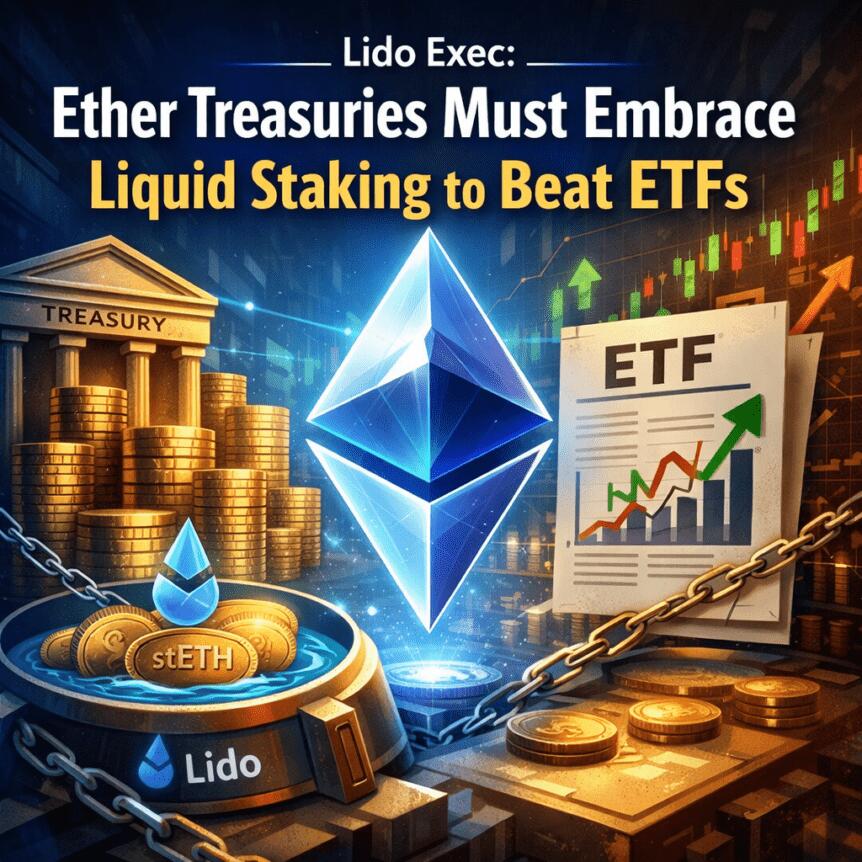
Lido Exec: Ether Treasuries Must Embrace Liquid Staking to Beat ETFs
For feedback or concerns regarding this content, please contact us at crypto.news@mexc.com
Lido Exec: Ether Treasuries Must Embrace Liquid Staking To Beat Etfs

Ether treasury managers are increasingly looking beyond straightforward staking rewards to extract higher yields, with liquid staking and other active deployment strategies moving into the mainstream playbook. Speaking at ETHCC 2026, Kean Gilbert, head of institutional relations at Lido Finance, highlighted liquid staking as a pathway for treasuries to earn extra returns while maintaining exposure to ETH staking benefits.

In the United States, listed staking products for Ether have proliferated, and public disclosures show treasuries experimenting with a blend of staking approaches. The current landscape includes several exchange-traded or registered products that package staked ETH into visible yields, alongside native staking options. As investors compare these vehicles, the underlying economics remain uneven, with different structures and fees complicating apples-to-apples judgments about potential returns.

Key takeaways

  • Liquid staking offers a transferable token that can be deployed elsewhere in DeFi while ETH remains staked, enabling yield-enhancing strategies beyond simple staking rewards.
  • Treasury managers are weighing active deployment methods—such as posting ETH as collateral and borrowing against it—as potential sources of higher return relative to passive staking vehicles.
  • Public filings show real-world adoption of liquid-staking alongside native staking, with companies reporting notable portions of rewards attributable to liquid-staking activity.
  • The U.S. ETF landscape for staked ETH has grown, but reported yields vary across products, and several datasets indicate that direct yield comparisons are not straightforward.
  • Analysts emphasize that actively managed treasury strategies offer potential premium through dynamic deployment, even if headline yields on ETFs don’t directly mirror on-chain staking rewards.

Active yield and the logic of liquid staking

Liquid staking, at its core, allows Ether holders to stake their assets while receiving a tradeable token representing their staked position. That token can be used across DeFi protocols, giving treasuries a path to generate additional yield without surrendering staking exposure. At ETHCC 2026, Gilbert framed liquid staking as a viable mechanism for treasury desks to pursue incremental returns by layering on additional strategies on top of the basic staking rewards.

Beyond simply staking, some treasury operations are considering using ETH as collateral to borrow against it, enabling a form of leverage that could boost overall yield if managed prudently. In practice, this means treasuries may activate a range of DeFi primitives—collateralized loans, liquidity provision, and cross- protocol basis trading—to capture returns that passive staked ETH products alone cannot deliver.

That perspective comes from Jimmy Xue, co-founder and chief operating officer of Axis, a quantitative yield platform. He adds that the premium reflected in a mutualized treasury’s market value—often described as a market net asset value or mNAV premium—signals investor confidence in a manager’s ability to deploy a treasurer’s ETH treasury across opportunities as they emerge. In his view, basis trading and related strategies can be major yield sources for treasury-oriented products, helping to bridge the gap between simple staking rewards and the full spectrum of deployed yields.

Yield figures and the ETF contrast

The current U.S. ETF lineup for staked Ether includes a set of products that publicly disclose staking economics, but direct comparisons to on-chain staking returns are not straightforward. Among notable offerings are:

  • REX-Osprey ETH + Staking ETF, which launched in September 2025.
  • Grayscale’s Ethereum Staking ETF and Ethereum Staking Mini ETF.
  • BlackRock’s iShares Staked Ethereum Trust ETF, introduced on March 12.

Issuer disclosures reveal varying fee structures and payout assumptions, which complicates simple yield comparisons. For example, Grayscale’s Ethereum Trust pages show net staking rewards around 2.26% as of April 6, while Grayscale’s ETH Staking product page lists about 2.56% as of April 2. By contrast, on-chain native ETH staking yields have hovered around 2.7% to 2.8% per year according to data from Staking Rewards. The discrepancy underscores how ETF mechanics—management fees, hedges, and the timing of reward accrual—shape reported yields even when the underlying staking economics are similar.

As Xue noted, the real value proposition of an actively managed treasury is not simply the headline yield but the ability to deploy capital from spot inventory across opportunities as they arise. This view aligns with the broader market trend of treasury desks seeking to convert passive staking into diversified, yield-enhancing activity through liquid staking and related strategies.

Glass‑door into real-world adoption: Sharplink and BTCS

Public disclosures provide a rare window into how Ether treasuries are actually deploying liquid-staking strategies. Sharplink Gaming, the second-largest Ether holder by reported holdings, disclosed that it had staked 14,516 ETH as of March, generating roughly 30.8 million dollars in staking rewards. Of those rewards, about one-third were attributed to liquid staking, with the remaining two-thirds stemming from native staking, according to a March 1 filing with the U.S. Securities and Exchange Commission. It’s worth noting that Sharplink’s broader 2025 results showed a material net loss—about $734 million—driven by the downturn in the crypto market during the year’s latter half. The filing provides a tangible backdrop to the tension between mark-to-market losses and staking yield, a dynamic that treasury desks must manage in real time.

BTCS Inc., ranked among the larger Ether treasuries by returns, has also integrated liquid staking into its program. The company holds 29,122 ETH and has liquid-staked 4,160 ETH through Rocket Pool nodes, a figure disclosed in a July 2025 SEC filing. That mix illustrates how treasuries blend native staking with liquid staking to diversify revenue streams and preserve liquidity while maintaining exposure to Ether’s yield potential.

Market observers have approached these disclosures with caution, recognizing that each firm’s structure—and the data they publish—reflects unique risk profiles, governance practices, and fee frameworks. Yet the trend is clear: treasury operations are increasingly reporting and quantifying liquid-staking activity as a meaningful component of total yield generation, rather than treating it as a separate, marginal strategy.

Where the space goes from here

As more Ether treasury players disclose their strategies, the debate over what constitutes the best approach will intensify. The ETF route provides visibility and regulatory clarity for investors seeking traditional, paper-traded exposure to staked ETH; liquid staking and other active yield methods offer potential upside through more dynamic management, albeit with higher complexity and counterparty considerations. The field is at a point where the lines between passive exposure and active treasury management are increasingly blurred, and investors are paying attention to who can consistently convert ETH into productive capital deployments.

ETHCC 2026 underscored that the conversation around liquid staking is transitioning from niche experimentation to a standard item on treasuries’ flight plans. For many market participants, the critical question is not only whether liquid staking can outperform passive staking on a headline basis but whether treasury managers can reliably manage risk and liquidity while pursuing higher, more diversified yields.

Looking ahead, investors and builders should watch several developments: the pace at which more treasuries disclose liquid-staking activity; how ETF providers adjust for complexities in yield reporting and fee structures; and how risk management frameworks evolve as treasuries deploy capital across collateralized and leverage-based strategies. If the past year offers a guide, the next chapter of Ether treasury management will hinge on transparent disclosures, prudent risk-taking, and the ability to translate sophisticated yield engineering into durable, risk-adjusted returns.

As the market weighs these approaches, one certainty remains: the sophistication of Ether treasuries is rising, and liquid staking is no longer a niche feature but a core instrument in the ongoing quest to turn ETH in all its forms into productive capital.

This article was originally published as Lido Exec: Ether Treasuries Must Embrace Liquid Staking to Beat ETFs on Crypto Breaking News – your trusted source for crypto news, Bitcoin news, and blockchain updates.


Market Opportunity
Audiera Logo
Audiera Price(BEAT)
$0,98713
$0,98713$0,98713
-4,02%
USD
Audiera (BEAT) Live Price Chart

AI Strategy: Powered 24/7

AI Strategy: Powered 24/7AI Strategy: Powered 24/7

Generate automated strategies using natural language

Disclaimer: The articles reposted on this site are sourced from public platforms and are provided for informational purposes only. They do not necessarily reflect the views of MEXC. All rights remain with the original authors. If you believe any content infringes on third-party rights, please contact crypto.news@mexc.com for removal. MEXC makes no guarantees regarding the accuracy, completeness, or timeliness of the content and is not responsible for any actions taken based on the information provided. The content does not constitute financial, legal, or other professional advice, nor should it be considered a recommendation or endorsement by MEXC.

You May Also Like

Ethereum koers toont zeldzaam dubbel koopsignaal en richt zich op $4.550

Ethereum koers toont zeldzaam dubbel koopsignaal en richt zich op $4.550

Connect met Like-minded Crypto Enthusiasts! Connect op Discord! Check onze Discord   Ethereum laat op de uurgrafiek twee opeenvolgende TD Sequential koopsignalen zien. Deze indicator meet uitputting in een trend en geeft vaak een signaal dat de verkoopdruk kan afnemen. Dit dubbele signaal verschijnt rond het niveau van $4.516, waar de ETH prijs kortstondig steun vindt. Dit type formatie komt zelden voor en wordt daarom extra nauwlettend gevolgd. Wat gaat de Ethereum koers hiermee doen? Ethereum koers test steun rond $4.516 De scherpe daling van de Ethereum koers vanaf de prijszone rond $4.800 bracht de ETH prijs in korte tijd naar ongeveer $4.516. Op dit niveau trad duidelijke koopactiviteit op, waardoor de neerwaartse beweging tijdelijk werd gestopt. Het dubbele signaal dat door de TD Sequential indicator is gegenereerd, viel precies samen met dit prijspunt. De TD Sequential is opgebouwd uit negen candles die een trend meetellen. Wanneer de negende candle verschijnt, kan dit duiden op een trendomslag. In dit geval verschenen zelfs twee signalen kort na elkaar, wat aangeeft dat de verkoopdruk mogelijk uitgeput is. Het feit dat dit gebeurde in een zone waar ETH kopers actief bleven, maakt het patroon extra opvallend. TD Sequential just flashed two buy signals for Ethereum $ETH! pic.twitter.com/JPO8EhiEPi — Ali (@ali_charts) September 16, 2025 Welke crypto nu kopen?Lees onze uitgebreide gids en leer welke crypto nu kopen verstandig kan zijn! Welke crypto nu kopen? Fed-voorzitter Jerome Powell heeft aangekondigd dat de rentes binnenkort zomaar eens omlaag zouden kunnen gaan, en tegelijkertijd blijft BlackRock volop crypto kopen, en dus lijkt de markt klaar om te gaan stijgen. Eén vraag komt telkens terug: welke crypto moet je nu kopen? In dit artikel bespreken we de munten die… Continue reading Ethereum koers toont zeldzaam dubbel koopsignaal en richt zich op $4.550 document.addEventListener('DOMContentLoaded', function() { var screenWidth = window.innerWidth; var excerpts = document.querySelectorAll('.lees-ook-description'); excerpts.forEach(function(description) { var excerpt = description.getAttribute('data-description'); var wordLimit = screenWidth wordLimit) { var trimmedDescription = excerpt.split(' ').slice(0, wordLimit).join(' ') + '...'; description.textContent = trimmedDescription; } }); }); Technische indicatoren schetsen herstelkans voor ETH Naast de dubbele koopsignalen verstrekken ook andere indicatoren belangrijke aanwijzingen. Tijdens de daling van de ETH koers waren grote rode candles zichtbaar, maar na de test van $4.516 stabiliseerde de Ethereum koers. Dit wijst op een mogelijke verschuiving in het evenwicht tussen de bears en bulls. Als deze opwaartse beweging doorzet, liggen de eerste weerstanden rond $4.550. Daarboven wacht een sterkere zone rond $4.650. Deze niveaus zijn in eerdere Ethereum sessies al meerdere keren getest. Een doorbraak zou ruimte openen richting de all-time high van ETH rond $4.953. Wanneer de prijs toch opnieuw onder $4.516 zakt, liggen er zones rond $4.500 en $4.450 waar grotere kooporders worden verwacht. Deze niveaus kunnen als een vangnet fungeren, mocht de druk opnieuw toenemen. Marktdynamiek bevestigt technische indicatoren De huidige situatie volgt op een bredere correctie in de cryptomarkt. Verschillende vooraanstaande crypto tokens zagen scherpe koersdalingen, waarna traders op zoek gingen naar signalen voor een mogelijke ommekeer. Dat juist Ethereum nu een dubbel TD Sequential signaal toont, versterkt de interesse in dit scenario. Fundamenteel blijft Ethereum sterk. Het aantal ETH tokens dat via staking is vastgezet, blijft groeien. Dat verkleint de vrije circulatie en vermindert verkoopdruk. Tegelijk blijft het netwerk intensief gebruikt voor DeFi, NFT’s en stablecoins. Deze activiteiten zorgen voor een stabiele vraag naar ETH, ook wanneer de prijs tijdelijk onder druk staat. Fundamentele drijfveren achter de Ethereum koers De Ethereum koers wordt echter niet alleen bepaald door candles en patronen, maar ook door bredere factoren. Een stijgend percentage van de totale ETH supply staat vast in staking contracten. Hierdoor neemt de liquiditeit op exchanges af. Dit kan prijsschommelingen versterken wanneer er plotseling meer koopdruk ontstaat. Daarnaast is Ethereum nog steeds het grootste smart contract platform. Nieuwe standaarden zoals ERC-8004 en ontwikkelingen rond layer-2 oplossingen houden de activiteit hoog. Deze technologische vooruitgang kan de waardepropositie ondersteunen en zo indirect bijdragen aan een ETH prijsherstel. Het belang van de korte termijn dynamiek De komende handelsdagen zullen duidelijk maken of de bulls genoeg kracht hebben om door de weerstandszone rond $4.550 te breken. Voor de bears ligt de focus juist op het verdedigen van de prijsregio rond $4.516. De whales, die met grote handelsorders opereren, kunnen hierin een beslissende rol spelen. Het dubbele TD Sequential signaal blijft hoe dan ook een zeldzame gebeurtenis. Voor cryptoanalisten vormt het een objectief aanknopingspunt om de kracht van de huidige Ethereum trend te toetsen. Vooruitblik op de ETH koers Ethereum liet twee opeenvolgende TD Sequential signalen zien op de uurgrafiek, iets wat zelden voorkomt. Deze formatie viel samen met steun rond $4.516, waar de bulls actief werden. Als de Ethereum koers boven dit niveau blijft, kan er ruimte ontstaan richting $4.550 en mogelijk $4.650. Zakt de prijs toch opnieuw onder $4.516, dan komen $4.500 en $4.450 in beeld als nieuwe steunzones. De combinatie van zeldzame indicatoren en een sterke fundamentele basis maakt Ethereum interessant voor zowel technische als fundamentele analyses. Of de bulls het momentum echt kunnen overnemen, zal blijken zodra de Ethereum koers de eerstvolgende weerstanden opnieuw test. Koop je crypto via Best Wallet Best wallet is een topklasse crypto wallet waarmee je anoniem crypto kan kopen. Met meer dan 60 chains gesupport kan je al je main crypto coins aanschaffen via Best Wallet. Best wallet - betrouwbare en anonieme wallet Best wallet - betrouwbare en anonieme wallet Meer dan 60 chains beschikbaar voor alle crypto Vroege toegang tot nieuwe projecten Hoge staking belongingen Lage transactiekosten Best wallet review Koop nu via Best Wallet Let op: cryptocurrency is een zeer volatiele en ongereguleerde investering. Doe je eigen onderzoek. Het bericht Ethereum koers toont zeldzaam dubbel koopsignaal en richt zich op $4.550 is geschreven door Dirk van Haaster en verscheen als eerst op Bitcoinmagazine.nl.
Share
Coinstats2025/09/17 23:31
Binance Perpetual Futures Revolution: QQQ and Major US Stocks Enter Crypto Derivatives Market with 10x Leverage

Binance Perpetual Futures Revolution: QQQ and Major US Stocks Enter Crypto Derivatives Market with 10x Leverage

BitcoinWorld Binance Perpetual Futures Revolution: QQQ and Major US Stocks Enter Crypto Derivatives Market with 10x Leverage In a groundbreaking move that bridges
Share
bitcoinworld2026/04/02 18:00
Franklin Templeton CEO Dismisses 50bps Rate Cut Ahead FOMC

Franklin Templeton CEO Dismisses 50bps Rate Cut Ahead FOMC

The post Franklin Templeton CEO Dismisses 50bps Rate Cut Ahead FOMC appeared on BitcoinEthereumNews.com. Franklin Templeton CEO Jenny Johnson has weighed in on whether the Federal Reserve should make a 25 basis points (bps) Fed rate cut or 50 bps cut. This comes ahead of the Fed decision today at today’s FOMC meeting, with the market pricing in a 25 bps cut. Bitcoin and the broader crypto market are currently trading flat ahead of the rate cut decision. Franklin Templeton CEO Weighs In On Potential FOMC Decision In a CNBC interview, Jenny Johnson said that she expects the Fed to make a 25 bps cut today instead of a 50 bps cut. She acknowledged the jobs data, which suggested that the labor market is weakening. However, she noted that this data is backward-looking, indicating that it doesn’t show the current state of the economy. She alluded to the wage growth, which she remarked is an indication of a robust labor market. She added that retail sales are up and that consumers are still spending, despite inflation being sticky at 3%, which makes a case for why the FOMC should opt against a 50-basis-point Fed rate cut. In line with this, the Franklin Templeton CEO said that she would go with a 25 bps rate cut if she were Jerome Powell. She remarked that the Fed still has the October and December FOMC meetings to make further cuts if the incoming data warrants it. Johnson also asserted that the data show a robust economy. However, she noted that there can’t be an argument for no Fed rate cut since Powell already signaled at Jackson Hole that they were likely to lower interest rates at this meeting due to concerns over a weakening labor market. Notably, her comment comes as experts argue for both sides on why the Fed should make a 25 bps cut or…
Share
BitcoinEthereumNews2025/09/18 00:36

No Chart Skills? Still Profit

No Chart Skills? Still ProfitNo Chart Skills? Still Profit

Copy top traders in 3s with auto trading!






