

Yuga Labs settles NFT copying lawsuit with accused artists
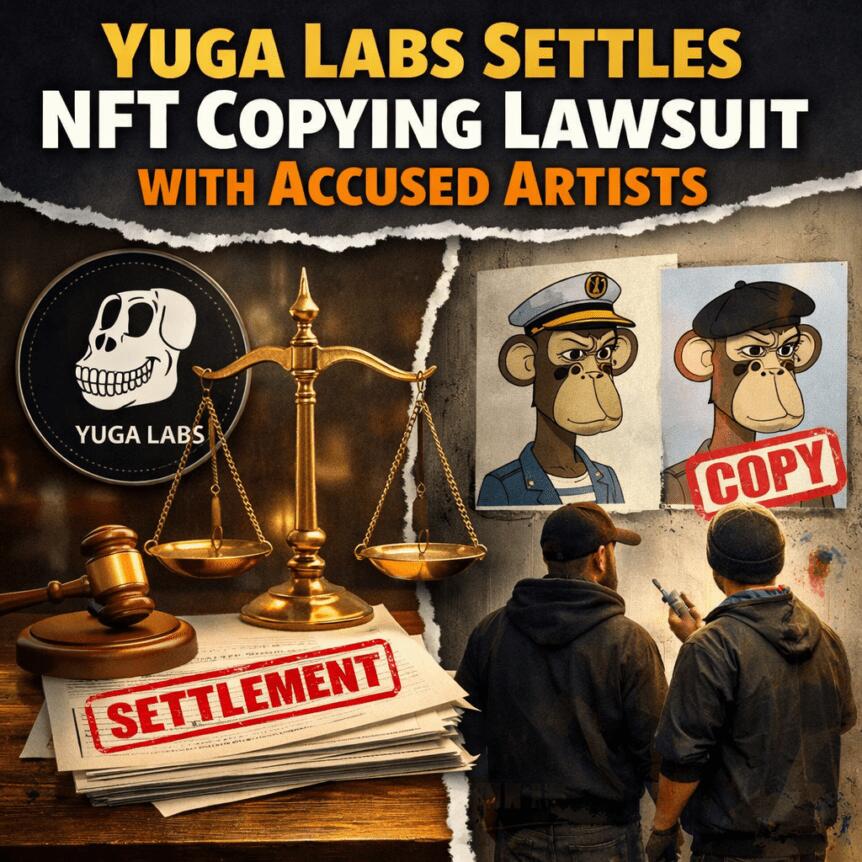
Yuga Labs has brought a nearly four-year legal dispute to a close with a settlement that bars its rivals from using its imagery and trademarks and pivots control of the related assets back to the crypto creator. Court filings this week show that Yuga Labs and artists Ryder Ripps and Jeremy Cahen have reached an agreement, ending the long-running case over lookalike NFTs tied to the Bored Ape Yacht Club (BAYC) brand.
Under the settlement, Ripps and Cahen are permanently prohibited from using Yuga Labs’ imagery and trademarks. In addition, they will transfer control of the RR/BAYC smart contracts, domain names, and any remaining NFTs associated with the RR/BAYC project to Yuga Labs within the next 10 days. An injunction from the court also restricts the pair from transferring, concealing, or disposing of any linked assets to evade compliance.
The RR/BAYC NFTs themselves remain accessible for holders and curious onlookers; as of this writing, they are still live on OKX Wallet, underscoring how the asset layer sits at the intersection of branding protection and active markets. OKX Wallet’s NFT collection page for RR/BAYC provides a live snapshot of those tokens still circulating in wallets.
Key takeaways
- The dispute over lookalike BAYC imagery ends with a settlement that imposes a permanent ban on using Yuga Labs’ branding and requires asset transfers to Yuga Labs within 10 days.
- The settlement closes a saga that stretched from a June 2022 filing through multiple court rulings, reversals, and appeals, including a 2023 ruling favoring Yuga and a subsequent shift in judgments on damages and trademark questions.
- Despite the injunction and transfers, RR/BAYC NFTs continue to function on live marketplaces, illustrating the persistence of lookalike projects in secondary markets even after legal action.
- The case highlights how IP enforcement plays out in NFT ecosystems, where branding and originality are central to project value and user trust.
Settlement marks a culmination of a high-stakes IP fight
The legal entanglement began when Yuga Labs filed suit in mid-2022, alleging that Ripps and Cahen copied BAYC’s distinctive ape artwork and sold lookalike NFTs to profit from brand confusion. The plaintiffs argued that the mimicry undermined Yuga Labs’ IP rights and damaged the value of the original BAYC ecosystem.
Earlier in the litigation, a court sided with Yuga Labs, finding that Ripps and Cahen had created unauthorized versions of BAYC NFTs and ordered the pair to pay damages. The initial judgment set damages at $1.37 million plus $200,000, tied to profits from the infringing NFTs. The post-judgment landscape grew more complex as outcomes from subsequent proceedings added layers of appeal and retrial expectations.
In 2024, the court’s order expanded the penalties, and the total rose to about $9 million after Ripps and Cahen lost a counterclaim related to the matter. An appeals court later tossed that judgment in 2025, ruling that a jury trial would be necessary to determine whether Yuga Labs’ trademarks had been infringed and to resolve related issues. The latest settlement then brings the case to a close, avoiding a further retrial while preserving the injunctions against the defendants.
What this means for IP in NFT ecosystems
The resolution underscores an important precedent for how branding and copyright claims are treated in the NFT space. Yuga Labs has repeatedly asserted that protecting its avatar-based IP is essential to maintain product integrity and user trust across a fast-evolving market. The settlement affirms that such protections can be backed by enforceable injunctions and asset transfers, even as markets continue to trade lookalike or derivative tokens in parallel to legitimate projects.
From an investor and builder perspective, the outcome reinforces a critical point: brand equity in digital collectibles matters as much as the underlying code and artwork. Projects seeking to capitalize on a well-known IP must navigate not only smart-contract functionality but also the legal boundaries of trademark and copyright. The case also demonstrates that even when a lookalike project garners attention and liquidity, the original IP owner may pursue a legal remedy that includes branding restrictions and asset handovers.
Transient markets meet durable rights
The fact that RR/BAYC NFTs remain visible on major wallets and marketplaces despite the injunction speaks to a nuanced dynamic in crypto markets. While the court order restricts the use of Yuga Labs’ branding and directs the transfer of domain and contract control, the assets already minted and circulating in wallets can continue to trade unless further restrictions are imposed by platform policies or additional court actions. This tension—between legal rights and ongoing market activity—illustrates how IP enforcement interacts with decentralized liquidity and public recordkeeping in real time.
For traders, holders, and creators, the settlement signals a potential re-emphasis on authenticating provenance and respecting IP boundaries before minting or marketing derivative projects. It also raises questions about how future settlements might structure ongoing obligations, such as royalties, licensing, or clear demarcations between parody, satire, and infringement in the NFT landscape.
What to watch next
With control of the RR/BAYC assets transferring to Yuga Labs within about a week, observers will want to track how the company integrates these elements back into its ecosystem. Will there be additional revivals or revocations tied to RR/BAYC tokens, and how will platforms handle branding-sensitive content tied to a well-known IP? The ongoing governance and ecosystem implications for BAYC’s broader community, as well as for other IP-heavy NFT projects, will be worth monitoring as more settlements of this type appear in the crypto legal arena.
Additionally, the market for lookalike NFTs in the wake of this case may reflect evolving risk assessments among buyers and traders. Even with a favorable outcome for IP owners, the persistence of lookalikes in wallets and marketplaces suggests a continuing need for diligence on authenticity and provenance in NFT collections.
As this saga concludes, investors can expect closer scrutiny of branding and copyright claims in NFT launches and a clearer path for IP holders to pursue enforcement when necessary. The case serves as a reminder that in the rapidly expanding NFT space, the boundaries of legal rights and market activity are increasingly intertwined, and that regulatory and judicial clarity will continue to shape how projects operate and compete.
Source data and developments referenced here draw on filings and reporting surrounding the settlement announced this week, including the permanent injunction barring use of Yuga Labs’ imagery and trademarks and the transfer timeline for RR/BAYC assets. The live RR/BAYC NFT collection, as noted, remains accessible on OKX Wallet during this transition.
This article was originally published as Yuga Labs settles NFT copying lawsuit with accused artists on Crypto Breaking News – your trusted source for crypto news, Bitcoin news, and blockchain updates.


You May Also Like

Metaplanet buys 5,075 Bitcoin in Q1 to become 3rd-largest treasury

The changing face of elder care in Malaysia — Sayed Mohammad Reza Yamani Sayed Umar

New Trump appointee Miran calls for half-point cut in only dissent as rest of Fed bands together



