The Developer Friction Score: A New Way to Measure if Your Internal Platform is Actually Helping or Just Adding Noise
Suppose the following scenario: Engineering executives of your new startup have spent six months and thousands of dollars to create a state-of-the-art Internal Developer Platform (IDP). You have implemented Kubernetes, established complex CI/CD pipelines, and required new security scanners to meet compliance.
Paper wise the infrastructure appears global. As a matter of fact, the developers are wretched.
The characteristics become slower in features, backlog with the pull requests, and Slack is reeking with engineers seeking to know how to circumvent the very platform you created. You wanted to create a paved highway but instead you put in place a toll booth.
The burn-out of developers to bad tooling is a disastrous approach in the fast-paced technological landscape in Africa where it is more difficult to keep senior engineers than to find capital. The team of engineers must be guided to a change that is not based on output-oriented measures but one that measures and removes operations pain.
We have to begin to measure the Developer Friction Score (DFS).
The Problem with Vanity Metrics
Over the last several years, DORA metrics (Deployment Frequency, Lead Time to Change, Mean Time to Recovery, Change Failure Rate) have been used by the industry as the measures of engineering success.
Although DORA is an excellent answer to pipeline output, it lacks the user experience. Deployment can be reported in DORA as two hours, but can.not be reported as an engineer spending 90 minutes struggling with a broken staging environment, searching for undocumented API keys, and waiting on a manual security approval.
There is a blind spot caused by focusing on output metrics. You may put engineers on the front line but when they fight the platform at every turn, then the system is very inefficient. Friction is counterproductive and prompts the practise of shadow IT, in which frustrated engineers may write outlawed scripts or tools to accomplish their work. This causes context switching, frustration and expensive developer churn.
What is the Developer Friction Score (DFS)?
DFS is an overall indicator of the level of time and cognitive load wasted by developers on non-value-adding activities. It provides the response to a very basic question How difficult is doing the right thing in this company?
Surprisingly, Developer Experience (DevEx) is fuzzy yet the Friction Score is quantitative. It also integrates automated telemetry, such as the failure rates of the pipeline, with targeted, specific surveys of the developers.
A Friction Score that is high implies that it is noising the platform. A low score implies that the platform makes work go faster.
How to Measure Developer Friction
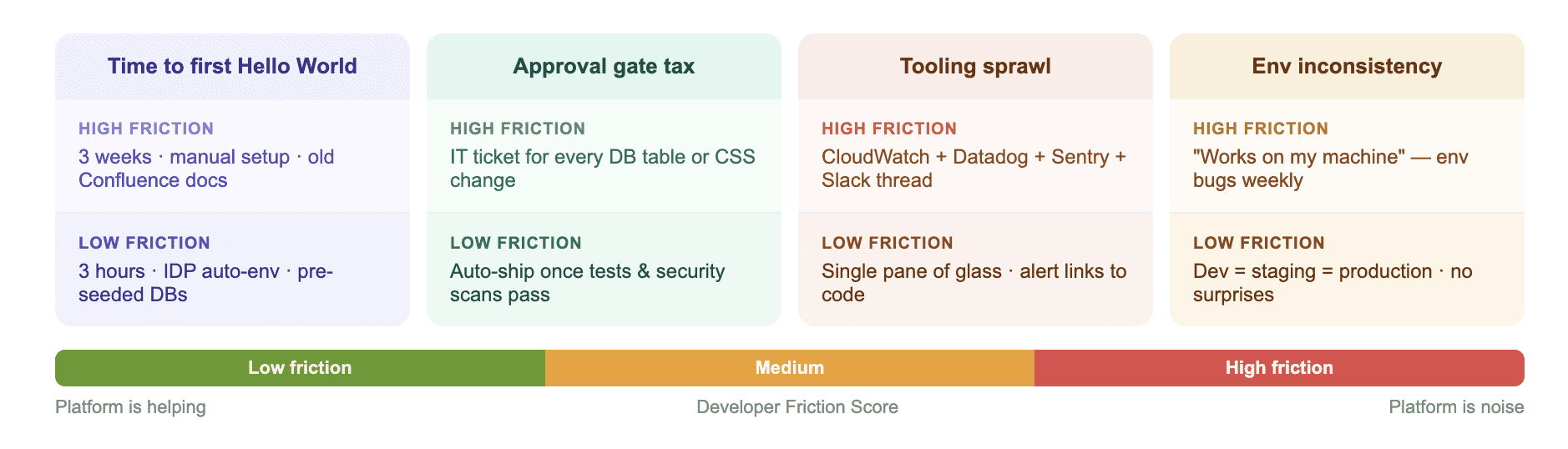
All teams of African engineers need to keep an eye on four pillars to calculate a correct DFS:
1. Time to First “Hello World” in Production
Once a new engineer is hired to join a startup, how many days do they take to make a one-line piece of code and have it run in production?
- High friction: three weeks are needed during this period he or she is reading old Confluence, request IT to provide AWS permission, and handily set up delicate Docker setups.
- Low friction: this takes about three hours; The IDP creates a secure cloud development environment (such as GitHub Codespaces) including already seeded test databases and and pre-configured access roles.
2. The Approval Gate Tax
What is the number of manual steps that involve the intervention of humans to release a regular update?
When engineers have to file IT tickets in order to create a new database table or get manual QA to accept a small change to the CSS, you are creating huge friction. Automated guardrails, not human gatekeepers are used in modern platforms. Codes should automatically ship once tests and security scans passed.
3. The Tooling Sprawl and Context Switch Tax
What is the number of tabs, dashboards, and CLIs that an engineer has open to determine why a microservice crashed is enormous?
- High fiction: going through AWS CloudWatch logs, infrastructure metrics on DataDog, and Sentry for application errors and piecing together a fragmented Slack thread for context.
- Low friction: the internal platform puts observability on a single pane of glass, with direct connection between a failed deployment alert and the specific line of code and the related error log.
4. Environment Inconsistency Rates
How frequent did developers claim that it worked on my machine?
This dread phrase, “Well, it worked on my machine” becomes hellish when the local dev environments are not a reflection of staging and production. Direct measurement of the primary infrastructure complexities is done by tracking the regularity of bugs related to the environment.
Treating the Platform as a Product
In order to constantly reduce DFS, just basically alter your perception of internal tools. Think of the IDP as a product and the developers as your highly esteem customers.
This implies the application of Standard product management principles to your DevOps and Platform Engineering Teams. A few startups even outsource platform product manager which is a dedicated role to streamline the internal developer experience.
Conduct user research. Send pulse surveys weekly with the question of the most frustrating thing about the deployment process this week. Monitor online to view suspended pipelines. When it takes 45 minutes to run a mandatory scanner on each commit, then it is not enough to ask developers to work with it. Re-architect the pipeline to execute delta scans on modified files at a reduced feedback of three minutes.
The ROI of Removing Friction
In a hub such as Lagos, Nairobi or Cape Town, engineering bandwidth is the most valuable and costly resource for startups. Each hour that a developer is doing the fight against the broken CI pipeline or waiting till a manual approval is granted is an hour that is not spent on the relevant building of revenue-generating features.
By actively measuring and driving down the Developer Friction Score, you aren’t just making your engineering team happier. You are drastically improving your time-to-market, reducing the devastating costs of developer burnout, and ensuring that the expensive platform you built is actually serving its intended purpose: helping your team ship brilliant products, faster.
Oluwafemi Oluseki is a Cloud Solutions Architect and Senior Platform Engineer working across AWS and Azure, with a focus on platform engineering, security, and AI infrastructure.
He is co-founder of LimeSoft Systems, where he develops cloud-native platforms and security-focused infrastructure to support modern application delivery. His work has supported production systems used across 50+ teams and organisations, improving deployment consistency and operational reliability.
He writes and mentors within the African tech community.


You May Also Like

What To Look For When Evaluating Nonprofit Budgeting Software for Finance Teams: A Platform Comparison

The PewBeam effect: like Nigeria’s fintech gold rush, a worship AI boom is coming