

Hyundai to deploy 30,000 humanoid units by 2030 in $26B physical ai push
Hyundai Motor Group is accelerating its long-term industrial shift, positioning physical ai at the core of a strategy that reaches far beyond traditional carmaking.
Hyundai expands its robotics and AI vision
In an interview with Semafor, chairman Chung Eui-sun said robotics and AI will drive Hyundai’s next growth phase, pushing the group into physical systems and automated infrastructure. Moreover, the company aims to connect software, robots and energy in a single industrial architecture.
According to United Press International, Hyundai plans to invest $26 billion in the US by 2028, building on roughly $20.5 billion deployed over the past 40 years. However, a growing portion of this capital is now tied directly to robotics, automation and AI-enabled production systems.
A large share of that spending supports AI-driven systems that Hyundai is folding into one integrated approach. Chung framed robotics and physical AI as central to Hyundai’s long-term direction, stressing that the company is developing machines designed to collaborate with people rather than replace them.
From automation to human-robot collaboration
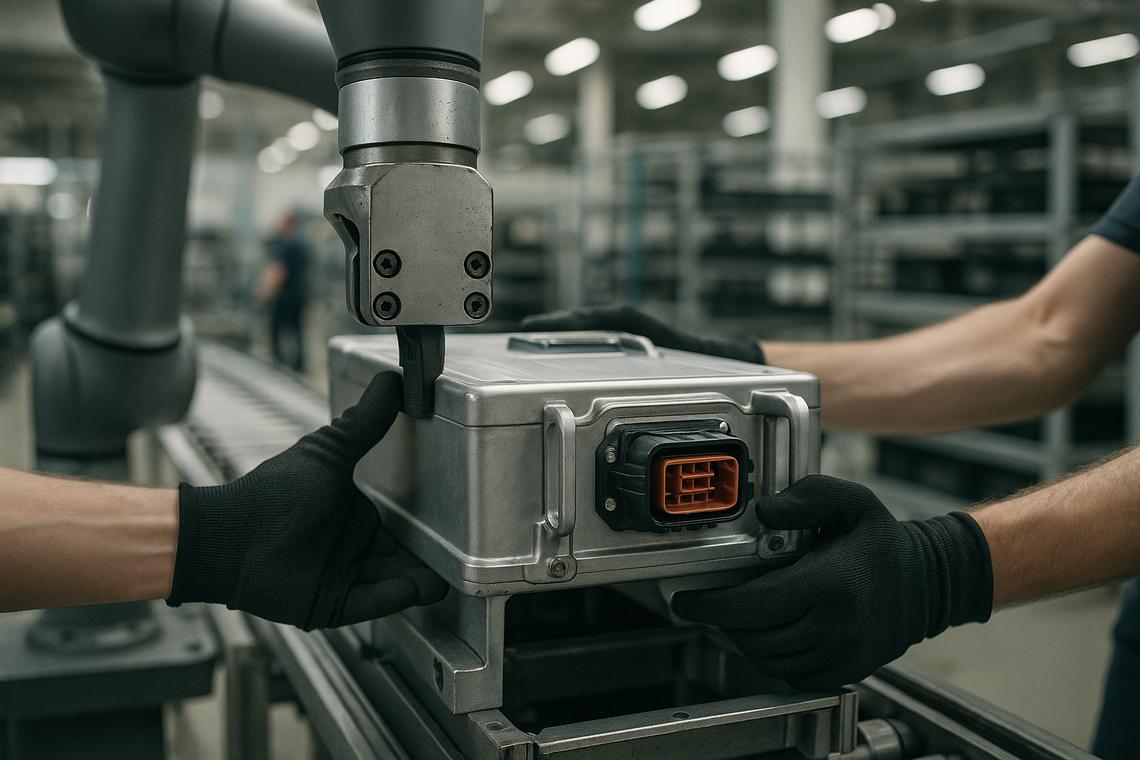
Hyundai is shifting from classic automation to environments where robots and humans share workflows in the same physical space. This includes humanoid platforms from Boston Dynamics, in which Hyundai acquired a controlling stake in 2021. The aim is to deploy these machines in demanding industrial operations.
The group is preparing these humanoid robots for manufacturing use, with large-scale deployment planned around 2028. Moreover, Hyundai expects to ramp production to as many as 30,000 units per year by 2030, targeting improved efficiency, safety and consistency on the factory floor.
In these scenarios, robots may take over repetitive or physically strenuous tasks, while human workers focus on oversight, coordination and problem-solving. Chung argued that such mixed teams could boost productivity and product quality as customer expectations and regulatory constraints evolve.
Exploring applications beyond the factory
Most current deployments still sit in industrial and manufacturing settings, where AI-driven manufacturing systems can be tested and scaled under controlled conditions. However, Hyundai is already exploring new use cases that extend beyond the assembly line and into broader mobility services.
Potential areas include logistics networks and shared mobility, where vehicles are paired with AI systems that manage routing, loading and maintenance. That said, these applications remain in early development, and their impact on deliveries and service models will roll out gradually over time.
Manufacturing as the first test bed for physical AI
While these new applications grow, manufacturing remains Hyundai’s main testing ground for advanced robotics. Factories are where the group is actively implementing its ideas, combining data, industrial software and robotics in its US operations to manage production more intelligently.
Physical AI systems build on this work by adding machines that adjust their actions based on real-time sensor and production data. Moreover, Chung said shifting regulations and changing customer demand in different regions are forcing the company to rethink how and where it operates globally.
Hyundai’s response combines global expansion with stronger local production, while using AI and robotics to standardize processes across markets. In this vision, the primary_keyword aligns hardware, software and data to coordinate output, safety and quality in complex factories.
Energy, hydrogen and AI infrastructure
Alongside robotics, Hyundai continues to invest heavily in hydrogen through its HTWO brand, which spans hydrogen production, storage and end use. The company sees hydrogen as a strategic pillar for both mobility and industrial applications.
Chung highlighted rising demand from AI infrastructure and data centres as one driver of renewed interest in hydrogen. He described hydrogen and electric vehicles as complementary technologies. However, the underlying idea is to match energy sources to how systems are used, from long-distance freight to local mobility services.
As AI moves deeper into physical environments, from factories to logistics hubs, energy becomes a visible constraint. Moreover, Hyundai expects future industrial systems to require stable, diversified power sources, which is why its hydrogen investments run in parallel with its robotics efforts.
Impact on end users and global scale
Most consumers are unlikely to encounter a humanoid robot directly in the near term. That said, they will increasingly feel the downstream effects of these technologies in faster production cycles, more responsive mobility services and potentially more resilient infrastructure.
According to the same UPI report, Hyundai sells more than 7 million vehicles each year across over 200 countries, supported by 16 global production facilities. Moreover, this scale gives the company substantial leverage to test and roll out new AI-enabled production models.
A gradual transition beyond traditional carmaking
Hyundai remains a major global carmaker, with core brands including Hyundai, Kia and Genesis providing the foundation of its business. However, what is changing is the way these vehicles and the surrounding systems are designed, manufactured and managed over their lifecycle.
Physical ai represents a shift from stand-alone products to connected, adaptive systems. It embeds AI into the environments where work and daily life take place, from production plants to logistics corridors. Moreover, many of the systems Hyundai is building will take years to scale and fully mature.
The company is, in effect, constructing a future in which machines and humans work together in the real world, supported by robotics, data and diversified energy. That transition remains gradual, but the investment commitments and product roadmaps now in place suggest Hyundai will be a central player in this emerging landscape.


You May Also Like

Not a loophole: Singapore AI export controls let China tap US AI legally

Exclusive interview with Smokey The Bera, co-founder of Berachain: How the innovative PoL public chain solves the liquidity problem and may be launched in a few months

NYSE-Listed Bitgo Rolls out Stablecoin Minting Platform for Institutional Clients – Bitcoin News



