

👨🏿🚀TechCabal Daily – A Standard hack
TGIF. 
It’s such a shame Meta had to shut down its “tokenmaxxing” system that ranked employees by how heavily they used AI. The employee who created the dashboard later discontinued it after news of the tool leaked online.
But I’ll be borrowing a leaf from its playbook to tokenmax my freewill this weekend by keeping my laptop off (at least until Sunday afternoon) and attempting something equally productive, like finding a needle in a haystack. You’re welcome to tokenmax your own freewill too, ideally with equally questionable life choices, or by hate-watching Arsenal’s game this weekend.
Let’s dive in.
—Emmanuel
- Quick Fire
 with Segun Akinnibosun
 - Standard Bank hackers ask for 1 bitcoin
- Sama to lay off over 1,000 workers
- Who secured the bag?

- World Wide Web 3
- Job Openings
features
Quick Fire with Segun Akinnibosun
 Image: Segun Akinnibosun, product designer at Rvysion
Segun Akinnibosun is a Product Designer with experience spanning Web3, fintech, and emerging technologies, with a strong focus on building scalable, user-centred products that deliver measurable business outcomes.
Akinnibosun currently serves as a Lead Product Designer at Rvysion, where he has led and delivered over 8 client products across fintech, media, logistics, and infrastructure. His work spans end-to-end product design, from early-stage concept development (0 → 1) to scaling existing systems.
- Explain what you do to a 5-year-old.
I am someone who makes apps and websites easy and fun to use.
Imagine you have a big toy box where everything is mixed up: cars, dolls, LEGO, crayons, all in one place. It’s hard to find anything, right? I’m the person who comes in and says, “Let’s fix this.”
I figure out where everything should go so it’s easy to find and nice to look at. I make things simple so people don’t get confused and can use them without stress.
But I don’t just fix things myself. I also lead a team of people who help build these apps and websites. So I’m a team captain, making sure everyone works together to create something really good. I also like to teach people what I know, so they can learn how to design things better, too.
- What is the most exciting thing about being a product designer today? And what is the hardest part about your job?
I get excited about how much influence product design has in tech today—to be a full sprint on its own, shape product thinking, and contribute to how people perceive your self-value as a business. Previously, if you simply had a developer, you were good. But design is evolving so much today.
It’s no longer just about making screens look good; it’s about shaping how products work, how businesses grow, and how people experience technology daily.
I’d say the hardest part of the work is that same level of influence—it’s also a burden. The scope of our work is expanding, so it’s not enough to say “I designed it”; you’re also responsible for the outcomes. If product adoption is low, if users are confused, if the product doesn’t perform, you haven’t performed.
I’ve had many moments where I’m thinking, “This is not the best version of this idea… but it’s the version we can ship right now.” It’s a real tension and a burden that talented designers now carry. Product design today gives you a seat at the table, but it also expects you to earn that seat every single day.
- What’s your advice for entry-level designers who want to grow their careers?
I’ll be honest, most entry-level designers are focusing on the wrong things. They’re obsessing over Dribbble-level visuals, perfect UI, and trendy animations. Meanwhile, the people actually getting hired are the ones who can think.
Stop trying to look like a designer and start thinking like one. Nobody cares if your button radius is 8px instead of 6px. What matters is whether you can break down a problem and connect your decisions to user needs and business goals.
Learn to communicate your work like your career depends on it, because it does. Be clear and simple: what was the problem, what did you do, and what changed? People are evaluating how you think, not just what you made.
Pick a lane, but don’t box yourself in. The goal is not to just be a UI designer forever. The goal is to own problems end-to-end. Focus less on making things look good and more on making things make sense.
20+ Markets. One API.
Fincra connects your business to Africa’s payment rails without building market by market. For collection, payout, FX, and settlement through a single integration. See what this means for your business.
Banking
Standard Bank data breach exposed customers’ card details, including names, card numbers, and expiry dates
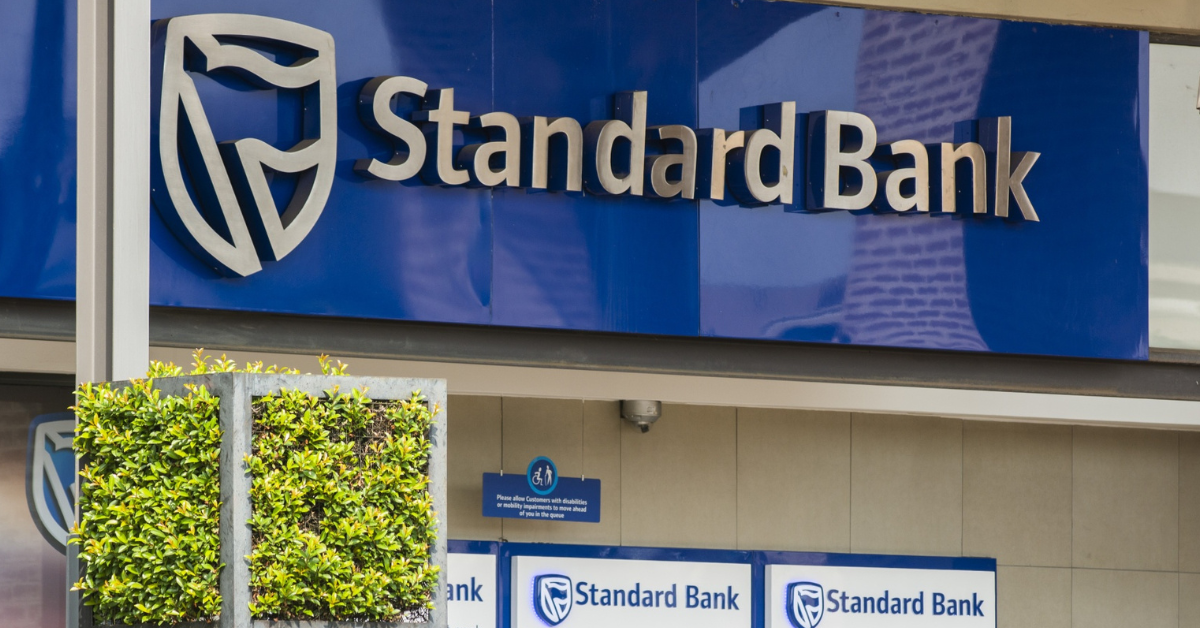 Image Source: Bloomberg
There’s something in the air, and several major organisations across Africa seem to have caught it: a data breach bug.
In case you missed it, Nigerian payment processing firm, Remita, and tier-2 lender, Sterling Bank, were allegedly breached in March, with the country’s data protection agency later confirming it is investigating “Remita, Sterling, and other entities” to uncover the full extent of the attack.
On Wednesday, Nigeria’s Corporate Affairs Commission (CAC), which keeps corporate records, confirmed that it suffered a security breach. In March, Standard Bank, South Africa’s largest bank, was also hit. The common denominator is Dark Forums. For every single case here, there are anonymous hackers on the data trading site claiming that they “hacked” these organisations.
Between the lines: In Standard Bank’s case, it immediately alerted customers in March that data had been stolen, but said it took steps to “secure its environment and mitigate the impact” and was investigating further.
In a Thursday statement, however, the bank told local publication TechCentral that a limited number of cases revealed that card details, specifically card numbers and expiry dates, were accessed in the attack. The bank said that card verification value (CVV) numbers, the three-digit numbers on the back of cards, were not affected. According to another local publication, MyBroadBand, the hacker is holding the bank to a 1 bitcoin (worth $74,585 on Thursday evening) ransom.
What is really happening? The wave of attacks, and how simultaneously it is happening, is pointing to how much hacker tools have upgraded, thanks to AI. Banking experts, including the US Federal Reserve Chair Jerome Powell, have warned that newer, more powerful models, including Mythos from Anthropic, whose release was pushed back, could expose cybersecurity vulnerabilities that were previously unknown.
AI is growing so fast that it’s becoming powerful enough to stress-test critical systems, a major cause for concern for African banks and organisations that have long been in a constant battle with cyber threats. Yet across these hacks, none have affected core banking operations so far. They’ve mostly hit document filings, likely pointing to weaker systems used to store customer records.
Standard Bank, in its latest update on Tuesday, said transactional banking and core operations were not impacted, critical because if that layer is breached, the monetary losses could be devastating.
Zoom out: While these incidents are concerning, AI tools could also be giving the same leverage to security experts. They can use these tools to stress-test their own systems, identify vulnerabilities early, and strengthen them before attackers do. We hope no other bank gets attacked, but more than ever, security can’t be an afterthought anymore.
20+ Markets. One API.
Breet is offering a $10,000 equity-free grant to growth-stage fintech, crypto and payments startups in Africa. Integrate the API, submit your product, and pitch live at ATE Lagos. Two winners get $5,000 each. Deadline by May 31. Learn more.
companies
Sama to lay off over 1,000 Kenyan data-labelling employees
 Meme, Image source: Tenor
There is a quiet rule in the AI economy: the smartest systems in the world still depend on very human, very replaceable labour. On Thursday, that reality showed up in Nairobi.
Sama, one of Africa’s best-known data labelling firms, said it will lay off over 1,100 workers after Meta pulled a major contract, cutting off the workstream that powered much of its local operation.
Why it matters: The layoffs are a reminder of how fragile Africa’s position in the AI value chain can be. For years, Kenya has marketed itself as a hub for “impact sourcing,” where young workers label data, moderate content, and train the systems that global tech companies monetise. But those jobs often hinge on a handful of foreign clients. When one leaves, the ripple is immediate.
Between the lines: Sama says it tried to salvage the relationship, but like most outsourcing arrangements, the leverage sits with the client. Meta’s decision switches off a pipeline that supported over a thousand livelihoods, even as demand for AI globally continues to surge.
What is really happening? The AI boom is not evenly distributed. While companies like Meta scale products such as AI-powered glasses, the underlying human work remains outsourced, fragmented, and vulnerable to sudden shifts in strategy, cost, or regulation. Investigations have already shown that some of this work involves reviewing sensitive user-generated content, raising questions about both labour conditions and data privacy.
Zoom out: Africa is firmly in the AI supply chain, but mostly at its most precarious layer. The continent provides the labour that makes machine learning possible, yet captures little of the long-term value. Until that changes, stories like Sama’s will keep repeating, where global demand rises, but local job security does not.
TECHCABAL 4.0
In March 2013, TechCabal published its first article. Thousands of stories later, the work continues, and today, it goes deeper.
TechCabal has always been free. That’s not changing.
We’ve opened a new layer. Reporting that goes further, built on sources you won’t find anywhere else, and told in ways we haven’t tried before. You’re among the first to see it.
Getting in takes less than 15 seconds.
You’re one step away from the other side.
Click the button below to see what TechCabal 4.0 looks like and what it means for you.
Insights
Funding Tracker
 Success Sotonwa, TechCabal Insights
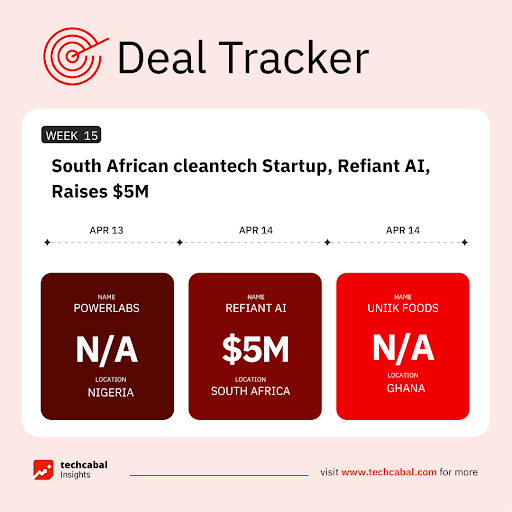
Refiant AI, a South African cleantech startup, raised $5 million in seed funding from VoLo Earth Ventures. (Apr 14)
Here are the other deals for the week:
- PowerLabs, a Nigerian cleantech startup, raised an undisclosed amount in a pre-seed funding round led by venture firm Breega, with additional backing from Catalyst Fund, Mercy Corps Ventures, and Kaleo Ventures. (Apr 13)
- Uniik Foods, a Ghanaian agrictech startup, secured an undisclosed investment backing from Mirepa Capital SME Fund. (Apr 14)
Follow us on Twitter, Instagram, and LinkedIn for more funding announcements. Before you go, find out more about regulatory passporting and the future of cross-border fintech in Africa.
CRYPTO TRACKER
The World Wide Web3
Source:

|
Coin Name |
Current Value |
Day |
Month |
|---|---|---|---|
| Bitcoin | $74,685 |
– 0.50% |
+ 0.85% |
| Ether | $2,321 |
– 1.55% |
– 0.10% |
| XRP | $1.42 |
+ 1.51% |
– 6.66% |
| Solana | $87.66 |
+ 2.64% |
– 6.89% |
* Data as of 06.49 AM WAT, April 17, 2026.
JOB OPENINGS
- Big Cabal Media — Senior Motion Designer, YouTube Growth Strategist, Quality Assurance Engineer, Editor-in-Chief (TechCabal) — Lagos, Nigeria
- Babban Gona — Machine Learning Engineer — Lagos, Nigeria
- Moniepoint — Data Analyst — Lagos, Nigeria
- Sun King — Product Operations Associate — Lagos, Nigeria
- M-KOPA — Business Intelligence Manager — Nairobi, Kenya
There are more jobs on TechCabal’s job board. If you have job opportunities to share, please submit them at bit.ly/tcxjobs.
- Delve into AI: Enugu plans AI institute to train talent for global markets
- LOLC Microfinance Bank directors risk prosecution over data case
- All you need to know about e-invoicing in Nigeria
Written by: Emmanuel Nwosu and Opeyemi Kareem
Edited by: Emmanuel Nwosu and Ganiu Oloruntade
Want more of TechCabal?
Sign up for our insightful newsletters on the business and economy of tech in Africa.
- The Next Wave: futuristic analysis of the business of tech in Africa.
- Francophone Weekly by TechCabal: insider insights and analysis of Francophone’s tech ecosystem
P:S If you’re often missing TC Daily in your inbox, check your Promotions folder and move any edition of TC Daily from “Promotions” to your “Main” or “Primary” folder and TC Daily will always come to you.



You May Also Like

Staggering $28 trillion flows through crypto’s ‘agent economy’ – but 76% of it is just bots shuffling stablecoins

Trump hints at US-Iran nuclear deal progress, Tehran denies uranium handover




