The difficulty of mining Bitcoin (BTC), a key metric that measures how challenging it is to add new blocks to the blockchain, has surged to a record high of 142.3 trillion as of Friday. This indicates an increasingly competitive environment for miners trying to validate transactions and secure the network. Following successive all-time highs in [...]The difficulty of mining Bitcoin (BTC), a key metric that measures how challenging it is to add new blocks to the blockchain, has surged to a record high of 142.3 trillion as of Friday. This indicates an increasingly competitive environment for miners trying to validate transactions and secure the network. Following successive all-time highs in [...]

Bitcoin Mining Difficulty Reaches Record High Again in September
For feedback or concerns regarding this content, please contact us at crypto.news@mexc.com
Bitcoin Mining Difficulty Reaches Record High Again In September

The difficulty of mining Bitcoin (BTC), a key metric that measures how challenging it is to add new blocks to the blockchain, has surged to a record high of 142.3 trillion as of Friday. This indicates an increasingly competitive environment for miners trying to validate transactions and secure the network.

Following successive all-time highs in August and September, driven by a surge in mining hardware deployment, Bitcoin’s network difficulty continues to reflect growing computational power. Concurrently, the network’s hashrate—the total processing power securing the blockchain—has also reached an all-time peak of over 1.1 trillion hashes per second, according to data from CryptoQuant.

This escalating difficulty and rising hashrate underscore the intensifying competition among miners, both individual and institutional. However, it also raises concerns about potential centralization, as the high costs associated with energy-intensive hardware and electricity requirements favor larger, well-funded entities. These trends highlight how the increasing difficulty is reshaping the landscape of Bitcoin mining, with implications for decentralization and network security.
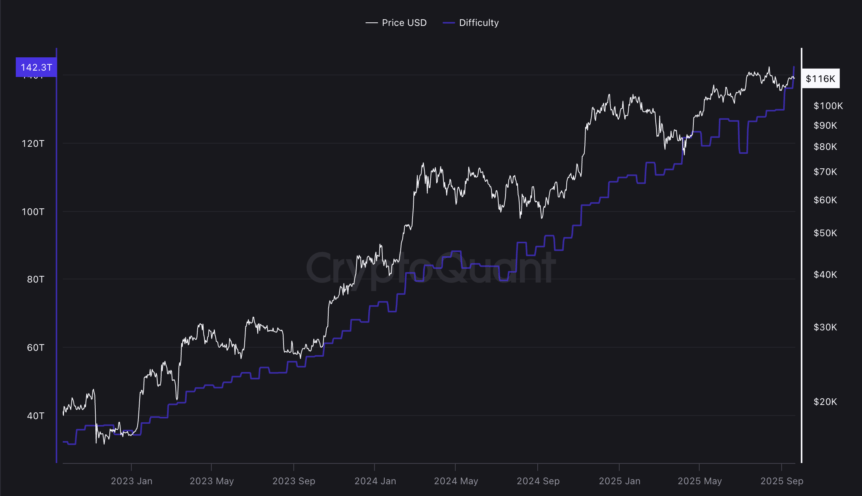
Bitcoin network difficultyBitcoin network difficulty reached a new all-time high in September. Source: CryptoQuant

Industry observers note that rising mining difficulty, combined with the demand for high-performance computing hardware, is making it increasingly challenging for smaller-scale miners to remain competitive. This shift could impact the decentralization of the Bitcoin network, prompting discussions about the future of mining operations globally.

Global and US government involvement shaping the mining landscape

While small miners face mounting hurdles, governments and energy firms are stepping into the fray. Several countries are already mining Bitcoin using excess or surplus energy, including Bhutan, Pakistan, and El Salvador. Notably, Pakistan announced plans to allocate 2,000 megawatts of surplus energy specifically for crypto mining, reflecting a broader regulatory embrace of digital assets.

Within the United States, particularly in Texas, energy providers are integrating Bitcoin mining into the grid infrastructure to help stabilize electrical supply. These arrangements enable utilities to use mining operations as a flexible load, consuming excess power during low-demand periods and reducing output during peak times, thus mitigating grid stress and avoiding outages.

Texas energy grid and Bitcoin miningEnergy providers in Texas are leveraging Bitcoin mining to balance electricity demand, as shown by reduced energy usage during peak periods. Source: ERCOT

This dynamic allows electricity companies to profit from excess energy and maintain grid stability without directly bearing the costs of variable energy prices. It also illustrates how Bitcoin mining is becoming intertwined with national energy strategies, raising questions about the broader implications for crypto regulation and market stability.

Related: Bitcoin mining stocks outperform BTC as investors bet on AI pivots

This article was originally published as Bitcoin Mining Difficulty Reaches Record High Again in September on Crypto Breaking News – your trusted source for crypto news, Bitcoin news, and blockchain updates.


Market Opportunity
Bitcoin Logo
Bitcoin Price(BTC)
$72,670.59
$72,670.59$72,670.59
-0.98%
USD
Bitcoin (BTC) Live Price Chart
Disclaimer: The articles reposted on this site are sourced from public platforms and are provided for informational purposes only. They do not necessarily reflect the views of MEXC. All rights remain with the original authors. If you believe any content infringes on third-party rights, please contact crypto.news@mexc.com for removal. MEXC makes no guarantees regarding the accuracy, completeness, or timeliness of the content and is not responsible for any actions taken based on the information provided. The content does not constitute financial, legal, or other professional advice, nor should it be considered a recommendation or endorsement by MEXC.

You May Also Like

CEO Sandeep Nailwal Shared Highlights About RWA on Polygon

CEO Sandeep Nailwal Shared Highlights About RWA on Polygon

The post CEO Sandeep Nailwal Shared Highlights About RWA on Polygon appeared on BitcoinEthereumNews.com. Polygon CEO Sandeep Nailwal highlighted Polygon’s lead in global bonds, Spiko US T-Bill, and Spiko Euro T-Bill. Polygon published an X post to share that its roadmap to GigaGas was still scaling. Sentiments around POL price were last seen to be bearish. Polygon CEO Sandeep Nailwal shared key pointers from the Dune and RWA.xyz report. These pertain to highlights about RWA on Polygon. Simultaneously, Polygon underlined its roadmap towards GigaGas. Sentiments around POL price were last seen fumbling under bearish emotions. Polygon CEO Sandeep Nailwal on Polygon RWA CEO Sandeep Nailwal highlighted three key points from the Dune and RWA.xyz report. The Chief Executive of Polygon maintained that Polygon PoS was hosting RWA TVL worth $1.13 billion across 269 assets plus 2,900 holders. Nailwal confirmed from the report that RWA was happening on Polygon. The Dune and https://t.co/W6WSFlHoQF report on RWA is out and it shows that RWA is happening on Polygon. Here are a few highlights: – Leading in Global Bonds: Polygon holds 62% share of tokenized global bonds (driven by Spiko’s euro MMF and Cashlink euro issues) – Spiko U.S.… — Sandeep | CEO, Polygon Foundation (※,※) (@sandeepnailwal) September 17, 2025 The X post published by Polygon CEO Sandeep Nailwal underlined that the ecosystem was leading in global bonds by holding a 62% share of tokenized global bonds. He further highlighted that Polygon was leading with Spiko US T-Bill at approximately 29% share of TVL along with Ethereum, adding that the ecosystem had more than 50% share in the number of holders. Finally, Sandeep highlighted from the report that there was a strong adoption for Spiko Euro T-Bill with 38% share of TVL. He added that 68% of returns were on Polygon across all the chains. Polygon Roadmap to GigaGas In a different update from Polygon, the community…
Share
BitcoinEthereumNews2025/09/18 01:10
Is Bitcoin Treasury Hype Fading? Data Suggests So

Is Bitcoin Treasury Hype Fading? Data Suggests So

Bitcoin treasury companies have seen a record-breaking 2025 so far, but CryptoQuant data shows momentum has started to slow down. Bitcoin Treasuries May Be Observing A Slowdown In a new post on X, on-chain analytics firm CryptoQuant has discussed how the latest trend is looking when it comes to Bitcoin corporate treasuries. Popularized by Michael […]
Share
Bitcoinist2025/09/18 06:00
Israel is losing close to $3 billion a week since fighting broke out with Iran, and markets are barely flinching

Israel is losing close to $3 billion a week since fighting broke out with Iran, and markets are barely flinching

Israel is losing close to $3 billion a week since fighting broke out with Iran, and markets are barely flinching. That figure comes from Israel’s Finance Ministry
Share
Cryptopolitan2026/03/05 05:20