

ICC’s decision on Duterte impacts the world; victims find ‘great hope’
It has happened only once before — that the leader of a country suddenly withdraws from the International Criminal Court (ICC) in the middle of what is called the preliminary examination phase, or the very first step the prosecutor takes to look into a country’s human rights problems.
Rodrigo Duterte wasn’t the trendsetter in that aspect. It was first done by then-Burundi president Pierre Nkurunziza on October 18, 2016. The ICC said then that Burundi’s withdrawal would not remove the court’s jurisdiction over them.
ICC is a young court with only a handful of cases. Every situation seems to raise new questions, and this is where the Philippines and Duterte became trendsetter of sorts.
In Burundi’s case, the prosecution opened an investigation during the one-year period when its withdrawal from the ICC took effect. Before October 2017, when the withdrawal became finally effective, the prosecution had already started the more rigorous second step of investigation. It was a step that needed the permission of judges.
The case of the Philippines was different in that Duterte’s withdrawal took effect in March 2019, a year after giving notice to the ICC, but investigation commenced only in 2021, or two years after.
It was a novel question about withdrawal, and one that involved highly technical arguments about the language of the law, and a moral discussion about the purpose and reason for existence of the ICC.
On one side were the human rights lawyers representing or helping victims, who said that if Duterte’s appeal won, it would embolden perpetrators to just simply withdraw their country’s membership once they are threatened with a preliminary examination.
On the other side were Duterte’s lawyers, inspired by two ICC dissenting judges in 2023, who said that the prosecutor has only one year — or the time for the withdrawal to take effect — to open its investigation, in order to preserve jurisdiction.
The appeals chamber, voting by a majority of 4 to 1, decided to confirm jurisdiction in Duterte’s case even if the preliminary examination went on for two years more after withdrawal. This, the appeals chamber said, is the balance between exacting accountability and respecting a country’s sovereign rights to withdraw.
By making that decision, the appeals chamber made these authoritative interpretations of the Rome Statute, or the treaty that governs the ICC:
- When it comes to withdrawals, Article 127 is the proper reference provision. Article 127 says a withdrawal shall not “prejudice in any way the continued consideration of any matter which was already under consideration by the Court prior to the date on which the withdrawal became effective.”
- “Any matter” in Article 127 includes a preliminary examination.
- Under Article 127, a matter under consideration by the Court also includes those being considered by the prosecutor, such as preliminary examination. This is crucial because if the appeals chamber interpreted “the Court” to refer to judges only, this would have excluded the preliminary examination process from matters not affected by withdrawal. Preliminary examinations are done only by prosecutors.
- This interpretation lives up to the “object and purpose” of the Rome Statute which is to “put an end to impunity.”
Impactful decision
Had Duterte won, the entire case would have been dropped. More than that, had Duterte won, he would have given perpetrators all around the world a blueprint on how to escape accountability, human rights lawyer Neri Colmenares told victims who needed clarification on what had just happened.
“Hindi lang ito issue na mawalan tayo ng malaking angkla sa ating kaso para sa hustisya ng ating kaanak, pati ang lahat ng mamamayan sa buong mundo na nilalapastangan ang kanilang karapatang pantao, apektado. Kasi lahat na lang ng diktador, sasabihin nila sundin natin ang modelo ni Duterte. Mabuti na lang, mabuti na lang,” Colmenares said on Wednesday, April 22.
(This is not just an issue of us losing a basis for our case to find justice for our loved ones, it also affects citizens worldwide whose human rights are being violated. Because then every dictator would say, “Let’s follow the Duterte model.” So this is a good thing, a good thing.)
For Nicholas Kaufman, Duterte’s lawyer, the decision was not sufficient because it did not say explicitly just how long a preliminary examination is allowed to continue.
“As it would now appear, an investigation may be opened post-withdrawal not just one year down the line, but even twenty years down the line,” Kaufman said in a statement.
For victims’ lawyer Gilbert Andres, what matters is that the decision has sent “a strong message to the international community of states that mere withdrawal from the Rome Statute does not protect responsible state officials from criminal accountability for international crimes.”
‘Great hope’ among victims
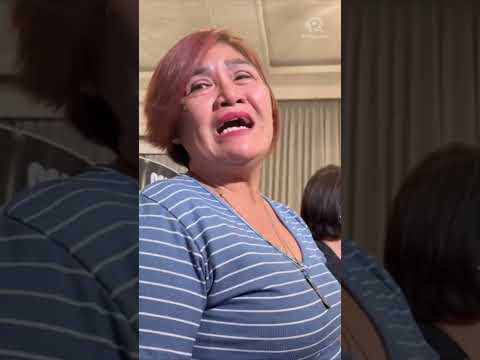
Mary Ann Domingo, whose son and husband were killed by anti-drug police operatives in 2016, was not always hopeful.
She said she is a living example of how hard it is to find justice, having to settle for a conviction for the lower crime of homicide, not murder as she wanted. In 2024 when Duterte faced the House of Representatives, Domingo felt defeated. She cried in the bathroom of the session hall, trying to comprehend how empty that brand of justice felt.
Now with this win, Domingo said she finally felt “great hope.”
“Napakalaking pag-asa. Ngayon pa lang, hindi pa man namin naririning ‘yung confirmation, panalo na kami na nakikita na ‘yung katotohanan hindi lang sa Pilipinas, kundi sa buong mundo,” said Domingo.
(I feel great hope. At this point, even if there’s no confirmation of charges yet, we’ve already won because truth is now being shown not just in the Philippines, but also in the whole world.)
For Domingo, it’s important that this could stop abusive officials.
“Ito ‘yung isang pamamaraan na mababahala na rin yung mga gobyerno na kung paano sila dapat gumalaw at gawin ang mga dapat gawin sa trabaho nila…kasi nakikita nila ‘yung ‘pag nakagawa sila ng mali, maari din sila makasuhan,” said Domingo.
(This is one way so that government officials become more wary about how they should act and do what they’re supposed to do in their jobs…because now they see that if they do something wrong, they can also be charged.)
 LEFT BEHIND. File photo of Mary Ann Domingo appearing before the House quad committee on November 13, 2024.
‘99.999% sure of a trial’
Filipinos needed this win, said activist Donna Miranda, whose brother Emilian Grey was killed in the name of the war on drugs in January 2017.
“Kailangan ng mga Pilipino ng panalo, lalo na sa korupsiyon, lalo na sa pagtaas ng bilihin, lalo na sa patuloy na mababang sahod. Kailangan lalong-lalo ng mga biktima ni Duterte na galing sa laylayan ng lipunan ng panalo,” said Miranda.
(Filipinos need a win, especially with this corruption, increasing prices of goods, especially at this time when wages are so low. Duterte’s victims who are poor especially need this win.)
Domingo attested to that.
“Ang hirap na wala kang katuwang, tapos nagpapatuloy ka na paano mo maitataguyod ‘yung pamilya mo, lalo na ‘yung sa mga bitima na walang sariling tahanan. Lalo na ‘yung hindi sa walang sariling tahanan, ‘yung pinaglilibingan pa ng mahal namin sa buhay, every five years, renew kami nang renew,” she said.
(It’s hard to live life without a partner, you continue living wondering how you could raise a family, especially for victims who don’t have their own homes. Especially those who not only have no home, but also have to renew rent in the cemetery every five years for loved ones buried there.)
Colmenares said he is now very confident that the upcoming decision will again be favorable. On or before April 30, the pre-trial chamber will decide whether the Duterte case on crimes against humanity can proceed to trial. This will be the result of the week-long confirmation of charges hearing last February.
“I am almost 99.999% sure that charges would be confirmed against Duterte. It’s impossible for the court to believe Duterte that there was no common plan,” said Colmenares in Filipino.
The prosecution was confident too, saying that Duterte’s own public speeches owning up to giving orders to kill is like confessing to his own crimes.
Lawyers hope that this momentum can convince other victims to come out and participate. Purisima Dacumos said she has found her strength in numbers. Dacumos’ husband Danny was killed in August 2017, and she has been mocked by neighbors.
“Hindi na po ako ngayon natatakot, laban na po ito ng marami,” said Dacumos. (I’m no longer scared, this is the fight of many people now.)
 ICC. Relatives of drug war victims watch a livestream of the International Criminal Court’s rejection of former president Rodrigo Duterte’s challenge to the Court’s jurisdiction over his alleged crimes against humanity charges, at the University of the Philippines Diliman on April 22, 2026.
‘It was just a matter of time’
Nanette Castillo, who still wears a necklace locket with the face of her son Aldrin in it, said she never doubted they would reach this stage.
“Hindi ako nag-alinlangan, it’s a matter of time lang, pero alam kong darating ang hustisya. Hindi ako natakot, kaya alam ko darating ang hustisya. Wala namang nakakawalang kriminal eh, alam ni Lord,” said Castillo.
(I never doubted. It was just a matter of time, but I knew justice wouild come. I was not afraid, I knew this would come. No criminal gets away, the Lord knows that.)
The ICC’s trust fund for victims is eager to start its assistance program for Philippine victims “as soon as possible.” But the kind of assistance depends on what the victims want and need for them to heal and rebuild.
Castillo said she doesn’t want to think about that for now, scared that any monetary help may betray her son’s memory.
“Sabihin nila para maghilom, wala akong sagot kung ano ang makakapagpahilom sa akin. ‘Yung puwang na ‘yun hindi kayang punan ng kahit na ano ‘yun,” said Castillo. (They say it’s for my healing, I don’t know what can heal me. That’s a void that nothing can ever fill.)
“Lagi ako umaatras eh kung ano ang gusto ko, gusto ko hustisya muna,” she said. (I always back away from that question — what do I want? I want justice.)
– Rappler.com


You May Also Like

GOP lawmakers want nothing to do with Trump's ballroom chaos: report

Not a loophole: Singapore AI export controls let China tap US AI legally

LIST: Bayanihan initiatives amid soaring oil prices


Trending News
More
