Oil Could Hit $150 Per Barrel If Hormuz Strait Remains Closed, Citi Warns
TLDR
- Citigroup increased its near-term Brent crude forecast to $120 per barrel from a previous $95 estimate
- Goldman Sachs elevated its fourth-quarter Brent projection to $90 per barrel, representing a nearly $30 increase from pre-crisis levels
- Persian Gulf crude shipments through the Strait of Hormuz have dropped to virtually zero
- Cumulative supply losses have reached approximately 500 million barrels since hostilities commenced
- Brent crude prices have surged nearly 50% since conflict erupted in late February
Major financial institutions Citigroup and Goldman Sachs have significantly elevated their crude oil price projections as the blockade of the Strait of Hormuz persists with no immediate resolution in sight. On Monday, Brent crude was hovering around $108.50 per barrel, climbing roughly 3% during the session and marking its sixth consecutive day of gains.
Citigroup’s revised outlook places Brent at $120 per barrel within the next zero to three-month timeframe. The financial institution has also adjusted its quarterly average projections to $110, $95, and $80 for Q2, Q3, and Q4 of 2026 respectively. These updated numbers represent substantial increases from the bank’s previous quarterly estimates of $95, $80, and $75.
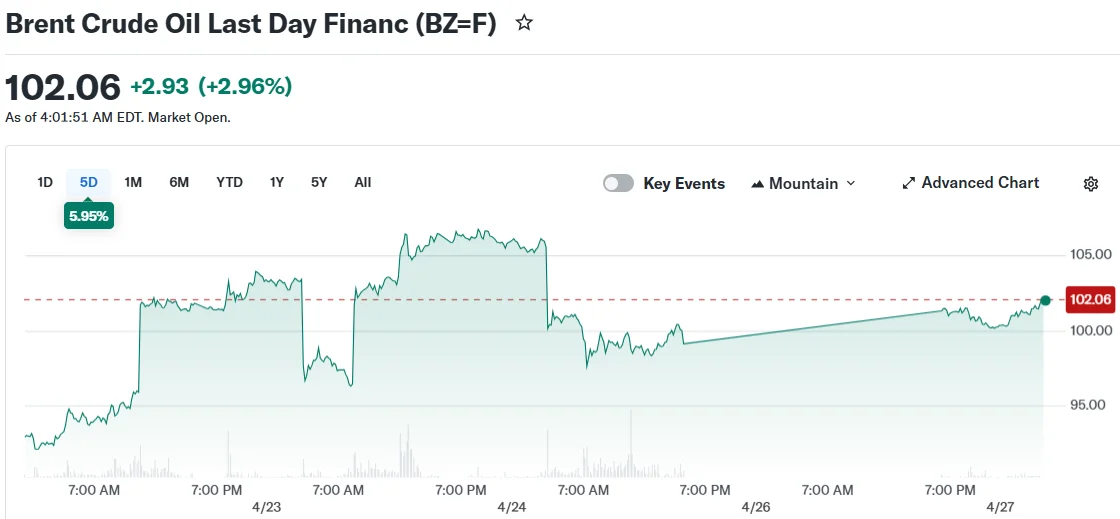 Brent Crude Oil Last Day Financ (BZ=F)
The bank assigns a 50% probability to its primary forecast scenario. This baseline assumption anticipates the Strait will begin reopening by the conclusion of May, representing a one-month delay compared to Citi’s earlier expectations.
Citi’s research team noted that Tehran’s regime possesses both economic and geopolitical motivations to maintain the effective closure of the Strait for the foreseeable future. The analysts contend this strategy would constrict worldwide oil availability, accelerate the depletion of stored reserves, and elevate market prices.
According to Citi’s calculations, approximately 500 million barrels in aggregate supply have vanished from markets since the conflict’s onset. Should the waterway remain blocked throughout May, the institution forecasts aggregate losses could climb to 1.3 billion barrels.
Goldman Sachs Raises Forecasts
Goldman Sachs similarly revised its oil price predictions upward on April 27. The investment bank currently anticipates Brent will average $90 per barrel during the fourth quarter of 2026, representing an increase from its earlier $80 forecast. Goldman indicates this projection now stands nearly $30 above pre-crisis levels, before what market watchers have termed the “Hormuz shock.”
Goldman’s analysis suggests that 14.5 million barrels daily of Persian Gulf crude output disruptions are causing worldwide stockpiles to decline at an unprecedented rate of 11 to 12 million barrels per day throughout April. The firm anticipates a supply shortfall of 9.6 million barrels daily for the current quarter. Goldman’s updated forecasts position Brent at $100 for the present quarter and $93 during Q3.
Morgan Stanley Holds Steady
Morgan Stanley has maintained its existing price forecasts without modification. The institution anticipates Brent will average $110 during the current quarter, $100 throughout Q3, and $90 in Q4. Morgan Stanley’s calculations indicate Gulf region oil shipments have plummeted by 14.2 million barrels daily as a consequence of the closure.
The financial institution noted that worldwide petroleum reserves have declined by an estimated 4.8 million barrels per day, with diminished consumption partially explaining the discrepancy.
Citi’s optimistic scenario, assigned a 30% probability, envisions Brent reaching $150 per barrel should disruptions persist through June’s conclusion. An extreme scenario involving damage to critical infrastructure could propel prices to a sustained range of $160–$180 per barrel.
Under Citi’s primary forecast scenario, global crude inventories are projected to fall to their lowest levels in more than ten years by the end of July.
The post Oil Could Hit $150 Per Barrel If Hormuz Strait Remains Closed, Citi Warns appeared first on Blockonomi.


You May Also Like

USD/JPY Breakout Risk Looms on Potential Bank of Japan Surprise – ING Warns

Soccer Finally Won Over America but the 2026 World Cup May Leave Fans Behind