If the Pectra upgrade prompts a surge in DApp and Ethereum network activity, ETH prices could recover.If the Pectra upgrade prompts a surge in DApp and Ethereum network activity, ETH prices could recover.

Ethereum Pectra upgrade adds new features. When will ETH be able to return to $2,000?

2025/05/08 19:16

By Marcel Pechman , Cointelegraph

Compiled by: Felix, PANews

Ethereum successfully implemented a key network upgrade on May 7, but the price of ETH and its derivatives indicators reacted mutedly to the upgrade. The muted reaction surprised traders and led analysts to question whether ETH still had a chance to rally 22% to reclaim the $2,200 level.
Ethereum Pectra upgrade adds new features. When will ETH be able to return to $2,000?

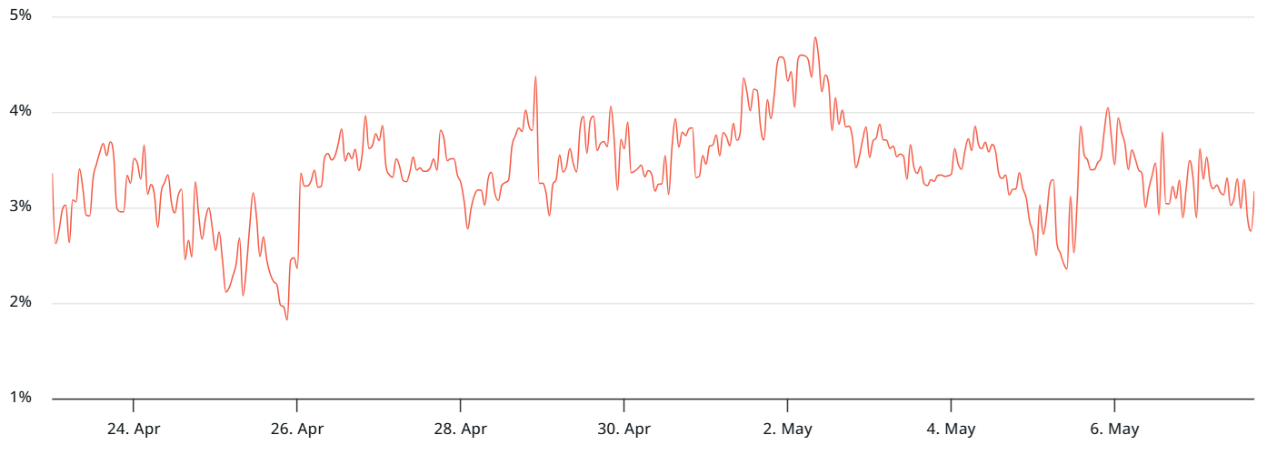
 ETH 30 -day futures annualized premium. Source: Laevitas.ch

The ETH futures premium has been below the neutral threshold of 5%, indicating a lack of interest from leveraged longs. More importantly, after the Pectra upgrade, this indicator remained unchanged at 3%, indicating that traders did not adjust their positions despite the successful deployment of the upgrade.

The muted market reaction is partly due to investors’ focus on macroeconomic issues as uncertainty over global trade disputes heightens the risk of a recession. But traders’ lack of interest in ether predates the recent deterioration in risk aversion. In fact, in the first three months of 2025, ETH underperformed the overall cryptocurrency market cap by 28%.

The muted reaction can be attributed in part to investors’ focus on macroeconomic issues, as the risk of a recession is growing amid uncertainty over global trade disputes. But traders’ lack of interest in ETH predates the recent rise in risk aversion. In fact, in the first three months of 2025, ETH underperformed the overall cryptocurrency market cap by 28%.

Pectra’s lackluster price performance following the upgrade reflects a general discontent in the market as other blockchains have shown some momentum.
Ethereum Pectra upgrade adds new features. When will ETH be able to return to $2,000?

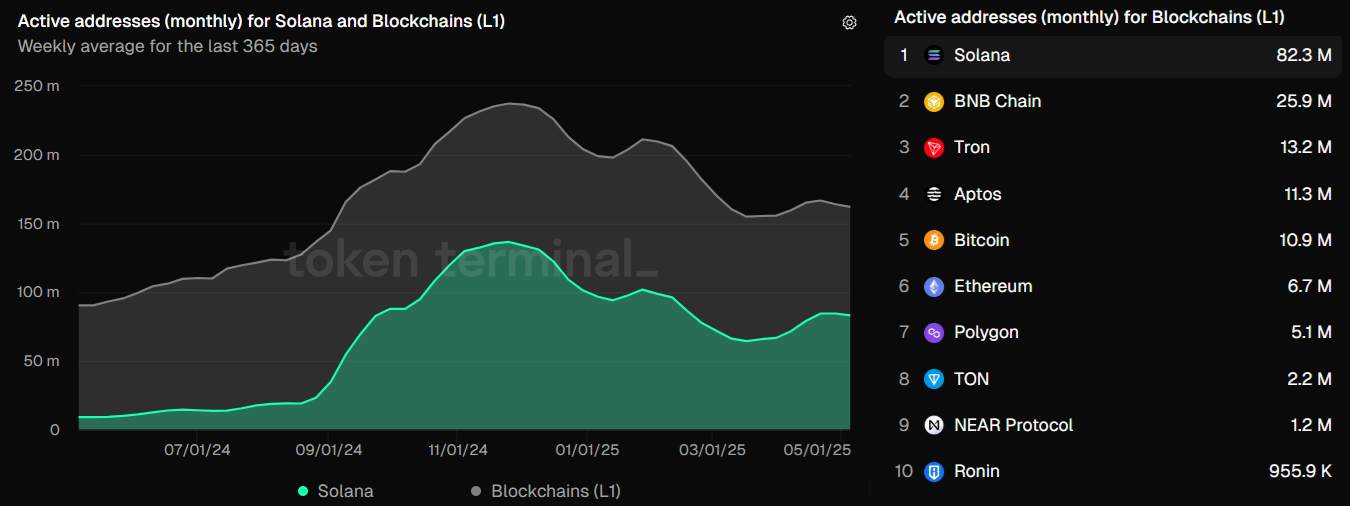
 Solana monthly active addresses compared to L1 competitors. Source: Token Terminal

Historically, high Ethereum base layer fees may have limited network activity, but since mid-February, these fees have fallen below $1. In addition, according to Token Terminal data, Ethereum's leading L2 solution Base currently has 10.3 million monthly active users, far less than Solana's 82.2 million and BNB Chain's 25.9 million.

Ethereum lags in DApp interoperability — will this affect ETH’s price?

Solana has dominated the DEX space by providing an integrated user experience, especially in token issuance. Similarly, Hyperliquid has outperformed expectations in perpetual contract trading, indicating that traders' main concerns are not necessarily on Ethereum's decentralization and security. Meanwhile, Tron has made significant progress in the stablecoin market.
Ethereum Pectra upgrade adds new features. When will ETH be able to return to $2,000?

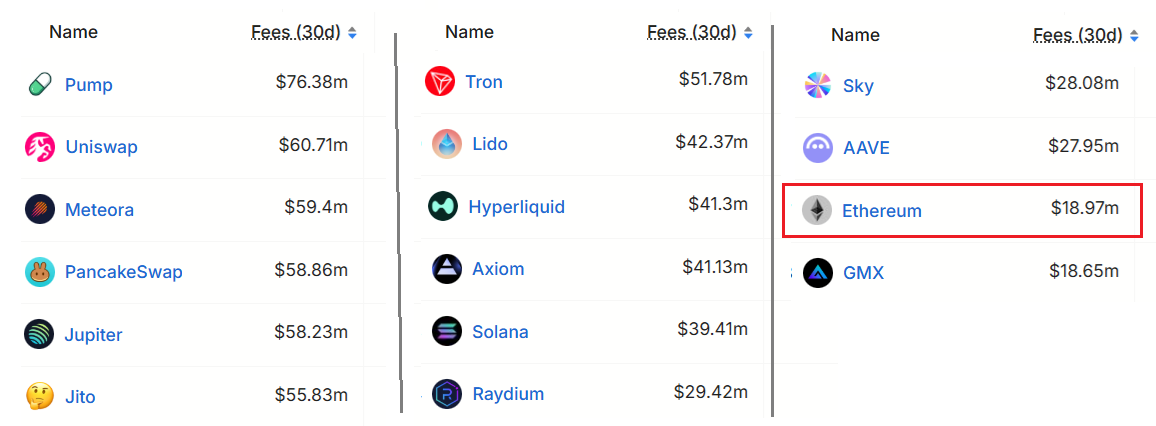
 Blockchain and DApps 30 -day fees (in USD). Source: DefiLlama

Ethereum still leads in terms of total locked value (TVL) at $53.7 billion. However, this has not brought much benefit to ETH holders. According to DefiLlama data, Ethereum network fees have been relatively low at only $19 million in the past 30 days. In comparison, Tron has accumulated fees of $51.8 million in the same period, while Solana has accumulated fees of $39.4 million.
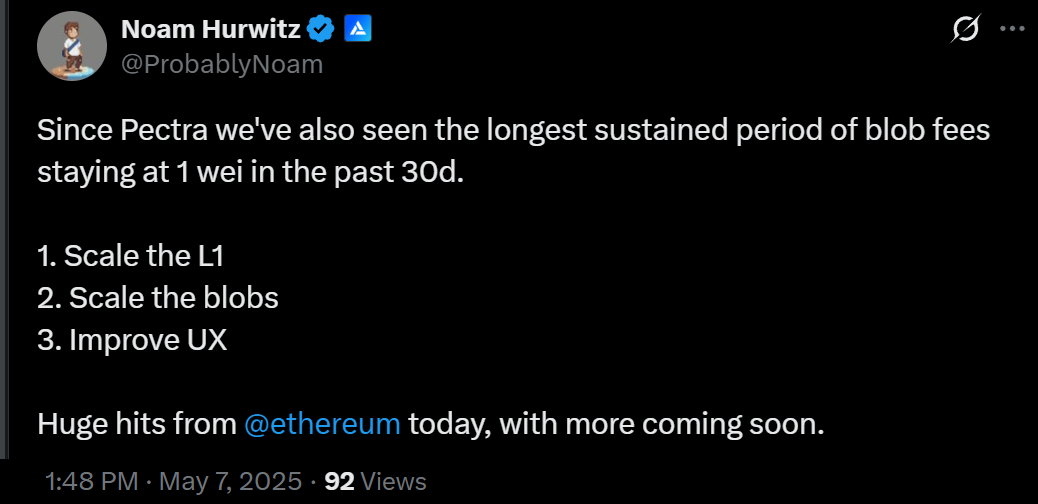
Ethereum Pectra upgrade adds new features. When will ETH be able to return to $2,000?

 Source: X/ProbablyNoam

Noam Hurwitz, Alchemy’s head of engineering, noted that Ethereum’s blob fees have dropped to their lowest levels since the Pectra upgrade. For Hurwitz, ETH’s success depends on the scalability of the base layer, including further improvements to the Rollup mechanism, and ultimately a more seamless user experience.

The interoperability of assets and data in the Ethereum L2 ecosystem has long been a problem, while users on the Solana and BNB chains can easily switch between multiple decentralized applications (DApps). Although the Pectra upgrade is a step in the right direction, it still does not solve this problem, which also explains why ETH has not been able to return to the $2,200 level in early March.

For the price of ETH to rise 22% from its current $1,810, investors will likely need assurance that progress on the network (whether through deposits or L2 growth) translates into noticeable returns. Ultimately, higher staking yields or stronger incentives will be needed to drive wider adoption of DApps, which in turn will increase demand for ETH within the ecosystem.

Related reading: Dialogue with the Ethereum Foundation: After the Pectra upgrade, the three core strategies for the future are explained in detail


Disclaimer: The articles reposted on this site are sourced from public platforms and are provided for informational purposes only. They do not necessarily reflect the views of MEXC. All rights remain with the original authors. If you believe any content infringes on third-party rights, please contact service@support.mexc.com for removal. MEXC makes no guarantees regarding the accuracy, completeness, or timeliness of the content and is not responsible for any actions taken based on the information provided. The content does not constitute financial, legal, or other professional advice, nor should it be considered a recommendation or endorsement by MEXC.

You May Also Like

How to earn from cloud mining: IeByte’s upgraded auto-cloud mining platform unlocks genuine passive earnings

How to earn from cloud mining: IeByte’s upgraded auto-cloud mining platform unlocks genuine passive earnings

The post How to earn from cloud mining: IeByte’s upgraded auto-cloud mining platform unlocks genuine passive earnings appeared on BitcoinEthereumNews.com. contributor Posted: September 17, 2025 As digital assets continue to reshape global finance, cloud mining has become one of the most effective ways for investors to generate stable passive income. Addressing the growing demand for simplicity, security, and profitability, IeByte has officially upgraded its fully automated cloud mining platform, empowering both beginners and experienced investors to earn Bitcoin, Dogecoin, and other mainstream cryptocurrencies without the need for hardware or technical expertise. Why cloud mining in 2025? Traditional crypto mining requires expensive hardware, high electricity costs, and constant maintenance. In 2025, with blockchain networks becoming more competitive, these barriers have grown even higher. Cloud mining solves this by allowing users to lease professional mining power remotely, eliminating the upfront costs and complexity. IeByte stands at the forefront of this transformation, offering investors a transparent and seamless path to daily earnings. IeByte’s upgraded auto-cloud mining platform With its latest upgrade, IeByte introduces: Full Automation: Mining contracts can be activated in just one click, with all processes handled by IeByte’s servers. Enhanced Security: Bank-grade encryption, cold wallets, and real-time monitoring protect every transaction. Scalable Options: From starter packages to high-level investment contracts, investors can choose the plan that matches their goals. Global Reach: Already trusted by users in over 100 countries. Mining contracts for 2025 IeByte offers a wide range of contracts tailored for every investor level. From entry-level plans with daily returns to premium high-yield packages, the platform ensures maximum accessibility. Contract Type Duration Price Daily Reward Total Earnings (Principal + Profit) Starter Contract 1 Day $200 $6 $200 + $6 + $10 bonus Bronze Basic Contract 2 Days $500 $13.5 $500 + $27 Bronze Basic Contract 3 Days $1,200 $36 $1,200 + $108 Silver Advanced Contract 1 Day $5,000 $175 $5,000 + $175 Silver Advanced Contract 2 Days $8,000 $320 $8,000 + $640 Silver…
Share
BitcoinEthereumNews2025/09/17 23:48
Hong Kong Backs Commercial Bank Tokenized Deposits in 2025

Hong Kong Backs Commercial Bank Tokenized Deposits in 2025

The post Hong Kong Backs Commercial Bank Tokenized Deposits in 2025 appeared on BitcoinEthereumNews.com. HKMA to support tokenized deposits and regular issuance of digital bonds. SFC drafting licensing framework for trading, custody, and stablecoin issuers. New rules will cover stablecoin issuers, digital asset trading, and custody services. Hong Kong is stepping up its digital finance ambitions with a policy blueprint that places tokenization at the core of banking innovation.  In the 2025 Policy Address, Chief Executive John Lee outlined measures that will see the Hong Kong Monetary Authority (HKMA) encourage commercial banks to roll out tokenized deposits and expand the city’s live tokenized-asset transactions. Hong Kong’s Project Ensemble to Drive Tokenized Deposits Lee confirmed that the HKMA will “continue to take forward Project Ensemble, including encouraging commercial banks to introduce tokenised deposits, and promoting live transactions of tokenised assets, such as the settlement of tokenised money market funds with tokenised deposits.” The initiative aims to embed tokenized deposits, bank liabilities represented as blockchain-based tokens, into mainstream financial operations. These deposits could facilitate the settlement of money-market funds and other financial instruments more quickly and efficiently. To ensure a controlled rollout, the HKMA will utilize its regulatory sandbox to enable banks to test tokenized products while enhancing risk management. Tokenized Bonds to Become a Regular Feature Beyond deposits, the government intends to make tokenized bond issuance a permanent element of Hong Kong’s financial markets. After successful pilots, including green bonds, the HKMA will help regularize the issuance process to build deep and liquid markets for digital bonds accessible to both local and international investors. Related: Beijing Blocks State-Owned Firms From Stablecoin Businesses in Hong Kong Hong Kong’s Global Financial Role The policy address also set out a comprehensive regulatory framework for digital assets. Hong Kong is implementing a regime for stablecoin issuers and drafting licensing rules for digital asset trading and custody services. The Securities…
Share
BitcoinEthereumNews2025/09/18 07:10