

Expert Speaks
In this controversial proposal, the Commission on Higher Education is eyeing a significant cut in general education units to 18, with the pilot testing targetedIn this controversial proposal, the Commission on Higher Education is eyeing a significant cut in general education units to 18, with the pilot testing targeted
FAST FACTS: CHED’s proposed reframed general education curriculum
For feedback or concerns regarding this content, please contact us at crypto.news@mexc.com
MANILA, Philippines – The Commission on Higher Education (CHED) wants to reduce general education (GE) units by half in the tertiary curriculum, a proposal that has drawn widespread opposition from schools, teachers, and other education stakeholders.
Officially presented in a public hearing last May 5, the controversial plan involves further cutting the minimum number of GE units from 36 to 18.
Back in school year (SY) 2018-2019, CHED already cut GE units from 60 to the current 36 as some subjects had been moved to senior high school. During that time, the first batch of SHS graduates under the K to 12 program enrolled in higher education institutions (HEIs).
Here are some details of CHED’s proposed “reframed” GE curriculum:
Reframed GE courses
Future college students would be seeing these six courses:
- Professional Communication
- Global Trends and Emerging Technologies
- Data, Evidence, and Ethics in a Knowledge-Driven Society
- Rizal and Philippine Studies
- Labor Education
- Institutional Course
Professional Communication would focus on “communication theories, genre conventions, and digital-AI literacy frameworks.”
Global Trends and Emerging Technologies is the reframed course combining The Contemporary World and Science, Technology, and Society.
Data, Evidence, and Ethics in a Knowledge-Driven Society, under CHED’s perspective, would be covering math, science, and ethics.
Students would still be learning history using the lens of Filipino hero Jose Rizal’s life and works. The Rizal course is mandated under Republic Act (RA) No. 1425, a nearly 70-year-old law.
Labor Education would fulfill the mandate of another law, RA 11551, to integrate lessons about labor rights and workplace practices into the tertiary curriculum. Some have pointed out, however, that HEIs are not necessarily required to make this a stand-alone course, as it can also be integrated into existing GE courses or elective courses.
Meanwhile, students may learn about their school’s history, core values, and culture through the Institutional Course.
Art Appreciation in the current curriculum is at risk of removal as, according to CHED, it is already taught in basic education and through SHS electives.
The plan presupposes that existing GE courses are already well integrated into the SHS curriculum — something that critics say is not always the case.
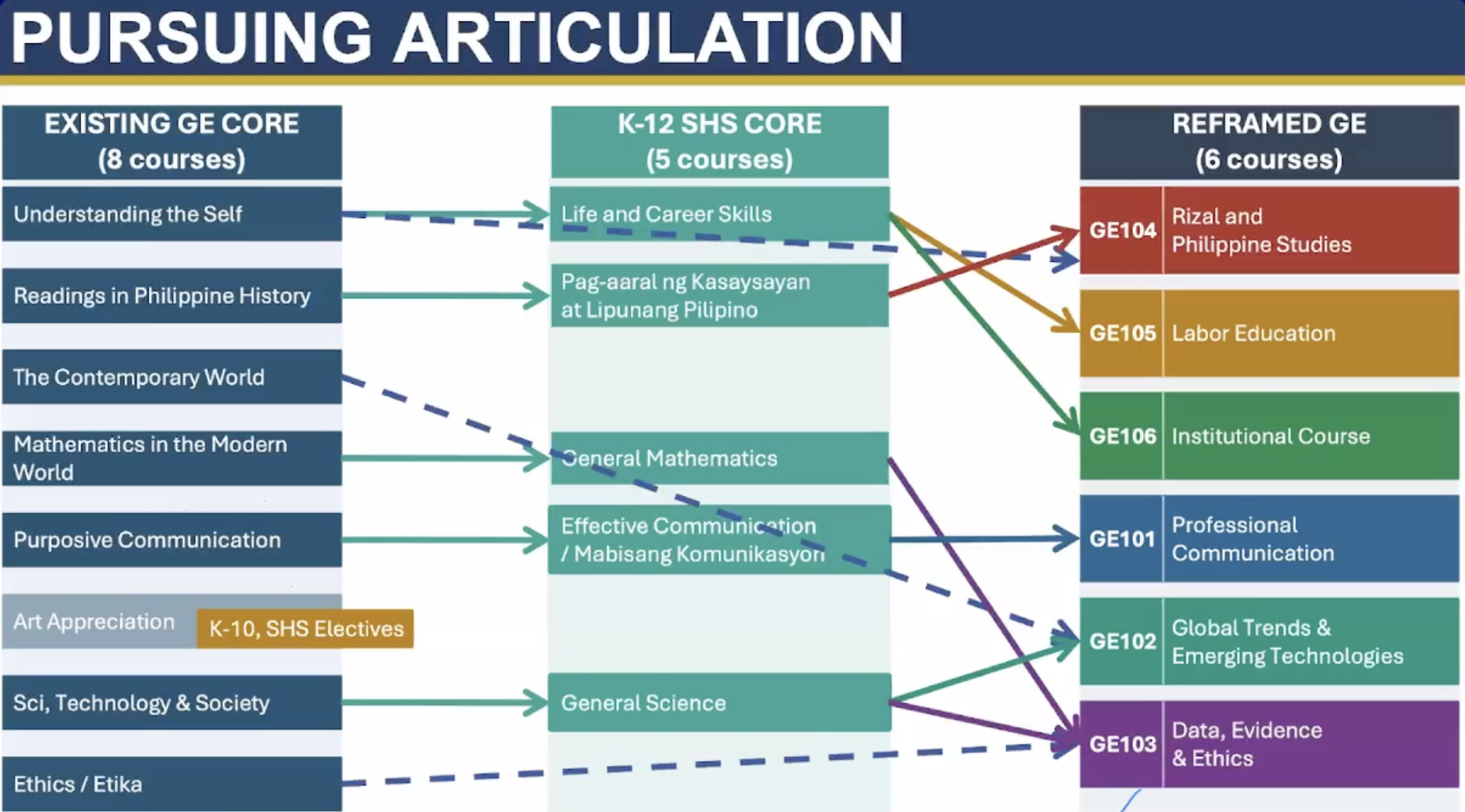 Image from Commission on Higher Education
Suggested maximum
Aside from proposing a lower minimum number of GE units, CHED is suggesting a cap of 36 units for autonomous HEIs, which would come with certain conditions.
“It should be OBE (outcome-based education)-compliant and no extension of time-to-degree. In other words, this flexibility is allowed, but disciplinary inflation and redundancies are not allowed,” Jonathan Macayan, co-chair of the CHED Technical Panel for General Education (TPGE), said during the hearing.
Why the need for reframing?
During the hearing, TPGE chairperson Edizon Fermin argued that the Philippines has the “heaviest assignment” of the GE component in curricula compared to other countries.
“EDCOM was able to articulate that, indeed, we are spending approximately or even more than one academic year just to complete a general education that has already been found out to have repetitive characteristics and content down in senior high school,” Fermin said.
He was referring to a previous observation by the Second Congressional Commission on Education that college students devote 50 units to general electives and legislated subjects.
In his presentation, Fermin said the proposed reframed GE would address issues raised during zonal public consultations.
He said there is redundancy or overlapping content between SHS and college GE courses, supposed misalignment due to gaps between intended outcomes and contemporary learner needs, and insufficient integration of digital literacy, artificial intelligence, and sustainability in the GE curriculum.
Macayan also emphasized that with the reframed curriculum, CHED is doing away with the “content-based design” curriculum, or what he explained was focusing on the scope and coverage of the course and the list of topics that teachers should cover.
“It shifts the focus to the desired competencies and to the learners,” Macayan said. “The focus is on the outcomes, and this refers to the demonstrable student abilities and competencies beyond knowing and understanding.”
Proposal still under review
The commission is eyeing the pilot testing of the proposal in the upcoming SY 2026-2027, full implementation by SY 2027-2028, and a three-year period as the “transition window.”
But universities and faculty members have expressed alarm over the plan, as it would primarily affect humanities and social sciences courses, and ultimately have an impact on students’ development and critical thinking. Teachers’ job losses are also feared.
During the public hearing, CHED said the proposed reframed GE curriculum will still be finalized.
The commission also said last Thursday, May 7, that it will examine stakeholder inputs to ensure that the proposed curriculum is “coherent, responsive, and aligned with national priorities and global standards.”
CHED is expected to revise the draft policy and get approval from the commission en banc before issuing a memorandum order. – Rappler.com


Disclaimer: The articles reposted on this site are sourced from public platforms and are provided for informational purposes only. They do not necessarily reflect the views of MEXC. All rights remain with the original authors. If you believe any content infringes on third-party rights, please contact crypto.news@mexc.com for removal. MEXC makes no guarantees regarding the accuracy, completeness, or timeliness of the content and is not responsible for any actions taken based on the information provided. The content does not constitute financial, legal, or other professional advice, nor should it be considered a recommendation or endorsement by MEXC.
You May Also Like

MARA shares sink as $1.3B Q1 loss tests AI pivot
MARA shares fell after a Q1 revenue miss and $1.3B loss as Bitcoin mining pressure offset its AI data center expansion plans in 2026.
Share
Crypto.news2026/05/12 12:59

Pi Network Users Shocked After Website Shutdown Claims Spread
Pi Network Users Shocked After Website Shutdown Claims Spread The Pi Network community is currently facing renewed confusion after viral claims surfaced on
Share
Hokanews2026/05/12 13:08

Pi Network Roadmap 2026 Sparks Debate Over Decentralization and $Pi Price Outlook
Pi Network Roadmap 2026 Sparks Debate Over Decentralization and $Pi Price Outlook A newly circulating simplified roadmap of Pi Network has sparked renewed
Share
Hokanews2026/05/12 13:00



