CLARITY Act Scores Another Major Win, But These Hurdles Could Still Kill It as BTC Falls Again
Bitcoin fell back below $79,000 on Friday after fresh inflation concerns hit risk markets again, and the timing came just as the crypto industry celebrated another major step for the CLARITY Act in the United States Senate.
The bill cleared the Senate Banking Committee with a 15 to 9 vote. That development gave crypto regulation supporters something positive to focus on, yet the broader market reaction remained cautious as BTC price weakness returned across derivatives exchanges.
The latest Bitcoin drop arrived after hotter macro inflation data pushed U.S. Treasury yields higher. That pressure reduced short term appetite for speculative assets. Liquidation data quickly followed as more than $500 million in leveraged long positions disappeared during the market shakeout. Bitcoin now trades close to $78,000 after losing support above $79,000 earlier in the day.
CLARITY Act Vote Moves Crypto Regulation Closer To Reality
Crypto analyst Crypto Patel described the Senate Banking Committee vote as a major victory for digital asset regulation in the United States. His analysis explained that the real political fight now begins because the bill still needs to clear the full Senate and complete House Senate reconciliation before lawmakers leave for summer recess.
Patel pointed toward two important deadlines that could decide the bill’s future. The House recess begins on July 27, and the Senate recess starts on August 10. Missing that timeline could delay progress until the fall agenda. That delay would make passage much harder because election season politics may dominate discussions later in the year.
Another factor deserves attention. The CLARITY Act still faces five major hurdles before it can become law.
The first issue centers on the ongoing SEC versus CFTC debate. Lawmakers still disagree about which assets should fall under securities rules and which should remain commodities. Stablecoin reward structures remain another difficult topic because current compromises still appear politically fragile.
Patel also noted that stricter anti-money laundering rules and national security measures may arrive during final negotiations. Ethics provisions connected to crypto related conflicts of interest continue creating political tension too. Trump family crypto ties remain part of the broader discussion inside Washington.
DeFi regulation and developer liability rules also remain unsettled. That uncertainty matters because many blockchain projects still operate without clear legal boundaries inside the United States.
Patel explained that the bill likely needs 60 Senate votes to survive. That requirement means at least 7 Democrats may need to support the legislation. Political disagreements around ethics provisions could still stall the process entirely.
Enterprise Focused Crypto Projects Could Benefit If Regulatory Clarity Improves
Market commentator X Finance Bull argued that the CLARITY Act matters because clearer rules may help serious blockchain projects separate themselves from speculative hype driven tokens.
His analysis focused on projects tied to real infrastructure and institutional use cases. HBAR remained part of the discussion because of its enterprise blockchain focus. XLM continued appearing in conversations around cross-border settlement systems. ONDO also entered the conversation because of its connection to tokenized real world assets.
LINK gained attention for oracle infrastructure utility across blockchain ecosystems. ADA stayed connected to smart contract development activity, and ALGO remained linked to scalable blockchain payment rails.
That argument matters because regulatory clarity often favors projects already connected to enterprise services, compliance structures, and institutional partnerships. Crypto markets historically move toward utility focused narratives during periods of tighter oversight.
Bitcoin Price Weakness Shows Macro Pressure Is Still Controlling Markets
Bitcoin continues facing downward pressure today as macroeconomic concerns weigh heavily on risk assets. A look at the BTC chart shows sellers taking control after the failure to defend the $79,000 level earlier in the session.
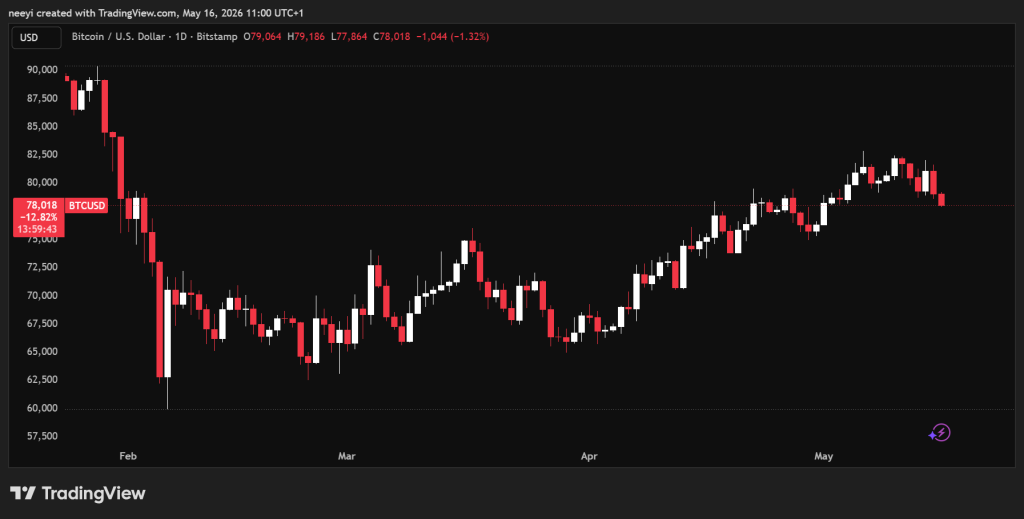 BTC Price Chart / TradingView.com
The recent liquidation event damaged bullish momentum across lower timeframes. Treasury yields moved higher after inflation data came in above expectations. That development reduced short term confidence across crypto and equity markets.
Current technical indicators also show bearish conditions dominating intraday trading activity.
| Name Of Indicator | Metrics | Interpretation |
|---|---|---|
| RSI (14) | 35.416 | RSI remains close to oversold territory. Selling pressure still dominates short term momentum. |
| MACD (12,26) | -464.2 | MACD remains deeply negative. Bearish momentum continues controlling BTC price direction. |
| Highs/Lows (14) | -1200.1942 | Lower highs and lower lows continue forming across recent sessions. |
| ROC | -0.883 | Negative rate of change shows BTC price losing momentum over recent trading periods. |
BTC Price Prediction Shows Two Key Scenarios For Today
BTC Upside Scenario
Bitcoin bulls still have a path toward recovery before the daily close. Buy volume must protect the $78,000 support area first. A clean hourly close above $79,331 could open the door toward a rebound between $79,345 and $80,600 later today.
That recovery scenario depends heavily on liquidation pressure cooling down across derivatives markets. Short term momentum indicators would also need to stabilize before buyers regain confidence.
Related Article: Clarity Act News: Bitcoin Dips Below $80K as Crypto Bill Talks Fail Overnight – No Deal on Two Issues
BTC Downside Scenario
Bitcoin may continue falling if bearish momentum remains active through the rest of the trading session. A breakdown below the $78,000 level could expose BTC price to a decline toward the $76,000 region.
Macro conditions still remain difficult for risk assets right now. Treasury yields continue pushing higher, and that pressure may keep limiting upside strength across crypto markets for now.
FAQs
Subscribe to our YouTube channel for daily crypto updates, market insights, and expert analysis.
The post CLARITY Act Scores Another Major Win, But These Hurdles Could Still Kill It as BTC Falls Again appeared first on CaptainAltcoin.


You May Also Like

Intesa Sanpaolo crypto exposure jumps to ~$235M in Q1 2026

Markets are moving toward a new global financial crisis. These are the tripwires that would confirm it