The US Senate’s high-profile crypto market structure bill remains on a tight timetable, with insiders warning that passage could slip into August or even miss theThe US Senate’s high-profile crypto market structure bill remains on a tight timetable, with insiders warning that passage could slip into August or even miss the

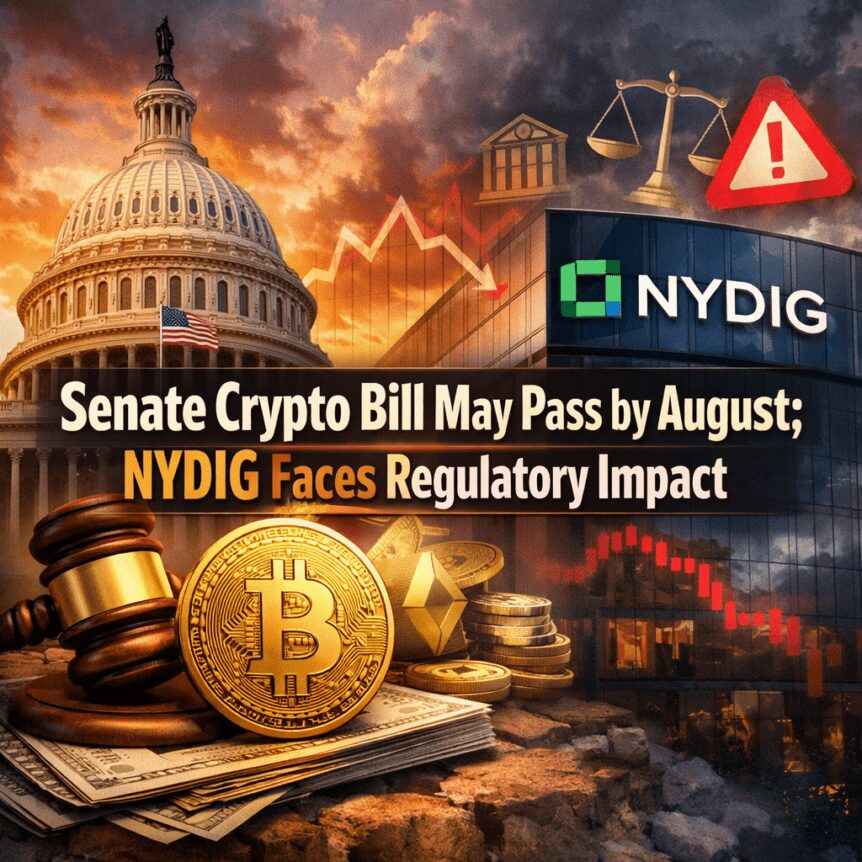
Senate Crypto Bill May Pass by August; NYDIG Faces Regulatory Impact
For feedback or concerns regarding this content, please contact us at crypto.news@mexc.com
Senate Crypto Bill May Pass By August; Nydig Faces Regulatory Impact

The US Senate’s high-profile crypto market structure bill remains on a tight timetable, with insiders warning that passage could slip into August or even miss the midterm window entirely if lawmakers cannot align before November. Greg Cipolaro, head of research at NYDIG, cautioned that the realistic negotiating window may extend from June to early August, while an earlier target floated by White House crypto adviser Patrick Witt pointed to July 4 for a Senate markup and floor votes. The reality, said Cipolaro, is likely less rigid: “This may represent an aspirational benchmark rather than a fixed legislative deadline.”

The draft legislation is designed to establish a comprehensive framework for how US regulators would oversee crypto markets, a centerpiece among this year’s most consequential crypto policy measures. Yet progress has been slowed by contentious negotiations over stablecoins, enforcement approaches to decentralized finance, and the extent of government officials’ use of crypto, among other sticking points.

According to Cointelegraph, the bill cleared a long-delayed markup in the Senate Banking Committee on Thursday, advancing to the Senate floor where it would require 60 votes to proceed and avoid a protracted debate. The committee vote was largely along party lines, underscoring the partisan dynamics that could shape the bill’s fate as lawmakers return from recess.

Key takeaways

  • The Senate Banking Committee moved the crypto market structure bill toward a full floor vote, setting up a 60-vote threshold to pass and avert extended debate.
  • With the Senate’s current 53-seat Republican majority, securing at least seven Democratic votes would be needed for swift passage; several Democrats have expressed concerns that the proposal does not go far enough to curb crime or sanctions evasion.
  • The timing remains uncertain: the realistic passage window spans June through early August, but a July–September recess and the looming midterms could complicate scheduling; a post-election lame-duck session remains a potential alternative path.
  • Beyond timing, passage would deliver regulatory clarity that could boost institutional participation in crypto markets. In particular, the bill would classify Bitcoin as a commodity under the Commodity Futures Trading Commission and reduce remaining regulatory overhang for Bitcoin as an institutional asset.
  • Even if enacted, the bill’s fate is contingent on broader political dynamics. A Democratic gain in the Senate could derail the current Republican-backed framework in the next Congress, given the different legislative environment after the midterms.

Legislative trajectory and timing

The core purpose of the bill is to prescribe how US watchdogs would regulate crypto markets, seeking to harmonize oversight across agencies and provide a clearer pathway for institutions operating in the space. Its resonance within the policy landscape is tied to the ongoing debate over stablecoins, anti-crime provisions, and how to integrate crypto activity within traditional financial law. The latest committee action marks a critical milestone, but substantial hurdles remain before a floor vote and eventual enactment.

Regulatory implications and market impact

Proponents argue that a formal framework would reduce legal uncertainty and enable more robust participation by banks and other large investors, which have frequently cited the lack of regulatory clarity as a constraint on capital deployment in crypto markets. A central feature described in policy discussions is the potential classification of Bitcoin as a commodity for CFTC oversight, addressing a longstanding question about its regulatory status and eliminating a major bit of ambiguity for market participants.

For exchanges, asset managers, and crypto firms, the bill’s passage would set a baseline of compliance expectations—particularly around disclosures, registration requirements, and enforcement mechanisms. In parallel, the proposed framework intersects with broader regulatory structures under consideration in other jurisdictions, and policymakers frequently reference cross-border alignment as a goal to facilitate legitimate global activity while deterring illicit finance.

Political dynamics, risk, and enforcement considerations

Political dynamics loom large. Republicans hold a 53-seat Senate majority, meaning cross-party support is essential for a timely enactment. Achieving consensus would require at least seven Democrats to back the measure for a rapid path to passage. Yet several Democrats have voiced concerns that the bill does not sufficiently deter crime or address sanctions evasion, raising questions about the balance between bipartisan cooperation and stringent safeguards.

As Cipolaro summarized in his briefing, congressional negotiators face a tradeoff: “Congressional negotiators face a tradeoff between accepting an imperfect bipartisan framework in 2026 versus risking a substantially different legislative environment after the midterms.” The statement underscores the high stakes of timing; a change in control after the midterms could reshape the legislative approach to crypto regulation, potentially altering or delaying the policy roadmap.

Beyond timing, there are substantive policy questions that could influence the bill’s durability after passage. Provisions related to decentralized finance, ethics rules, and enforcement authorities remain focal points of negotiation, and even if the bill advances, regulatory interpretation and practical implementation will require close coordination across agencies and in-depth compliance programs by market participants.

From a compliance perspective, the potential clarity offered by a enacted framework could align with existing AML/KYC expectations and licensing regimes, while also prompting banks and broker-dealers to reassess their crypto exposure, risk controls, and reporting obligations. The interplay with other regulatory initiatives—such as the broader financial services rulebook and cross-border policy efforts—will be critical to ensure coherence and avoid regulatory arbitrage.

Closing the loop on enforcement considerations, a finalized framework would still need to address how to supervise rapidly evolving technologies and products within the crypto ecosystem, particularly when it comes to DeFi platforms and new token structures. Market participants would benefit from well-defined standards, but the evolving nature of the asset class means that oversight will require ongoing monitoring and possible updates to policy to address emerging risks.

What happens next remains highly dependent on calendar and coalition-building. Analysts and compliance teams should monitor committee schedules, potential amendments targeting stablecoins, and the broader electoral context, as these factors will shape both the likelihood of passage and the regulatory architecture that would follow.

If enacted, the law would mark a significant milestone in US crypto policy, providing a clearer authorization framework for institutional participation and enabling regulators to articulate specific standards for market integrity and consumer protection. For now, market observers are balancing optimism about regulatory clarity with caution about political wagering and the complexity of crafting durable, cross-agency oversight that can withstand changing administrations and election outcomes.

Source note: Coverage reflects developments reported in contemporary policy and market briefs, with attribution to Cointelegraph where cited.

Looking ahead, stakeholders will want to watch for the final passage dynamics, the specific text of any amendments, and the timing of a floor vote. The course of the bill will illuminate how Congress intends to frame crypto in the regulated financial system and what that means for the trajectory of crypto markets, institutional adoption, and cross-border regulatory alignment.

This article was originally published as Senate Crypto Bill May Pass by August; NYDIG Faces Regulatory Impact on Crypto Breaking News – your trusted source for crypto news, Bitcoin news, and blockchain updates.


Market Opportunity
Billions Logo
Billions Price(BILL)
$0.02595
$0.02595$0.02595
+3.05%
USD
Billions (BILL) Live Price Chart

Get Covered, Share 1M USDT

Get Covered, Share 1M USDTGet Covered, Share 1M USDT

Higher VVIP tiers, higher compensation odds.

Disclaimer: The articles reposted on this site are sourced from public platforms and are provided for informational purposes only. They do not necessarily reflect the views of MEXC. All rights remain with the original authors. If you believe any content infringes on third-party rights, please contact crypto.news@mexc.com for removal. MEXC makes no guarantees regarding the accuracy, completeness, or timeliness of the content and is not responsible for any actions taken based on the information provided. The content does not constitute financial, legal, or other professional advice, nor should it be considered a recommendation or endorsement by MEXC.

You May Also Like

Not a loophole: Singapore AI export controls let China tap US AI legally

Not a loophole: Singapore AI export controls let China tap US AI legally

American AI technology is reaching Chinese tech giants through a route that US export controls were never designed to close: Singapore. The city-state sits outside
Share
The Cryptonomist2026/07/10 14:46
Unlocking Massive Value: Curve Finance Revenue Sharing Proposal for CRV Holders

Unlocking Massive Value: Curve Finance Revenue Sharing Proposal for CRV Holders

BitcoinWorld Unlocking Massive Value: Curve Finance Revenue Sharing Proposal for CRV Holders The dynamic world of decentralized finance (DeFi) is constantly evolving, bringing forth new opportunities and innovations. A significant development is currently unfolding at Curve Finance, a leading decentralized exchange (DEX). Its founder, Michael Egorov, has put forth an exciting proposal designed to offer a more direct path for token holders to earn revenue. This initiative, centered around a new Curve Finance revenue sharing model, aims to bolster the value for those actively participating in the protocol’s governance. What is the “Yield Basis” Proposal and How Does it Work? At the core of this forward-thinking initiative is a new protocol dubbed Yield Basis. Michael Egorov introduced this concept on the CurveDAO governance forum, outlining a mechanism to distribute sustainable profits directly to CRV holders. Specifically, it targets those who stake their CRV tokens to gain veCRV, which are essential for governance participation within the Curve ecosystem. Let’s break down the initial steps of this innovative proposal: crvUSD Issuance: Before the Yield Basis protocol goes live, $60 million in crvUSD will be issued. Strategic Fund Allocation: The funds generated from the sale of these crvUSD tokens will be strategically deployed into three distinct Bitcoin-based liquidity pools: WBTC, cbBTC, and tBTC. Pool Capping: To ensure balanced risk and diversified exposure, each of these pools will be capped at $10 million. This carefully designed structure aims to establish a robust and consistent income stream, forming the bedrock of a sustainable Curve Finance revenue sharing mechanism. Why is This Curve Finance Revenue Sharing Significant for CRV Holders? This proposal marks a pivotal moment for CRV holders, particularly those dedicated to the long-term health and governance of Curve Finance. Historically, generating revenue for token holders in the DeFi space can often be complex. The Yield Basis proposal simplifies this by offering a more direct and transparent pathway to earnings. By staking CRV for veCRV, holders are not merely engaging in governance; they are now directly positioned to benefit from the protocol’s overall success. The significance of this development is multifaceted: Direct Profit Distribution: veCRV holders are set to receive a substantial share of the profits generated by the Yield Basis protocol. Incentivized Governance: This direct financial incentive encourages more users to stake their CRV, which in turn strengthens the protocol’s decentralized governance structure. Enhanced Value Proposition: The promise of sustainable revenue sharing could significantly boost the inherent value of holding and staking CRV tokens. Ultimately, this move underscores Curve Finance’s dedication to rewarding its committed community and ensuring the long-term vitality of its ecosystem through effective Curve Finance revenue sharing. Understanding the Mechanics: Profit Distribution and Ecosystem Support The distribution model for Yield Basis has been thoughtfully crafted to strike a balance between rewarding veCRV holders and supporting the wider Curve ecosystem. Under the terms of the proposal, a substantial portion of the value generated by Yield Basis will flow back to those who contribute to the protocol’s governance. Returns for veCRV Holders: A significant share, specifically between 35% and 65% of the value generated by Yield Basis, will be distributed to veCRV holders. This flexible range allows for dynamic adjustments based on market conditions and the protocol’s performance. Ecosystem Reserve: Crucially, 25% of the Yield Basis tokens will be reserved exclusively for the Curve ecosystem. This allocation can be utilized for various strategic purposes, such as funding ongoing development, issuing grants, or further incentivizing liquidity providers. This ensures the continuous growth and innovation of the platform. The proposal is currently undergoing a democratic vote on the CurveDAO governance forum, giving the community a direct voice in shaping the future of Curve Finance revenue sharing. The voting period is scheduled to conclude on September 24th. What’s Next for Curve Finance and CRV Holders? The proposed Yield Basis protocol represents a pioneering approach to sustainable revenue generation and community incentivization within the DeFi landscape. If approved by the community, this Curve Finance revenue sharing model has the potential to establish a new benchmark for how decentralized exchanges reward their most dedicated participants. It aims to foster a more robust and engaged community by directly linking governance participation with tangible financial benefits. This strategic move by Michael Egorov and the Curve Finance team highlights a strong commitment to innovation and strengthening the decentralized nature of the protocol. For CRV holders, a thorough understanding of this proposal is crucial for making informed decisions regarding their staking strategies and overall engagement with one of DeFi’s foundational platforms. FAQs about Curve Finance Revenue Sharing Q1: What is the main goal of the Yield Basis proposal? A1: The primary goal is to establish a more direct and sustainable way for CRV token holders who stake their tokens (receiving veCRV) to earn revenue from the Curve Finance protocol. Q2: How will funds be generated for the Yield Basis protocol? A2: Initially, $60 million in crvUSD will be issued and sold. The funds from this sale will then be allocated to three Bitcoin-based pools (WBTC, cbBTC, and tBTC), with each pool capped at $10 million, to generate profits. Q3: Who benefits from the Yield Basis revenue sharing? A3: The proposal states that between 35% and 65% of the value generated by Yield Basis will be returned to veCRV holders, who are CRV stakers participating in governance. Q4: What is the purpose of the 25% reserve for the Curve ecosystem? A4: This 25% reserve of Yield Basis tokens is intended to support the broader Curve ecosystem, potentially funding development, grants, or other initiatives that contribute to the platform’s growth and sustainability. Q5: When is the vote on the Yield Basis proposal? A5: A vote on the proposal is currently underway on the CurveDAO governance forum and is scheduled to run until September 24th. If you found this article insightful and valuable, please consider sharing it with your friends, colleagues, and followers on social media! Your support helps us continue to deliver important DeFi insights and analysis to a wider audience. To learn more about the latest DeFi market trends, explore our article on key developments shaping decentralized finance institutional adoption. This post Unlocking Massive Value: Curve Finance Revenue Sharing Proposal for CRV Holders first appeared on BitcoinWorld.
Share
Coinstats2025/09/18 00:35
Q2 Market Insights: Bitcoin regains dominance in risk-averse environment, ETFs remain critical to market structure


Q2 Market Insights: Bitcoin regains dominance in risk-averse environment, ETFs remain critical to market structure

The market will show a downward trend in the short term, and then rebound and set new highs in the second half of the year.
Share
PANews2025/04/28 19:40

Record Ads, Stock Down 7%

Record Ads, Stock Down 7%Record Ads, Stock Down 7%

Jul 29: Meta earnings face the market's question.

