By Luke, Mars Finance The Plasma airdrop ultimately distributed 9,300 $XPL to each participant. Based on the recent high of $1.45, this represents an airdrop reward worth over $13,400 USD – regardless of the initial investment. This astonishing wealth creation has once again put the spotlight on Founders Fund, a key investor behind the event. This top-tier VC firm, founded by Peter Thiel, has practically solidified its reputation as the crypto world's "airdrop treasure map" thanks to its early investments in projects like Starknet, Avail, and Plasma. Their success is clearly no accident. Behind it lies a clear investment philosophy and decision-making system. So, what lies at the heart of this system? What's the thinking behind Founders Fund's leadership? After the Plasma explosion, what other projects, aligned with their philosophy and offering high airdrop potential, are worth our close attention? The "brain" and "OG": Founders Fund's dual decision-making core Founders Fund's strong momentum in the crypto space stems from the perfect complementarity between its two core figures: one is the "brain" who provides top-level philosophy and grand narratives, while the other is the "crypto OG" who is responsible for going deep into the front lines and ensuring tactical execution. Peter Thiel: The Brain and Soul of Investing As the founder and spiritual leader of Founders Fund, Peter Thiel's personal philosophy deeply imprints every investment decision of the fund. The "contrarian thinking" and pursuit of "monopolistic technology," as conveyed in his book "Zero to One," form the cornerstones of Founders Fund's investments. As the godfather of the "PayPal Mafia," Thiel has a long-standing obsession with creating a next-generation financial network independent of traditional systems. This profound perspective dictates that Founders Fund consistently focuses on underlying protocols and infrastructure that can reshape the industry landscape, rather than chasing short-term application trends. He sets the direction for the fund: to seek out teams that are solving the most difficult problems and have the potential to create a new future. Joey Krug: A Crypto OG on the Front Lines If Thiel provides the philosophical guidance on "why to invest," then partner Joey Krug addresses the tactical questions of "who to invest" and "how to invest." Krug is a true OG in the crypto world. As the co-founder of the decentralized prediction market Augur, he has real-world experience building and operating a successful DeFi protocol from scratch. Prior to joining Founders Fund, he served as co-CIO at Pantera Capital, accumulating extensive crypto investment experience. Krug has emphasized his paramount importance to a team's "shipping velocity," or the ability to consistently transform ideas into products. It is his deep industry background and keen judgment of technical execution that ensures Founders Fund's grand narrative is precisely matched with the most capable teams. Thiel's top-level design combined with Krug's front-line insights constitute the dual core of Founders Fund's decision-making in the field of encryption, enabling them to grasp the biggest technological waves and identify the "surfers" who are most capable of riding them. Founders Fund Crypto Investment Doctrine: Portfolio Overview This table aims to integrate the scattered projects observed by users and the research findings of this report into a structured analytical tool, clearly demonstrating Founders Fund's investment model that prioritizes infrastructure, intervenes early, and targets high-potential companies. Alpha List: Potential Projects Worth Paying Attention to Based on the above investment dogma, we can clearly screen out the next batch of projects with high airdrop potential in Founders Fund's portfolio. 1. Polymarket: The King of Prediction Markets Project Introduction: As the undisputed leader in decentralized prediction markets, Polymarket allows users to trade on the outcomes of global hot topics, such as elections, economic data, and regulatory approvals. It has become a crucial hub for obtaining information and identifying trends in the crypto world and beyond, with consistently high daily trading volume and monthly active users. Airdrop Expectations: Polymarket's token issuance is practically an open secret. First, as a decentralized protocol requiring community governance and value capture, tokens are essential components of its closed ecosystem. Second, and most crucially, its filing with the US SEC explicitly mentions "warrants," which are typically considered in investment agreements to grant early investors the right to receive tokens in the future. Recent positive regulatory signals from the US Commodity Futures Trading Commission (CFTC) have cleared a major hurdle for its token issuance. Reasons to Watch: The community generally anticipates that Polymarket's airdrop will likely follow the model of Starknet and Avail, with large-scale retroactive airdrops targeted at early, heavily engaged users of the platform. This is a project with a mature product, a large user base, and a clear business model. The launch of its token will be a highly anticipated demonstration of its value. 2. Sentient: AI + Crypto at the forefront, a value carrier for grand narratives Project Introduction: Sentient's vision is ambitious: to build a decentralized, open network for artificial general intelligence (AGI). In an era where AI computing power and models are increasingly monopolized by tech giants, Sentient seeks to create a permissionless, community-owned AI economy through blockchain technology. Airdrop Expectations: For a protocol aiming to build a global decentralized network, a token is essential. It's not only a core tool for incentivizing AI model contributors, computing power providers, and data validators, but also the sole vehicle for network governance and value distribution. The $85 million seed round provides ample funding for building a vast ecosystem and executing large-scale community incentive programs, including airdrops. Reasons to Watch: Sentient perfectly aligns with Founders Fund's philosophy of investing in revolutionary technologies. Its airdrop will go beyond simply generating wealth; it represents the initial distribution of ownership in the future decentralized AI network. For users who are optimistic about the AI + Crypto space, early participation in the ecosystem and contributing to its network could yield extremely high returns. 3. N1 (formerly Layer N): The next generation of financial L2, re-emerging the value of infrastructure Project Description: N1 is a high-performance Rollup network (L2) designed specifically for financial applications. Its goal is not to be a one-size-fits-all general-purpose chain, but rather to provide extreme performance and efficiency for financial scenarios such as high-frequency trading and derivatives settlement through a customized architecture. Airdrop Expectations: As a project led by Founders Fund, N1 has garnered significant attention since its inception. Issuing tokens and using airdrops to incentivize early adopters, developers, and ecosystem projects on L2 public chains has become an industry standard. Tokens are not only used for decentralized governance but also serve as a key tool for capturing network value and competing with competitors like Starknet and Arbitrum for liquidity and users. Reasons to Watch: N1 represents the professionalization and refinement of the L2 track. Following the successful path of Starknet, N1's airdrop is likely to be closely linked to the depth of interaction on its testnet and the early adoption of its future mainnet. For users familiar with L2 interactions, this is an opportunity not to be missed. 4. Opensea: The pending giant airdrop Project Introduction: As the "OG" and founder of the NFT market, Opensea has practically defined the entire sector. Founders Fund participated in its seed round as early as 2018, demonstrating its foresight in the "digital ownership economy." Airdrop Expectations: The community has been calling for Opensea to issue a governance token for several years. This move stems from the fact that competitors like LooksRare and Blur, which have rapidly risen through vampire attacks and token airdrops, need a powerful tool to reward their vast user base and incentivize future platform loyalty. Issuing a token to achieve community-based governance and value sharing is considered an inevitable choice. Reasons to Watch: Opensea's airdrop opportunity is unlike any new project. It doesn't rely on testnet interaction, but rather has the potential to be a retroactive airdrop of unprecedented scale. Rewards may include rewards based on years of transaction history, total transaction volume, NFT holdings, and collections created. While long anticipated, its potential scale makes it a "sleeping giant" that every NFT enthusiast cannot ignore. 5. Infrastructure Matrix: Caldera, Citrea, Helius In addition to the three star projects mentioned above, Founders Fund’s investment portfolio also includes a group of “water sellers” - key infrastructure that provides core tools and services for the entire crypto ecosystem. They also have an inherent need to issue tokens. Caldera: A "Rollup as a Service" (RaaS) platform that allows developers to deploy their own Rollup chains with a single click. With the rise of "app-chain" technology, Caldera is poised to become the "AWS" of the future blockchain world, and the potential for its platform token is enormous. Citrea: We specialize in Layer 2 solutions for the Bitcoin ecosystem. With the Bitcoin ecosystem's recovery, Layer 2 projects, which bring programmability and scalability to the Bitcoin network, are becoming a focus of market attention. Issuing tokens to incentivize ecosystem development and ensure network security is a necessary step in their development. Helius: A leading infrastructure provider in the Solana ecosystem, providing developers with key services such as APIs and nodes. While primarily focused on B2B operations, many core infrastructure providers will ultimately share the value and governance of the protocol with the broader ecosystem by issuing governance tokens. Conclusion In a market fatigued by fleeting meme narratives and renewing its search for sustainable value, Founders Fund's investment playbook offers a clear, proven path. It reminds us that projects truly committed to building underlying technologies and solving core problems, navigating the tumultuous hype cycle, are the foundation for ultimately surviving bull and bear markets and accumulating value. Following the smart money is essentially following an effective strategy for discovering long-term value. This list provides a clear direction for research and participation. However, in the crypto world, where opportunities and risks coexist, DYOR (Do Your Own Research) should always be the first principle before participating in any project.By Luke, Mars Finance The Plasma airdrop ultimately distributed 9,300 $XPL to each participant. Based on the recent high of $1.45, this represents an airdrop reward worth over $13,400 USD – regardless of the initial investment. This astonishing wealth creation has once again put the spotlight on Founders Fund, a key investor behind the event. This top-tier VC firm, founded by Peter Thiel, has practically solidified its reputation as the crypto world's "airdrop treasure map" thanks to its early investments in projects like Starknet, Avail, and Plasma. Their success is clearly no accident. Behind it lies a clear investment philosophy and decision-making system. So, what lies at the heart of this system? What's the thinking behind Founders Fund's leadership? After the Plasma explosion, what other projects, aligned with their philosophy and offering high airdrop potential, are worth our close attention? The "brain" and "OG": Founders Fund's dual decision-making core Founders Fund's strong momentum in the crypto space stems from the perfect complementarity between its two core figures: one is the "brain" who provides top-level philosophy and grand narratives, while the other is the "crypto OG" who is responsible for going deep into the front lines and ensuring tactical execution. Peter Thiel: The Brain and Soul of Investing As the founder and spiritual leader of Founders Fund, Peter Thiel's personal philosophy deeply imprints every investment decision of the fund. The "contrarian thinking" and pursuit of "monopolistic technology," as conveyed in his book "Zero to One," form the cornerstones of Founders Fund's investments. As the godfather of the "PayPal Mafia," Thiel has a long-standing obsession with creating a next-generation financial network independent of traditional systems. This profound perspective dictates that Founders Fund consistently focuses on underlying protocols and infrastructure that can reshape the industry landscape, rather than chasing short-term application trends. He sets the direction for the fund: to seek out teams that are solving the most difficult problems and have the potential to create a new future. Joey Krug: A Crypto OG on the Front Lines If Thiel provides the philosophical guidance on "why to invest," then partner Joey Krug addresses the tactical questions of "who to invest" and "how to invest." Krug is a true OG in the crypto world. As the co-founder of the decentralized prediction market Augur, he has real-world experience building and operating a successful DeFi protocol from scratch. Prior to joining Founders Fund, he served as co-CIO at Pantera Capital, accumulating extensive crypto investment experience. Krug has emphasized his paramount importance to a team's "shipping velocity," or the ability to consistently transform ideas into products. It is his deep industry background and keen judgment of technical execution that ensures Founders Fund's grand narrative is precisely matched with the most capable teams. Thiel's top-level design combined with Krug's front-line insights constitute the dual core of Founders Fund's decision-making in the field of encryption, enabling them to grasp the biggest technological waves and identify the "surfers" who are most capable of riding them. Founders Fund Crypto Investment Doctrine: Portfolio Overview This table aims to integrate the scattered projects observed by users and the research findings of this report into a structured analytical tool, clearly demonstrating Founders Fund's investment model that prioritizes infrastructure, intervenes early, and targets high-potential companies. Alpha List: Potential Projects Worth Paying Attention to Based on the above investment dogma, we can clearly screen out the next batch of projects with high airdrop potential in Founders Fund's portfolio. 1. Polymarket: The King of Prediction Markets Project Introduction: As the undisputed leader in decentralized prediction markets, Polymarket allows users to trade on the outcomes of global hot topics, such as elections, economic data, and regulatory approvals. It has become a crucial hub for obtaining information and identifying trends in the crypto world and beyond, with consistently high daily trading volume and monthly active users. Airdrop Expectations: Polymarket's token issuance is practically an open secret. First, as a decentralized protocol requiring community governance and value capture, tokens are essential components of its closed ecosystem. Second, and most crucially, its filing with the US SEC explicitly mentions "warrants," which are typically considered in investment agreements to grant early investors the right to receive tokens in the future. Recent positive regulatory signals from the US Commodity Futures Trading Commission (CFTC) have cleared a major hurdle for its token issuance. Reasons to Watch: The community generally anticipates that Polymarket's airdrop will likely follow the model of Starknet and Avail, with large-scale retroactive airdrops targeted at early, heavily engaged users of the platform. This is a project with a mature product, a large user base, and a clear business model. The launch of its token will be a highly anticipated demonstration of its value. 2. Sentient: AI + Crypto at the forefront, a value carrier for grand narratives Project Introduction: Sentient's vision is ambitious: to build a decentralized, open network for artificial general intelligence (AGI). In an era where AI computing power and models are increasingly monopolized by tech giants, Sentient seeks to create a permissionless, community-owned AI economy through blockchain technology. Airdrop Expectations: For a protocol aiming to build a global decentralized network, a token is essential. It's not only a core tool for incentivizing AI model contributors, computing power providers, and data validators, but also the sole vehicle for network governance and value distribution. The $85 million seed round provides ample funding for building a vast ecosystem and executing large-scale community incentive programs, including airdrops. Reasons to Watch: Sentient perfectly aligns with Founders Fund's philosophy of investing in revolutionary technologies. Its airdrop will go beyond simply generating wealth; it represents the initial distribution of ownership in the future decentralized AI network. For users who are optimistic about the AI + Crypto space, early participation in the ecosystem and contributing to its network could yield extremely high returns. 3. N1 (formerly Layer N): The next generation of financial L2, re-emerging the value of infrastructure Project Description: N1 is a high-performance Rollup network (L2) designed specifically for financial applications. Its goal is not to be a one-size-fits-all general-purpose chain, but rather to provide extreme performance and efficiency for financial scenarios such as high-frequency trading and derivatives settlement through a customized architecture. Airdrop Expectations: As a project led by Founders Fund, N1 has garnered significant attention since its inception. Issuing tokens and using airdrops to incentivize early adopters, developers, and ecosystem projects on L2 public chains has become an industry standard. Tokens are not only used for decentralized governance but also serve as a key tool for capturing network value and competing with competitors like Starknet and Arbitrum for liquidity and users. Reasons to Watch: N1 represents the professionalization and refinement of the L2 track. Following the successful path of Starknet, N1's airdrop is likely to be closely linked to the depth of interaction on its testnet and the early adoption of its future mainnet. For users familiar with L2 interactions, this is an opportunity not to be missed. 4. Opensea: The pending giant airdrop Project Introduction: As the "OG" and founder of the NFT market, Opensea has practically defined the entire sector. Founders Fund participated in its seed round as early as 2018, demonstrating its foresight in the "digital ownership economy." Airdrop Expectations: The community has been calling for Opensea to issue a governance token for several years. This move stems from the fact that competitors like LooksRare and Blur, which have rapidly risen through vampire attacks and token airdrops, need a powerful tool to reward their vast user base and incentivize future platform loyalty. Issuing a token to achieve community-based governance and value sharing is considered an inevitable choice. Reasons to Watch: Opensea's airdrop opportunity is unlike any new project. It doesn't rely on testnet interaction, but rather has the potential to be a retroactive airdrop of unprecedented scale. Rewards may include rewards based on years of transaction history, total transaction volume, NFT holdings, and collections created. While long anticipated, its potential scale makes it a "sleeping giant" that every NFT enthusiast cannot ignore. 5. Infrastructure Matrix: Caldera, Citrea, Helius In addition to the three star projects mentioned above, Founders Fund’s investment portfolio also includes a group of “water sellers” - key infrastructure that provides core tools and services for the entire crypto ecosystem. They also have an inherent need to issue tokens. Caldera: A "Rollup as a Service" (RaaS) platform that allows developers to deploy their own Rollup chains with a single click. With the rise of "app-chain" technology, Caldera is poised to become the "AWS" of the future blockchain world, and the potential for its platform token is enormous. Citrea: We specialize in Layer 2 solutions for the Bitcoin ecosystem. With the Bitcoin ecosystem's recovery, Layer 2 projects, which bring programmability and scalability to the Bitcoin network, are becoming a focus of market attention. Issuing tokens to incentivize ecosystem development and ensure network security is a necessary step in their development. Helius: A leading infrastructure provider in the Solana ecosystem, providing developers with key services such as APIs and nodes. While primarily focused on B2B operations, many core infrastructure providers will ultimately share the value and governance of the protocol with the broader ecosystem by issuing governance tokens. Conclusion In a market fatigued by fleeting meme narratives and renewing its search for sustainable value, Founders Fund's investment playbook offers a clear, proven path. It reminds us that projects truly committed to building underlying technologies and solving core problems, navigating the tumultuous hype cycle, are the foundation for ultimately surviving bull and bear markets and accumulating value. Following the smart money is essentially following an effective strategy for discovering long-term value. This list provides a clear direction for research and participation. However, in the crypto world, where opportunities and risks coexist, DYOR (Do Your Own Research) should always be the first principle before participating in any project.

A look at Founders Fund, the top Wall Street VC behind Plasma: What other big airdrops are in its hands?

2025/09/26 16:00
9 min read
For feedback or concerns regarding this content, please contact us at crypto.news@mexc.com

By Luke, Mars Finance

The Plasma airdrop ultimately distributed 9,300 $XPL to each participant. Based on the recent high of $1.45, this represents an airdrop reward worth over $13,400 USD – regardless of the initial investment.

This astonishing wealth creation has once again put the spotlight on Founders Fund, a key investor behind the event. This top-tier VC firm, founded by Peter Thiel, has practically solidified its reputation as the crypto world's "airdrop treasure map" thanks to its early investments in projects like Starknet, Avail, and Plasma.
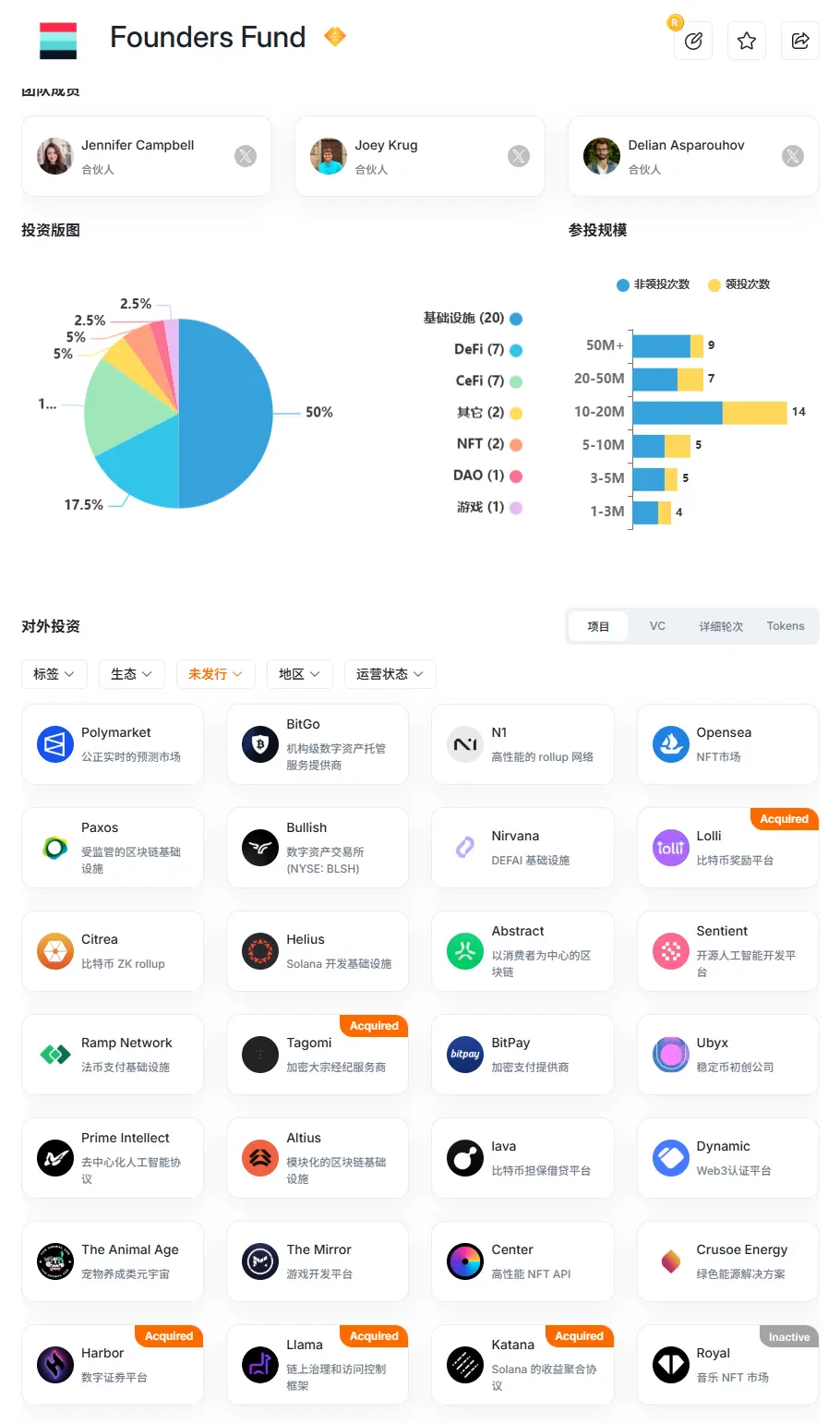
Their success is clearly no accident. Behind it lies a clear investment philosophy and decision-making system. So, what lies at the heart of this system? What's the thinking behind Founders Fund's leadership? After the Plasma explosion, what other projects, aligned with their philosophy and offering high airdrop potential, are worth our close attention?

The "brain" and "OG": Founders Fund's dual decision-making core

Founders Fund's strong momentum in the crypto space stems from the perfect complementarity between its two core figures: one is the "brain" who provides top-level philosophy and grand narratives, while the other is the "crypto OG" who is responsible for going deep into the front lines and ensuring tactical execution.

Peter Thiel: The Brain and Soul of Investing

As the founder and spiritual leader of Founders Fund, Peter Thiel's personal philosophy deeply imprints every investment decision of the fund. The "contrarian thinking" and pursuit of "monopolistic technology," as conveyed in his book "Zero to One," form the cornerstones of Founders Fund's investments. As the godfather of the "PayPal Mafia," Thiel has a long-standing obsession with creating a next-generation financial network independent of traditional systems. This profound perspective dictates that Founders Fund consistently focuses on underlying protocols and infrastructure that can reshape the industry landscape, rather than chasing short-term application trends. He sets the direction for the fund: to seek out teams that are solving the most difficult problems and have the potential to create a new future.

Joey Krug: A Crypto OG on the Front Lines

If Thiel provides the philosophical guidance on "why to invest," then partner Joey Krug addresses the tactical questions of "who to invest" and "how to invest." Krug is a true OG in the crypto world. As the co-founder of the decentralized prediction market Augur, he has real-world experience building and operating a successful DeFi protocol from scratch. Prior to joining Founders Fund, he served as co-CIO at Pantera Capital, accumulating extensive crypto investment experience. Krug has emphasized his paramount importance to a team's "shipping velocity," or the ability to consistently transform ideas into products. It is his deep industry background and keen judgment of technical execution that ensures Founders Fund's grand narrative is precisely matched with the most capable teams.

Thiel's top-level design combined with Krug's front-line insights constitute the dual core of Founders Fund's decision-making in the field of encryption, enabling them to grasp the biggest technological waves and identify the "surfers" who are most capable of riding them.

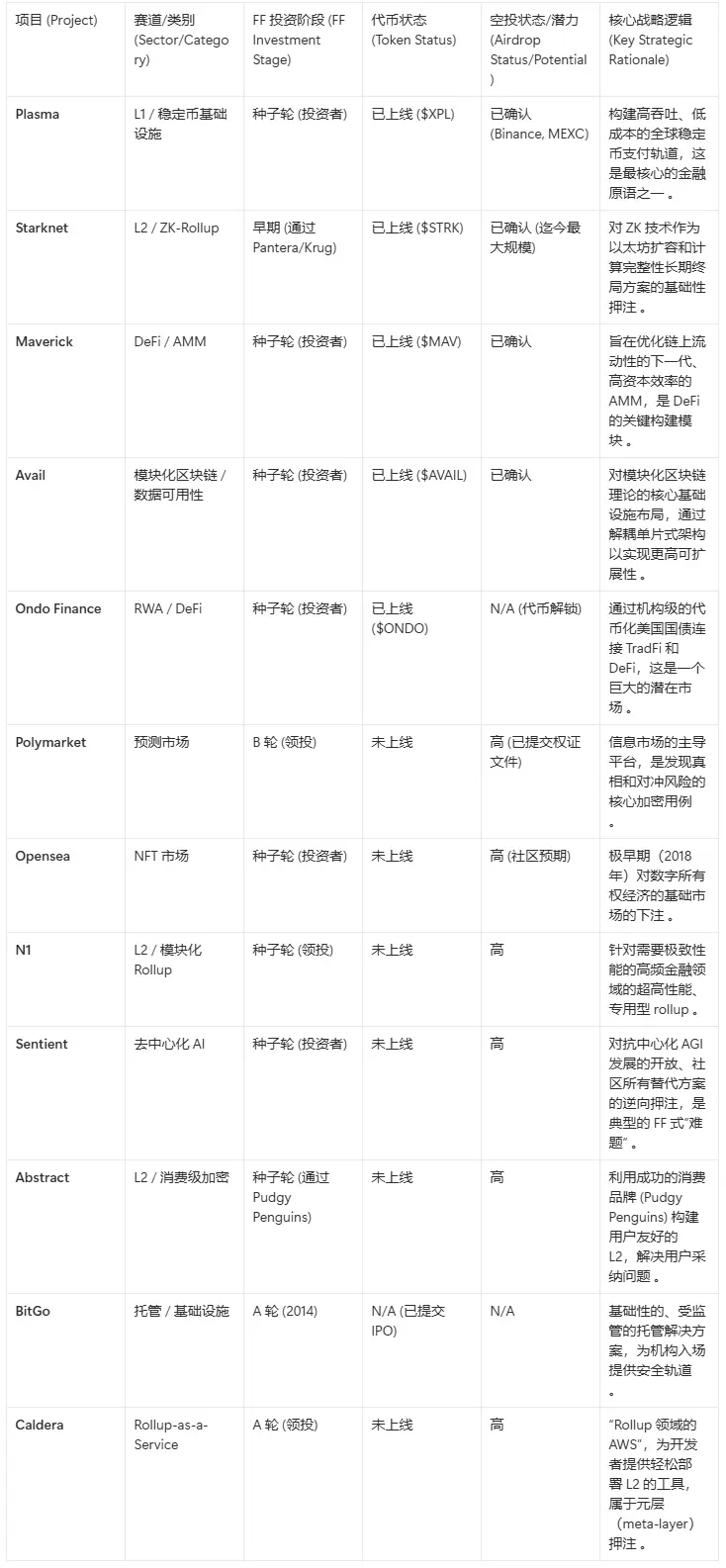
Founders Fund Crypto Investment Doctrine: Portfolio Overview

This table aims to integrate the scattered projects observed by users and the research findings of this report into a structured analytical tool, clearly demonstrating Founders Fund's investment model that prioritizes infrastructure, intervenes early, and targets high-potential companies.
Alpha List: Potential Projects Worth Paying Attention to

Based on the above investment dogma, we can clearly screen out the next batch of projects with high airdrop potential in Founders Fund's portfolio.

1. Polymarket: The King of Prediction Markets

Project Introduction: As the undisputed leader in decentralized prediction markets, Polymarket allows users to trade on the outcomes of global hot topics, such as elections, economic data, and regulatory approvals. It has become a crucial hub for obtaining information and identifying trends in the crypto world and beyond, with consistently high daily trading volume and monthly active users.

Airdrop Expectations: Polymarket's token issuance is practically an open secret. First, as a decentralized protocol requiring community governance and value capture, tokens are essential components of its closed ecosystem. Second, and most crucially, its filing with the US SEC explicitly mentions "warrants," which are typically considered in investment agreements to grant early investors the right to receive tokens in the future. Recent positive regulatory signals from the US Commodity Futures Trading Commission (CFTC) have cleared a major hurdle for its token issuance.

Reasons to Watch: The community generally anticipates that Polymarket's airdrop will likely follow the model of Starknet and Avail, with large-scale retroactive airdrops targeted at early, heavily engaged users of the platform. This is a project with a mature product, a large user base, and a clear business model. The launch of its token will be a highly anticipated demonstration of its value.

2. Sentient: AI + Crypto at the forefront, a value carrier for grand narratives

Project Introduction: Sentient's vision is ambitious: to build a decentralized, open network for artificial general intelligence (AGI). In an era where AI computing power and models are increasingly monopolized by tech giants, Sentient seeks to create a permissionless, community-owned AI economy through blockchain technology.

Airdrop Expectations: For a protocol aiming to build a global decentralized network, a token is essential. It's not only a core tool for incentivizing AI model contributors, computing power providers, and data validators, but also the sole vehicle for network governance and value distribution. The $85 million seed round provides ample funding for building a vast ecosystem and executing large-scale community incentive programs, including airdrops.

Reasons to Watch: Sentient perfectly aligns with Founders Fund's philosophy of investing in revolutionary technologies. Its airdrop will go beyond simply generating wealth; it represents the initial distribution of ownership in the future decentralized AI network. For users who are optimistic about the AI + Crypto space, early participation in the ecosystem and contributing to its network could yield extremely high returns.

3. N1 (formerly Layer N): The next generation of financial L2, re-emerging the value of infrastructure

Project Description: N1 is a high-performance Rollup network (L2) designed specifically for financial applications. Its goal is not to be a one-size-fits-all general-purpose chain, but rather to provide extreme performance and efficiency for financial scenarios such as high-frequency trading and derivatives settlement through a customized architecture.

Airdrop Expectations: As a project led by Founders Fund, N1 has garnered significant attention since its inception. Issuing tokens and using airdrops to incentivize early adopters, developers, and ecosystem projects on L2 public chains has become an industry standard. Tokens are not only used for decentralized governance but also serve as a key tool for capturing network value and competing with competitors like Starknet and Arbitrum for liquidity and users.

Reasons to Watch: N1 represents the professionalization and refinement of the L2 track. Following the successful path of Starknet, N1's airdrop is likely to be closely linked to the depth of interaction on its testnet and the early adoption of its future mainnet. For users familiar with L2 interactions, this is an opportunity not to be missed.

4. Opensea: The pending giant airdrop

Project Introduction: As the "OG" and founder of the NFT market, Opensea has practically defined the entire sector. Founders Fund participated in its seed round as early as 2018, demonstrating its foresight in the "digital ownership economy."

Airdrop Expectations: The community has been calling for Opensea to issue a governance token for several years. This move stems from the fact that competitors like LooksRare and Blur, which have rapidly risen through vampire attacks and token airdrops, need a powerful tool to reward their vast user base and incentivize future platform loyalty. Issuing a token to achieve community-based governance and value sharing is considered an inevitable choice.

Reasons to Watch: Opensea's airdrop opportunity is unlike any new project. It doesn't rely on testnet interaction, but rather has the potential to be a retroactive airdrop of unprecedented scale. Rewards may include rewards based on years of transaction history, total transaction volume, NFT holdings, and collections created. While long anticipated, its potential scale makes it a "sleeping giant" that every NFT enthusiast cannot ignore.

5. Infrastructure Matrix: Caldera, Citrea, Helius

In addition to the three star projects mentioned above, Founders Fund’s investment portfolio also includes a group of “water sellers” - key infrastructure that provides core tools and services for the entire crypto ecosystem. They also have an inherent need to issue tokens.

Caldera: A "Rollup as a Service" (RaaS) platform that allows developers to deploy their own Rollup chains with a single click. With the rise of "app-chain" technology, Caldera is poised to become the "AWS" of the future blockchain world, and the potential for its platform token is enormous.

Citrea: We specialize in Layer 2 solutions for the Bitcoin ecosystem. With the Bitcoin ecosystem's recovery, Layer 2 projects, which bring programmability and scalability to the Bitcoin network, are becoming a focus of market attention. Issuing tokens to incentivize ecosystem development and ensure network security is a necessary step in their development.

Helius: A leading infrastructure provider in the Solana ecosystem, providing developers with key services such as APIs and nodes. While primarily focused on B2B operations, many core infrastructure providers will ultimately share the value and governance of the protocol with the broader ecosystem by issuing governance tokens.

Conclusion

In a market fatigued by fleeting meme narratives and renewing its search for sustainable value, Founders Fund's investment playbook offers a clear, proven path. It reminds us that projects truly committed to building underlying technologies and solving core problems, navigating the tumultuous hype cycle, are the foundation for ultimately surviving bull and bear markets and accumulating value.

Following the smart money is essentially following an effective strategy for discovering long-term value. This list provides a clear direction for research and participation. However, in the crypto world, where opportunities and risks coexist, DYOR (Do Your Own Research) should always be the first principle before participating in any project.

Market Opportunity
LOOK Logo
LOOK Price(LOOK)
$0.00479
$0.00479$0.00479
+16.54%
USD
LOOK (LOOK) Live Price Chart
Disclaimer: The articles reposted on this site are sourced from public platforms and are provided for informational purposes only. They do not necessarily reflect the views of MEXC. All rights remain with the original authors. If you believe any content infringes on third-party rights, please contact crypto.news@mexc.com for removal. MEXC makes no guarantees regarding the accuracy, completeness, or timeliness of the content and is not responsible for any actions taken based on the information provided. The content does not constitute financial, legal, or other professional advice, nor should it be considered a recommendation or endorsement by MEXC.

You May Also Like

Why is the Crypto Market Rising Today? Top Factors Impacting BTC, ETH & XRP Prices

Why is the Crypto Market Rising Today? Top Factors Impacting BTC, ETH & XRP Prices

The post Why is the Crypto Market Rising Today? Top Factors Impacting BTC, ETH & XRP Prices  appeared first on Coinpedia Fintech News Selling pressure across the
Share
CoinPedia2026/03/05 13:30
Google's AP2 protocol has been released. Does encrypted AI still have a chance?
Google's AP2 protocol has been released. Does encrypted AI still have a chance?

Following the MCP and A2A protocols, the AI Agent market has seen another blockbuster arrival: the Agent Payments Protocol (AP2), developed by Google. This will clearly further enhance AI Agents' autonomous multi-tasking capabilities, but the unfortunate reality is that it has little to do with web3AI. Let's take a closer look: What problem does AP2 solve? Simply put, the MCP protocol is like a universal hook, enabling AI agents to connect to various external tools and data sources; A2A is a team collaboration communication protocol that allows multiple AI agents to cooperate with each other to complete complex tasks; AP2 completes the last piece of the puzzle - payment capability. In other words, MCP opens up connectivity, A2A promotes collaboration efficiency, and AP2 achieves value exchange. The arrival of AP2 truly injects "soul" into the autonomous collaboration and task execution of Multi-Agents. Imagine AI Agents connecting Qunar, Meituan, and Didi to complete the booking of flights, hotels, and car rentals, but then getting stuck at the point of "self-payment." What's the point of all that multitasking? So, remember this: AP2 is an extension of MCP+A2A, solving the last mile problem of AI Agent automated execution. What are the technical highlights of AP2? The core innovation of AP2 is the Mandates mechanism, which is divided into real-time authorization mode and delegated authorization mode. Real-time authorization is easy to understand. The AI Agent finds the product and shows it to you. The operation can only be performed after the user signs. Delegated authorization requires the user to set rules in advance, such as only buying the iPhone 17 when the price drops to 5,000. The AI Agent monitors the trigger conditions and executes automatically. The implementation logic is cryptographically signed using Verifiable Credentials (VCs). Users can set complex commission conditions, including price ranges, time limits, and payment method priorities, forming a tamper-proof digital contract. Once signed, the AI Agent executes according to the conditions, with VCs ensuring auditability and security at every step. Of particular note is the "A2A x402" extension, a technical component developed by Google specifically for crypto payments, developed in collaboration with Coinbase and the Ethereum Foundation. This extension enables AI Agents to seamlessly process stablecoins, ETH, and other blockchain assets, supporting native payment scenarios within the Web3 ecosystem. What kind of imagination space can AP2 bring? After analyzing the technical principles, do you think that's it? Yes, in fact, the AP2 is boring when it is disassembled alone. Its real charm lies in connecting and opening up the "MCP+A2A+AP2" technology stack, completely opening up the complete link of AI Agent's autonomous analysis+execution+payment. From now on, AI Agents can open up many application scenarios. For example, AI Agents for stock investment and financial management can help us monitor the market 24/7 and conduct independent transactions. Enterprise procurement AI Agents can automatically replenish and renew without human intervention. AP2's complementary payment capabilities will further expand the penetration of the Agent-to-Agent economy into more scenarios. Google obviously understands that after the technical framework is established, the ecological implementation must be relied upon, so it has brought in more than 60 partners to develop it, almost covering the entire payment and business ecosystem. Interestingly, it also involves major Crypto players such as Ethereum, Coinbase, MetaMask, and Sui. Combined with the current trend of currency and stock integration, the imagination space has been doubled. Is web3 AI really dead? Not entirely. Google's AP2 looks complete, but it only achieves technical compatibility with Crypto payments. It can only be regarded as an extension of the traditional authorization framework and belongs to the category of automated execution. There is a "paradigm" difference between it and the autonomous asset management pursued by pure Crypto native solutions. The Crypto-native solutions under exploration are taking the "decentralized custody + on-chain verification" route, including AI Agent autonomous asset management, AI Agent autonomous transactions (DeFAI), AI Agent digital identity and on-chain reputation system (ERC-8004...), AI Agent on-chain governance DAO framework, AI Agent NPC and digital avatars, and many other interesting and fun directions. Ultimately, once users get used to AI Agent payments in traditional fields, their acceptance of AI Agents autonomously owning digital assets will also increase. And for those scenarios that AP2 cannot reach, such as anonymous transactions, censorship-resistant payments, and decentralized asset management, there will always be a time for crypto-native solutions to show their strength? The two are more likely to be complementary rather than competitive, but to be honest, the key technological advancements behind AI Agents currently all come from web2AI, and web3AI still needs to keep up the good work!
Share
PANews2025/09/18 07:00
Xhavic Showcases Layer-2 Vision at Dubai Web3 Event

Xhavic Showcases Layer-2 Vision at Dubai Web3 Event

Xhavic Blockchain positioned itself at the center of global Web3 discussions during a major pre-launch event held in Dubai. The gathering also featured the soft
Share
CoinTrust2026/03/05 13:33