Recent investigations by the U.S. House of Representatives have spotlighted concerning issues within the Securities and Exchange Commission (SEC), including the deletion of former Chair Gary Gensler’s text messages. The controversy raises questions about transparency and the agency’s handling of sensitive communications related to cryptocurrency enforcement, prompting calls for greater oversight amidst ongoing crypto regulation [...]Recent investigations by the U.S. House of Representatives have spotlighted concerning issues within the Securities and Exchange Commission (SEC), including the deletion of former Chair Gary Gensler’s text messages. The controversy raises questions about transparency and the agency’s handling of sensitive communications related to cryptocurrency enforcement, prompting calls for greater oversight amidst ongoing crypto regulation [...]

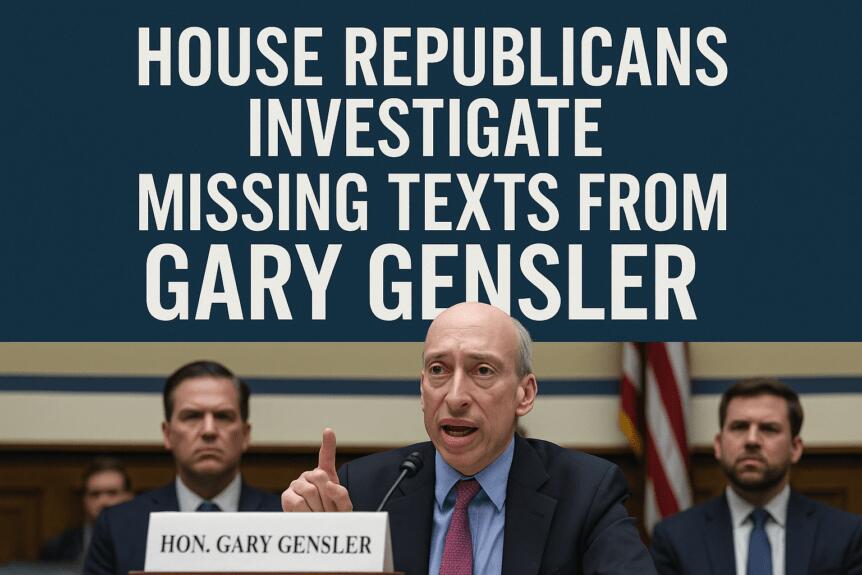
House Republicans Investigate Missing Texts from Gary Gensler
For feedback or concerns regarding this content, please contact us at crypto.news@mexc.com
House Republicans Investigate Missing Texts From Gary Gensler
Recent investigations by the U.S. House of Representatives have spotlighted concerning issues within the Securities and Exchange Commission (SEC), including the deletion of former Chair Gary Gensler’s text messages. The controversy raises questions about transparency and the agency’s handling of sensitive communications related to cryptocurrency enforcement, prompting calls for greater oversight amidst ongoing crypto regulation debates.
  • U.S. House Republicans are probing the loss of Gensler’s text messages from his tenure as SEC Chair.
  • The SEC’s Inspector General report highlighted technical failures and poor data management leading to message deletion.
  • Deleted texts involve key enforcement actions against crypto firms, raising concerns over transparency.
  • Some argue Gensler’s SEC applied double standards, citing contrasting enforcement practices.
  • The controversy feeds into broader concerns over crypto regulation and transparency within U.S. financial agencies.

Congressional Investigation Unfolds

U.S. House Republicans have formally raised concerns with SEC Chair Paul Atkins over the unexplained loss of text messages from former SEC Chair Gary Gensler, dating back to his leadership of the agency between 2021 and 2025. These messages, now missing due to what the SEC’s Inspector General described as a flawed automated data wipe, have become a focal point in ongoing investigations into regulatory transparency. The House Financial Services Committee is actively engaging with the IG’s findings, seeking clarity on the circumstances surrounding the data loss and oversight over the agency’s data management practices.

Many in the crypto industry have accused Gensler of being a key architect behind efforts by the Biden administration to impose stricter controls over fintech and crypto sectors, citing actions such as lawsuits that many believe hinder industry growth. Critics argue that this opacity and enforcement pattern could be part of a broader strategy to limit crypto innovation.

Senators Highlight Discrepancies

The investigative letter, signed by House Ranking Members Ann Wagner, Dan Meuser, and Bryan Steil, points out that Gensler’s SEC filed multiple lawsuits against crypto firms for allegedly widespread record-keeping failures, resulting in hefty fines. Meanwhile, the deletion of Gensler’s own communications suggests a double standard, many lawmakers argue.

IT Department Under Scrutiny

The SEC’s Inspector General revealed that an automated policy—poorly understood and poorly managed—led to the deletion of Gensler’s mobile device data, including texts exchanged between October 2022 and September 2023. These shortcomings were compounded by deficient backup procedures and overlooked system alerts, worsening the impact of data loss on transparency and oversight.

Implications for Crypto Enforcement

Alarmingly, some of the missing messages pertain to SEC enforcement actions against cryptocurrency operations, such as investigations into digital asset firms. The absence of such records raises concerns over whether the SEC’s enforcement decisions and communications are fully accessible or scrutinizable by the public and Congress.

In a separate security breach, the SEC’s Twitter account was compromised in January 2024, leading to false claims about Bitcoin ETF approvals. The breach was attributed to the agency’s failure to enable two-factor authentication, exposing systemic vulnerabilities in its digital defenses.

The accumulating questions about transparency, regulatory consistency, and data security are likely to influence ongoing debates over how best to regulate digital assets within the U.S. financial framework.

This article was originally published as House Republicans Investigate Missing Texts from Gary Gensler on Crypto Breaking News – your trusted source for crypto news, Bitcoin news, and blockchain updates.


Disclaimer: The articles reposted on this site are sourced from public platforms and are provided for informational purposes only. They do not necessarily reflect the views of MEXC. All rights remain with the original authors. If you believe any content infringes on third-party rights, please contact crypto.news@mexc.com for removal. MEXC makes no guarantees regarding the accuracy, completeness, or timeliness of the content and is not responsible for any actions taken based on the information provided. The content does not constitute financial, legal, or other professional advice, nor should it be considered a recommendation or endorsement by MEXC.

You May Also Like

OpenVPP accused of falsely advertising cooperation with the US government; SEC commissioner clarifies no involvement

OpenVPP accused of falsely advertising cooperation with the US government; SEC commissioner clarifies no involvement

PANews reported on September 17th that on-chain sleuth ZachXBT tweeted that OpenVPP ( $OVPP ) announced this week that it was collaborating with the US government to advance energy tokenization. SEC Commissioner Hester Peirce subsequently responded, stating that the company does not collaborate with or endorse any private crypto projects. The OpenVPP team subsequently hid the response. Several crypto influencers have participated in promoting the project, and the accounts involved have been questioned as typical influencer accounts.
Share
PANews2025/09/17 23:58
Trump's allegation against Noem would constitute a federal crime: analyst

Trump's allegation against Noem would constitute a federal crime: analyst

President Donald Trump caught everyone off guard by suddenly firing Homeland Security Secretary Kristi Noem — but being out of a job could just be the start of
Share
Rawstory2026/03/06 04:49
Aave DAO to Shut Down 50% of L2s While Doubling Down on GHO

Aave DAO to Shut Down 50% of L2s While Doubling Down on GHO

The post Aave DAO to Shut Down 50% of L2s While Doubling Down on GHO appeared on BitcoinEthereumNews.com. Aave DAO is gearing up for a significant overhaul by shutting down over 50% of underperforming L2 instances. It is also restructuring its governance framework and deploying over $100 million to boost GHO. This could be a pivotal moment that propels Aave back to the forefront of on-chain lending or sparks unprecedented controversy within the DeFi community. Sponsored Sponsored ACI Proposes Shutting Down 50% of L2s The “State of the Union” report by the Aave Chan Initiative (ACI) paints a candid picture. After a turbulent period in the DeFi market and internal challenges, Aave (AAVE) now leads in key metrics: TVL, revenue, market share, and borrowing volume. Aave’s annual revenue of $130 million surpasses the combined cash reserves of its competitors. Tokenomics improvements and the AAVE token buyback program have also contributed to the ecosystem’s growth. Aave global metrics. Source: Aave However, the ACI’s report also highlights several pain points. First, regarding the Layer-2 (L2) strategy. While Aave’s L2 strategy was once a key driver of success, it is no longer fit for purpose. Over half of Aave’s instances on L2s and alt-L1s are not economically viable. Based on year-to-date data, over 86.6% of Aave’s revenue comes from the mainnet, indicating that everything else is a side quest. On this basis, ACI proposes closing underperforming networks. The DAO should invest in key networks with significant differentiators. Second, ACI is pushing for a complete overhaul of the “friendly fork” framework, as most have been unimpressive regarding TVL and revenue. In some cases, attackers have exploited them to Aave’s detriment, as seen with Spark. Sponsored Sponsored “The friendly fork model had a good intention but bad execution where the DAO was too friendly towards these forks, allowing the DAO only little upside,” the report states. Third, the instance model, once a smart…
Share
BitcoinEthereumNews2025/09/18 02:28