

TRON Post-Quantum Signatures Launch on Nile Testnet After Vote
TLDR;
- TRON quantum-resistant signatures are now active on the Nile testnet after Committee Proposal No. 20628 received approval on July 2.
- The testnet initially activates FN-DSA-512, a lattice-based signature algorithm derived from the cryptographic scheme previously known as Falcon.
- Developers can use TRON’s guidance to test post-quantum transaction signing and examine the feature’s performance within a public test environment.
- The functionality remains limited to the Nile testnet, while any production deployment will require further testing and separate mainnet approval.
TRON has activated a new post-quantum security feature on its Nile testnet following the approval of Committee Proposal No. 20628. The upgrade enables developers to test blockchain signatures designed to resist attacks from future quantum computers.
The TRON quantum-resistant signatures feature initially supports FN-DSA-512. Justin Sun said the committee approved the proposal on July 2. TRON has invited developers to test and verify the feature using its published usage guidance.
TRX traded near $0.319 following the announcement, with a market capitalization of about $30.26 billion. The price showed only a modest daily gain, suggesting traders had not treated the technical upgrade as an immediate market catalyst.
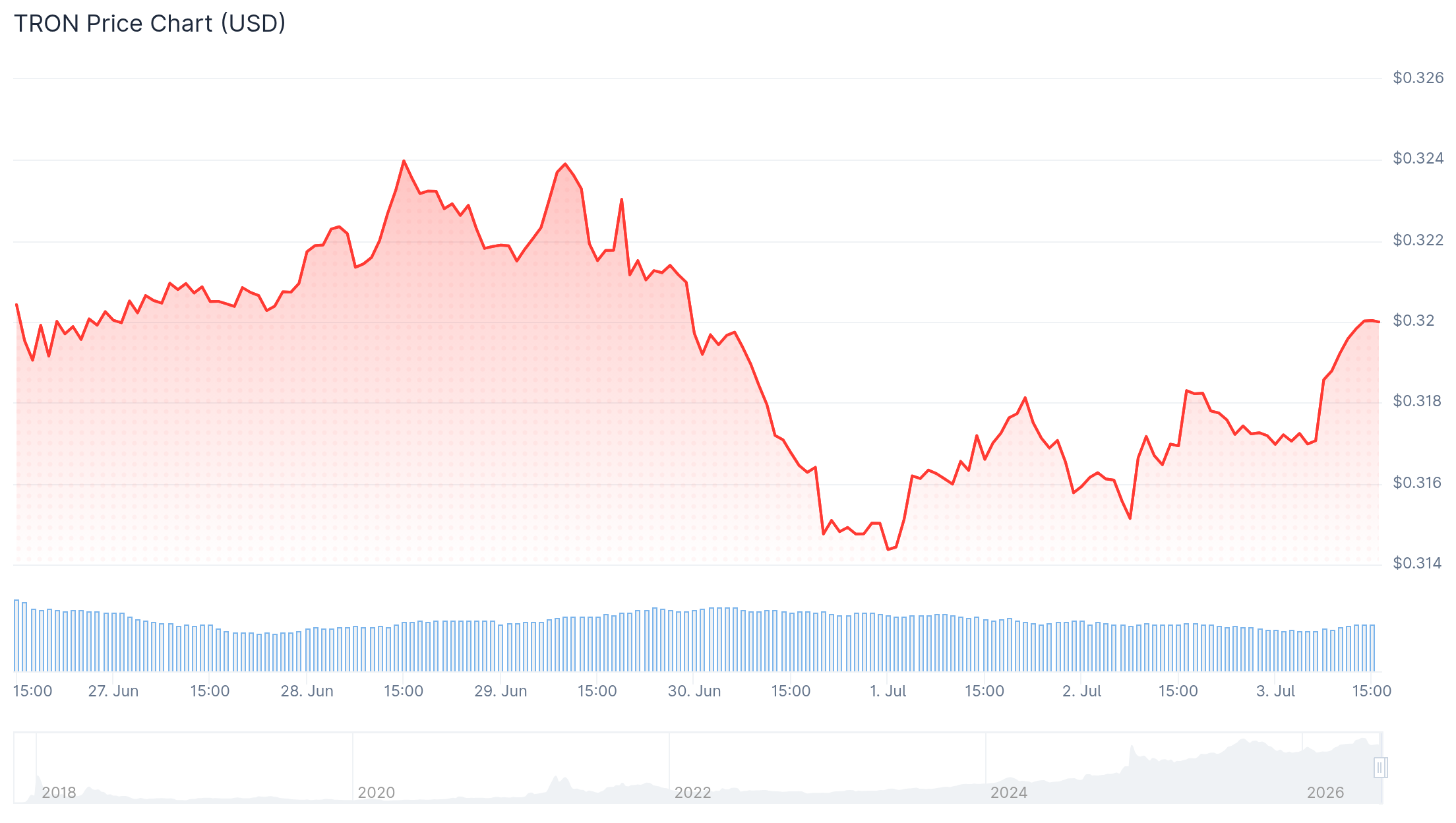 Source: Coingecko
TRON Post-Quantum Signatures Enter Nile Testnet Trials
The Nile testnet allows developers to examine new TRON features before possible production deployment. Test tokens have no market value, letting teams test contracts and transactions without risking real assets.
TRON post-quantum signatures aim to address a future threat from large-scale quantum computers. Such machines could eventually weaken elliptic-curve cryptography, which many blockchain networks use to approve transactions.
No publicly available quantum computer can currently break major blockchain signature systems. The upgrade is therefore preventive and does not respond to an active attack.
FN-DSA-512 is based on Falcon-512, a lattice-based signature scheme selected through NIST’s post-quantum cryptography program. FN-DSA stands for FFT over NTRU-Lattice-Based Digital Signature Algorithm. It is not a Dilithium-based system.
NIST is developing FIPS 206 as the proposed standard for FN-DSA. Unlike ML-DSA, which NIST finalized under FIPS 204, FN-DSA has not yet reached final standard status.
Falcon-512 produces signatures with a maximum size of about 667 bytes. That compact structure may help limit storage and bandwidth demands compared with larger post-quantum signatures.
Mainnet Adoption Requires Wider Wallet and Node Support
TRON post-quantum signatures can now be assessed across several parts of the test network. The underlying upgrade supports post-quantum transaction signing, block signatures and other verification processes.
TRON’s Nile release includes support for FN-DSA-512 and ML-DSA-44. However, each algorithm requires separate governance activation. Proposal No. 20628 specifically activated FN-DSA-512.
The test period will show how larger signatures affect processing speed, network storage and transaction costs. These issues matter for TRON due to its high transaction volume and extensive stablecoin activity.
A mainnet release would also require wallet providers, exchanges, validators and application developers to update their infrastructure. Existing users may need a migration method for moving assets into quantum-resistant accounts.
TRON could use a hybrid system that accepts traditional and post-quantum signatures simultaneously. That structure would reduce disruption while users and service providers adopt new keys.
Committee Proposal No. 20628 does not establish a mainnet launch date. TRON has only confirmed that developers can begin testing and verification on Nile using its post-quantum signature guidance.
The post TRON Post-Quantum Signatures Launch on Nile Testnet After Vote appeared first on Blockonomi.


You May Also Like

One Of Frank Sinatra’s Most Famous Albums Is Back In The Spotlight

Not a loophole: Singapore AI export controls let China tap US AI legally

LIST: Bayanihan initiatives amid soaring oil prices



