Encointer introduces a novel monetary system for local cryptocurrencies, where each participant earns basic income through periodic “proof-of-personhood” ceremonies. To prevent inflation, Encointer employs demurrage—a fee that gradually burns inactive tokens—encouraging spending and maintaining equilibrium. Unlike Bitcoin’s fixed cap, Encointer’s model ties issuance to participation and purchasing power within communities, allowing flexible parameters via on-chain governance. This creates a sustainable, egalitarian, and locally responsive economic system.Encointer introduces a novel monetary system for local cryptocurrencies, where each participant earns basic income through periodic “proof-of-personhood” ceremonies. To prevent inflation, Encointer employs demurrage—a fee that gradually burns inactive tokens—encouraging spending and maintaining equilibrium. Unlike Bitcoin’s fixed cap, Encointer’s model ties issuance to participation and purchasing power within communities, allowing flexible parameters via on-chain governance. This creates a sustainable, egalitarian, and locally responsive economic system.

What If Your Money Expired Every Month?

Abstract and I. Motivation

II. Local Currencies

III. Unique Pop Ceremonies

IV. Monetary Policy

V. Purchasing-Power Adjusted Transaction Fees

VI. Architecture

VII. Trusted Execution Environment Security

VIII. Encointer Association

IX. Known Limitations

X. Conclusion and References

VI. ARCHITECTURE

In this section we describe the system architecture for Encointer as a Polkadot parachain (or parathread) using the SubstraTEE framework. Explaining these technologies is beyond the scope of this paper and the reader shall refer to [9] and [17].

\ Figure 3 shows the entire stack of the Encointer platform.

\ A. Relay Chain

\ At the lowest level, we have the Polkadot relay chain as a NPoS-validated root-of-trust. The relay chain’s native token is the DOT and the block time is 6s.

\ Parachains need to bond DOTs in order to get a slot

\ B. Parachain

\ The Encointer parachain enjoys the security of the underlying relay chain and serves the following purposes:

\ • registry for remote-attested TEEs who provide sidechain validation

\ • finality for sidechain blocks

\ • global scheduling of ceremonies

\ • registry of community currencies and their parameters

\ There is no need for the parachain to have its own native token, therefore it will use DOT for fee payments. Sidechain validators will have to pay parachain fees in DOT to have their TEE attested and their blocks finalized. Users will not usually interact with the parachain directly but fees for registering a new currency have to be paid in DOT as well.

\ Parachain fees are expected to be marginal as they only serve the purpose of spam-prevention. There are no validators that need to be incentivized. While collators are needed for availability to produce blocks which are then validated by relay-chain validators, their role is not security critical. Encointer communities will have a strong intrinsic incentive to run collators without much compensation.

\ Fig. 3. Encointer Stack as a Polkadot parachain using the SubstraTEE framework
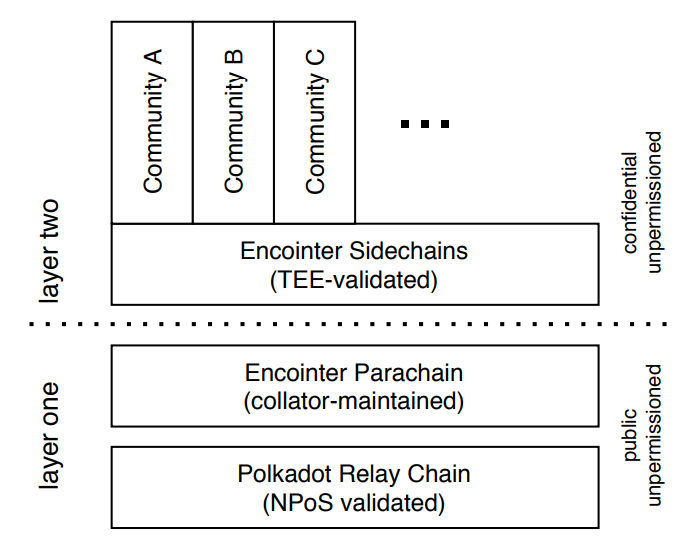
\ It should be said that there is no guarantee that Encointer can become a parachain as the slots are limited. Auctions where DOT holders can bond their DOTs for parachain candidates will determine slot allocations. Should Encointer not win a slot, it could still run as a parathread where DOTs have to be paid for each validated block. The confirmation time for finality will be much longer in that case, but sidechains would not be affected much.

\ C. Sidechains

\ The Encointer sidechains maintain the community currency balance ledger and perform the Encointer protocol for uPoP (See III). Each community has its own shard holding its confidential state.

\ The sidechain validators are run in TEEs to get both integrity and confidentiality. As TEEs are considered to be trusted, there is no need for a consensus protocol for sidechain blocks. This simplifies the design significantly and allows for sub-second block times due to a low communication overhead.

\ Sidechain validators can only operate a limited number of shards per machine. Therefore we expect local communities to take care of their own sidechain validator infrastructure.

\ Running sidechain validators for any shard is unpermissioned. Every remote-attested TEE will be provisioned with the necessary keys to participate in block-production. All sidechain validators run the same code which is asserted by remote attestation.

\

:::info Author:

(1) Alain Brenzikofer (alain@encointer.org).

:::


:::info This paper is available on arxiv under CC BY-NC-SA 4.0 DEED license.

:::

\

Market Opportunity
Capverse Logo
Capverse Price(CAP)
$0.1283
$0.1283$0.1283
-1.40%
USD
Capverse (CAP) Live Price Chart
Disclaimer: The articles reposted on this site are sourced from public platforms and are provided for informational purposes only. They do not necessarily reflect the views of MEXC. All rights remain with the original authors. If you believe any content infringes on third-party rights, please contact service@support.mexc.com for removal. MEXC makes no guarantees regarding the accuracy, completeness, or timeliness of the content and is not responsible for any actions taken based on the information provided. The content does not constitute financial, legal, or other professional advice, nor should it be considered a recommendation or endorsement by MEXC.

You May Also Like

Ethereum unveils roadmap focusing on scaling, interoperability, and security at Japan Dev Conference

Ethereum unveils roadmap focusing on scaling, interoperability, and security at Japan Dev Conference

The post Ethereum unveils roadmap focusing on scaling, interoperability, and security at Japan Dev Conference appeared on BitcoinEthereumNews.com. Key Takeaways Ethereum’s new roadmap was presented by Vitalik Buterin at the Japan Dev Conference. Short-term priorities include Layer 1 scaling and raising gas limits to enhance transaction throughput. Vitalik Buterin presented Ethereum’s development roadmap at the Japan Dev Conference today, outlining the blockchain platform’s priorities across multiple timeframes. The short-term goals focus on scaling solutions and increasing Layer 1 gas limits to improve transaction capacity. Mid-term objectives target enhanced cross-Layer 2 interoperability and faster network responsiveness to create a more seamless user experience across different scaling solutions. The long-term vision emphasizes building a secure, simple, quantum-resistant, and formally verified minimalist Ethereum network. This approach aims to future-proof the platform against emerging technological threats while maintaining its core functionality. The roadmap presentation comes as Ethereum continues to compete with other blockchain platforms for market share in the smart contract and decentralized application space. Source: https://cryptobriefing.com/ethereum-roadmap-scaling-interoperability-security-japan/
Share
BitcoinEthereumNews2025/09/18 00:25
Husky Inu (HINU) Completes Move To $0.00020688

Husky Inu (HINU) Completes Move To $0.00020688

Husky Inu (HINU) has completed its latest price jump, rising from $0.00020628 to $0.00020688. The price jump is part of the project’s pre-launch phase, which began on April 1, 2025.
Share
Cryptodaily2025/09/18 01:10
SEC dismisses civil action against Gemini with prejudice

SEC dismisses civil action against Gemini with prejudice

The SEC was satisfied with Gemini’s agreement to contribute $40 million toward the full recovery of Gemini Earn investors’ assets lost as a result of the Genesis
Share
Coinstats2026/01/24 06:43