Bitcoin is performing beyond expectations and it’s causing the rest of the crypto market to follow. While there was a lull in $BTC’s performance back in September, it was just the calm before the storm – now it’s hit a new all-time high of $126K and looks set to climb even higher.Bitcoin is performing beyond expectations and it’s causing the rest of the crypto market to follow. While there was a lull in $BTC’s performance back in September, it was just the calm before the storm – now it’s hit a new all-time high of $126K and looks set to climb even higher.

2025’s Best Crypto Presale Accelerates with $274K Whale Buy – Bitcoin Hyper Amps Up

2025's Best Crypto Presale Accelerates with $274K Whale Buy - Bitcoin Hyper Amps Up

But it’s not all great news for Bitcoin. The inevitable rush of new users onto the Bitcoin network is going to cause even worse scalability issues for a blockchain that’s already struggling to handle its current average number of transactions – a problem that neither Ethereum nor Solana has.

To stay competitive with Web3-capable competitors, Bitcoin requires assistance. That’s where Bitcoin Hyper ($HYPER) comes in. It’s a Layer-2 for Bitcoin based on a Solana Virtual Machine (SVM) that intends to hypercharge the Bitcoin network by adding in high-speed Solana scalability and smart contract support.

There’s plenty of evidence to suggest that Bitcoin Hyper will grow alongside $BTC as it trends upwards, not least the amount of community support $HYPER has already received as a presale. We’ve just seen a whopping $274K whale buy in the last 12 hours, adding to $HYPER’s $22.3M presale.

Read on, and we’ll delve into exactly how the Bitcoin Hyper Layer-2 is revolutionizing the Bitcoin network forever, making it one of the top crypto presales to consider in 2025.

Why is Bitcoin so Slow?

The Bitcoin network isn’t as fast as other blockchains because it prioritizes ensuring transaction security. Whenever a transaction is made, it’s added to a block, which needs to be validated by the majority of the network before it’s committed to the blockchain. This process usually takes around ten minutes.

However, each block can only be so big. This places a hard cap on the number of transactions that the Bitcoin network can process simultaneously, estimated to be 7 to 10 transactions per second. By comparison, Ethereum can support hundreds per second, and Solana can support thousands.

Competition for those transaction slots is only going to get worse as Bitcoin becomes more popular. Unfortunately, this means that the fees for processing your $BTC will continue to increase, primarily due to the Bitcoin network’s poor scalability.

For long-term traders, it’s not as much of an issue. You’re buying $BTC for the long haul, so slow processing speeds aren’t a problem if it means you’ve got rock-solid security guarantees. If you’re at the mall trying to pay for a coffee in Bitcoin, an hour-long wait is unacceptable.
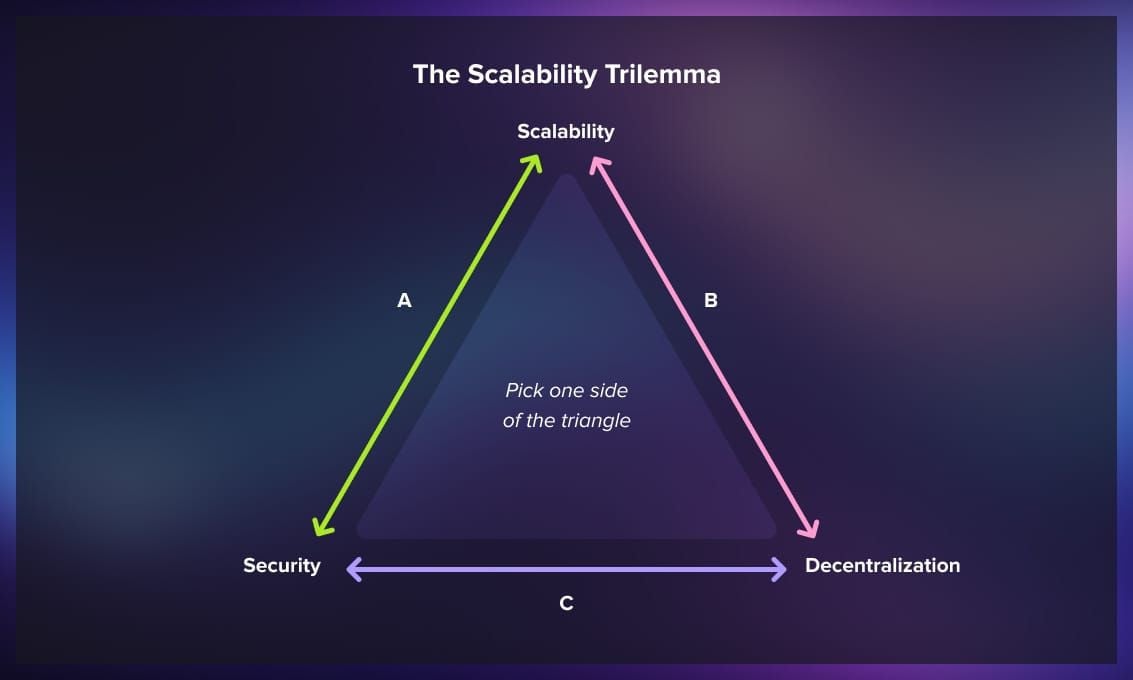
The Scalability Trilemma diagram shows security and decentralization cause scalability to suffer

Source: serokell.io

It’s not easy to solve this problem, either. There’s a school of thought among blockchain developers that you can make a decentralized blockchain quick or secure, but not both. However, Bitcoin needs scalability to join the rest of the crypto revolution and fulfill its real potential as the dominant cryptocurrency.

Bitcoin Hyper could be the solution. The Bitcoin blockchain is already extremely secure, so Bitcoin Hyper focuses on increasing the speed of the network by using Solana as the basis for a Layer 2 that utilizes parallel processing to handle transactions more efficiently. Let’s check out how it works.

How does $HYPER solve these issues?

The Bitcoin Hyper Layer-2 acts as a temporary ledger that records trades made using $BTC on the network and periodically commits them back to the Layer-1. This way, the total number of transactions made on the Layer-1 is reduced, taking strain off the Bitcoin Blockchain.

Inevitably, more users will get into Bitcoin as the price of the coin increases. Bitcoin Hyper acts as an essential pressure valve for the Bitcoin blockchain, allowing for $BTC transactions between accounts that can be processed nearly instantly while maintaining synchronization with Layer-1.
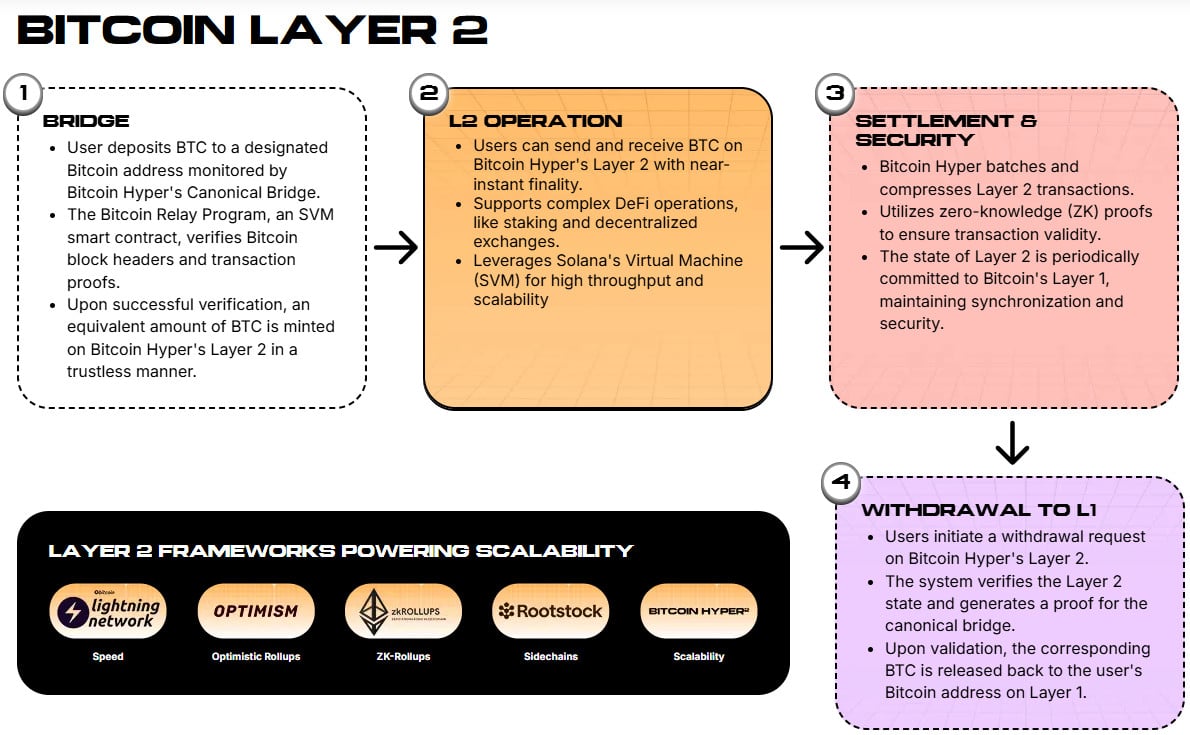
Bitcoin Layer 2 operational mechanism from the Bitcoin Hyper presale website.

The Bitcoin Hyper infrastructure allows for easy onboarding and withdrawal of $BTC

The two layers are joined together using a Canonical Bridge. To transfer $BTC to the Bitcoin Hyper network, all you have to do is send the amount you want to use to the Canonical Bridge address. You receive an equivalent amount of wrapped $BTC which the Canonical Bridge mines for you.

Receiving $BTC from the Bitcoin Hyper network is just as easy. Make a withdrawal request along with the amount of $wBTC you want to burn, and the Canonical Bridge releases your $BTC from custody to your account.

For more information on how Bitcoin Hyper works, you can check out our Bitcoin Hyper review.

Why is $HYPER Set to Rise?

It appears that the recent rise and retraction of Bitcoin were merely setting the stage for a new rally, as evidenced by its jump to over $126K. More than ever, Bitcoin needs a way to handle greater transactions without compromising on security, as the rise of $BTC will attract more users.

As a result, analysts expect a flood of interest in Bitcoin Hyper when it is released. That bodes well for $HYPER, the official utility token of the Bitcoin Hyper network. As more capital flows in, the token is expected to perform better.

There are a few ways that holding $HYPER adds extra utility to the Bitcoin Hyper:

  • Reduced fees when you trade on crypto or run smart contracts
  • Access to the Bitcoin DAO to vote on future proposals for the blockchain
  • Staking rewards for long-term growth of your $HYPER
  • Access to exclusive features on Web3 smart contracts running on Bitcoin Hyper

Given the multitude of ways you can utilize the token, $HYPER should be in high demand when it is released. Our price prediction for $HYPER suggests that we’ll see at least $0.03 for $HYPER by the end of 2025, but this could go as high as $0.2 if Bitcoin’s rally continues through to the end of the year.

Our optimistic scenario suggests a potential 10x increase from the current price of $0.013075. However, it’s essential not to get too excited – we believe a crypto downturn may occur in 2026, so don’t be surprised if $HYPER is affected as well.

Graph showing forecast of Bitcoin Hyper from 2025 to 2030

Our price prediction graph suggests a great long-term upshot for Bitcoin Hyper

In the long term, we believe that $HYPER could reach a value of up to $1.20 if the project is successful and the developers can attract DeFi applications onto the Bitcoin Hyper blockchain, making Bitcoin a true competitor with other Web3 blockchains.

If the recent whale buy of $274K is anything to go by, the market agrees that $HYPER is one of the best crypto presales. To date, $HYPER has raised over $22.3M and shows no signs of slowing down as the presale begins to wrap up. If you want to buy your $HYPER while it’s still cheap, you’ll need to be fast.

Any $HYPER you buy now can be staked for 53% in rewards per annum, but time’s running out. It’s a dynamic presale, so the longer you wait, the worse these rewards will become – and the higher the price for $HYPER. If you need more help, you can check out our how to buy Bitcoin Hyper guide.

Visit the official site to buy Bitcoin Hyper today.

Market Opportunity
Hyperlane Logo
Hyperlane Price(HYPER)
$0.13644
$0.13644$0.13644
-4.08%
USD
Hyperlane (HYPER) Live Price Chart
Disclaimer: The articles reposted on this site are sourced from public platforms and are provided for informational purposes only. They do not necessarily reflect the views of MEXC. All rights remain with the original authors. If you believe any content infringes on third-party rights, please contact service@support.mexc.com for removal. MEXC makes no guarantees regarding the accuracy, completeness, or timeliness of the content and is not responsible for any actions taken based on the information provided. The content does not constitute financial, legal, or other professional advice, nor should it be considered a recommendation or endorsement by MEXC.

You May Also Like

Washington Faces New Dilemma Over Venezuela’s Alleged BTC Reserves

Washington Faces New Dilemma Over Venezuela’s Alleged BTC Reserves

The issue surfaced after the dramatic removal of Venezuela’s longtime leader, Nicolás Maduro, who was captured by U.S. forces and […] The post Washington Faces
Share
Coindoo2026/01/13 10:14
Google's AP2 protocol has been released. Does encrypted AI still have a chance?

Google's AP2 protocol has been released. Does encrypted AI still have a chance?

Following the MCP and A2A protocols, the AI Agent market has seen another blockbuster arrival: the Agent Payments Protocol (AP2), developed by Google. This will clearly further enhance AI Agents' autonomous multi-tasking capabilities, but the unfortunate reality is that it has little to do with web3AI. Let's take a closer look: What problem does AP2 solve? Simply put, the MCP protocol is like a universal hook, enabling AI agents to connect to various external tools and data sources; A2A is a team collaboration communication protocol that allows multiple AI agents to cooperate with each other to complete complex tasks; AP2 completes the last piece of the puzzle - payment capability. In other words, MCP opens up connectivity, A2A promotes collaboration efficiency, and AP2 achieves value exchange. The arrival of AP2 truly injects "soul" into the autonomous collaboration and task execution of Multi-Agents. Imagine AI Agents connecting Qunar, Meituan, and Didi to complete the booking of flights, hotels, and car rentals, but then getting stuck at the point of "self-payment." What's the point of all that multitasking? So, remember this: AP2 is an extension of MCP+A2A, solving the last mile problem of AI Agent automated execution. What are the technical highlights of AP2? The core innovation of AP2 is the Mandates mechanism, which is divided into real-time authorization mode and delegated authorization mode. Real-time authorization is easy to understand. The AI Agent finds the product and shows it to you. The operation can only be performed after the user signs. Delegated authorization requires the user to set rules in advance, such as only buying the iPhone 17 when the price drops to 5,000. The AI Agent monitors the trigger conditions and executes automatically. The implementation logic is cryptographically signed using Verifiable Credentials (VCs). Users can set complex commission conditions, including price ranges, time limits, and payment method priorities, forming a tamper-proof digital contract. Once signed, the AI Agent executes according to the conditions, with VCs ensuring auditability and security at every step. Of particular note is the "A2A x402" extension, a technical component developed by Google specifically for crypto payments, developed in collaboration with Coinbase and the Ethereum Foundation. This extension enables AI Agents to seamlessly process stablecoins, ETH, and other blockchain assets, supporting native payment scenarios within the Web3 ecosystem. What kind of imagination space can AP2 bring? After analyzing the technical principles, do you think that's it? Yes, in fact, the AP2 is boring when it is disassembled alone. Its real charm lies in connecting and opening up the "MCP+A2A+AP2" technology stack, completely opening up the complete link of AI Agent's autonomous analysis+execution+payment. From now on, AI Agents can open up many application scenarios. For example, AI Agents for stock investment and financial management can help us monitor the market 24/7 and conduct independent transactions. Enterprise procurement AI Agents can automatically replenish and renew without human intervention. AP2's complementary payment capabilities will further expand the penetration of the Agent-to-Agent economy into more scenarios. Google obviously understands that after the technical framework is established, the ecological implementation must be relied upon, so it has brought in more than 60 partners to develop it, almost covering the entire payment and business ecosystem. Interestingly, it also involves major Crypto players such as Ethereum, Coinbase, MetaMask, and Sui. Combined with the current trend of currency and stock integration, the imagination space has been doubled. Is web3 AI really dead? Not entirely. Google's AP2 looks complete, but it only achieves technical compatibility with Crypto payments. It can only be regarded as an extension of the traditional authorization framework and belongs to the category of automated execution. There is a "paradigm" difference between it and the autonomous asset management pursued by pure Crypto native solutions. The Crypto-native solutions under exploration are taking the "decentralized custody + on-chain verification" route, including AI Agent autonomous asset management, AI Agent autonomous transactions (DeFAI), AI Agent digital identity and on-chain reputation system (ERC-8004...), AI Agent on-chain governance DAO framework, AI Agent NPC and digital avatars, and many other interesting and fun directions. Ultimately, once users get used to AI Agent payments in traditional fields, their acceptance of AI Agents autonomously owning digital assets will also increase. And for those scenarios that AP2 cannot reach, such as anonymous transactions, censorship-resistant payments, and decentralized asset management, there will always be a time for crypto-native solutions to show their strength? The two are more likely to be complementary rather than competitive, but to be honest, the key technological advancements behind AI Agents currently all come from web2AI, and web3AI still needs to keep up the good work!
Share
PANews2025/09/18 07:00
GBP trades firmly against US Dollar

GBP trades firmly against US Dollar

The post GBP trades firmly against US Dollar appeared on BitcoinEthereumNews.com. Pound Sterling trades firmly against US Dollar ahead of Fed’s policy outcome The Pound Sterling (GBP) clings to Tuesday’s gains near 1.3640 against the US Dollar (USD) during the European trading session on Wednesday. The GBP/USD pair holds onto gains as the US Dollar remains on the back foot amid firm expectations that the Federal Reserve (Fed) will cut interest rates in the monetary policy announcement at 18:00 GMT. At the time of writing, the US Dollar Index (DXY), which tracks the Greenback’s value against six major currencies, holds onto losses near a fresh two-month low of 96.60 posted on Tuesday. Read more… UK inflation unchanged at 3.8%, Pound shrugs The British pound is unchanged on Wednesday, trading at 1.3645 in the European session. Today’s inflation report was a dour reminder that UK inflation remains entrenched. CPI for August was unchanged at 3.8% y/y, matching the consensus and its highest level since January 2024. Airfares decreased but this was offset by food and petrol prices. Monthly, CPI rose 0.3%, up from 0.1% in July and matching the consensus. Core CPI, which excludes volatile items such as food and energy, eased to 3.6% from 3.8%. Monthly, core CPI ticked up to 0.3% from 0.2%. The inflation report comes just a day before the Bank of England announces its rate decision. Inflation is almost double the BoE’s target of 2% and today’s release likely means that the BoE will not reduce rates before 2026. Read more… Source: https://www.fxstreet.com/news/pound-sterling-price-news-and-forecast-gbp-trades-firmly-against-us-dollar-ahead-of-feds-policy-outcome-202509171209
Share
BitcoinEthereumNews2025/09/18 01:50