Analysts at JPMorgan say that stablecoins have the potential to generate at least $1.4 trillion in demand for U.S. dollars by 2027, considering most of the market is backed by the currency. According to a note from the bank, the…Analysts at JPMorgan say that stablecoins have the potential to generate at least $1.4 trillion in demand for U.S. dollars by 2027, considering most of the market is backed by the currency. According to a note from the bank, the…

JPMorgan: Stablecoins to boost US dollar demand by $1.4T

Analysts at JPMorgan say that stablecoins have the potential to generate at least $1.4 trillion in demand for U.S. dollars by 2027, considering most of the market is backed by the currency.

Summary
  • JPMorgan has predicted that the U.S dollar will receive a $1.4 trillion boost in demand following the rising wave of stablecoin adoption.
  • At press time, the stablecoin market is dominated by USD-pegged tokens, contributing to more than 90% of the total market cap. Tether’s USDT alone dominates the market by nearly 60%.

According to a note from the bank, the rapid growth of the stablecoin market could potentially lift the U.S. dollar along with it. Instead of dethroning the fiat-currency and taking over as the dominant payment instrument, analysts from JPMorgan predict the adoption of dollar-pegged tokens could generate about $1.4 trillion in demand for U.S dollars by 2027.

This massive increase can be attributed to overseas investors adopting the token for transactions and investments, which would require them to convert local currencies into tokens that are backed by the U.S-dollar or equivalents of it. Some are backed by U.S. treasuries, bonds and other dollar-based assets.

“Whether such a high-end scenario growth trajectory will actually play out remains to be seen, but if it does, stablecoin-related dollar inflows could become cumulatively significant,” said JPMorgan in its official statement.
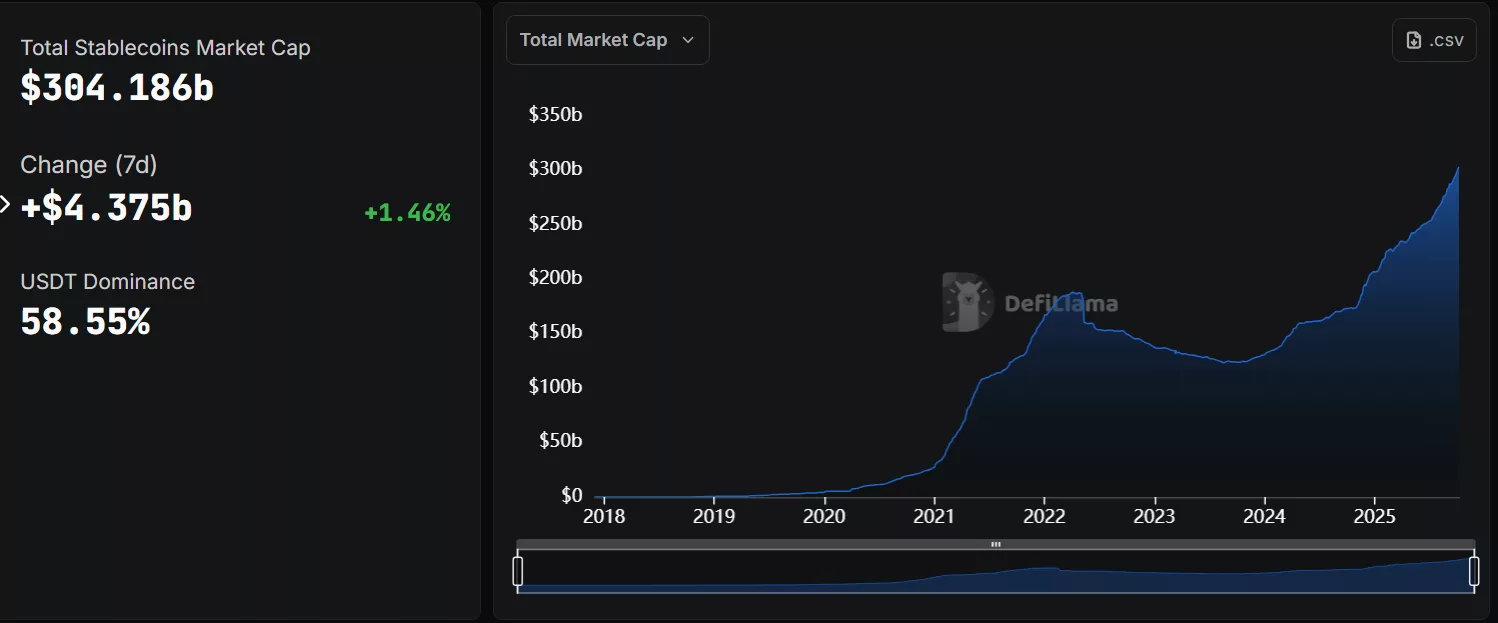
The stablecoin market is projected to reach $2 trillion in the next two years | Source: DeFi Llama

Although there has been an increase in the number tokens backed by other fiat-currencies, such as the ruble-backed A7A5 and Circle’s euro-pegged EURC (EURC), none have managed to surpass the domination of USD-backed tokens.

According to data from CoinGecko, USD tokens make up more than $300 billion of the $304 billion-valued market cap. This means that more than 90% of these assets are backed by the U.S dollar in some shape or form. In fact, Tether’s own dollar-backed USDT (USDT) alone currently contributes to nearly 60% of the total market cap.

“Given that [about] 99% of the total stablecoin supply is pegged 1:1 to the dollar, stablecoin market growth necessarily implies some demand for the dollar,” said the bank.

What is fueling the stablecoin market?

According to JPMorgan, the stablecoin market could grow to reach $2 trillion in the next few years. This marks a $1.7 trillion jump from its current value at $304 billion. While such a massive leap may seem difficult to imagine, the past year has shown promising growth in financial adoption worldwide.

Just a week prior, the market surpassed $300 billion for the first time in history. In just five years, the industry has grown from a meager $4 billion to more than $300 billion in market cap. In 2025 alone, the market has received a $100 billion boost from investors eager to take part in the fairly new financial technology.

The emergence of global regulations that facilitate stablecoin usage has also played a major role in accelerating mainstream adoption. The United States government passing the GENIUS Act became a stepping stone that accelerated the growth of dollar-backed tokens.

Outside of the U.S, Hong Kong’s Stablecoin Ordinance became the catalyst that set off a frenzy of firms eager to acquire a license in order to issue their own tokens pegged to local currencies. In the EU, banks have grown increasingly eager to launch their own euro-backed tokens, with the goal of challenging the U.S dollar’s dominance over the market.


Market Opportunity
Boost Logo
Boost Price(BOOST)
$0.002411
$0.002411$0.002411
+2.42%
USD
Boost (BOOST) Live Price Chart
Disclaimer: The articles reposted on this site are sourced from public platforms and are provided for informational purposes only. They do not necessarily reflect the views of MEXC. All rights remain with the original authors. If you believe any content infringes on third-party rights, please contact service@support.mexc.com for removal. MEXC makes no guarantees regarding the accuracy, completeness, or timeliness of the content and is not responsible for any actions taken based on the information provided. The content does not constitute financial, legal, or other professional advice, nor should it be considered a recommendation or endorsement by MEXC.

You May Also Like

Social engineering kost crypto miljarden in 2025

Social engineering kost crypto miljarden in 2025

De grootste dreiging voor crypto zit niet altijd in bugs of fouten in de code. Vaak gaat het fout bij mensen zelf. Nieuwe cijfers over 2025 laten zien hoe misleiding
Share
Coinstats2025/12/26 03:01
Christmas Stocking Stuffers? Don't Ignore These Bitcoin Mining Stocks That Gave Impressive Returns In 2025

Christmas Stocking Stuffers? Don't Ignore These Bitcoin Mining Stocks That Gave Impressive Returns In 2025

Christmas brings cheer, cakes and cozy vibes, but it can also be a perfect time for kicking off investments you may not have considered before.read more
Share
Coinstats2025/12/26 03:01
China Blocks Nvidia’s RTX Pro 6000D as Local Chips Rise

China Blocks Nvidia’s RTX Pro 6000D as Local Chips Rise

The post China Blocks Nvidia’s RTX Pro 6000D as Local Chips Rise appeared on BitcoinEthereumNews.com. China Blocks Nvidia’s RTX Pro 6000D as Local Chips Rise China’s internet regulator has ordered the country’s biggest technology firms, including Alibaba and ByteDance, to stop purchasing Nvidia’s RTX Pro 6000D GPUs. According to the Financial Times, the move shuts down the last major channel for mass supplies of American chips to the Chinese market. Why Beijing Halted Nvidia Purchases Chinese companies had planned to buy tens of thousands of RTX Pro 6000D accelerators and had already begun testing them in servers. But regulators intervened, halting the purchases and signaling stricter controls than earlier measures placed on Nvidia’s H20 chip. Image: Nvidia An audit compared Huawei and Cambricon processors, along with chips developed by Alibaba and Baidu, against Nvidia’s export-approved products. Regulators concluded that Chinese chips had reached performance levels comparable to the restricted U.S. models. This assessment pushed authorities to advise firms to rely more heavily on domestic processors, further tightening Nvidia’s already limited position in China. China’s Drive Toward Tech Independence The decision highlights Beijing’s focus on import substitution — developing self-sufficient chip production to reduce reliance on U.S. supplies. “The signal is now clear: all attention is focused on building a domestic ecosystem,” said a representative of a leading Chinese tech company. Nvidia had unveiled the RTX Pro 6000D in July 2025 during CEO Jensen Huang’s visit to Beijing, in an attempt to keep a foothold in China after Washington restricted exports of its most advanced chips. But momentum is shifting. Industry sources told the Financial Times that Chinese manufacturers plan to triple AI chip production next year to meet growing demand. They believe “domestic supply will now be sufficient without Nvidia.” What It Means for the Future With Huawei, Cambricon, Alibaba, and Baidu stepping up, China is positioning itself for long-term technological independence. Nvidia, meanwhile, faces…
Share
BitcoinEthereumNews2025/09/18 01:37



