Institutional investors expect tokenized assets to take up a much larger role in global portfolios by the end of the decade, with private markets seen as the first to shift. A State Street study published Thursday projects that by 2030, between 10% and 24% of institutional investments could be made through tokenized instruments. Private equity and private fixed income are viewed as the most likely early candidates for tokenization. These markets have long struggled with illiquidity and high operational costs, making them prime targets for digital instruments designed to boost efficiency and unlock liquidity. “The acceleration in adoption of emerging technologies is remarkable. Institutional investors are moving beyond experimentation, and digital assets are now a strategic lever for growth, efficiency, and innovation,” said Joerg Ambrosius, president of Investment Services at State Street. He added that tokenization, artificial intelligence and quantum computing are converging to reshape the future of finance, with early adopters leading the charge. Digital Assets Average 7% of Portfolios, Set to More Than Double in Three Years The research also shows that while tokenization is gaining traction, many investors believe other technologies will have an even greater impact on operations. More than half of respondents pointed to generative AI and quantum computing as more transformative than blockchain, though they see the technologies working in tandem. Currently, institutional portfolios hold an average of 7% in digital assets, according to the study. That figure is expected to rise to 16% within three years. The most common forms are digital cash, along with tokenized versions of listed equities and fixed income. On average, respondents hold 1% of their portfolios in each of these categories. Asset Managers Outpace Owners in Bitcoin, Ethereum and Tokenized Assets Asset managers reported higher exposure than asset owners across nearly every category. 14% of managers said they held 2% to 5% of portfolios in Bitcoin, compared with 7% of asset owners. A small share of managers also admitted to having at least 5% of assets in Ethereum, meme coins or NFTs, pointing to the broader range of risk appetite. Tokenization of real-world assets is another area where managers are ahead. They reported greater exposure to tokenized public assets, tokenized private assets and digital cash than asset owners. Even so, cryptocurrencies remain the biggest driver of returns within digital portfolios. 27% of respondents said Bitcoin is their strongest performer today. A quarter also expect it to remain the top performer in three years. Meanwhile, Ethereum ranked second. 21% cited it as their biggest return generator now, and 22% expect that trend to continue. By contrast, only 13% said tokenized public assets drive most of their digital returns. Just 10% pointed to private assets. These figures are expected to remain mostly unchanged over the next three years. State Street Finds Confidence Growing That Tokenization Trend Is Durable State Street’s study suggests that private assets could be the first major beneficiaries of tokenization. This would likely happen once infrastructure improves and investor confidence matures. Moreover, institutions broadly expect digital assets to become mainstream within a decade. This reflects growing acceptance that the shift is structural rather than cyclical. The findings add weight to the view that tokenization could transform capital markets. By digitizing ownership of assets such as real estate and private credit, institutions could cut settlement times, reduce costs, and expand access to investors who were previously excluded from private marketsInstitutional investors expect tokenized assets to take up a much larger role in global portfolios by the end of the decade, with private markets seen as the first to shift. A State Street study published Thursday projects that by 2030, between 10% and 24% of institutional investments could be made through tokenized instruments. Private equity and private fixed income are viewed as the most likely early candidates for tokenization. These markets have long struggled with illiquidity and high operational costs, making them prime targets for digital instruments designed to boost efficiency and unlock liquidity. “The acceleration in adoption of emerging technologies is remarkable. Institutional investors are moving beyond experimentation, and digital assets are now a strategic lever for growth, efficiency, and innovation,” said Joerg Ambrosius, president of Investment Services at State Street. He added that tokenization, artificial intelligence and quantum computing are converging to reshape the future of finance, with early adopters leading the charge. Digital Assets Average 7% of Portfolios, Set to More Than Double in Three Years The research also shows that while tokenization is gaining traction, many investors believe other technologies will have an even greater impact on operations. More than half of respondents pointed to generative AI and quantum computing as more transformative than blockchain, though they see the technologies working in tandem. Currently, institutional portfolios hold an average of 7% in digital assets, according to the study. That figure is expected to rise to 16% within three years. The most common forms are digital cash, along with tokenized versions of listed equities and fixed income. On average, respondents hold 1% of their portfolios in each of these categories. Asset Managers Outpace Owners in Bitcoin, Ethereum and Tokenized Assets Asset managers reported higher exposure than asset owners across nearly every category. 14% of managers said they held 2% to 5% of portfolios in Bitcoin, compared with 7% of asset owners. A small share of managers also admitted to having at least 5% of assets in Ethereum, meme coins or NFTs, pointing to the broader range of risk appetite. Tokenization of real-world assets is another area where managers are ahead. They reported greater exposure to tokenized public assets, tokenized private assets and digital cash than asset owners. Even so, cryptocurrencies remain the biggest driver of returns within digital portfolios. 27% of respondents said Bitcoin is their strongest performer today. A quarter also expect it to remain the top performer in three years. Meanwhile, Ethereum ranked second. 21% cited it as their biggest return generator now, and 22% expect that trend to continue. By contrast, only 13% said tokenized public assets drive most of their digital returns. Just 10% pointed to private assets. These figures are expected to remain mostly unchanged over the next three years. State Street Finds Confidence Growing That Tokenization Trend Is Durable State Street’s study suggests that private assets could be the first major beneficiaries of tokenization. This would likely happen once infrastructure improves and investor confidence matures. Moreover, institutions broadly expect digital assets to become mainstream within a decade. This reflects growing acceptance that the shift is structural rather than cyclical. The findings add weight to the view that tokenization could transform capital markets. By digitizing ownership of assets such as real estate and private credit, institutions could cut settlement times, reduce costs, and expand access to investors who were previously excluded from private markets

Tokenized Assets Could Form Up to a Quarter of Portfolios By 2030: State Street

2025/10/10 13:21
3 min read
For feedback or concerns regarding this content, please contact us at crypto.news@mexc.com

Institutional investors expect tokenized assets to take up a much larger role in global portfolios by the end of the decade, with private markets seen as the first to shift.

A State Street study published Thursday projects that by 2030, between 10% and 24% of institutional investments could be made through tokenized instruments.

Private equity and private fixed income are viewed as the most likely early candidates for tokenization. These markets have long struggled with illiquidity and high operational costs, making them prime targets for digital instruments designed to boost efficiency and unlock liquidity.

“The acceleration in adoption of emerging technologies is remarkable. Institutional investors are moving beyond experimentation, and digital assets are now a strategic lever for growth, efficiency, and innovation,” said Joerg Ambrosius, president of Investment Services at State Street.

He added that tokenization, artificial intelligence and quantum computing are converging to reshape the future of finance, with early adopters leading the charge.

Digital Assets Average 7% of Portfolios, Set to More Than Double in Three Years

The research also shows that while tokenization is gaining traction, many investors believe other technologies will have an even greater impact on operations.

More than half of respondents pointed to generative AI and quantum computing as more transformative than blockchain, though they see the technologies working in tandem.

Currently, institutional portfolios hold an average of 7% in digital assets, according to the study. That figure is expected to rise to 16% within three years. The most common forms are digital cash, along with tokenized versions of listed equities and fixed income. On average, respondents hold 1% of their portfolios in each of these categories.
Asset Managers Outpace Owners in Bitcoin, Ethereum and Tokenized Assets

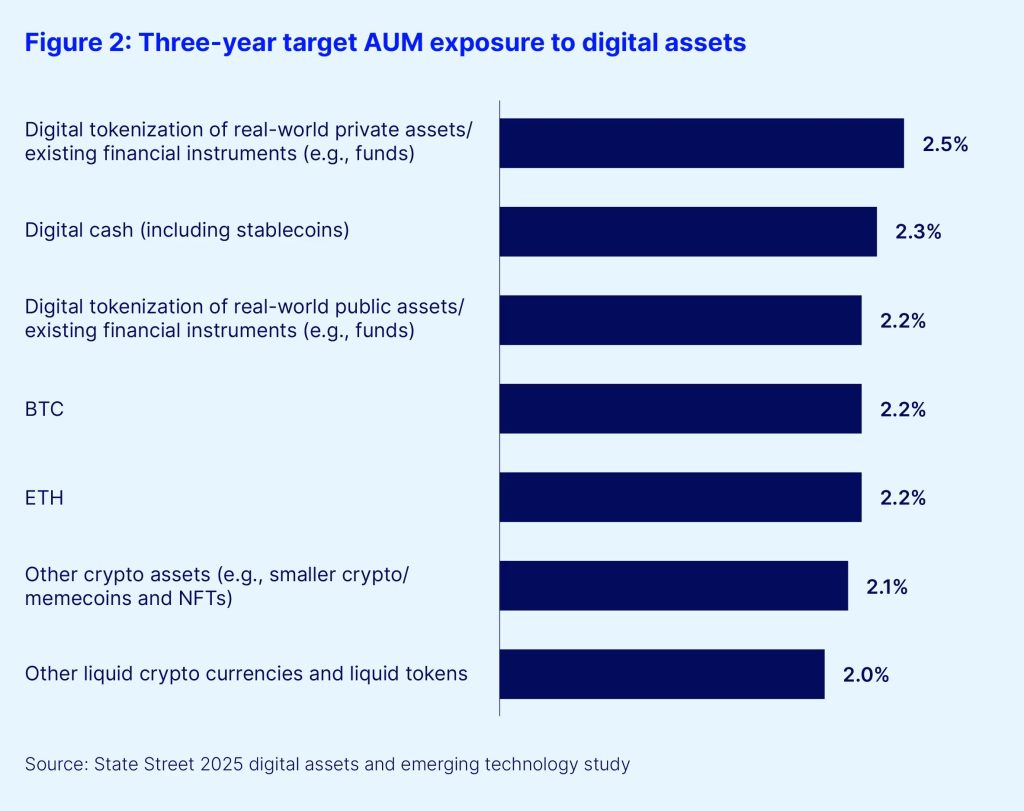
Asset managers reported higher exposure than asset owners across nearly every category. 14% of managers said they held 2% to 5% of portfolios in Bitcoin, compared with 7% of asset owners. A small share of managers also admitted to having at least 5% of assets in Ethereum, meme coins or NFTs, pointing to the broader range of risk appetite.

Tokenization of real-world assets is another area where managers are ahead. They reported greater exposure to tokenized public assets, tokenized private assets and digital cash than asset owners.

Even so, cryptocurrencies remain the biggest driver of returns within digital portfolios.

27% of respondents said Bitcoin is their strongest performer today. A quarter also expect it to remain the top performer in three years.

Meanwhile, Ethereum ranked second. 21% cited it as their biggest return generator now, and 22% expect that trend to continue.

By contrast, only 13% said tokenized public assets drive most of their digital returns. Just 10% pointed to private assets. These figures are expected to remain mostly unchanged over the next three years.

State Street Finds Confidence Growing That Tokenization Trend Is Durable

State Street’s study suggests that private assets could be the first major beneficiaries of tokenization. This would likely happen once infrastructure improves and investor confidence matures.

Moreover, institutions broadly expect digital assets to become mainstream within a decade. This reflects growing acceptance that the shift is structural rather than cyclical.

The findings add weight to the view that tokenization could transform capital markets. By digitizing ownership of assets such as real estate and private credit, institutions could cut settlement times, reduce costs, and expand access to investors who were previously excluded from private markets.


Disclaimer: The articles reposted on this site are sourced from public platforms and are provided for informational purposes only. They do not necessarily reflect the views of MEXC. All rights remain with the original authors. If you believe any content infringes on third-party rights, please contact crypto.news@mexc.com for removal. MEXC makes no guarantees regarding the accuracy, completeness, or timeliness of the content and is not responsible for any actions taken based on the information provided. The content does not constitute financial, legal, or other professional advice, nor should it be considered a recommendation or endorsement by MEXC.

You May Also Like

Urgent Warning For US Banks To Avoid Payments Market Collapse

Urgent Warning For US Banks To Avoid Payments Market Collapse

The post Urgent Warning For US Banks To Avoid Payments Market Collapse appeared on BitcoinEthereumNews.com. Crypto Regulatory Clarity: Urgent Warning For US Banks
Share
BitcoinEthereumNews2026/03/09 12:02
Trump’s Decisive Stance: US Will Consult Israel on Ending Iran War But Retains Final Authority

Trump’s Decisive Stance: US Will Consult Israel on Ending Iran War But Retains Final Authority

BitcoinWorld Trump’s Decisive Stance: US Will Consult Israel on Ending Iran War But Retains Final Authority WASHINGTON, D.C., March 2025 – In a significant statement
Share
bitcoinworld2026/03/09 12:40
Why This New Trending Meme Coin Is Being Dubbed The New PEPE After Record Presale

Why This New Trending Meme Coin Is Being Dubbed The New PEPE After Record Presale

The post Why This New Trending Meme Coin Is Being Dubbed The New PEPE After Record Presale appeared on BitcoinEthereumNews.com. Crypto News 17 September 2025 | 20:13 The meme coin market is heating up once again as traders look for the next breakout token. While Shiba Inu (SHIB) continues to build its ecosystem and PEPE holds onto its viral roots, a new contender, Layer Brett (LBRETT), is gaining attention after raising more than $3.7 million in its presale. With a live staking system, fast-growing community, and real tech backing, some analysts are already calling it “the next PEPE.” Here’s the latest on the Shiba Inu price forecast, what’s going on with PEPE, and why Layer Brett is drawing in new investors fast. Shiba Inu price forecast: Ecosystem builds, but retail looks elsewhere Shiba Inu (SHIB) continues to develop its broader ecosystem with Shibarium, the project’s Layer 2 network built to improve speed and lower gas fees. While the community remains strong, the price hasn’t followed suit lately. SHIB is currently trading around $0.00001298, and while that’s a decent jump from its earlier lows, it still falls short of triggering any major excitement across the market. The project includes additional tokens like BONE and LEASH, and also has ongoing initiatives in DeFi and NFTs. However, even with all this development, many investors feel the hype that once surrounded SHIB has shifted elsewhere, particularly toward newer, more dynamic meme coins offering better entry points and incentives. PEPE: Can it rebound or is the momentum gone? PEPE saw a parabolic rise during the last meme coin surge, catching fire on social media and delivering massive short-term gains for early adopters. However, like most meme tokens driven largely by hype, it has since cooled off. PEPE is currently trading around $0.00001076, down significantly from its peak. While the token still enjoys a loyal community, analysts believe its best days may be behind it unless…
Share
BitcoinEthereumNews2025/09/18 02:50



