WormHole is a graph algorithm that outperforms traditional traversal and indexing-based methods like BiBFS, PLL, and MLL. Through extensive benchmarking on large datasets from SNAP and KONECT, WormHole demonstrates superior efficiency in query cost, inquiry time, and setup performance. It achieves 99% path accuracy with minimal overhead, offering faster and more scalable solutions for large graph queries—particularly when compared to indexing algorithms that time out or require massive resources.WormHole is a graph algorithm that outperforms traditional traversal and indexing-based methods like BiBFS, PLL, and MLL. Through extensive benchmarking on large datasets from SNAP and KONECT, WormHole demonstrates superior efficiency in query cost, inquiry time, and setup performance. It achieves 99% path accuracy with minimal overhead, offering faster and more scalable solutions for large graph queries—particularly when compared to indexing algorithms that time out or require massive resources.

WormHole Algorithm Outperforms BiBFS in Query Efficiency and Accuracy

Abstract and 1. Introduction

1.1 Our Contribution

1.2 Setting

1.3 The algorithm

  1. Related Work

  2. Algorithm

    3.1 The Structural Decomposition Phase

    3.2 The Routing Phase

    3.3 Variants of WormHole

  3. Theoretical Analysis

    4.1 Preliminaries

    4.2 Sublinearity of Inner Ring

    4.3 Approximation Error

    4.4 Query Complexity

  4. Experimental Results

    5.1 WormHole𝐸, WormHole𝐻 and BiBFS

    5.2 Comparison with index-based methods

    5.3 WormHole as a primitive: WormHole𝑀

References

5 EXPERIMENTAL RESULTS

In this section, we experimentally evaluate the performance of our algorithm. We look at several metrics to evaluate performance in different aspects. We compare with BiBFS, a traversal-based approach, and with the indexing algorithms PLL and MLL. We test several aspects, summarized next. Detailed results are provided in the rest of this section.

\ (1) Query cost: By query cost, we refer to the number of vertices queried by WormHole, consistent with our access model (see §1.2). We show that WormHole actually does remarkably well in terms of query cost, seeing a small fraction of the whole graph even for several thousands of shortest path inquiries. See Figures 2(b) and 5.

\ (2) Inquiry time: We demonstrate that WormHole𝐸 achieves consistent speedups over traditional BiBFS, even while using it as the sole primitive in the procedure. More complex methods such as PLL and MLL time out for the majority of large graphs. We also provide variants that achieve substantially higher speedups. Finally, in §5.3, we show how using the existing indexing-based state or the art methods on the core lets us achieve indexing-level inquiry times. See Figure 1.

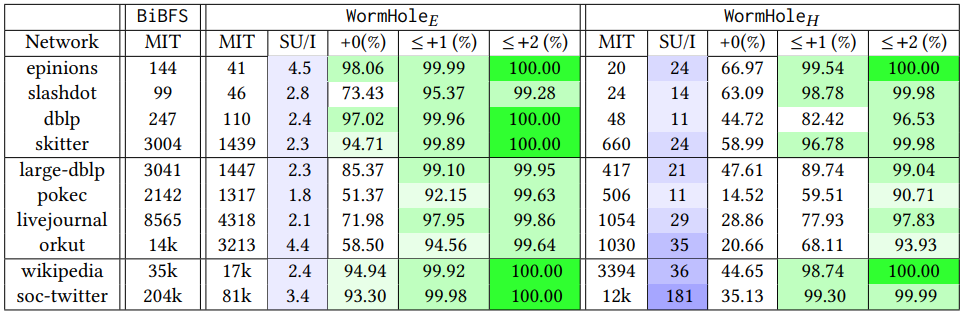
\ (3) Accuracy: We show that our estimated shortest paths are accurate up to an additive error 2 on 99% of the inquiries for the default version WormHole𝐸; a faster heuristic, WormHole𝐻 , shows lower accuracy, but still over 90% of inquiries satisfy this condition. See §5.1 and Table 3 for details.

\ (4) Setup: We look at the setup time and disk space with each associated method. Perhaps as expected, WormHole𝐸 beats the indexing based algorithms by a wide margin in terms of both space and time: see Figure 7. In §5.3 we further show that using these methods restricted to Cin results in a variant WormHole𝑀 with much lower setup cost ( Table 6).

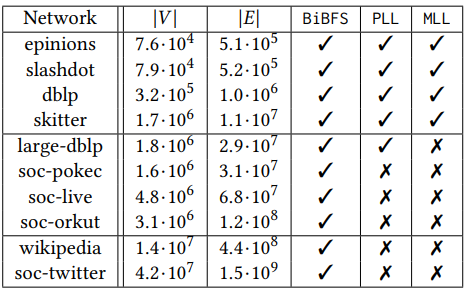
\ Datasets. The experiments have been carried out on a series of datasets of varying sizes, as detailed in Table 2. The datasets have been taken either from the SNAP large networks database [36] or the KONECT project [34]. We organize the results into two broad sections: we first introduce two variants

\
\ Table 2: Network datasets used for experimental evaluation with their corresponding sizes. We observe that BiBFS finishes on all the datasets, but the indexing based methods do not on the medium and large networks. We were able to set up MLL on large-dblp in reasonable time, but the subsequent shortest path inquiries were met with consistent segmentation faults that we were unable to debug.
\ Table 3: Summary of WormHole with the two cases: WormHole𝐸, with the exact shortest path through the inner ring, and WormHole𝐻 that picks only the shortest path between the highest degree vertices – refer to §5.1. We note the mean inquiry times per inquiry (MIT) in microseconds, and average speed up per inquiry (SU/I) compared to BiBFS for each method. We also note the percentiles of inquiries by absolute error: for WormHole𝐸, we get absolute error under 2 for over 99% of the inquiries. This drops for WormHole𝐻 , but it is still above 99% for six of the ten datasets, and over 90% in all of them. Accuracy numbers are highlighted in green, where darker is better. Similarly, we have a gradient of violet for speedups; darker is faster. For WormHole𝐸, speedup over BiBFS per inquiry on average is usually between 2× and 3×, but this increases to consistently between 20−30× in WormHole𝐻 , and reaches a max of 181× in our largest dataset, soc-twitter.

\ of our algorithm. We then compare it with BiBFS as well as indexing based methods – PLL and MLL. The latter two did not terminate in 12 hours for most of the graphs, while BiBFS completed on even our largest networks.

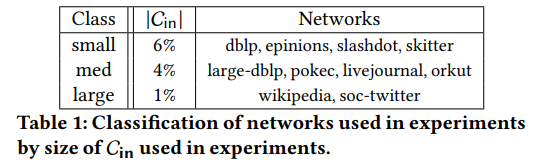
\ We classify the examined graphs into three different classes and use a fixed percentage as the ‘optimal’ inner ring size for graphs of comparable size (where the inner core size as % of the total size decreases for larger networks, an indication for the sublinearity of our approach). This takes into account the tradeoff between accuracy and the query/memory costs incurred by a larger inner ring. The classification is summarized in Table 1. For the experimental section, we default to these sizes unless mentioned otherwise.

\ Implementation details. We run our experiments on an AWS ec2 instance with 32 AMD EPYC™ 7R32 vCPUs and 64GB of RAM. The code is written in C++ and is available in the supplementary material as a zipped folder, with links to the datasets. The backbone of the graph algorithms is a subgraph counting library that uses compressed sparse representations [45].

\

:::info Authors:

(1) Talya Eden, Bar-Ilan University (talyaa01@gmail.com);

(2) Omri Ben-Eliezer, MIT (omrib@mit.edu);

(3) C. Seshadhri, UC Santa Cruz (sesh@ucsc.edu).

:::


:::info This paper is available on arxiv under CC BY 4.0 license.

:::

\

Market Opportunity
Wink Logo
Wink Price(LIKE)
$0.002845
$0.002845$0.002845
+0.63%
USD
Wink (LIKE) Live Price Chart
Disclaimer: The articles reposted on this site are sourced from public platforms and are provided for informational purposes only. They do not necessarily reflect the views of MEXC. All rights remain with the original authors. If you believe any content infringes on third-party rights, please contact service@support.mexc.com for removal. MEXC makes no guarantees regarding the accuracy, completeness, or timeliness of the content and is not responsible for any actions taken based on the information provided. The content does not constitute financial, legal, or other professional advice, nor should it be considered a recommendation or endorsement by MEXC.

You May Also Like

BetFury is at SBC Summit Lisbon 2025: Affiliate Growth in Focus

BetFury is at SBC Summit Lisbon 2025: Affiliate Growth in Focus

The post BetFury is at SBC Summit Lisbon 2025: Affiliate Growth in Focus appeared on BitcoinEthereumNews.com. Press Releases are sponsored content and not a part of Finbold’s editorial content. For a full disclaimer, please . Crypto assets/products can be highly risky. Never invest unless you’re prepared to lose all the money you invest. Curacao, Curacao, September 17th, 2025, Chainwire BetFury steps onto the stage of SBC Summit Lisbon 2025 — one of the key gatherings in the iGaming calendar. From 16 to 18 September, the platform showcases its brand strength, deepens affiliate connections, and outlines its plans for global expansion. BetFury continues to play a role in the evolving crypto and iGaming partnership landscape. BetFury’s Participation at SBC Summit The SBC Summit gathers over 25,000 delegates, including 6,000+ affiliates — the largest concentration of affiliate professionals in iGaming. For BetFury, this isn’t just visibility, it’s a strategic chance to present its Affiliate Program to the right audience. Face-to-face meetings, dedicated networking zones, and affiliate-focused sessions make Lisbon the ideal ground to build new partnerships and strengthen existing ones. BetFury Meets Affiliate Leaders at its Massive Stand BetFury arrives at the summit with a massive stand placed right in the center of the Affiliate zone. Designed as a true meeting hub, the stand combines large LED screens, a sleek interior, and the best coffee at the event — but its core mission goes far beyond style. Here, BetFury’s team welcomes partners and affiliates to discuss tailored collaborations, explore growth opportunities across multiple GEOs, and expand its global Affiliate Program. To make the experience even more engaging, the stand also hosts: Affiliate Lottery — a branded drum filled with exclusive offers and personalized deals for affiliates. Merch Kits — premium giveaways to boost brand recognition and leave visitors with a lasting conference memory. Besides, at SBC Summit Lisbon, attendees have a chance to meet the BetFury team along…
Share
BitcoinEthereumNews2025/09/18 01:20
Trump's border chief insists Americans support ICE – and is shut down by host: 'Come on!'

Trump's border chief insists Americans support ICE – and is shut down by host: 'Come on!'

Border Patrol Chief Greg Bovino was shut down Friday during an appearance on NewsNation after suggesting that federal immigration officials enjoyed widespread support
Share
Rawstory2026/01/23 22:36
Top 7 Managed IT Services for Legal Firms

Top 7 Managed IT Services for Legal Firms

If your practice management system went down at 3 p.m. on a filing deadline, how many people in your firm would know exactly what to do and who to call?  For most
Share
Techbullion2026/01/23 22:36