By Deng Tong, Golden Finance On October 15, Brevis released the "Pico Prism" technology product, which attracted collective support from Ethereum officials and sparked heated discussions in the community. On October 16, the official Ethereum account retweeted Brevis’s “Pico Prism” tweet and wrote: “This is a big step towards the future of Ethereum. Zero-knowledge proof technology like Pico Prism will enable Ethereum to scale to meet global demand while still maintaining credibility and decentralization.” On October 15, Vitalik retweeted and wrote: “Great to see @brevis_zk’s Pico Prism enter the ZK-EVM verification field! A major step forward in ZK-EVM verification speed and diversity.” Ethereum core developer Justin Drake also joined the call. What is the origin of Pico Prism that has caused the official Ethereum account to go crazy and call for it? 1. Pico Prism’s Technological Breakthrough Developed by Brevis, Pico Prism implements real-time proofs (RTP) for Ethereum Layer-1 using consumer-grade hardware equipped with 64 RTX 5090 GPUs. In a test conducted in September, Pico Prism achieved 99.6% real-time proofs in less than 12 seconds. A blog post published by Brevis describes Pico Prism as follows: Pico Prism pioneered real-time proof of a 45M gas limit block using affordable consumer-grade hardware. We benchmarked Pico Prism on eight servers, each equipped with eight RTX 5090 GPUs, for a total of 64 GPUs. To compare with SP1 Hypercube, we uniformly sampled 1,000 blocks from the same time period as the Succinct benchmark. For the 45M gas limit block, we benchmarked every block generated on September 1, 2025. In addition to individual metrics, Pico Prism achieved a 3.4x performance advantage over SP1 in terms of speed and cost efficiency (calculated as average verification time × hardware cost). Pico Prism uses a consumer-grade RTX 5090 GPU, demonstrating that real-time verification is possible without expensive data center hardware. Multi-GPU and multi-machine proof Pico's major breakthrough is the migration from a single-machine, single-GPU prover to a fully distributed multi-machine, multi-GPU architecture. The core of this leap is a complete redesign of the computational pipeline. Thanks to Pico's modular design, the proof process is broken down into multiple stages, from simulation to hierarchical recursion. Compute-intensive workloads are offloaded to the GPU, while setup tasks remain on the CPU, executed in a highly parallel pipeline that keeps the GPU saturated and operating at peak efficiency. This extreme optimization and parallelization delivers near-linear speedup when scaling across multi-machine, multi-GPU setups. The result is transformative and undeniable: Pico Prism enables true real-time proofs at Ethereum scale using readily accessible, consumer-grade hardware. Future Plans With the release of Pico Prism, the path to Ethereum L1 zkVM integration has become clearer. While we are only 2.2% away from our updated goal of sub-10 second real-time verification, we have already begun rolling out some low-hanging fruit to make this goal a breeze. The next major milestone for Pico Prism is a focus on reducing verification costs. We have a roadmap to achieve 99% real-time verification using fewer than 16 RTX 5090 GPUs in the coming months. 2. Significance for Ethereum 1. Implement lightweight verification This breakthrough means that computationally expensive proofs can finally keep up with block production using affordable consumer hardware, making lightweight verification practical for the first time. Currently, each validator re-executes every transaction to verify a block, which requires expensive hardware and creates a fundamental bottleneck. But "real-time proofs break this paradigm. One prover generates a proof, and everyone else verifies it within milliseconds." 2. Towards 10,000 TPS According to the Ethereum roadmap, validators will move from re-executing transactions to simply verifying ZK proofs, allowing the base layer to reach 10,000 transactions per second. Ryan Sean Adams of Bankless noted: “If scaling continues at a rate of 3x per year, Ethereum L1 will reach 10,000 TPS by April 2029.” Justin Drake, a Bitcoin security researcher, explained that Ethereum's Fusaka upgrade, expected in December, will simplify real-time proofs. "EIP-7825 limits the gas usage of each transaction, enabling more parallel proofs across sub-blockchains. By the end of the year, several teams will be proving every L1 EVM block on a 16-GPU cluster, using less than 10kW of total power." 3. Nodes can be run on mobile phones “The future of the phone as a node is about to become a reality,” said Mike Warner, a tech entrepreneur. Adams noted that Ethereum is transitioning to a zk-chain: Layer 1 will run global DeFi, with large blocks capable of 10,000 transactions per second and nodes that can run on mobile phones, while Layer 2 will run everything else. "No other blockchain follows this strategy—using zero-knowledge proof technology for maximum scalability and decentralization. Bitcoin remains conservative with first-generation cryptography. Ethereum is actively transitioning to second-generation cryptography. Other blockchains use nodes that require data centers to scale." This is essentially the holy grail of blockchain: achieving massive scalability without sacrificing decentralization or security. What is real-time proof and why is it important for Ethereum? Real-time Proving is a new, more efficient technology that allows transactions to be verified by generating a small proof, rather than requiring every node to re-execute all transactions, significantly increasing transaction speed and reducing costs. It is important for Ethereum because it enables massive scalability without sacrificing decentralization, making Ethereum transactions faster, cheaper, and more secure. Significant Scalability: Real-time proofs significantly increase Ethereum’s transaction processing capacity without compromising decentralization. Reduced costs: Since nodes do not need to perform complex calculations, the cost of transactions is significantly reduced. Improved speed: Transaction verification speed is greatly improved, and the user experience will be better. Improved security: By making transaction verification more efficient and secure, real-time proofs help enhance the security of the entire Ethereum network. “The data speaks for itself,” said Mo Dong, CEO and co-founder of Brevis. “The infrastructure we built is capable of handling the real-world data currently produced on Ethereum. The faster performance brings economic benefits that make real-time proofs practical for production deployments.” With Pico Prism, the path to Ethereum L1 zkEVM integration is now clearer.By Deng Tong, Golden Finance On October 15, Brevis released the "Pico Prism" technology product, which attracted collective support from Ethereum officials and sparked heated discussions in the community. On October 16, the official Ethereum account retweeted Brevis’s “Pico Prism” tweet and wrote: “This is a big step towards the future of Ethereum. Zero-knowledge proof technology like Pico Prism will enable Ethereum to scale to meet global demand while still maintaining credibility and decentralization.” On October 15, Vitalik retweeted and wrote: “Great to see @brevis_zk’s Pico Prism enter the ZK-EVM verification field! A major step forward in ZK-EVM verification speed and diversity.” Ethereum core developer Justin Drake also joined the call. What is the origin of Pico Prism that has caused the official Ethereum account to go crazy and call for it? 1. Pico Prism’s Technological Breakthrough Developed by Brevis, Pico Prism implements real-time proofs (RTP) for Ethereum Layer-1 using consumer-grade hardware equipped with 64 RTX 5090 GPUs. In a test conducted in September, Pico Prism achieved 99.6% real-time proofs in less than 12 seconds. A blog post published by Brevis describes Pico Prism as follows: Pico Prism pioneered real-time proof of a 45M gas limit block using affordable consumer-grade hardware. We benchmarked Pico Prism on eight servers, each equipped with eight RTX 5090 GPUs, for a total of 64 GPUs. To compare with SP1 Hypercube, we uniformly sampled 1,000 blocks from the same time period as the Succinct benchmark. For the 45M gas limit block, we benchmarked every block generated on September 1, 2025. In addition to individual metrics, Pico Prism achieved a 3.4x performance advantage over SP1 in terms of speed and cost efficiency (calculated as average verification time × hardware cost). Pico Prism uses a consumer-grade RTX 5090 GPU, demonstrating that real-time verification is possible without expensive data center hardware. Multi-GPU and multi-machine proof Pico's major breakthrough is the migration from a single-machine, single-GPU prover to a fully distributed multi-machine, multi-GPU architecture. The core of this leap is a complete redesign of the computational pipeline. Thanks to Pico's modular design, the proof process is broken down into multiple stages, from simulation to hierarchical recursion. Compute-intensive workloads are offloaded to the GPU, while setup tasks remain on the CPU, executed in a highly parallel pipeline that keeps the GPU saturated and operating at peak efficiency. This extreme optimization and parallelization delivers near-linear speedup when scaling across multi-machine, multi-GPU setups. The result is transformative and undeniable: Pico Prism enables true real-time proofs at Ethereum scale using readily accessible, consumer-grade hardware. Future Plans With the release of Pico Prism, the path to Ethereum L1 zkVM integration has become clearer. While we are only 2.2% away from our updated goal of sub-10 second real-time verification, we have already begun rolling out some low-hanging fruit to make this goal a breeze. The next major milestone for Pico Prism is a focus on reducing verification costs. We have a roadmap to achieve 99% real-time verification using fewer than 16 RTX 5090 GPUs in the coming months. 2. Significance for Ethereum 1. Implement lightweight verification This breakthrough means that computationally expensive proofs can finally keep up with block production using affordable consumer hardware, making lightweight verification practical for the first time. Currently, each validator re-executes every transaction to verify a block, which requires expensive hardware and creates a fundamental bottleneck. But "real-time proofs break this paradigm. One prover generates a proof, and everyone else verifies it within milliseconds." 2. Towards 10,000 TPS According to the Ethereum roadmap, validators will move from re-executing transactions to simply verifying ZK proofs, allowing the base layer to reach 10,000 transactions per second. Ryan Sean Adams of Bankless noted: “If scaling continues at a rate of 3x per year, Ethereum L1 will reach 10,000 TPS by April 2029.” Justin Drake, a Bitcoin security researcher, explained that Ethereum's Fusaka upgrade, expected in December, will simplify real-time proofs. "EIP-7825 limits the gas usage of each transaction, enabling more parallel proofs across sub-blockchains. By the end of the year, several teams will be proving every L1 EVM block on a 16-GPU cluster, using less than 10kW of total power." 3. Nodes can be run on mobile phones “The future of the phone as a node is about to become a reality,” said Mike Warner, a tech entrepreneur. Adams noted that Ethereum is transitioning to a zk-chain: Layer 1 will run global DeFi, with large blocks capable of 10,000 transactions per second and nodes that can run on mobile phones, while Layer 2 will run everything else. "No other blockchain follows this strategy—using zero-knowledge proof technology for maximum scalability and decentralization. Bitcoin remains conservative with first-generation cryptography. Ethereum is actively transitioning to second-generation cryptography. Other blockchains use nodes that require data centers to scale." This is essentially the holy grail of blockchain: achieving massive scalability without sacrificing decentralization or security. What is real-time proof and why is it important for Ethereum? Real-time Proving is a new, more efficient technology that allows transactions to be verified by generating a small proof, rather than requiring every node to re-execute all transactions, significantly increasing transaction speed and reducing costs. It is important for Ethereum because it enables massive scalability without sacrificing decentralization, making Ethereum transactions faster, cheaper, and more secure. Significant Scalability: Real-time proofs significantly increase Ethereum’s transaction processing capacity without compromising decentralization. Reduced costs: Since nodes do not need to perform complex calculations, the cost of transactions is significantly reduced. Improved speed: Transaction verification speed is greatly improved, and the user experience will be better. Improved security: By making transaction verification more efficient and secure, real-time proofs help enhance the security of the entire Ethereum network. “The data speaks for itself,” said Mo Dong, CEO and co-founder of Brevis. “The infrastructure we built is capable of handling the real-world data currently produced on Ethereum. The faster performance brings economic benefits that make real-time proofs practical for production deployments.” With Pico Prism, the path to Ethereum L1 zkEVM integration is now clearer.

A new approach to scaling? Learn about Pico Prism, the platform Ethereum is promoting.

2025/10/17 20:00

By Deng Tong, Golden Finance

On October 15, Brevis released the "Pico Prism" technology product, which attracted collective support from Ethereum officials and sparked heated discussions in the community.

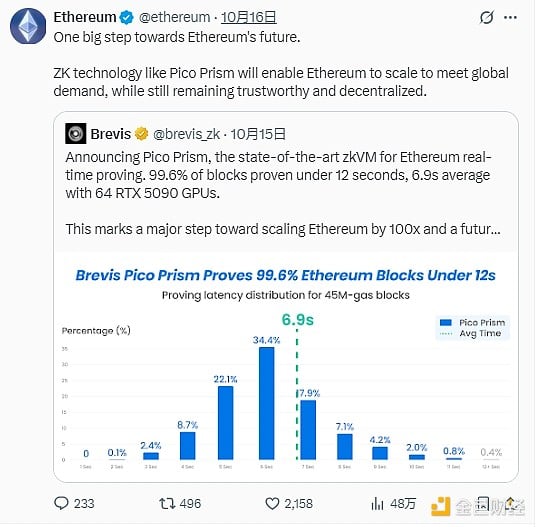
On October 16, the official Ethereum account retweeted Brevis’s “Pico Prism” tweet and wrote: “This is a big step towards the future of Ethereum. Zero-knowledge proof technology like Pico Prism will enable Ethereum to scale to meet global demand while still maintaining credibility and decentralization.”
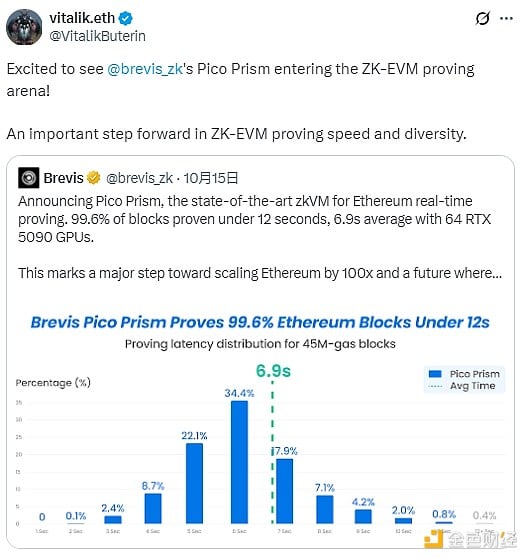
On October 15, Vitalik retweeted and wrote: “Great to see @brevis_zk’s Pico Prism enter the ZK-EVM verification field! A major step forward in ZK-EVM verification speed and diversity.”
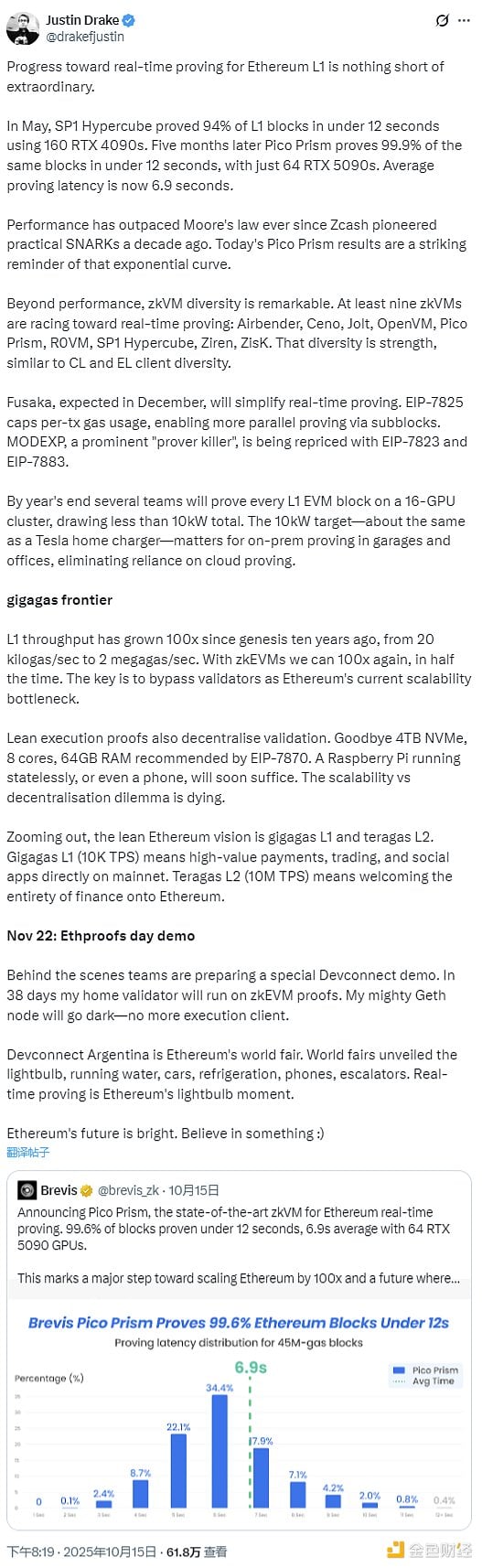
Ethereum core developer Justin Drake also joined the call.
What is the origin of Pico Prism that has caused the official Ethereum account to go crazy and call for it?

1. Pico Prism’s Technological Breakthrough

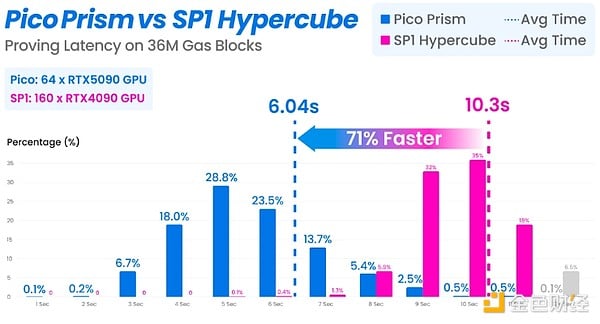
Developed by Brevis, Pico Prism implements real-time proofs (RTP) for Ethereum Layer-1 using consumer-grade hardware equipped with 64 RTX 5090 GPUs. In a test conducted in September, Pico Prism achieved 99.6% real-time proofs in less than 12 seconds.

A blog post published by Brevis describes Pico Prism as follows:

Pico Prism pioneered real-time proof of a 45M gas limit block using affordable consumer-grade hardware. We benchmarked Pico Prism on eight servers, each equipped with eight RTX 5090 GPUs, for a total of 64 GPUs. To compare with SP1 Hypercube, we uniformly sampled 1,000 blocks from the same time period as the Succinct benchmark. For the 45M gas limit block, we benchmarked every block generated on September 1, 2025.
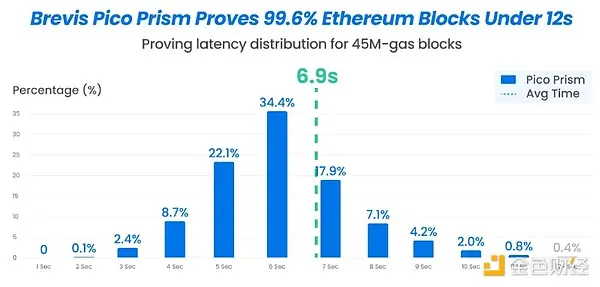
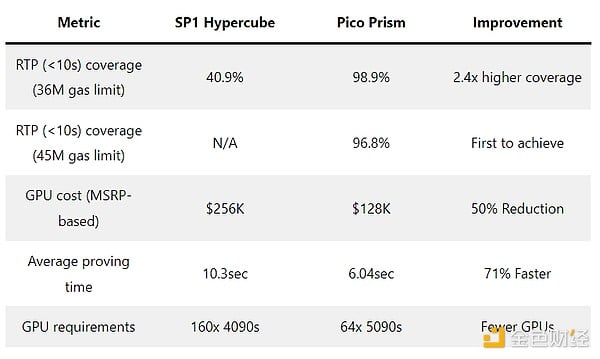
In addition to individual metrics, Pico Prism achieved a 3.4x performance advantage over SP1 in terms of speed and cost efficiency (calculated as average verification time × hardware cost).

Pico Prism uses a consumer-grade RTX 5090 GPU, demonstrating that real-time verification is possible without expensive data center hardware.

Multi-GPU and multi-machine proof

Pico's major breakthrough is the migration from a single-machine, single-GPU prover to a fully distributed multi-machine, multi-GPU architecture. The core of this leap is a complete redesign of the computational pipeline.

Thanks to Pico's modular design, the proof process is broken down into multiple stages, from simulation to hierarchical recursion. Compute-intensive workloads are offloaded to the GPU, while setup tasks remain on the CPU, executed in a highly parallel pipeline that keeps the GPU saturated and operating at peak efficiency. This extreme optimization and parallelization delivers near-linear speedup when scaling across multi-machine, multi-GPU setups. The result is transformative and undeniable: Pico Prism enables true real-time proofs at Ethereum scale using readily accessible, consumer-grade hardware.

Future Plans

With the release of Pico Prism, the path to Ethereum L1 zkVM integration has become clearer. While we are only 2.2% away from our updated goal of sub-10 second real-time verification, we have already begun rolling out some low-hanging fruit to make this goal a breeze.

The next major milestone for Pico Prism is a focus on reducing verification costs. We have a roadmap to achieve 99% real-time verification using fewer than 16 RTX 5090 GPUs in the coming months.

2. Significance for Ethereum

1. Implement lightweight verification

This breakthrough means that computationally expensive proofs can finally keep up with block production using affordable consumer hardware, making lightweight verification practical for the first time. Currently, each validator re-executes every transaction to verify a block, which requires expensive hardware and creates a fundamental bottleneck. But "real-time proofs break this paradigm. One prover generates a proof, and everyone else verifies it within milliseconds."

2. Towards 10,000 TPS

According to the Ethereum roadmap, validators will move from re-executing transactions to simply verifying ZK proofs, allowing the base layer to reach 10,000 transactions per second.

Ryan Sean Adams of Bankless noted: “If scaling continues at a rate of 3x per year, Ethereum L1 will reach 10,000 TPS by April 2029.”

Justin Drake, a Bitcoin security researcher, explained that Ethereum's Fusaka upgrade, expected in December, will simplify real-time proofs. "EIP-7825 limits the gas usage of each transaction, enabling more parallel proofs across sub-blockchains. By the end of the year, several teams will be proving every L1 EVM block on a 16-GPU cluster, using less than 10kW of total power."

3. Nodes can be run on mobile phones

“The future of the phone as a node is about to become a reality,” said Mike Warner, a tech entrepreneur.

Adams noted that Ethereum is transitioning to a zk-chain: Layer 1 will run global DeFi, with large blocks capable of 10,000 transactions per second and nodes that can run on mobile phones, while Layer 2 will run everything else. "No other blockchain follows this strategy—using zero-knowledge proof technology for maximum scalability and decentralization. Bitcoin remains conservative with first-generation cryptography. Ethereum is actively transitioning to second-generation cryptography. Other blockchains use nodes that require data centers to scale."

This is essentially the holy grail of blockchain: achieving massive scalability without sacrificing decentralization or security.

What is real-time proof and why is it important for Ethereum?

Real-time Proving is a new, more efficient technology that allows transactions to be verified by generating a small proof, rather than requiring every node to re-execute all transactions, significantly increasing transaction speed and reducing costs. It is important for Ethereum because it enables massive scalability without sacrificing decentralization, making Ethereum transactions faster, cheaper, and more secure.

  • Significant Scalability: Real-time proofs significantly increase Ethereum’s transaction processing capacity without compromising decentralization.
  • Reduced costs: Since nodes do not need to perform complex calculations, the cost of transactions is significantly reduced.
  • Improved speed: Transaction verification speed is greatly improved, and the user experience will be better.
  • Improved security: By making transaction verification more efficient and secure, real-time proofs help enhance the security of the entire Ethereum network.

“The data speaks for itself,” said Mo Dong, CEO and co-founder of Brevis. “The infrastructure we built is capable of handling the real-world data currently produced on Ethereum. The faster performance brings economic benefits that make real-time proofs practical for production deployments.”

With Pico Prism, the path to Ethereum L1 zkEVM integration is now clearer.

Market Opportunity
Brainedge Logo
Brainedge Price(LEARN)
$0.0088
$0.0088$0.0088
-0.11%
USD
Brainedge (LEARN) Live Price Chart
Disclaimer: The articles reposted on this site are sourced from public platforms and are provided for informational purposes only. They do not necessarily reflect the views of MEXC. All rights remain with the original authors. If you believe any content infringes on third-party rights, please contact service@support.mexc.com for removal. MEXC makes no guarantees regarding the accuracy, completeness, or timeliness of the content and is not responsible for any actions taken based on the information provided. The content does not constitute financial, legal, or other professional advice, nor should it be considered a recommendation or endorsement by MEXC.

You May Also Like

Franklin Templeton CEO Dismisses 50bps Rate Cut Ahead FOMC

Franklin Templeton CEO Dismisses 50bps Rate Cut Ahead FOMC

The post Franklin Templeton CEO Dismisses 50bps Rate Cut Ahead FOMC appeared on BitcoinEthereumNews.com. Franklin Templeton CEO Jenny Johnson has weighed in on whether the Federal Reserve should make a 25 basis points (bps) Fed rate cut or 50 bps cut. This comes ahead of the Fed decision today at today’s FOMC meeting, with the market pricing in a 25 bps cut. Bitcoin and the broader crypto market are currently trading flat ahead of the rate cut decision. Franklin Templeton CEO Weighs In On Potential FOMC Decision In a CNBC interview, Jenny Johnson said that she expects the Fed to make a 25 bps cut today instead of a 50 bps cut. She acknowledged the jobs data, which suggested that the labor market is weakening. However, she noted that this data is backward-looking, indicating that it doesn’t show the current state of the economy. She alluded to the wage growth, which she remarked is an indication of a robust labor market. She added that retail sales are up and that consumers are still spending, despite inflation being sticky at 3%, which makes a case for why the FOMC should opt against a 50-basis-point Fed rate cut. In line with this, the Franklin Templeton CEO said that she would go with a 25 bps rate cut if she were Jerome Powell. She remarked that the Fed still has the October and December FOMC meetings to make further cuts if the incoming data warrants it. Johnson also asserted that the data show a robust economy. However, she noted that there can’t be an argument for no Fed rate cut since Powell already signaled at Jackson Hole that they were likely to lower interest rates at this meeting due to concerns over a weakening labor market. Notably, her comment comes as experts argue for both sides on why the Fed should make a 25 bps cut or…
Share
BitcoinEthereumNews2025/09/18 00:36
While Bitcoin Stagnates, Gold Breaks Record After Record! Is the Situation Too Bad for BTC? Bloomberg Analyst Explains!

While Bitcoin Stagnates, Gold Breaks Record After Record! Is the Situation Too Bad for BTC? Bloomberg Analyst Explains!

Jim Bianco argued that Bitcoin's adoption narrative has lost strength, while Bloomberg analyst Eric Balchunas maintained that BTC is still in good shape. Continue
Share
Coinstats2026/01/24 01:53
Your Closet Is Worth More Than You Think. Vinted Is Here to Prove It

Your Closet Is Worth More Than You Think. Vinted Is Here to Prove It

Europe’s leading fashion resale app, Vinted, has landed in New York, ready to help people turn their unworn clothes into cash and make space at home. One in five
Share
AI Journal2026/01/24 02:31