In the context of yield compression and bear market in the crypto market, how can investors manage risks and adjust strategies to avoid falling into the trap of blindly chasing returns.In the context of yield compression and bear market in the crypto market, how can investors manage risks and adjust strategies to avoid falling into the trap of blindly chasing returns.

A practical guide to surviving a bear market: How to avoid the yield trap?

2025/04/07 14:30
4 min read
For feedback or concerns regarding this content, please contact us at crypto.news@mexc.com

Author: Santisa , Crypto KOL

Compiled by: Felix, PANews

Before starting the content of this article, let’s take a look at the following story (or reality).

A “never-ending” list of tariffs was announced. Then the market crashed and altcoins collapsed.

Your original low-risk "mine" yield has dropped from 30% to near the level of a Treasury bill (note: T-bill, a short-term debt security issued by the government).

This is unacceptable to you. You originally planned to retire with $300,000, and the annual "mining" income is $90,000. Therefore, the rate of return must be high.

So you start moving down the risk curve, chasing imaginary levels of return that the market would favor you.

You traded your blue chip for an unknown new project; you increased your yield by deploying your assets into a riskier new fixed-term protocol or AMM. You started to feel secretly proud.

After a few weeks, you start to question why you were so risk-averse in the first place. This was apparently a “safe and sure” way to make money.

Then, the surprise came.
A practical guide to surviving a bear market: How to avoid the yield trap?

The custodial, leveraged, L2 wrapped, ultra-liquid foundational trading project you entrusted your life savings to collapsed, and now you have lost 70% of your PT-shitUSD-27AUG2025. You got some vested governance tokens, and a few months later the project was abandoned.

Although this story is exaggerated, it reflects the reality that has been played out many times during bear market when yields are compressed. Based on this, this article will try to provide a manual on how to survive a yield bear market.

As people try to adjust to the new reality, in the face of a market crash, they increase risk to make up for the difference in returns, while ignoring the potential costs of these decisions.

Market neutral investors are also speculators whose advantage is to find unadjusted interest rates. Unlike their directional trading partners, these speculators face only two outcomes: either making a little money every day or losing a lot of money all at once.

I personally believe that the neutral rate in the crypto market will be seriously misaligned on the way up, providing an alpha that is higher than its true risk, but the opposite is true on the way down, providing returns below the risk-free rate (RFR) while taking on a lot of risk.

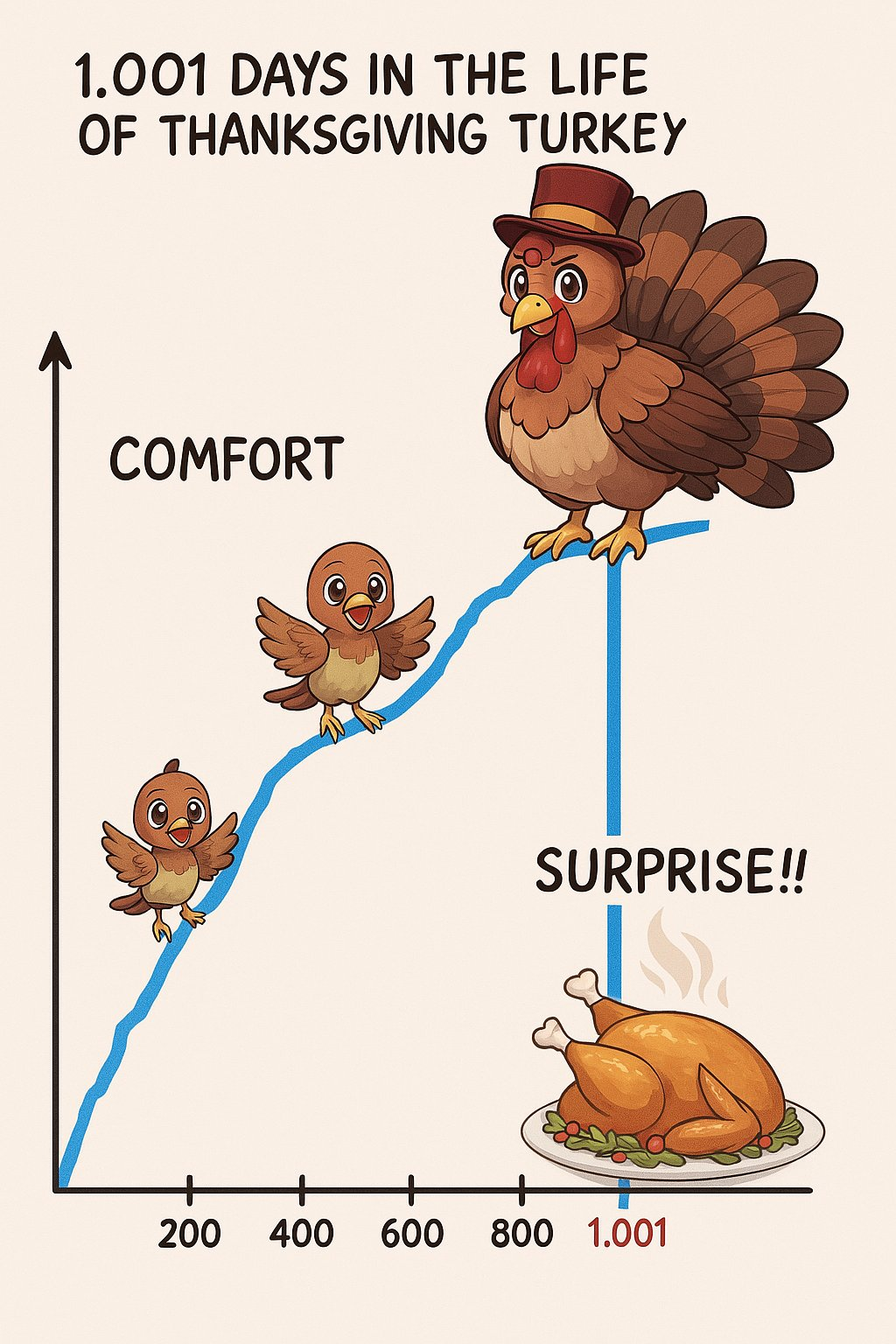
Obviously, there is a time to take risks and a time to avoid them. Those who fail to see this will become someone else's "Thanksgiving dinner".

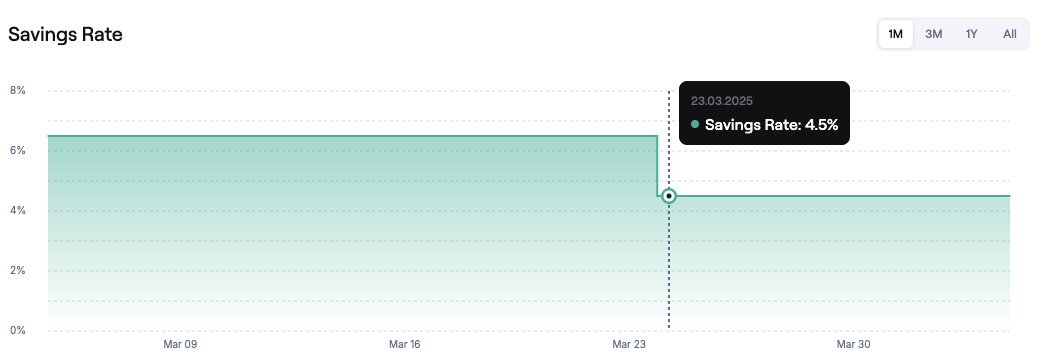
For example, at the time of writing, AAVE’s USDC yield is 2.7% and sUSDS yields 4.5%.

  • AAVE USDC bears 60% of the RFR and also assumes smart contract, oracle, custody and financial risks.

A practical guide to surviving a bear market: How to avoid the yield trap?

 source
  • Maker incurs fees 25 basis points above the RFR while taking on the risks of smart contracts, custody, and actively investing in higher-risk projects.
A practical guide to surviving a bear market: How to avoid the yield trap?

 source

When analyzing the interest rates of DeFi market-neutral investments, you need to consider:

  • Custody Risk
  • Financial risks
  • Smart Contract Risks
  • Risk-free rate

You can assign an annual risk percentage to each risk, add the RFR, and arrive at the required "risk-adjusted return" for each investment opportunity. Anything above that rate is alpha, and anything below that rate is not alpha.

Maker’s required risk-adjusted return was calculated a while ago and came up with a fair compensation of 9.56%.

Maker’s interest rate is currently around 4.5%.

Both AAVE and Maker hold secondary capital (~1% of total deposits), but even with significant insurance, yields below the RFR should not be acceptable to depositors.

In the age of Blackroll T-bills and regulated on-chain issuers, this is the result of laziness, lost keys, and stupid money.

So what to do? It depends on your size.

If you have a smaller portfolio (less than $5 million), there are still attractive options. Check out the safer protocols for all-chain deployments; they often offer incentives on lesser-known chains with lower TVL, or do some base trading on high-yield, low-liquidity perpetual contracts.

If you have a large sum of money (over $20 million):

Buy short-term Treasuries and wait and see. Favorable market conditions will eventually return. You can also search for OTC exchanges; quite a few projects are still looking around for TVL and are willing to significantly dilute their holders.

If you have LPs, let them know this and even ask them to exit. On-chain treasuries are still lower than real trading. Don't get carried away by the unadjusted risk-return. Good opportunities are obvious. Keep it simple and avoid greed. You should be here for the long term and manage your risk-return properly; if not, the market will figure it out for you.

Related reading: Comprehensive data analysis of the capital flows behind the trillion-dollar growth of stablecoins. If altcoins did not rise, where did the money go?

Disclaimer: The articles reposted on this site are sourced from public platforms and are provided for informational purposes only. They do not necessarily reflect the views of MEXC. All rights remain with the original authors. If you believe any content infringes on third-party rights, please contact crypto.news@mexc.com for removal. MEXC makes no guarantees regarding the accuracy, completeness, or timeliness of the content and is not responsible for any actions taken based on the information provided. The content does not constitute financial, legal, or other professional advice, nor should it be considered a recommendation or endorsement by MEXC.

You May Also Like

IP Hits $11.75, HYPE Climbs to $55, BlockDAG Surpasses Both with $407M Presale Surge!

IP Hits $11.75, HYPE Climbs to $55, BlockDAG Surpasses Both with $407M Presale Surge!

The post IP Hits $11.75, HYPE Climbs to $55, BlockDAG Surpasses Both with $407M Presale Surge! appeared on BitcoinEthereumNews.com. Crypto News 17 September 2025 | 18:00 Discover why BlockDAG’s upcoming Awakening Testnet launch makes it the best crypto to buy today as Story (IP) price jumps to $11.75 and Hyperliquid hits new highs. Recent crypto market numbers show strength but also some limits. The Story (IP) price jump has been sharp, fueled by big buybacks and speculation, yet critics point out that revenue still lags far behind its valuation. The Hyperliquid (HYPE) price looks solid around the mid-$50s after a new all-time high, but questions remain about sustainability once the hype around USDH proposals cools down. So the obvious question is: why chase coins that are either stretched thin or at risk of retracing when you could back a network that’s already proving itself on the ground? That’s where BlockDAG comes in. While other chains are stuck dealing with validator congestion or outages, BlockDAG’s upcoming Awakening Testnet will be stress-testing its EVM-compatible smart chain with real miners before listing. For anyone looking for the best crypto coin to buy, the choice between waiting on fixes or joining live progress feels like an easy one. BlockDAG: Smart Chain Running Before Launch Ethereum continues to wrestle with gas congestion, and Solana is still known for network freezes, yet BlockDAG is already showing a different picture. Its upcoming Awakening Testnet, set to launch on September 25, isn’t just a demo; it’s a live rollout where the chain’s base protocols are being stress-tested with miners connected globally. EVM compatibility is active, account abstraction is built in, and tools like updated vesting contracts and Stratum integration are already functional. Instead of waiting for fixes like other networks, BlockDAG is proving its infrastructure in real time. What makes this even more important is that the technology is operational before the coin even hits exchanges. That…
Share
BitcoinEthereumNews2025/09/18 00:32
China Blocks Nvidia’s RTX Pro 6000D as Local Chips Rise

China Blocks Nvidia’s RTX Pro 6000D as Local Chips Rise

The post China Blocks Nvidia’s RTX Pro 6000D as Local Chips Rise appeared on BitcoinEthereumNews.com. China Blocks Nvidia’s RTX Pro 6000D as Local Chips Rise China’s internet regulator has ordered the country’s biggest technology firms, including Alibaba and ByteDance, to stop purchasing Nvidia’s RTX Pro 6000D GPUs. According to the Financial Times, the move shuts down the last major channel for mass supplies of American chips to the Chinese market. Why Beijing Halted Nvidia Purchases Chinese companies had planned to buy tens of thousands of RTX Pro 6000D accelerators and had already begun testing them in servers. But regulators intervened, halting the purchases and signaling stricter controls than earlier measures placed on Nvidia’s H20 chip. Image: Nvidia An audit compared Huawei and Cambricon processors, along with chips developed by Alibaba and Baidu, against Nvidia’s export-approved products. Regulators concluded that Chinese chips had reached performance levels comparable to the restricted U.S. models. This assessment pushed authorities to advise firms to rely more heavily on domestic processors, further tightening Nvidia’s already limited position in China. China’s Drive Toward Tech Independence The decision highlights Beijing’s focus on import substitution — developing self-sufficient chip production to reduce reliance on U.S. supplies. “The signal is now clear: all attention is focused on building a domestic ecosystem,” said a representative of a leading Chinese tech company. Nvidia had unveiled the RTX Pro 6000D in July 2025 during CEO Jensen Huang’s visit to Beijing, in an attempt to keep a foothold in China after Washington restricted exports of its most advanced chips. But momentum is shifting. Industry sources told the Financial Times that Chinese manufacturers plan to triple AI chip production next year to meet growing demand. They believe “domestic supply will now be sufficient without Nvidia.” What It Means for the Future With Huawei, Cambricon, Alibaba, and Baidu stepping up, China is positioning itself for long-term technological independence. Nvidia, meanwhile, faces…
Share
BitcoinEthereumNews2025/09/18 01:37
Uphold’s Massive 1.59 Billion XRP Holdings Shocks Community, CEO Reveals The Real Owners

Uphold’s Massive 1.59 Billion XRP Holdings Shocks Community, CEO Reveals The Real Owners

Uphold, a cloud-based digital financial service platform, has come under the spotlight after on-chain data confirmed that it safeguards approximately 1.59 billion XRP. According to Uphold’s Chief Executive Officer (CEO), Simon McLoughlin, these tokens are fully owned by customers, not the exchange itself.  Uphold Clarifies Massive XRP Holdings The crypto community was taken by surprise […]
Share
Bitcoinist2025/09/18 00:30