The recent collapse in gold prices, erasing over $2.5 trillion in market value in a single day, highlights the increasing volatility even in traditionally safe assets. This sharp decline follows a period of strong gains and has sparked renewed debate about the resilience of gold as a hedge in turbulent markets. As cryptocurrencies like Bitcoin [...]The recent collapse in gold prices, erasing over $2.5 trillion in market value in a single day, highlights the increasing volatility even in traditionally safe assets. This sharp decline follows a period of strong gains and has sparked renewed debate about the resilience of gold as a hedge in turbulent markets. As cryptocurrencies like Bitcoin [...]

Gold’s $2.5T Crash Surpasses Bitcoin’s Total Market Cap

Gold’s $2.5t Crash Surpasses Bitcoin’s Total Market Cap

The recent collapse in gold prices, erasing over $2.5 trillion in market value in a single day, highlights the increasing volatility even in traditionally safe assets. This sharp decline follows a period of strong gains and has sparked renewed debate about the resilience of gold as a hedge in turbulent markets. As cryptocurrencies like Bitcoin continue to experience fluctuations, this market turmoil underscores the unpredictable nature of both traditional and digital assets amid the current economic climate.

  • Gold experienced a nearly 8% drop in 24 hours, marking one of its largest two-day declines since 2013, with $2.5 trillion wiped from its market cap.
  • The correction is statistically rare, occurring once every 240,000 trading days, yet similar heavy declines have happened multiple times since 1971.
  • The sell-off was driven by FOMO-driven momentum, with profit-taking and weak hands contributing to an intense market shakeout.
  • While gold’s recent plunge surpasses Bitcoin’s entire market cap, Bitcoin’s own volatility remains significant, sparking discussions about the future of crypto as a store of value.
  • The crypto Fear & Greed Index has sunk to levels last seen in December 2022, reflecting widespread market apprehension.

Gold, a cornerstone of traditional investing and long considered a safe-haven asset, faced a brutal sell-off that erased over $2.5 trillion from its market value in just 24 hours, surpassing the market cap of Bitcoin. The decline extends a dramatic correction from recent weeks, with the metal dropping nearly 8% in a single day, reminiscent of its largest two-day drops since 2013. Such rapid moves have unsettled investors, many of whom viewed gold as a hedge against inflation and market turbulence, especially after a 60% surge earlier in 2022.

Gold’s 7% drop is rare: Here’s why it crashed

Market analysts point out that this correction is highly unusual, statistically likening it to an event expected only once every 240,000 trading days. Swiss resources investor Alexander Stahel commented on social media that gold has experienced even larger declines historically, with such corrections occurring 21 times since 1971. The recent plunge was fueled by FOMO-driven enthusiasm as investors flocked into gold-related assets—physical gold, gold tokens, and equity—which created a bubble ready to burst.

“FOMO caused the latest rally. Now, profit-taking and weak hands got shaken out,” Stahel explained, adding that calmer days could be on the horizon. This recent volatility comes amid signals that traditional safe assets are no longer immune to market shocks, especially with growing fears about inflation, geopolitical tensions, and uncertain monetary policies.

Crypto Market Impact and Broader Sentiment

The magnitude of the gold correction surpasses Bitcoin’s entire market cap of approximately $2.2 trillion, leading some analysts to compare the two markets. Veteran trader Peter Brandt noted that the gold decline’s scale is equivalent to 55% of all cryptocurrencies combined, emphasizing the size of the move. Meanwhile, Bitcoin itself suffered a modest 5.2% drop from its intra-day high of $114,000, though it remains within a relatively small daily loss range of 0.8% — highlighting its notorious volatility.
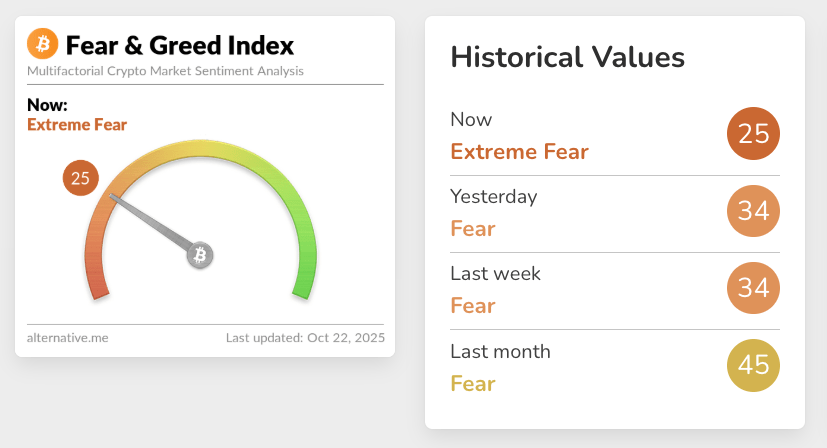
Gold, Bitcoin Price, InflationThe Crypto Fear & Greed Index. Source: Alternative.me

Despite some inflows into Bitcoin spot ETFs—amounting to $142 million in the past day—the broader cryptocurrency market plunged into a state of “Extreme Fear,” as indicated by the Crypto Fear & Greed Index hitting levels last seen in late 2022. This heightened sentiment of fear reflects ongoing uncertainty across global markets, with investors re-evaluating their risk exposure.

Interestingly, Deutsche Bank analysts recently highlighted parallels between gold and Bitcoin, suggesting that rising interest in both assets might reflect a search for safe-haven alternatives amid ongoing market volatility. Although gold has recently reached new nominal highs, it only surpassed its inflation-adjusted all-time peak earlier this month, showing its complex relationship with real economic growth and inflation dynamics.

Market Implications

The current market upheaval underscores that even traditionally “safe” assets like gold can experience dramatic corrections, especially when driven by speculative momentum. As markets adapt to ongoing macroeconomic uncertainties, cryptocurrency proponents continue to watch for Bitcoin’s ability to establish itself as a reliable store of value comparable to gold amidst rising volatility.

This article was originally published as Gold’s $2.5T Crash Surpasses Bitcoin’s Total Market Cap on Crypto Breaking News – your trusted source for crypto news, Bitcoin news, and blockchain updates.


Market Opportunity
Capverse Logo
Capverse Price(CAP)
$0.1287
$0.1287$0.1287
+0.53%
USD
Capverse (CAP) Live Price Chart
Disclaimer: The articles reposted on this site are sourced from public platforms and are provided for informational purposes only. They do not necessarily reflect the views of MEXC. All rights remain with the original authors. If you believe any content infringes on third-party rights, please contact service@support.mexc.com for removal. MEXC makes no guarantees regarding the accuracy, completeness, or timeliness of the content and is not responsible for any actions taken based on the information provided. The content does not constitute financial, legal, or other professional advice, nor should it be considered a recommendation or endorsement by MEXC.

You May Also Like

Global Crypto Leaders to Converge in Dubai for Historic 30th Edition of HODL

Global Crypto Leaders to Converge in Dubai for Historic 30th Edition of HODL

The 30th edition of the HODL (Formerly World Blockchain Summit), the world's longest-running Crypto & Web3 Summit series is set to return to Dubai.
Share
Crypto Breaking News2025/06/17 20:16
Buterin pushes Layer 2 interoperability as cornerstone of Ethereum’s future

Buterin pushes Layer 2 interoperability as cornerstone of Ethereum’s future

Ethereum founder, Vitalik Buterin, has unveiled new goals for the Ethereum blockchain today at the Japan Developer Conference. The plan lays out short-term, mid-term, and long-term goals touching on L2 interoperability and faster responsiveness among others. In terms of technology, he said again that he is sure that Layer 2 options are the best way […]
Share
Cryptopolitan2025/09/18 01:15
Chinese Bitcoin Hardware Titans Control 95% of Market, Now Coming to America to Dodge Trump Tariff War

Chinese Bitcoin Hardware Titans Control 95% of Market, Now Coming to America to Dodge Trump Tariff War

Three of China’s largest Bitcoin hardware manufacturers are establishing production facilities in the United States as President Donald Trump’s tariff policies reshape the cryptocurrency industry. The three industry leaders, Bitmain, Canaan, and MicroBT, collectively control over 90% of the global mining rig market. These companies are the architects of Bitcoin’s physical infrastructure, manufacturing the specialized ASIC (Application-Specific Integrated Circuit) machines that form the backbone of the world’s most valuable cryptocurrency network. Every Bitcoin mined globally likely passes through hardware bearing Chinese engineering fingerprints. 95% Market Control Sparks “Digital Dependency Trap” and Security Risks According to a June 18 Reuters report, these Bitcoin mining giants are establishing U.S. operations to circumvent potential tariffs. However, critics have raised security concerns about Chinese involvement in sectors spanning semiconductor manufacturing and energy infrastructure. Guang Yang, chief technology officer at crypto technology provider Conflux Network, described the situation as extending beyond trade policy. “The U.S.-China trade war goes beyond tariffs,” Yang stated. “It’s a strategic pivot toward ‘politically acceptable’ hardware sources.” Bitmain, the largest of the three companies by revenue, initiated U.S. production of mining equipment in December , one month after Trump’s presidential election victory. Canaan began trial production in the United States on April 2 to avoid tariffs following Trump’s announcement of new trade levies. One of the largest manufacturers of #bitcoin mining machines, Canaan, has set up a base of operations outside of China. CEO Zhang says, Kazakhstan is essential to "expanding after-sales geographical coverage and providing […] support growing international customer base" pic.twitter.com/7D5Xh2ici5 — Documenting ₿itcoin 📄 (@DocumentingBTC) June 23, 2021 Third-ranked MicroBT announced in a statement that it is “actively implementing a localization strategy in the U.S.” to “avoid the impact of tariffs.” $11.9B by 2028: The Market These Giants Are Fighting for According to Frost & Sullivan’s “2024 Global Blockchain Hardware Industry White Paper,” the ASIC-based Bitcoin mining hardware market demonstrates substantial consolidation. When measured by computing power sold, these three Chinese companies command 95.4% of the global market share. The Bitcoin ecosystem encompasses five primary segments: hardware supply, mining farm operations, mining pool management, trading platforms, and payment processing services. Hardware manufacturers like Canaan, the first Bitcoin mining company to go public and the second-largest by computing power , focus exclusively on integrated circuit (IC) design, manufacturing, and equipment sales. Industry analysts project continued sector expansion, with the market expected to reach $11.9 billion by 2028, representing a compound annual growth rate of 15.3%, contingent on Bitcoin’s continued price appreciation driven by supply scarcity. Source: Frost & Sullivan China’s Historical Bitcoin Mining Advantage Understanding today’s migration requires examining how China achieved such overwhelming market control in the first place. The foundation was laid during the historic 2017 Bitcoin boom, when three key factors aligned to create Chinese mining supremacy. During the early expansion phase, Chinese officials recognized cryptocurrency mining as a profitable venture that attracted substantial foreign investment. Consequently, authorities initially overlooked the mining sector while simultaneously restricting Bitcoin trading and initial coin offerings. Hydro-power plants go on sale in China since #Bitcoin mining crackdown has reduced demand for electricity. – South China Morning Post pic.twitter.com/QKEbUzWN4g — Bitcoin Archive (@BTC_Archive) June 30, 2021 China’s extensive hydroelectric infrastructure further strengthened the country’s mining operations, providing the cheap energy essential for profitable Bitcoin production. Does Chinese Hardware Control America’s Bitcoin Network? While the United States leads global Bitcoin mining operations with over 38% of total network activity , American miners depend almost entirely on Chinese-manufactured equipment. America Leads Bitcoin Mining Operation/ Source: Bitbo This creates what security analysts describe as a “digital dependency trap,” a scenario where America’s cryptocurrency infrastructure relies fundamentally on hardware produced by its primary economic rival. Guang Yang, Conflux Network’s chief technology officer, frames this dependency in geopolitical terms that extend far beyond trade economics . “The U.S.-China trade war goes beyond tariffs,” Yang explains. “It’s a strategic pivot toward ‘politically acceptable’ hardware sources.” His assessment reflects growing concerns within the cryptocurrency community about supply chain vulnerabilities that could impact national economic security.
Share
CryptoNews2025/06/19 04:26



