This article describes the technique for achieving disentangled motion representation by splitting full-body kinematics into upper and lower halves.This article describes the technique for achieving disentangled motion representation by splitting full-body kinematics into upper and lower halves.

Disentangled Motion Representation: Encoding Full-Body Avatars into Discrete Latent Spaces

2025/10/22 23:55
2 min read
For feedback or concerns regarding this content, please contact us at crypto.news@mexc.com

Abstract and 1. Introduction

  1. Related Work

    2.1. Motion Reconstruction from Sparse Input

    2.2. Human Motion Generation

  2. SAGE: Stratified Avatar Generation and 3.1. Problem Statement and Notation

    3.2. Disentangled Motion Representation

    3.3. Stratified Motion Diffusion

    3.4. Implementation Details

  3. Experiments and Evaluation Metrics

    4.1. Dataset and Evaluation Metrics

    4.2. Quantitative and Qualitative Results

    4.3. Ablation Study

  4. Conclusion and References

\ Supplementary Material

A. Extra Ablation Studies

B. Implementation Details

3.2. Disentangled Motion Representation

In this section, our objective is to disentangle full-body human motions into upper-body and lower-body parts and encode them to discrete latent spaces. This can effectively reduce the complexity and burden of encoding since each encoding takes care of only half-body motions.

\
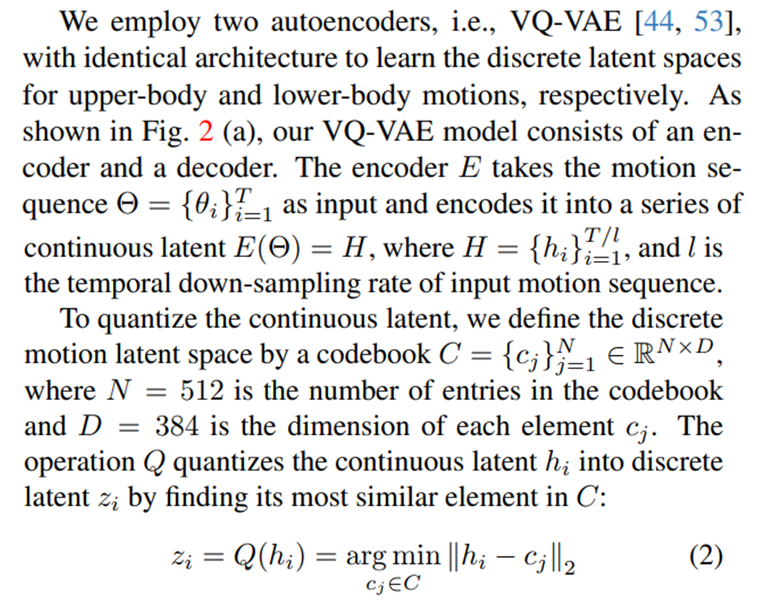
\ Figure 2. The overall architecture of our SAGE Net. It mainly contains two components: (a) Disentangled VQ-VAE for discrete human motion latent learning. To facilitate visualization, we incorporate zero rotations as padding for the lower body in the Upper VQ-VAE, and vice versa for the Lower VQ-VAE. Consequently, in the visualizations of the Upper VQ-VAE, the lower body remains in a stationary pose, whereas in the visualizations of the Lower VQ-VAE, the upper body is maintained in a T-pose. (b) The stratified diffusion model, which models the conditional distribution of the latent space for upper and lower motion. This model sequentially infers the upper and lower body latents, capturing the correlation between upper and lower motions. By employing a dedicated full-body decoder on the concatenated upper and lower latents, we can obtain full-body motion.
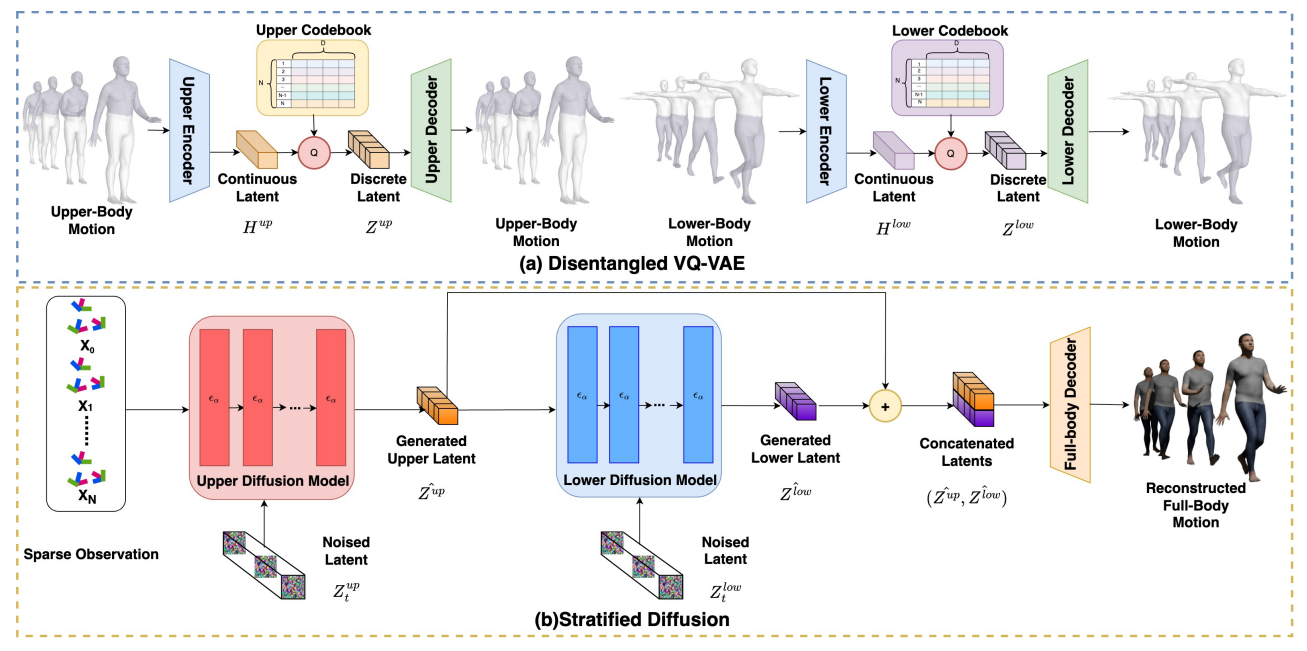
\ Since continuous latent from all data samples share the same codebook C, all the real motions in the training set could be expressed by a finite number of bases in latent space.

\
\

:::info Authors:

(1) Han Feng, equal contributions, ordered by alphabet from Wuhan University;

(2) Wenchao Ma, equal contributions, ordered by alphabet from Pennsylvania State University;

(3) Quankai Gao, University of Southern California;

(4) Xianwei Zheng, Wuhan University;

(5) Nan Xue, Ant Group (xuenan@ieee.org);

(6) Huijuan Xu, Pennsylvania State University.

:::


:::info This paper is available on arxiv under CC BY 4.0 DEED license.

:::

\

Disclaimer: The articles reposted on this site are sourced from public platforms and are provided for informational purposes only. They do not necessarily reflect the views of MEXC. All rights remain with the original authors. If you believe any content infringes on third-party rights, please contact crypto.news@mexc.com for removal. MEXC makes no guarantees regarding the accuracy, completeness, or timeliness of the content and is not responsible for any actions taken based on the information provided. The content does not constitute financial, legal, or other professional advice, nor should it be considered a recommendation or endorsement by MEXC.

You May Also Like

The Channel Factories We’ve Been Waiting For

The Channel Factories We’ve Been Waiting For

The post The Channel Factories We’ve Been Waiting For appeared on BitcoinEthereumNews.com. Visions of future technology are often prescient about the broad strokes while flubbing the details. The tablets in “2001: A Space Odyssey” do indeed look like iPads, but you never see the astronauts paying for subscriptions or wasting hours on Candy Crush.  Channel factories are one vision that arose early in the history of the Lightning Network to address some challenges that Lightning has faced from the beginning. Despite having grown to become Bitcoin’s most successful layer-2 scaling solution, with instant and low-fee payments, Lightning’s scale is limited by its reliance on payment channels. Although Lightning shifts most transactions off-chain, each payment channel still requires an on-chain transaction to open and (usually) another to close. As adoption grows, pressure on the blockchain grows with it. The need for a more scalable approach to managing channels is clear. Channel factories were supposed to meet this need, but where are they? In 2025, subnetworks are emerging that revive the impetus of channel factories with some new details that vastly increase their potential. They are natively interoperable with Lightning and achieve greater scale by allowing a group of participants to open a shared multisig UTXO and create multiple bilateral channels, which reduces the number of on-chain transactions and improves capital efficiency. Achieving greater scale by reducing complexity, Ark and Spark perform the same function as traditional channel factories with new designs and additional capabilities based on shared UTXOs.  Channel Factories 101 Channel factories have been around since the inception of Lightning. A factory is a multiparty contract where multiple users (not just two, as in a Dryja-Poon channel) cooperatively lock funds in a single multisig UTXO. They can open, close and update channels off-chain without updating the blockchain for each operation. Only when participants leave or the factory dissolves is an on-chain transaction…
Share
BitcoinEthereumNews2025/09/18 00:09
Stablecoins firm as Mastercard enables stablecoin settlement

Stablecoins firm as Mastercard enables stablecoin settlement

The post Stablecoins firm as Mastercard enables stablecoin settlement appeared on BitcoinEthereumNews.com. What Mastercard’s Crypto Partner Program is and how it
Share
BitcoinEthereumNews2026/03/12 10:44
South Africa launches HIV vaccine trial

South Africa launches HIV vaccine trial

South Africa HIV vaccine trial efforts are advancing after researchers launched the first locally developed HIV vaccine study on the continent.   South Africa expands
Share
Furtherafrica2026/03/12 09:30




