This article introduces Stratified Motion Diffusion, a novel technique that employs cascaded latent sampling to reconstruct full-body avatars.This article introduces Stratified Motion Diffusion, a novel technique that employs cascaded latent sampling to reconstruct full-body avatars.

Generating Consistent Full-Body Avatars: Stratified Motion Diffusion for Decoupled Kinematics

Abstract and 1. Introduction

  1. Related Work

    2.1. Motion Reconstruction from Sparse Input

    2.2. Human Motion Generation

  2. SAGE: Stratified Avatar Generation and 3.1. Problem Statement and Notation

    3.2. Disentangled Motion Representation

    3.3. Stratified Motion Diffusion

    3.4. Implementation Details

  3. Experiments and Evaluation Metrics

    4.1. Dataset and Evaluation Metrics

    4.2. Quantitative and Qualitative Results

    4.3. Ablation Study

  4. Conclusion and References

\ Supplementary Material

A. Extra Ablation Studies

B. Implementation Details

3.3. Stratified Motion Diffusion

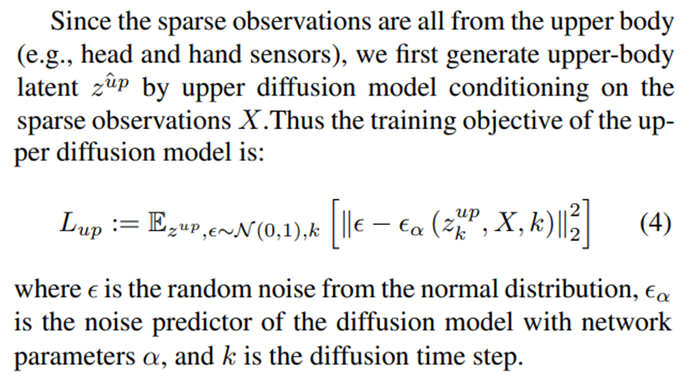
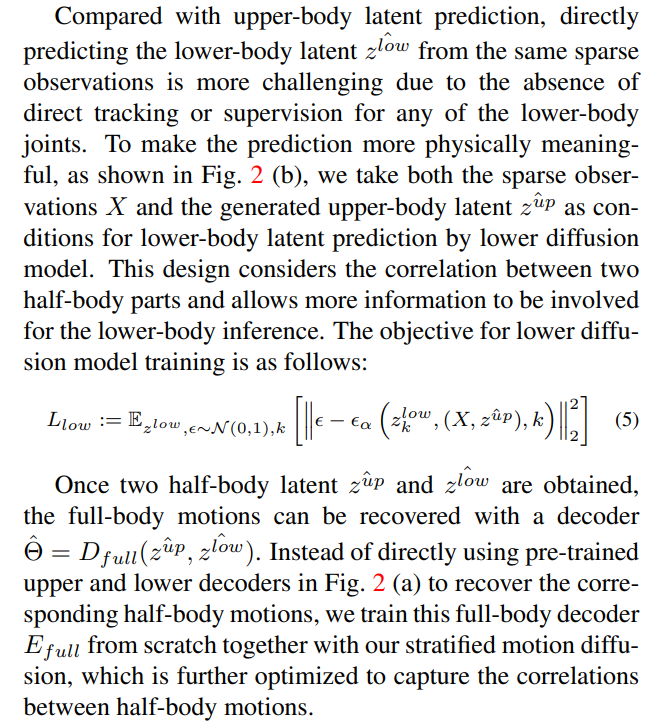
After encoding and expressing different human motions as latents, we aim to properly sample from the latent space for full-body motion reconstructions and match the sparse observations.

\ Although disentangling the full-body motions into upper and lower parts enhances effectiveness and efficiency for motion representation learning, it’s crucial to include the correlation between two body parts during generation. Otherwise, severe inconsistency would be witnessed in reconstructed full-body motions. To this end, we propose Stratified Motion Diffusion to sample upper-body and lowerbody latent in a cascaded manner with explicit considerations of the correlations mentioned above.

\
\
\

:::info Authors:

(1) Han Feng, equal contributions, ordered by alphabet from Wuhan University;

(2) Wenchao Ma, equal contributions, ordered by alphabet from Pennsylvania State University;

(3) Quankai Gao, University of Southern California;

(4) Xianwei Zheng, Wuhan University;

(5) Nan Xue, Ant Group (xuenan@ieee.org);

(6) Huijuan Xu, Pennsylvania State University.

:::


:::info This paper is available on arxiv under CC BY 4.0 DEED license.

:::

\

Disclaimer: The articles reposted on this site are sourced from public platforms and are provided for informational purposes only. They do not necessarily reflect the views of MEXC. All rights remain with the original authors. If you believe any content infringes on third-party rights, please contact service@support.mexc.com for removal. MEXC makes no guarantees regarding the accuracy, completeness, or timeliness of the content and is not responsible for any actions taken based on the information provided. The content does not constitute financial, legal, or other professional advice, nor should it be considered a recommendation or endorsement by MEXC.

You May Also Like

Polygon Tops RWA Rankings With $1.1B in Tokenized Assets

Polygon Tops RWA Rankings With $1.1B in Tokenized Assets

The post Polygon Tops RWA Rankings With $1.1B in Tokenized Assets appeared on BitcoinEthereumNews.com. Key Notes A new report from Dune and RWA.xyz highlights Polygon’s role in the growing RWA sector. Polygon PoS currently holds $1.13 billion in RWA Total Value Locked (TVL) across 269 assets. The network holds a 62% market share of tokenized global bonds, driven by European money market funds. The Polygon POL $0.25 24h volatility: 1.4% Market cap: $2.64 B Vol. 24h: $106.17 M network is securing a significant position in the rapidly growing tokenization space, now holding over $1.13 billion in total value locked (TVL) from Real World Assets (RWAs). This development comes as the network continues to evolve, recently deploying its major “Rio” upgrade on the Amoy testnet to enhance future scaling capabilities. This information comes from a new joint report on the state of the RWA market published on Sept. 17 by blockchain analytics firm Dune and data platform RWA.xyz. The focus on RWAs is intensifying across the industry, coinciding with events like the ongoing Real-World Asset Summit in New York. Sandeep Nailwal, CEO of the Polygon Foundation, highlighted the findings via a post on X, noting that the TVL is spread across 269 assets and 2,900 holders on the Polygon PoS chain. The Dune and https://t.co/W6WSFlHoQF report on RWA is out and it shows that RWA is happening on Polygon. Here are a few highlights: – Leading in Global Bonds: Polygon holds 62% share of tokenized global bonds (driven by Spiko’s euro MMF and Cashlink euro issues) – Spiko U.S.… — Sandeep | CEO, Polygon Foundation (※,※) (@sandeepnailwal) September 17, 2025 Key Trends From the 2025 RWA Report The joint publication, titled “RWA REPORT 2025,” offers a comprehensive look into the tokenized asset landscape, which it states has grown 224% since the start of 2024. The report identifies several key trends driving this expansion. According to…
Share
BitcoinEthereumNews2025/09/18 00:40
Vitalik Buterin Reveals Ethereum’s Long-Term Focus on Quantum Resistance

Vitalik Buterin Reveals Ethereum’s Long-Term Focus on Quantum Resistance

TLDR Ethereum focuses on quantum resistance to secure the blockchain’s future. Vitalik Buterin outlines Ethereum’s long-term development with security goals. Ethereum aims for improved transaction efficiency and layer-2 scalability. Ethereum maintains a strong market position with price stability above $4,000. Vitalik Buterin, the co-founder of Ethereum, has shared insights into the blockchain’s long-term development. During [...] The post Vitalik Buterin Reveals Ethereum’s Long-Term Focus on Quantum Resistance appeared first on CoinCentral.
Share
Coincentral2025/09/18 00:31
Academic Publishing and Fairness: A Game-Theoretic Model of Peer-Review Bias

Academic Publishing and Fairness: A Game-Theoretic Model of Peer-Review Bias

Exploring how biases in the peer-review system impact researchers' choices, showing how principles of fairness relate to the production of scientific knowledge based on topic importance and hardness.
Share
Hackernoon2025/09/17 23:15




