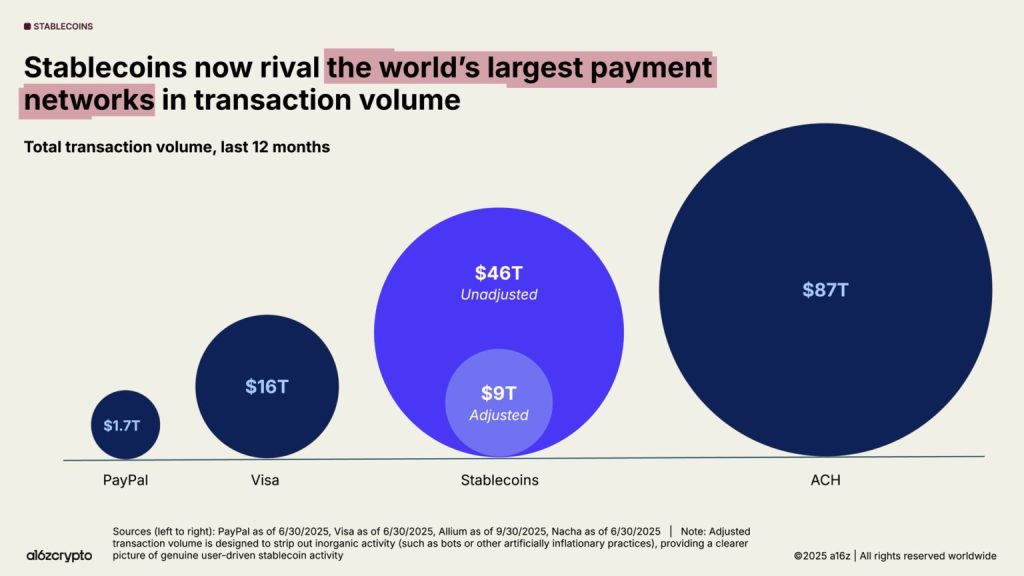
Stablecoins have quietly become one of the biggest payment networks in the world, moving trillions of dollars on-chain and cementing their role in global finance. According to Andreessen Horowitz’s State of Crypto 2025 report released Wednesday, these digital tokens processed $46 trillion in total transaction volume over the past year, a 106% increase from the previous year. The report described stablecoins as the clearest signal of crypto’s maturity this year. While total volumes include high-frequency financial flows rather than retail payments, the numbers are still staggering. A16z Says Stablecoins Are Closing In On ACH Network Volumes Stablecoin transaction activity now approaches that of the US Automated Clearing House, or ACH, the electronic backbone of the US banking system. ACH processes most direct deposits, payroll and bill payments across American banks, making this milestone a sign that stablecoins are beginning to operate at the same scale as the infrastructure that powers traditional finance. On an adjusted basis that filters out bot-driven or artificial activity, stablecoins processed about $9 trillion in the past 12 months, up 87% from a year earlier. That level represents more than half of Visa’s payment volume and more than five times PayPal’s. Organic Growth Signals Shift From Speculation To Everyday Use Across Global Markets In earlier years, stablecoins were mainly used for crypto trading settlements. Now, they have become one of the fastest, cheapest and most borderless ways to send US dollars. Transfers often settle in less than a second and cost less than a cent. The report calls them the “backbone of the on-chain economy” as they power remittances, cross-border payments and decentralized financial services. Tether And USDC Dominate With 87% Share As On-Chain Dollar Usage Surges Usage continues to rise sharply. Monthly adjusted transaction volume hit an all-time high of $1.25 trillion in Sept. 2025 alone, showing momentum that remains uncorrelated with speculative crypto trading. This trend, A16z said, points to strong organic demand and growing real-world utility. Stablecoin supply has also surged to record levels, surpassing $300b. The two largest issuers, Tether (USDT) and USD Coin (USDC), account for roughly 87% of all circulating supply. Ethereum and Tron remain the main blockchains for settlement, processing about $772b in adjusted stablecoin transactions in September, or nearly two-thirds of global volume. Although dominated by these incumbents, new issuers and networks are gaining traction. Developers are building stablecoins tied to local currencies and region-specific rails, expanding the market beyond US-denominated assets. A16z’s data shows stablecoins are now a meaningful macroeconomic force. More than 1% of all US dollars in circulation now exist in tokenized form on public blockchains. Stablecoins Now The 17th Largest Holder Of Treasuries, Up From 20th Place Last Year Stablecoin reserves collectively hold over $150b in US Treasuries, making them the 17th largest holder, ahead of many sovereign countries and up from 20th place last year. This comes as foreign central banks reduce exposure to US government debt and increase gold holdings for the first time in three decades. Even as global demand for Treasuries weakens, stablecoins are driving renewed appetite for dollar-denominated assets. Nearly all stablecoins are pegged to the US dollar, which reinforces its position as the world’s reserve currency. A16z projects the total stablecoin market could grow tenfold, surpassing $3 trillion by 2030. The report concludes that stablecoins, once a niche trading tool, are now a pillar of digital finance. They bridge the worlds of traditional money and blockchain networks, and for the first time, they are beginning to rival the payment giants that shaped the modern financial eraStablecoins have quietly become one of the biggest payment networks in the world, moving trillions of dollars on-chain and cementing their role in global finance. According to Andreessen Horowitz’s State of Crypto 2025 report released Wednesday, these digital tokens processed $46 trillion in total transaction volume over the past year, a 106% increase from the previous year. The report described stablecoins as the clearest signal of crypto’s maturity this year. While total volumes include high-frequency financial flows rather than retail payments, the numbers are still staggering. A16z Says Stablecoins Are Closing In On ACH Network Volumes Stablecoin transaction activity now approaches that of the US Automated Clearing House, or ACH, the electronic backbone of the US banking system. ACH processes most direct deposits, payroll and bill payments across American banks, making this milestone a sign that stablecoins are beginning to operate at the same scale as the infrastructure that powers traditional finance. On an adjusted basis that filters out bot-driven or artificial activity, stablecoins processed about $9 trillion in the past 12 months, up 87% from a year earlier. That level represents more than half of Visa’s payment volume and more than five times PayPal’s. Organic Growth Signals Shift From Speculation To Everyday Use Across Global Markets In earlier years, stablecoins were mainly used for crypto trading settlements. Now, they have become one of the fastest, cheapest and most borderless ways to send US dollars. Transfers often settle in less than a second and cost less than a cent. The report calls them the “backbone of the on-chain economy” as they power remittances, cross-border payments and decentralized financial services. Tether And USDC Dominate With 87% Share As On-Chain Dollar Usage Surges Usage continues to rise sharply. Monthly adjusted transaction volume hit an all-time high of $1.25 trillion in Sept. 2025 alone, showing momentum that remains uncorrelated with speculative crypto trading. This trend, A16z said, points to strong organic demand and growing real-world utility. Stablecoin supply has also surged to record levels, surpassing $300b. The two largest issuers, Tether (USDT) and USD Coin (USDC), account for roughly 87% of all circulating supply. Ethereum and Tron remain the main blockchains for settlement, processing about $772b in adjusted stablecoin transactions in September, or nearly two-thirds of global volume. Although dominated by these incumbents, new issuers and networks are gaining traction. Developers are building stablecoins tied to local currencies and region-specific rails, expanding the market beyond US-denominated assets. A16z’s data shows stablecoins are now a meaningful macroeconomic force. More than 1% of all US dollars in circulation now exist in tokenized form on public blockchains. Stablecoins Now The 17th Largest Holder Of Treasuries, Up From 20th Place Last Year Stablecoin reserves collectively hold over $150b in US Treasuries, making them the 17th largest holder, ahead of many sovereign countries and up from 20th place last year. This comes as foreign central banks reduce exposure to US government debt and increase gold holdings for the first time in three decades. Even as global demand for Treasuries weakens, stablecoins are driving renewed appetite for dollar-denominated assets. Nearly all stablecoins are pegged to the US dollar, which reinforces its position as the world’s reserve currency. A16z projects the total stablecoin market could grow tenfold, surpassing $3 trillion by 2030. The report concludes that stablecoins, once a niche trading tool, are now a pillar of digital finance. They bridge the worlds of traditional money and blockchain networks, and for the first time, they are beginning to rival the payment giants that shaped the modern financial era

Stablecoin Payments Hit $9 Trillion in 2025, Rivaling Global Giants Like PayPal and Visa: A16z

2025/10/23 12:25
3 min read
For feedback or concerns regarding this content, please contact us at crypto.news@mexc.com

Stablecoins have quietly become one of the biggest payment networks in the world, moving trillions of dollars on-chain and cementing their role in global finance.

According to Andreessen Horowitz’s State of Crypto 2025 report released Wednesday, these digital tokens processed $46 trillion in total transaction volume over the past year, a 106% increase from the previous year.

The report described stablecoins as the clearest signal of crypto’s maturity this year. While total volumes include high-frequency financial flows rather than retail payments, the numbers are still staggering.

A16z Says Stablecoins Are Closing In On ACH Network Volumes

Stablecoin transaction activity now approaches that of the US Automated Clearing House, or ACH, the electronic backbone of the US banking system.

ACH processes most direct deposits, payroll and bill payments across American banks, making this milestone a sign that stablecoins are beginning to operate at the same scale as the infrastructure that powers traditional finance.

On an adjusted basis that filters out bot-driven or artificial activity, stablecoins processed about $9 trillion in the past 12 months, up 87% from a year earlier. That level represents more than half of Visa’s payment volume and more than five times PayPal’s.
Organic Growth Signals Shift From Speculation To Everyday Use Across Global Markets

In earlier years, stablecoins were mainly used for crypto trading settlements. Now, they have become one of the fastest, cheapest and most borderless ways to send US dollars.

Transfers often settle in less than a second and cost less than a cent. The report calls them the “backbone of the on-chain economy” as they power remittances, cross-border payments and decentralized financial services.

Tether And USDC Dominate With 87% Share As On-Chain Dollar Usage Surges

Usage continues to rise sharply. Monthly adjusted transaction volume hit an all-time high of $1.25 trillion in Sept. 2025 alone, showing momentum that remains uncorrelated with speculative crypto trading. This trend, A16z said, points to strong organic demand and growing real-world utility.

Stablecoin supply has also surged to record levels, surpassing $300b. The two largest issuers, Tether (USDT) and USD Coin (USDC), account for roughly 87% of all circulating supply.

Ethereum and Tron remain the main blockchains for settlement, processing about $772b in adjusted stablecoin transactions in September, or nearly two-thirds of global volume.

Although dominated by these incumbents, new issuers and networks are gaining traction. Developers are building stablecoins tied to local currencies and region-specific rails, expanding the market beyond US-denominated assets.

A16z’s data shows stablecoins are now a meaningful macroeconomic force. More than 1% of all US dollars in circulation now exist in tokenized form on public blockchains.

Stablecoins Now The 17th Largest Holder Of Treasuries, Up From 20th Place Last Year

Stablecoin reserves collectively hold over $150b in US Treasuries, making them the 17th largest holder, ahead of many sovereign countries and up from 20th place last year.

This comes as foreign central banks reduce exposure to US government debt and increase gold holdings for the first time in three decades. Even as global demand for Treasuries weakens, stablecoins are driving renewed appetite for dollar-denominated assets.

Nearly all stablecoins are pegged to the US dollar, which reinforces its position as the world’s reserve currency. A16z projects the total stablecoin market could grow tenfold, surpassing $3 trillion by 2030.

The report concludes that stablecoins, once a niche trading tool, are now a pillar of digital finance. They bridge the worlds of traditional money and blockchain networks, and for the first time, they are beginning to rival the payment giants that shaped the modern financial era.


Market Opportunity
Wink Logo
Wink Price(LIKE)
$0.001656
$0.001656$0.001656
+0.91%
USD
Wink (LIKE) Live Price Chart
Disclaimer: The articles reposted on this site are sourced from public platforms and are provided for informational purposes only. They do not necessarily reflect the views of MEXC. All rights remain with the original authors. If you believe any content infringes on third-party rights, please contact crypto.news@mexc.com for removal. MEXC makes no guarantees regarding the accuracy, completeness, or timeliness of the content and is not responsible for any actions taken based on the information provided. The content does not constitute financial, legal, or other professional advice, nor should it be considered a recommendation or endorsement by MEXC.

You May Also Like

Bitcoin ETFs Surge with 20,685 BTC Inflows, Marking Strongest Week

Bitcoin ETFs Surge with 20,685 BTC Inflows, Marking Strongest Week

TLDR Bitcoin ETFs recorded their strongest weekly inflows since July, reaching 20,685 BTC. U.S. Bitcoin ETFs contributed nearly 97% of the total inflows last week. The surge in Bitcoin ETF inflows pushed holdings to a new high of 1.32 million BTC. Fidelity’s FBTC product accounted for 36% of the total inflows, marking an 18-month high. [...] The post Bitcoin ETFs Surge with 20,685 BTC Inflows, Marking Strongest Week appeared first on CoinCentral.
Share
Coincentral2025/09/18 02:30
Solana Faces Bearish Pressures: What’s Next?

Solana Faces Bearish Pressures: What’s Next?

The post Solana Faces Bearish Pressures: What’s Next? appeared on BitcoinEthereumNews.com. Solana (SOL), a prominent layer-1 blockchain known for its high performance
Share
BitcoinEthereumNews2026/03/12 14:00
A Netflix ‘KPop Demon Hunters’ Short Film Has Been Rated For Release

A Netflix ‘KPop Demon Hunters’ Short Film Has Been Rated For Release

The post A Netflix ‘KPop Demon Hunters’ Short Film Has Been Rated For Release appeared on BitcoinEthereumNews.com. KPop Demon Hunters Netflix Everyone has wondered what may be the next step for KPop Demon Hunters as an IP, given its record-breaking success on Netflix. Now, the answer may be something exactly no one predicted. According to a new filing with the MPA, something called Debut: A KPop Demon Hunters Story has been rated PG by the ratings body. It’s listed alongside some other films, and this is obviously something that has not been publicly announced. A short film could be well, very short, a few minutes, and likely no more than ten. Even that might be pushing it. Using say, Pixar shorts as a reference, most are between 4 and 8 minutes. The original movie is an hour and 36 minutes. The “Debut” in the title indicates some sort of flashback, perhaps to when HUNTR/X first arrived on the scene before they blew up. Previously, director Maggie Kang has commented about how there were more backstory components that were supposed to be in the film that were cut, but hinted those could be explored in a sequel. But perhaps some may be put into a short here. I very much doubt those scenes were fully produced and simply cut, but perhaps they were finished up for this short film here. When would Debut: KPop Demon Hunters theoretically arrive? I’m not sure the other films on the list are much help. Dead of Winter is out in less than two weeks. Mother Mary does not have a release date. Ne Zha 2 came out earlier this year. I’ve only seen news stories saying The Perfect Gamble was supposed to come out in Q1 2025, but I’ve seen no evidence that it actually has. KPop Demon Hunters Netflix It could be sooner rather than later as Netflix looks to capitalize…
Share
BitcoinEthereumNews2025/09/18 02:23