How to Earn Yield on Stablecoins in 2025, and Why It Is More Profitable Than Bank Deposits

SPONSORED POST*
For decades, earning interest meant parking dollars in a savings account or buying government bonds. But with the ongoing adoption of crypto and regulatory clarity, a new form of yield generation is emerging. It doesn’t rely on banks at all: instead, it leverages blockchain-based synthetic dollars, stablecoin-like assets designed to stay pegged to the U.S. dollar while actively generating yield.
In 2025, two protocols stand out for redefining how stable assets can earn income: Ethena and Falcon Finance. Both let users hold a dollar-pegged token that earns on-chain yield, but they take very different paths to get there. This article explores how they work to reveal why returns on stablecoins can far exceed those of traditional bank deposits.
From Static Dollars to Yield-Bearing Digital Dollars
Conventional stablecoins like USDT or USDC are backed by cash and U.S. Treasuries held in reserve. They’re stable, but they don’t share any of the yield that reserves earn. Synthetic dollar protocols, on the other hand, distribute the yield to users by putting collateral to work in on-chain and off-chain markets.
This new generation of protocols, including Falcon and Ethena, converts passive holdings into yield-bearing digital dollars. Users deposit crypto or stablecoins as collateral to mint their synthetic dollars, which remain pegged to $1 but accrue returns in the background. The result: an asset that is stable like cash but productive like an investment fund.
Ethena: The Crypto-Native Route to Yield
Ethena Labs launched USDe, a synthetic dollar that stays stable through a delta-neutral strategy, a structure that neutralizes price swings while collecting yield. To date, USDe remains an undisputed leader of the synthetic dollar space, with its total supply surpassing $14 billion in September 2025.
USDe market cap from January 2024 to October 2025. Source: CoinMarketCap
When users deposit crypto assets to Ethena, the protocol hedges its exposure with short positions in perpetual futures markets. This balance keeps USDe pegged to $1, while the funding rate paid by long traders on these exchanges becomes Ethena’s source of income. Together with staking rewards from ETH-based collateral, these payments generate the returns distributed to holders of sUSDe, the yield-bearing version of USDe.
In strong bull markets, when traders pay high funding premiums to go long, Ethena’s yields rise to 8% or more. When volatility fades and funding rates compress, returns drop accordingly. Ethena’s structure is fully crypto-native: transparent, decentralized, and independent from traditional finance, but remains closely tied to crypto market cycles.
Falcon Finance: A Multi-Strategy Yield Engine
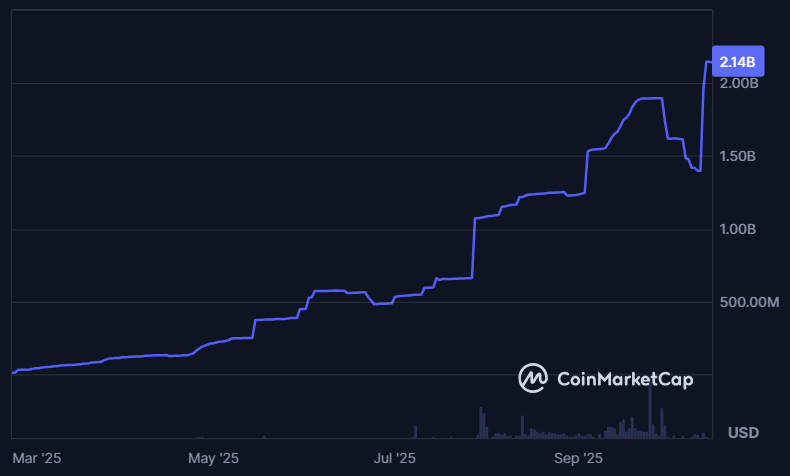
While Ethena perfects the art of crypto-native yield, Falcon Finance takes a broader, hybrid approach. Its stablecoin-like synthetic dollar, USDf, and its yield-bearing counterpart, sUSDf, are powered by a multi-strategy engine that blends on-chain trading, staking, and real-world assets (RWAs). USDf is catching up with USDe in terms of market presence: its total supply exceeded $2 billion by October 2025, less than 1 year after the launch of Falcon.
USDf market cap from March to October 2025. Source: CoinMarketCap
Falcon’s yield engine rests on three core pillars:
- Funding rate arbitrage (both positive and negative): Falcon capitalizes on both sides of the crypto perpetual funding market, unlike most protocols that rely solely on positive funding rates. This allows it to extract yield even when markets turn neutral or bearish.
- Cross-exchange arbitrage: The protocol exploits price spreads between exchanges. When volatility spikes, Falcon’s bots open hedged positions across venues, capturing short-term inefficiencies that compound over time.
- Altcoin and native staking yields: By including staking yields from a diversified set of assets, not just blue chips like ETH or BTC but also select altcoins, Falcon consistently adds additional return compared to BTC-focused strategies.
Falcon also taps into tokenized real-world assets. In particular, it included USTB, a tokenized Treasury Bill fund that represents short-term U.S. government bonds on-chain, in its list of assets accepted as collateral. With this move, Falcon became one of the first yield-generation protocols to integrate real fixed-income instruments directly into its system, an important first step toward its goal of becoming a universal collateralization layer.
These combined strategies allow Falcon to maintain a steady 8-12% APY, even when market volatility and crypto funding rates decline. The return rate can be boosted by locking crypto in the protocol for fixed terms of 1-12 months.
Collateral: Depth and Diversity
Collateral design is where Falcon and Ethena diverge most sharply. Ethena supports a limited range of crypto assets, primarily ETH, stETH, and major stablecoins, to mint USDe. Its approach keeps the system lean and crypto-native but restricts exposure to a single asset class.
By contrast, Falcon Finance accepts a much wider variety of collateral, including stablecoins like USDT, USDC, DAI, FDUSD, and USDS, as well as altcoins, blue-chip crypto, and tokenized RWAs.
Consistency vs. Cycles
Both Falcon and Ethena share the goal of generating yield from stablecoin-like assets that are synthetic dollars, but their return dynamics differ.
Ethena’s yields fluctuate with market sentiment and trading activity. They shine during bull markets but can decline when volatility and funding premiums fall. In contrast, Falcon’s yields remain stable and consistently high, driven by uncorrelated income sources—trading arbitrage, staking, and RWA yield—allowing users to earn even in sideways markets.
That consistency makes Falcon’s model more resilient and adaptable across economic cycles. On the other hand, a more conservative approach to yield generation makes Ethena less prone to the broader market risks.
Why Synthetic Dollar Yields Outperform USD Bank Deposits
Income-generation tools in traditional finance (TradFi) like savings accounts or money market funds in 2025 offer around 4-5% APY on U.S. dollar deposits. By contrast, protocols like Falcon and Ethena regularly deliver 8-12%, or even higher, on dollar-pegged assets.
This gap exists for several reasons:
- Yield-generation protocols cut out financial intermediaries, distributing the full yield from collateralized assets directly to users.
- Strategies like arbitrage, staking, and perpetual funding capture real crypto market inefficiencies that are inaccessible to banks.
- Tokenized RWAs, such as Falcon’s USTB, bring institutional-grade returns on-chain while maintaining full transparency.
- Finally, crypto operates globally and continuously, compounding yields in real time rather than through periodic bank interest payments.
However, higher returns come with higher risks. Yield-generation protocols are still exposed to smart contract vulnerabilities, market volatility, and liquidity fluctuations. Unlike bank deposits insured by governments or central banks, crypto investments mostly depend on technical security and collateral management. While the technology is becoming more robust, investors should always balance the potential for higher APY with an understanding of the inherent risks in the crypto ecosystem.
Final Thoughts
Earning yield on stablecoins is no longer just a niche experiment—it’s becoming a legitimate and mainstream alternative to traditional banking products. In 2025, Ethena and Falcon represent two leading visions for how digital dollars can earn income. Falcon’s broader strategy and integration of real-world assets make its returns both more consistent and structurally higher, while Ethena remains the leader in the space, acclaimed for its stability.


You May Also Like

Vietnam Launches First Regulated Crypto Exchange Pilot in Q2 2026

Why The Green Bay Packers Must Take The Cleveland Browns Seriously — As Hard As That Might Be