Bitcoin’s grinding tape, tamed volatility and repeated, incremental all-time highs are not symptoms of a failed cycle but evidence of a market changing hands and changing character, according to Alex Thorn, Galaxy’s head of firmwide research in an interview released October 23. Bitcoin Bull Run Gone Quiet: Here’s Why The researcher argues that the driver capping bitcoin’s near-term upside is exogenous—US–China tariff risk—rather than any structural deterioration in the asset’s fundamentals or adoption. “I don’t yet think it’s more existential than that for the bull market,” he said, describing the current price action as “sort of crab,” with the market “still” climbing a wall of worry. The price discussion hinged on two linked observations. First, bitcoin is not trading like gold yet because “markets move on the margins,” and marginal flows still treat BTC as risk. Second, those margins are shifting, with passive, long-term allocators steadily absorbing distribution from older cohorts. “Significant distribution from old hands to new hands” has created resistance, he said, but that process is “healthy,” widening ownership and maturing the market. He framed a psychological and structural line of demarcation at six figures: “Maybe we delineate there the pre-$100K bitcoin world versus the post-$100K bitcoin world. I think it’s going to look a lot different.” Related Reading: Last-Ever Bitcoin Dip Below $100,000 Looms This Week, Standard Chartered Warns He contends gold’s behavior helps explain the present inter-asset divergence. “This still is the debasement trade…and it’s the anti-US government trade,” he said, noting that recent gold strength has been “all offshore,” with bids arriving “during European and Asian hours,” consistent with “foreign central banks and large…sovereign wealth funds” diversifying away from US exposure. By contrast, the bitcoin price is pinned to risk appetite at the edges of the market. That said, he expects the asset to converge toward a gold-like profile as ownership migrates to institutions: “BlackRock’s chilling the digital gold narrative…Fidelity, this is how they talk about it,” he said, adding that as more supply moves into the hands of registered investment advisors and passive vehicles, BTC “will…trade a lot more like a risk-off, non-sovereign scarcity hedge asset.” The near-term overhang, in his view, is the tariff scare that followed statements on October 10 about potential 100% levies on China, which “caused” a leverage washout and stalled a strong October. “Quite simply an abatement of the tariff war between the US and China…would sort of set us right back on course in risk markets,” he said, anticipating a compromise rather than a “protracted bloody trade war.” Thorn also downplayed the next Federal Reserve meeting as a catalyst for bitcoin’s direction, while acknowledging that with official economic data delayed, the Fed’s own proprietary datasets could make its communication unusually market-relevant: “They’re going to have data. We don’t have data, but they’ll share the data.” Galaxy Lowers EOY Bitcoin Price Prediction Against that backdrop, he marked down—but did not abandon—his year-end targets. “At the beginning of the year, I was calling for $150,000 and then $185,000 in Q4… I am going to materially draw down that prediction to maybe like $130,000 by EOY,” he said. Thorn described 2025’s path as a slow, volatile stair-step higher—“from like $100k to…$74k to then $126k to now $108l”—with realized volatility declining. To illustrate the regime change, host Joe Consorti highlighted a 90-day realized volatility reading near 29, far below the 2017 and 2021 cycle peaks, and summarized the shifting drivers: “It’s more of a macro trade than anything…moving much further into…being impacted…by the macro regime.” Related Reading: Bitcoin Could Drop To $97,500 If This Key On-Chain Level Fails, Glassnode Warns Institutional distribution channels were a recurring theme. The Galaxy research head pointed to wealth-platform access and custody bank initiatives as late-cycle but powerful accelerants. Thorn cited Morgan Stanley’s move to let advisors recommend a small allocation (2-4%) through spot ETFs and said that three of the four largest global custody banks have either launched or announced digital-asset custody, with one notable holdout. The implication, he argued, is that the ETF bid and wirehouse adoption are replacing the old, concentrated holder base: “The era of the early bitcoin adopter is now finally, I think, fully coming to an end. And now you’re in…whatever that stage is…this is going to be a widely owned macro asset in everybody’s portfolio.” NEW EPISODE: Over The Horizon 🎙️ Alex Thorn (@intangiblecoins) joins me to discuss: – Why markets are so anxious – Institutional adoption and Bitcoin’s next era – AI CapEx & lessons from the dot-com boom – The future of digital asset treasuries pic.twitter.com/pVuKs3MWJH — Horizon (@JoinHorizon_) October 23, 2025 Macro cross-currents complicate the timing. The AI capital-expenditure boom—he called it “the most important trend in markets”—is either nearing a speculative blow-off or, in a more geopolitical framing, just entering a Manhattan Project–style national-priority phase. If the latter proves correct, the knock-on effects for liquidity, rates, energy and semiconductors could be larger and longer-lived than typical tech cycles. But for bitcoin specifically, he kept coming back to tariffs as the decisive near-term swing factor and to microstructure as the reason the chart feels both heavier and sturdier than past cycles: a passive ETF bid absorbing OG supply at psychologically significant round numbers, without the “massive uplifts” that once followed fresh all-time highs. The base case he outlined is not euphoria but endurance. Or, as he put it more bluntly earlier in the conversation, the bull run hasn’t died—“it’s evolving.” At press time, BTC traded at $111,183. Featured image created with DALL.E, chart from TradingView.comBitcoin’s grinding tape, tamed volatility and repeated, incremental all-time highs are not symptoms of a failed cycle but evidence of a market changing hands and changing character, according to Alex Thorn, Galaxy’s head of firmwide research in an interview released October 23. Bitcoin Bull Run Gone Quiet: Here’s Why The researcher argues that the driver capping bitcoin’s near-term upside is exogenous—US–China tariff risk—rather than any structural deterioration in the asset’s fundamentals or adoption. “I don’t yet think it’s more existential than that for the bull market,” he said, describing the current price action as “sort of crab,” with the market “still” climbing a wall of worry. The price discussion hinged on two linked observations. First, bitcoin is not trading like gold yet because “markets move on the margins,” and marginal flows still treat BTC as risk. Second, those margins are shifting, with passive, long-term allocators steadily absorbing distribution from older cohorts. “Significant distribution from old hands to new hands” has created resistance, he said, but that process is “healthy,” widening ownership and maturing the market. He framed a psychological and structural line of demarcation at six figures: “Maybe we delineate there the pre-$100K bitcoin world versus the post-$100K bitcoin world. I think it’s going to look a lot different.” Related Reading: Last-Ever Bitcoin Dip Below $100,000 Looms This Week, Standard Chartered Warns He contends gold’s behavior helps explain the present inter-asset divergence. “This still is the debasement trade…and it’s the anti-US government trade,” he said, noting that recent gold strength has been “all offshore,” with bids arriving “during European and Asian hours,” consistent with “foreign central banks and large…sovereign wealth funds” diversifying away from US exposure. By contrast, the bitcoin price is pinned to risk appetite at the edges of the market. That said, he expects the asset to converge toward a gold-like profile as ownership migrates to institutions: “BlackRock’s chilling the digital gold narrative…Fidelity, this is how they talk about it,” he said, adding that as more supply moves into the hands of registered investment advisors and passive vehicles, BTC “will…trade a lot more like a risk-off, non-sovereign scarcity hedge asset.” The near-term overhang, in his view, is the tariff scare that followed statements on October 10 about potential 100% levies on China, which “caused” a leverage washout and stalled a strong October. “Quite simply an abatement of the tariff war between the US and China…would sort of set us right back on course in risk markets,” he said, anticipating a compromise rather than a “protracted bloody trade war.” Thorn also downplayed the next Federal Reserve meeting as a catalyst for bitcoin’s direction, while acknowledging that with official economic data delayed, the Fed’s own proprietary datasets could make its communication unusually market-relevant: “They’re going to have data. We don’t have data, but they’ll share the data.” Galaxy Lowers EOY Bitcoin Price Prediction Against that backdrop, he marked down—but did not abandon—his year-end targets. “At the beginning of the year, I was calling for $150,000 and then $185,000 in Q4… I am going to materially draw down that prediction to maybe like $130,000 by EOY,” he said. Thorn described 2025’s path as a slow, volatile stair-step higher—“from like $100k to…$74k to then $126k to now $108l”—with realized volatility declining. To illustrate the regime change, host Joe Consorti highlighted a 90-day realized volatility reading near 29, far below the 2017 and 2021 cycle peaks, and summarized the shifting drivers: “It’s more of a macro trade than anything…moving much further into…being impacted…by the macro regime.” Related Reading: Bitcoin Could Drop To $97,500 If This Key On-Chain Level Fails, Glassnode Warns Institutional distribution channels were a recurring theme. The Galaxy research head pointed to wealth-platform access and custody bank initiatives as late-cycle but powerful accelerants. Thorn cited Morgan Stanley’s move to let advisors recommend a small allocation (2-4%) through spot ETFs and said that three of the four largest global custody banks have either launched or announced digital-asset custody, with one notable holdout. The implication, he argued, is that the ETF bid and wirehouse adoption are replacing the old, concentrated holder base: “The era of the early bitcoin adopter is now finally, I think, fully coming to an end. And now you’re in…whatever that stage is…this is going to be a widely owned macro asset in everybody’s portfolio.” NEW EPISODE: Over The Horizon 🎙️ Alex Thorn (@intangiblecoins) joins me to discuss: – Why markets are so anxious – Institutional adoption and Bitcoin’s next era – AI CapEx & lessons from the dot-com boom – The future of digital asset treasuries pic.twitter.com/pVuKs3MWJH — Horizon (@JoinHorizon_) October 23, 2025 Macro cross-currents complicate the timing. The AI capital-expenditure boom—he called it “the most important trend in markets”—is either nearing a speculative blow-off or, in a more geopolitical framing, just entering a Manhattan Project–style national-priority phase. If the latter proves correct, the knock-on effects for liquidity, rates, energy and semiconductors could be larger and longer-lived than typical tech cycles. But for bitcoin specifically, he kept coming back to tariffs as the decisive near-term swing factor and to microstructure as the reason the chart feels both heavier and sturdier than past cycles: a passive ETF bid absorbing OG supply at psychologically significant round numbers, without the “massive uplifts” that once followed fresh all-time highs. The base case he outlined is not euphoria but endurance. Or, as he put it more bluntly earlier in the conversation, the bull run hasn’t died—“it’s evolving.” At press time, BTC traded at $111,183. Featured image created with DALL.E, chart from TradingView.com

Bitcoin Bull Run Hasn’t Died—It’s Evolving, Says Galaxy Research Head

2025/10/24 19:00

Bitcoin’s grinding tape, tamed volatility and repeated, incremental all-time highs are not symptoms of a failed cycle but evidence of a market changing hands and changing character, according to Alex Thorn, Galaxy’s head of firmwide research in an interview released October 23.

Bitcoin Bull Run Gone Quiet: Here’s Why

The researcher argues that the driver capping bitcoin’s near-term upside is exogenous—US–China tariff risk—rather than any structural deterioration in the asset’s fundamentals or adoption. “I don’t yet think it’s more existential than that for the bull market,” he said, describing the current price action as “sort of crab,” with the market “still” climbing a wall of worry.

The price discussion hinged on two linked observations. First, bitcoin is not trading like gold yet because “markets move on the margins,” and marginal flows still treat BTC as risk. Second, those margins are shifting, with passive, long-term allocators steadily absorbing distribution from older cohorts. “Significant distribution from old hands to new hands” has created resistance, he said, but that process is “healthy,” widening ownership and maturing the market. He framed a psychological and structural line of demarcation at six figures: “Maybe we delineate there the pre-$100K bitcoin world versus the post-$100K bitcoin world. I think it’s going to look a lot different.”

He contends gold’s behavior helps explain the present inter-asset divergence. “This still is the debasement trade…and it’s the anti-US government trade,” he said, noting that recent gold strength has been “all offshore,” with bids arriving “during European and Asian hours,” consistent with “foreign central banks and large…sovereign wealth funds” diversifying away from US exposure.

By contrast, the bitcoin price is pinned to risk appetite at the edges of the market. That said, he expects the asset to converge toward a gold-like profile as ownership migrates to institutions: “BlackRock’s chilling the digital gold narrative…Fidelity, this is how they talk about it,” he said, adding that as more supply moves into the hands of registered investment advisors and passive vehicles, BTC “will…trade a lot more like a risk-off, non-sovereign scarcity hedge asset.”

The near-term overhang, in his view, is the tariff scare that followed statements on October 10 about potential 100% levies on China, which “caused” a leverage washout and stalled a strong October. “Quite simply an abatement of the tariff war between the US and China…would sort of set us right back on course in risk markets,” he said, anticipating a compromise rather than a “protracted bloody trade war.”

Thorn also downplayed the next Federal Reserve meeting as a catalyst for bitcoin’s direction, while acknowledging that with official economic data delayed, the Fed’s own proprietary datasets could make its communication unusually market-relevant: “They’re going to have data. We don’t have data, but they’ll share the data.”

Galaxy Lowers EOY Bitcoin Price Prediction

Against that backdrop, he marked down—but did not abandon—his year-end targets. “At the beginning of the year, I was calling for $150,000 and then $185,000 in Q4… I am going to materially draw down that prediction to maybe like $130,000 by EOY,” he said.

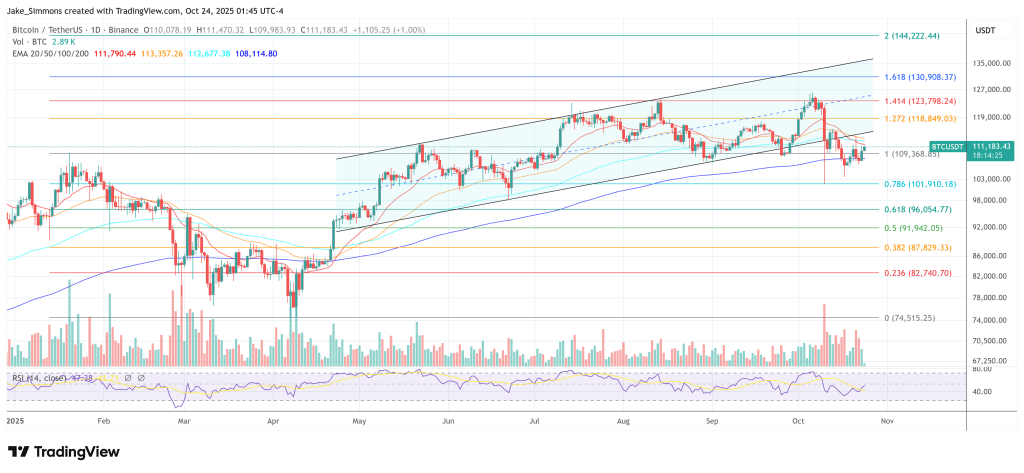
Thorn described 2025’s path as a slow, volatile stair-step higher—“from like $100k to…$74k to then $126k to now $108l”—with realized volatility declining. To illustrate the regime change, host Joe Consorti highlighted a 90-day realized volatility reading near 29, far below the 2017 and 2021 cycle peaks, and summarized the shifting drivers: “It’s more of a macro trade than anything…moving much further into…being impacted…by the macro regime.”

Institutional distribution channels were a recurring theme. The Galaxy research head pointed to wealth-platform access and custody bank initiatives as late-cycle but powerful accelerants. Thorn cited Morgan Stanley’s move to let advisors recommend a small allocation (2-4%) through spot ETFs and said that three of the four largest global custody banks have either launched or announced digital-asset custody, with one notable holdout.

The implication, he argued, is that the ETF bid and wirehouse adoption are replacing the old, concentrated holder base: “The era of the early bitcoin adopter is now finally, I think, fully coming to an end. And now you’re in…whatever that stage is…this is going to be a widely owned macro asset in everybody’s portfolio.”

Macro cross-currents complicate the timing. The AI capital-expenditure boom—he called it “the most important trend in markets”—is either nearing a speculative blow-off or, in a more geopolitical framing, just entering a Manhattan Project–style national-priority phase. If the latter proves correct, the knock-on effects for liquidity, rates, energy and semiconductors could be larger and longer-lived than typical tech cycles.

But for bitcoin specifically, he kept coming back to tariffs as the decisive near-term swing factor and to microstructure as the reason the chart feels both heavier and sturdier than past cycles: a passive ETF bid absorbing OG supply at psychologically significant round numbers, without the “massive uplifts” that once followed fresh all-time highs.

The base case he outlined is not euphoria but endurance. Or, as he put it more bluntly earlier in the conversation, the bull run hasn’t died—“it’s evolving.”

At press time, BTC traded at $111,183.
Bitcoin price
Market Opportunity
Threshold Logo
Threshold Price(T)
$0,009101
$0,009101$0,009101
-2,76%
USD
Threshold (T) Live Price Chart
Disclaimer: The articles reposted on this site are sourced from public platforms and are provided for informational purposes only. They do not necessarily reflect the views of MEXC. All rights remain with the original authors. If you believe any content infringes on third-party rights, please contact service@support.mexc.com for removal. MEXC makes no guarantees regarding the accuracy, completeness, or timeliness of the content and is not responsible for any actions taken based on the information provided. The content does not constitute financial, legal, or other professional advice, nor should it be considered a recommendation or endorsement by MEXC.

You May Also Like

CME Group to launch options on XRP and SOL futures

CME Group to launch options on XRP and SOL futures

The post CME Group to launch options on XRP and SOL futures appeared on BitcoinEthereumNews.com. CME Group will offer options based on the derivative markets on Solana (SOL) and XRP. The new markets will open on October 13, after regulatory approval.  CME Group will expand its crypto products with options on the futures markets of Solana (SOL) and XRP. The futures market will start on October 13, after regulatory review and approval.  The options will allow the trading of MicroSol, XRP, and MicroXRP futures, with expiry dates available every business day, monthly, and quarterly. The new products will be added to the existing BTC and ETH options markets. ‘The launch of these options contracts builds on the significant growth and increasing liquidity we have seen across our suite of Solana and XRP futures,’ said Giovanni Vicioso, CME Group Global Head of Cryptocurrency Products. The options contracts will have two main sizes, tracking the futures contracts. The new market will be suitable for sophisticated institutional traders, as well as active individual traders. The addition of options markets singles out XRP and SOL as liquid enough to offer the potential to bet on a market direction.  The options on futures arrive a few months after the launch of SOL futures. Both SOL and XRP had peak volumes in August, though XRP activity has slowed down in September. XRP and SOL options to tap both institutions and active traders Crypto options are one of the indicators of market attitudes, with XRP and SOL receiving a new way to gauge sentiment. The contracts will be supported by the Cumberland team.  ‘As one of the biggest liquidity providers in the ecosystem, the Cumberland team is excited to support CME Group’s continued expansion of crypto offerings,’ said Roman Makarov, Head of Cumberland Options Trading at DRW. ‘The launch of options on Solana and XRP futures is the latest example of the…
Share
BitcoinEthereumNews2025/09/18 00:56
XRP Volumes Crash 52%, Is This Concerning?

XRP Volumes Crash 52%, Is This Concerning?

The post XRP Volumes Crash 52%, Is This Concerning? appeared on BitcoinEthereumNews.com. XRP price action What’s coming? XRP trading volumes have plunged 52% in
Share
BitcoinEthereumNews2026/01/25 17:52
Spot Bitcoin ETFs End Week With $1.33 Billion Outflows, Worst Since February 2025

Spot Bitcoin ETFs End Week With $1.33 Billion Outflows, Worst Since February 2025

TLDR Spot Bitcoin ETFs saw $1.33 billion in outflows, marking their worst performance since February 2025. Ethereum ETFs mirrored the trend with $611 million in
Share
Coincentral2026/01/25 18:16