

New Bitcoin Improvement Proposal Aims To Improve Privacy: Here’s How
A new Bitcoin Improvement Proposal titled “Chain Code Delegation for Private Collaborative Custody” has been opened on the Bitcoin BIPs repository, targeting a long-standing privacy leak in multisig collaborations that rely on shared extended public keys.
The technique, authored by Bitkey engineers and collaborators, with a public explainer from Bitkey, proposes withholding BIP32 chain codes from non-privileged participants so that cosigners can help with recovery and policy enforcement without gaining sweeping visibility into a user’s balances and transaction history. Bitkey says it plans to implement the scheme first if it becomes an accepted standard.
How The BIP Enhances Bitcoin Privacy
The crux of the privacy problem is well known to wallet engineers and custodial partners: in typical collaborative or assisted multisig, the cosigner is handed an xpub plus chain code, which lets them deterministically derive the addresses in a user’s wallet and, by scanning the blockchain, infer balances and flows.
Bitkey’s post frames the status quo plainly: sharing a key with a third party has “traditionally meant giving that party visibility into a user’s wallet balance and transaction history.” The new approach, they argue, “aims to remove that tradeoff” by withholding chain codes entirely and revealing only what is minimally necessary at spend time.
The proposed BIP’s abstract is crisp about the change in trust boundaries: “We propose a new BIP for Chain Code Delegation, a collaborative custody technique that involves privileged participants (delegatee) withholding BIP32 chain codes at key setup time from a delegator, and sharing only enough information for non-privileged participants to provide their signature.”
In the non-blinded flow, “the delegatee derives a per-spend scalar tweak t from the (withheld) chain code, the delegator computes the child key (x+t, P+tG), and produces a standard signature over the transaction’s sighash.” The blinded flow layers Schnorr blind signing on top so that the cosigner remains oblivious to the final message while still enforcing the per-spend tweak, leveraging the linearity of Schnorr for correctness.
Functionally, the technique narrows what a cosigner can learn and when. Rather than permanent, global observability over all derived addresses, the cosigner only sees per-spend data as needed. The Bitkey explainer translates this into a user-facing promise: cosigners can assist with recovery or spend policies “without learning anything about unrelated transactions or overall balances.”
If widely adopted, that shift would make collaborative custody wallets more comparable to DIY multisig on privacy, while preserving the operational benefits that have made assisted models attractive to mainstream and enterprise users.
The design has been incubating in the open. A technical discussion thread on Delving Bitcoin over the summer summarized two key benefits that extend beyond privacy: limiting the “security blast radius” because, without the chain code or undisclosed tweaks, a custodian’s key is effectively unspendable for UTXOs they haven’t been explicitly delegated for; and tightly scoping what gets revealed at the moment of spend, often just before those outputs are consumed. That thread foreshadowed the BIP now filed and offers useful context for reviewers tracing how the proposal hardened through feedback.
Bitkey positions itself as the first mover on implementation once the standard is vetted. “Bitkey plans to be the first to implement Chain Code Delegation in production,” the company wrote, arguing that it will enable “a private collaborative wallet—something that hasn’t been possible until now.” The explicit intention is for the technique to be an “open, community-vetted standard that any wallet or custody provider can adopt,” not a vendor-locked feature.
Prominent industry accounts amplified the announcement on X. Principal executive officer and chairman of Block, Inc Jack Dorsey highlighted Bitkey’s focus on pushing privacy improvements from product to protocol.
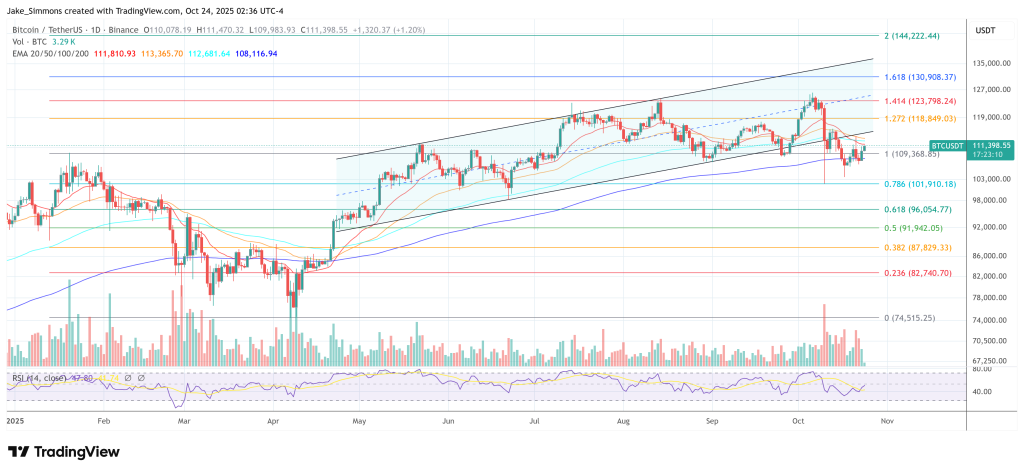
At press time, Bitcoin traded at $111,398.


You May Also Like

Not a loophole: Singapore AI export controls let China tap US AI legally

Exclusive interview with Smokey The Bera, co-founder of Berachain: How the innovative PoL public chain solves the liquidity problem and may be launched in a few months

UK FCA May Exempt Crypto Firms from Key TradFi Rules — What’s at Stake?



