A new Bitcoin improvement proposal has ignited controversy across the Bitcoin community, with developers and users clashing over claims that it threatens legal consequences for those who reject it. The proposal, titled Bitcoin Improvement Proposal 444 (BIP-444), was published late Friday by an anonymous developer using the alias “Dathon Ohm.” It calls for a temporary soft fork to limit the amount of arbitrary data that can be included in Bitcoin transactions, a move supporters say is meant to protect node operators from legal risks, but critics are calling an attempt to impose censorship on the network. Legal Threats or Misunderstood Wording? Inside Bitcoin’s Latest Developer Feud The document, which spans multiple technical sections, includes a contentious line that has become the center of the storm. On line 261, it states that “there is a moral and legal impediment to any attempt to reject this soft fork.” A few lines later, between lines 270 and 272, it adds: “Rejecting this soft fork may subject you to legal or moral consequences or could result in you splitting off to a new altcoin like Bcash. However, strictly speaking, you are free to choose.”Source: GitHub That phrasing triggered immediate backlash on X (formerly Twitter), with critics accusing the proposal’s authors of using “legal threats” to coerce the Bitcoin community into accepting the soft fork. Ben Kaufman, a Bitcoin developer, described it as “the most clear case of an attack on Bitcoin.” Canadian cryptographer Peter Todd shared a screenshot of the section, saying it was “clear [Luke Dashjr] expects his soft fork to get adopted due to legal threats.” Galaxy Digital’s Alex Thorn called it “explicitly an attack on Bitcoin” and “incredibly stupid.” Luke Dashjr, a longtime Bitcoin Core developer and outspoken critic of Ordinals, has publicly supported the proposal but denied writing it. Dashjr said on X that the soft fork is “on track with no technical objections,” describing it as a “simple, temporary measure” to buy time for a long-term solution. “This isn’t intended to be an ideal fix,” he wrote, “only good enough to give us breathing room.” New Bitcoin Proposal Seeks to Limit Data Storage, Citing Legal Threats to Node Operators The soft fork proposal follows the release of Bitcoin Core v30, which went live earlier this month. That update effectively lifted the 83-byte limit on OP_RETURN data, allowing larger payloads to be attached to Bitcoin transactions. While only about 6.5% of reachable nodes have adopted v30 so far, according to Bitnodes data, the change has reignited debate over what Bitcoin should, and should not, be used for.Source: Bitnodes BIP-444’s authors argue that Bitcoin’s expanded data capacity could expose node operators to criminal liability if illegal material, such as child sexual abuse content, is uploaded to the blockchain. “If the blockchain contains content that is illegal to possess or distribute, node operators are forced to choose between violating the law (or their conscience) or shutting down their node,” the document states. “This unacceptable dilemma directly undermines the incentive to validate, leading to inevitable centralization and posing an existential threat to Bitcoin’s security model.” To address that, the proposal introduces a set of technical restrictions. OP_RETURN outputs would be capped at 83 bytes, most other scriptPubKeys at 34 bytes, and data push sizes limited to 256 bytes. It also seeks to invalidate unused script versions, restrict Taproot Merkle trees, and ban the OP_IF command in Tapscript, a change that would effectively disable Ordinals inscriptions. These measures would make some transactions previously considered valid become invalid, though the proposal emphasizes that the soft fork would last only about a year while developers seek a permanent solution. Security Fix or Threat to Bitcoin’s Voluntary Consensus? Despite the technical rationale, the proposal’s wording has alarmed many Bitcoiners. Some called the “moral and legal impediment” language “Orwellian,” referencing George Orwell’s depiction of authoritarian control in 1984. Others warned that using moral or legal arguments to push through a fork contradicts Bitcoin’s principle of voluntary consensus. Supporters of the proposal argue that the “legal consequences” phrasing has been misinterpreted. They say the line refers to the potential liability that could arise from running nodes containing illegal content, not an actual legal threat to dissenters. Dashjr himself echoed this explanation, saying, “It doesn’t say that. Maybe you can propose a clarification if you think it’s unclear.” He added that “may isn’t certain,” suggesting that the clause originated in an earlier draft and should be updated for clarity. Still, many remain unconvinced. Jameson Lopp, co-founder of Bitcoin security firm Casa, criticized the proposal for failing to define what constitutes “illegal or immoral” content, noting that “legal experts disagree on the liability node operators would face.” Lopp added, “By running a node, you consent to the consensus rules of the network. If you don’t consent, you can simply not run a node.”Source: Github/Lopp Others warned that forcing consensus around the proposal could lead to a network split. A user under the handle Leonidas, known in the Ordinals community, argued that censoring data transactions “sets a dangerous precedent,” equating it to state censorship of financial transactions. “There is no meaningful difference between normalizing the censorship of JPEG or memecoin transactions and normalizing the censorship of monetary transactions by nation-states,” he said. Meanwhile, Peter Todd claimed to have already demonstrated a workaround, posting a transaction that he said contains the entire text of BIP-444 yet remains “100% standard and fully compatible” with the proposed rules, a move that, if true, would undermine the technical purpose of the soft fork. The BIP-444 proposal has not yet been submitted to Bitcoin’s official development mailing list, a necessary step before any draft improvement proposal can move toward formal review or activation. But the uproar around its language has already deepened existing divisions between developers over the direction of Bitcoin’s protocolA new Bitcoin improvement proposal has ignited controversy across the Bitcoin community, with developers and users clashing over claims that it threatens legal consequences for those who reject it. The proposal, titled Bitcoin Improvement Proposal 444 (BIP-444), was published late Friday by an anonymous developer using the alias “Dathon Ohm.” It calls for a temporary soft fork to limit the amount of arbitrary data that can be included in Bitcoin transactions, a move supporters say is meant to protect node operators from legal risks, but critics are calling an attempt to impose censorship on the network. Legal Threats or Misunderstood Wording? Inside Bitcoin’s Latest Developer Feud The document, which spans multiple technical sections, includes a contentious line that has become the center of the storm. On line 261, it states that “there is a moral and legal impediment to any attempt to reject this soft fork.” A few lines later, between lines 270 and 272, it adds: “Rejecting this soft fork may subject you to legal or moral consequences or could result in you splitting off to a new altcoin like Bcash. However, strictly speaking, you are free to choose.”Source: GitHub That phrasing triggered immediate backlash on X (formerly Twitter), with critics accusing the proposal’s authors of using “legal threats” to coerce the Bitcoin community into accepting the soft fork. Ben Kaufman, a Bitcoin developer, described it as “the most clear case of an attack on Bitcoin.” Canadian cryptographer Peter Todd shared a screenshot of the section, saying it was “clear [Luke Dashjr] expects his soft fork to get adopted due to legal threats.” Galaxy Digital’s Alex Thorn called it “explicitly an attack on Bitcoin” and “incredibly stupid.” Luke Dashjr, a longtime Bitcoin Core developer and outspoken critic of Ordinals, has publicly supported the proposal but denied writing it. Dashjr said on X that the soft fork is “on track with no technical objections,” describing it as a “simple, temporary measure” to buy time for a long-term solution. “This isn’t intended to be an ideal fix,” he wrote, “only good enough to give us breathing room.” New Bitcoin Proposal Seeks to Limit Data Storage, Citing Legal Threats to Node Operators The soft fork proposal follows the release of Bitcoin Core v30, which went live earlier this month. That update effectively lifted the 83-byte limit on OP_RETURN data, allowing larger payloads to be attached to Bitcoin transactions. While only about 6.5% of reachable nodes have adopted v30 so far, according to Bitnodes data, the change has reignited debate over what Bitcoin should, and should not, be used for.Source: Bitnodes BIP-444’s authors argue that Bitcoin’s expanded data capacity could expose node operators to criminal liability if illegal material, such as child sexual abuse content, is uploaded to the blockchain. “If the blockchain contains content that is illegal to possess or distribute, node operators are forced to choose between violating the law (or their conscience) or shutting down their node,” the document states. “This unacceptable dilemma directly undermines the incentive to validate, leading to inevitable centralization and posing an existential threat to Bitcoin’s security model.” To address that, the proposal introduces a set of technical restrictions. OP_RETURN outputs would be capped at 83 bytes, most other scriptPubKeys at 34 bytes, and data push sizes limited to 256 bytes. It also seeks to invalidate unused script versions, restrict Taproot Merkle trees, and ban the OP_IF command in Tapscript, a change that would effectively disable Ordinals inscriptions. These measures would make some transactions previously considered valid become invalid, though the proposal emphasizes that the soft fork would last only about a year while developers seek a permanent solution. Security Fix or Threat to Bitcoin’s Voluntary Consensus? Despite the technical rationale, the proposal’s wording has alarmed many Bitcoiners. Some called the “moral and legal impediment” language “Orwellian,” referencing George Orwell’s depiction of authoritarian control in 1984. Others warned that using moral or legal arguments to push through a fork contradicts Bitcoin’s principle of voluntary consensus. Supporters of the proposal argue that the “legal consequences” phrasing has been misinterpreted. They say the line refers to the potential liability that could arise from running nodes containing illegal content, not an actual legal threat to dissenters. Dashjr himself echoed this explanation, saying, “It doesn’t say that. Maybe you can propose a clarification if you think it’s unclear.” He added that “may isn’t certain,” suggesting that the clause originated in an earlier draft and should be updated for clarity. Still, many remain unconvinced. Jameson Lopp, co-founder of Bitcoin security firm Casa, criticized the proposal for failing to define what constitutes “illegal or immoral” content, noting that “legal experts disagree on the liability node operators would face.” Lopp added, “By running a node, you consent to the consensus rules of the network. If you don’t consent, you can simply not run a node.”Source: Github/Lopp Others warned that forcing consensus around the proposal could lead to a network split. A user under the handle Leonidas, known in the Ordinals community, argued that censoring data transactions “sets a dangerous precedent,” equating it to state censorship of financial transactions. “There is no meaningful difference between normalizing the censorship of JPEG or memecoin transactions and normalizing the censorship of monetary transactions by nation-states,” he said. Meanwhile, Peter Todd claimed to have already demonstrated a workaround, posting a transaction that he said contains the entire text of BIP-444 yet remains “100% standard and fully compatible” with the proposed rules, a move that, if true, would undermine the technical purpose of the soft fork. The BIP-444 proposal has not yet been submitted to Bitcoin’s official development mailing list, a necessary step before any draft improvement proposal can move toward formal review or activation. But the uproar around its language has already deepened existing divisions between developers over the direction of Bitcoin’s protocol

Bitcoin Soft Fork Sparks Fury Over ‘Legal Threats’ – Core Devs Face Backlash

A new Bitcoin improvement proposal has ignited controversy across the Bitcoin community, with developers and users clashing over claims that it threatens legal consequences for those who reject it.

The proposal, titled Bitcoin Improvement Proposal 444 (BIP-444), was published late Friday by an anonymous developer using the alias “Dathon Ohm.”

It calls for a temporary soft fork to limit the amount of arbitrary data that can be included in Bitcoin transactions, a move supporters say is meant to protect node operators from legal risks, but critics are calling an attempt to impose censorship on the network.

The document, which spans multiple technical sections, includes a contentious line that has become the center of the storm.

On line 261, it states that “there is a moral and legal impediment to any attempt to reject this soft fork.”

A few lines later, between lines 270 and 272, it adds: “Rejecting this soft fork may subject you to legal or moral consequences or could result in you splitting off to a new altcoin like Bcash. However, strictly speaking, you are free to choose.”
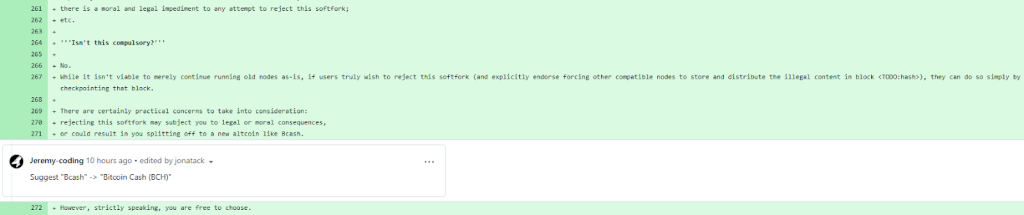
Source: GitHub

That phrasing triggered immediate backlash on X (formerly Twitter), with critics accusing the proposal’s authors of using “legal threats” to coerce the Bitcoin community into accepting the soft fork.

Ben Kaufman, a Bitcoin developer, described it as “the most clear case of an attack on Bitcoin.” Canadian cryptographer Peter Todd shared a screenshot of the section, saying it was “clear [Luke Dashjr] expects his soft fork to get adopted due to legal threats.”

Galaxy Digital’s Alex Thorn called it “explicitly an attack on Bitcoin” and “incredibly stupid.”

Luke Dashjr, a longtime Bitcoin Core developer and outspoken critic of Ordinals, has publicly supported the proposal but denied writing it.

Dashjr said on X that the soft fork is “on track with no technical objections,” describing it as a “simple, temporary measure” to buy time for a long-term solution. “This isn’t intended to be an ideal fix,” he wrote, “only good enough to give us breathing room.”

The soft fork proposal follows the release of Bitcoin Core v30, which went live earlier this month. That update effectively lifted the 83-byte limit on OP_RETURN data, allowing larger payloads to be attached to Bitcoin transactions.

While only about 6.5% of reachable nodes have adopted v30 so far, according to Bitnodes data, the change has reignited debate over what Bitcoin should, and should not, be used for.

Source: Bitnodes

BIP-444’s authors argue that Bitcoin’s expanded data capacity could expose node operators to criminal liability if illegal material, such as child sexual abuse content, is uploaded to the blockchain.

“If the blockchain contains content that is illegal to possess or distribute, node operators are forced to choose between violating the law (or their conscience) or shutting down their node,” the document states.

“This unacceptable dilemma directly undermines the incentive to validate, leading to inevitable centralization and posing an existential threat to Bitcoin’s security model.”

To address that, the proposal introduces a set of technical restrictions. OP_RETURN outputs would be capped at 83 bytes, most other scriptPubKeys at 34 bytes, and data push sizes limited to 256 bytes.

It also seeks to invalidate unused script versions, restrict Taproot Merkle trees, and ban the OP_IF command in Tapscript, a change that would effectively disable Ordinals inscriptions.

These measures would make some transactions previously considered valid become invalid, though the proposal emphasizes that the soft fork would last only about a year while developers seek a permanent solution.

Security Fix or Threat to Bitcoin’s Voluntary Consensus?

Despite the technical rationale, the proposal’s wording has alarmed many Bitcoiners. Some called the “moral and legal impediment” language “Orwellian,” referencing George Orwell’s depiction of authoritarian control in 1984.

Others warned that using moral or legal arguments to push through a fork contradicts Bitcoin’s principle of voluntary consensus.

Supporters of the proposal argue that the “legal consequences” phrasing has been misinterpreted.

They say the line refers to the potential liability that could arise from running nodes containing illegal content, not an actual legal threat to dissenters.

Dashjr himself echoed this explanation, saying, “It doesn’t say that. Maybe you can propose a clarification if you think it’s unclear.”

He added that “may isn’t certain,” suggesting that the clause originated in an earlier draft and should be updated for clarity.

Still, many remain unconvinced. Jameson Lopp, co-founder of Bitcoin security firm Casa, criticized the proposal for failing to define what constitutes “illegal or immoral” content, noting that “legal experts disagree on the liability node operators would face.”

Lopp added, “By running a node, you consent to the consensus rules of the network. If you don’t consent, you can simply not run a node.”

Source: Github/Lopp

Others warned that forcing consensus around the proposal could lead to a network split. A user under the handle Leonidas, known in the Ordinals community, argued that censoring data transactions “sets a dangerous precedent,” equating it to state censorship of financial transactions.

“There is no meaningful difference between normalizing the censorship of JPEG or memecoin transactions and normalizing the censorship of monetary transactions by nation-states,” he said.

Meanwhile, Peter Todd claimed to have already demonstrated a workaround, posting a transaction that he said contains the entire text of BIP-444 yet remains “100% standard and fully compatible” with the proposed rules, a move that, if true, would undermine the technical purpose of the soft fork.

The BIP-444 proposal has not yet been submitted to Bitcoin’s official development mailing list, a necessary step before any draft improvement proposal can move toward formal review or activation.

But the uproar around its language has already deepened existing divisions between developers over the direction of Bitcoin’s protocol.


Market Opportunity
Engines of Fury Logo
Engines of Fury Price(FURY)
$0.00639
$0.00639$0.00639
+1.75%
USD
Engines of Fury (FURY) Live Price Chart
Disclaimer: The articles reposted on this site are sourced from public platforms and are provided for informational purposes only. They do not necessarily reflect the views of MEXC. All rights remain with the original authors. If you believe any content infringes on third-party rights, please contact service@support.mexc.com for removal. MEXC makes no guarantees regarding the accuracy, completeness, or timeliness of the content and is not responsible for any actions taken based on the information provided. The content does not constitute financial, legal, or other professional advice, nor should it be considered a recommendation or endorsement by MEXC.

You May Also Like

Wormhole launches reserve tying protocol revenue to token

Wormhole launches reserve tying protocol revenue to token

The post Wormhole launches reserve tying protocol revenue to token appeared on BitcoinEthereumNews.com. Wormhole is changing how its W token works by creating a new reserve designed to hold value for the long term. Announced on Wednesday, the Wormhole Reserve will collect onchain and offchain revenues and other value generated across the protocol and its applications (including Portal) and accumulate them into W, locking the tokens within the reserve. The reserve is part of a broader update called W 2.0. Other changes include a 4% targeted base yield for tokenholders who stake and take part in governance. While staking rewards will vary, Wormhole said active users of ecosystem apps can earn boosted yields through features like Portal Earn. The team stressed that no new tokens are being minted; rewards come from existing supply and protocol revenues, keeping the cap fixed at 10 billion. Wormhole is also overhauling its token release schedule. Instead of releasing large amounts of W at once under the old “cliff” model, the network will shift to steady, bi-weekly unlocks starting October 3, 2025. The aim is to avoid sharp periods of selling pressure and create a more predictable environment for investors. Lockups for some groups, including validators and investors, will extend an additional six months, until October 2028. Core contributor tokens remain under longer contractual time locks. Wormhole launched in 2020 as a cross-chain bridge and now connects more than 40 blockchains. The W token powers governance and staking, with a capped supply of 10 billion. By redirecting fees and revenues into the new reserve, Wormhole is betting that its token can maintain value as demand for moving assets and data between chains grows. This is a developing story. This article was generated with the assistance of AI and reviewed by editor Jeffrey Albus before publication. Get the news in your inbox. Explore Blockworks newsletters: Source: https://blockworks.co/news/wormhole-launches-reserve
Share
BitcoinEthereumNews2025/09/18 01:55
Top Altcoins To Hold Before 2026 For Maximum ROI – One Is Under $1!

Top Altcoins To Hold Before 2026 For Maximum ROI – One Is Under $1!

BlockchainFX presale surges past $7.5M at $0.024 per token with 500x ROI potential, staking rewards, and BLOCK30 bonus still live — top altcoin to hold before 2026.
Share
Blockchainreporter2025/09/18 01:16
Best Crypto to Buy as Saylor & Crypto Execs Meet in US Treasury Council

Best Crypto to Buy as Saylor & Crypto Execs Meet in US Treasury Council

The post Best Crypto to Buy as Saylor & Crypto Execs Meet in US Treasury Council appeared on BitcoinEthereumNews.com. Michael Saylor and a group of crypto executives met in Washington, D.C. yesterday to push for the Strategic Bitcoin Reserve Bill (the BITCOIN Act), which would see the U.S. acquire up to 1M $BTC over five years. With Bitcoin being positioned yet again as a cornerstone of national monetary policy, many investors are turning their eyes to projects that lean into this narrative – altcoins, meme coins, and presales that could ride on the same wave. Read on for three of the best crypto projects that seem especially well‐suited to benefit from this macro shift:  Bitcoin Hyper, Best Wallet Token, and Remittix. These projects stand out for having a strong use case and high adoption potential, especially given the push for a U.S. Bitcoin reserve.   Why the Bitcoin Reserve Bill Matters for Crypto Markets The strategic Bitcoin Reserve Bill could mark a turning point for the U.S. approach to digital assets. The proposal would see America build a long-term Bitcoin reserve by acquiring up to one million $BTC over five years. To make this happen, lawmakers are exploring creative funding methods such as revaluing old gold certificates. The plan also leans on confiscated Bitcoin already held by the government, worth an estimated $15–20B. This isn’t just a headline for policy wonks. It signals that Bitcoin is moving from the margins into the core of financial strategy. Industry figures like Michael Saylor, Senator Cynthia Lummis, and Marathon Digital’s Fred Thiel are all backing the bill. They see Bitcoin not just as an investment, but as a hedge against systemic risks. For the wider crypto market, this opens the door for projects tied to Bitcoin and the infrastructure that supports it. 1. Bitcoin Hyper ($HYPER) – Turning Bitcoin Into More Than Just Digital Gold The U.S. may soon treat Bitcoin as…
Share
BitcoinEthereumNews2025/09/18 00:27